
Enterprise SEO / Planning to release
Enterprise SEO Services
Get SEO work moving across your organization
Your content team has a publishing calendar. Engineering has a release backlog. Regional managers have their own priorities. Somewhere between them, important pages wait for changes that everyone agrees should happen.
EduGuestPost’s enterprise SEO services help connect those decisions. Build an ongoing program around the products, markets and customer journeys that matter to your business, with prioritized work, clear responsibilities and checks after implementation.
Share your website, priority business units, main platforms and the delivery bottleneck you want to resolve.
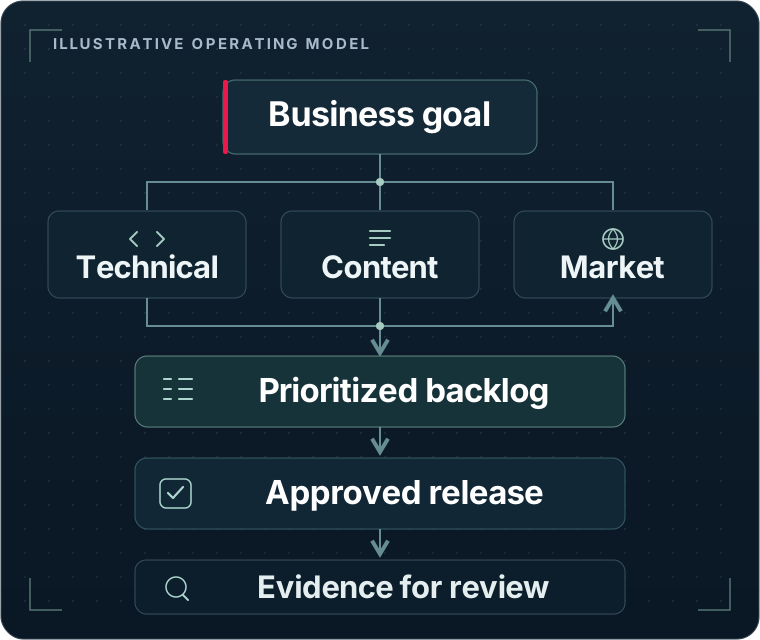
The engagement can combine planning, implementation coordination and agreed delivery work. We define who researches, writes, develops, approves and releases each change before that work enters the schedule. You get a practical way to move from a search opportunity to a checked release and a documented result.
01 / A usable operating plan
What your enterprise SEO program should deliver
The scope sets out the work, evidence and responsibilities for each delivery cycle.
| Deliverable | What it contains | How your team uses it |
|---|---|---|
| Program brief | Business goals, site boundaries, decision makers and measurement definitions | Align stakeholders on the same priorities |
| Prioritized backlog | Evidence, affected page groups, effort, dependencies and proposed owners | Decide what can move into delivery |
| Implementation requirements | Content briefs or technical tickets with acceptance checks | Give writers and developers actionable instructions |
| Release record | Approved changes, checked URLs, findings and unresolved gaps | Confirm what actually reached the live site |
| Outcome review | Search and business evidence, limitations and next decisions | Continue, adjust or investigate the next cycle |
02 / Built around complexity
When an enterprise program makes sense
Complexity matters more than a particular page count. A business with several brands and approval layers can need enterprise coordination even when its website is smaller than an online retailer’s catalog.
This approach fits organizations where:
- A shared template affects many product, category or service pages.
- Several teams publish through different CMS platforms or subdomains.
- Product lines, regions or business units compete for the same development capacity.
- SEO recommendations repeatedly stall between approval and release.
- Leadership needs to understand which work supports a commercial priority.
There is no special enterprise ranking algorithm. The difference is how research, decisions and implementation are managed across the organization. A one-time assessment identifies issues; consulting helps shape decisions. This program carries agreed priorities through recurring delivery and review.
03 / Connect decisions to delivery
Connect the workstreams around a business goal
Technical changes that account for the whole template
A product template can generate a missing heading across a catalog. A filter can create thousands of low-value URLs. A JavaScript component can expose different links in the initial response and rendered page. Those are different problems and need different evidence.
We establish which page families should be searchable, how they are discovered and which system controls them. Technical requirements can then address the relevant architecture, response codes, canonical signals, internal links, rendering or sitemap behavior.
The inventory combines available crawl results with relevant CMS, sitemap, Search Console and log evidence. Included sections, configuration limits and missing sources stay visible. Sampling a template helps identify a pattern; it does not clear every URL on the website.
Crawl budget work belongs in the plan when evidence shows a meaningful access or discovery constraint. More crawling alone is not a business outcome, and crawling does not guarantee indexing.
Content priorities that preserve a distinct job for each page
Start with the reader’s task and the existing destination. A product comparison, product category, regional service page and implementation guide can support the same subject while answering different questions.
We map priority needs to existing pages before recommending new ones. Shared keywords alone do not justify a merge. Where pages appear interchangeable, the review considers their purpose, search evidence, internal links and business role before proposing a change.
Content briefs identify the intended reader, decision, supporting evidence and review owner. Subject specialists verify product claims, eligibility, pricing and regional details. Updating a useful page can be a better investment than adding another article to an already crowded section.
The Topical Map Generator can organize your researched topics into hubs and supporting pages, with assigned URLs, owners and link-review pairs. It does not discover demand or prove that every proposed page deserves publication.
Regional and specialist projects with named responsibilities
International expansion, a migration, a location-page rollout and performance remediation can all affect the enterprise roadmap. Each needs its own requirements, review process and delivery capacity.
The program can coordinate agreed specialist work, including dependencies between central teams and local reviewers. A translation is not a complete regional offer, and a shared location template still needs accurate local information. Dedicated migration, development, analytics implementation or training projects are scoped explicitly when needed.
04 / From a priority to a checked release
How we turn priorities into released work
Establish the operating brief
We begin with the commercial objective and the people who can make changes happen. That might be better discovery of an underrepresented product range, stronger support for a priority market or removal of a recurring template problem.
Useful starting inputs include the current roadmap, platform list, available performance exports, known technical concerns and upcoming launches. We also identify content approvers, development owners and release restrictions. Access, data handling, procurement requirements, meeting cadence and escalation arrangements are agreed for the actual engagement.
Rank opportunities against real constraints
An urgent indexability error and an optional copy improvement should not compete solely on the number of affected URLs. We consider business relevance, supporting evidence, expected reach, implementation effort, risk and dependencies.
A promising opportunity may wait for a platform change. A modest template correction may be ready for the next release. The backlog records those tradeoffs so stakeholders can see why a task is moving, blocked or deferred. Estimates remain estimates until the responsible team has assessed the work.
Prepare a handoff that a team can use
An implementation item should state the problem, affected page group, evidence, proposed action, owner and acceptance check. Where relevant, it also includes reproduction steps, example URLs and dependencies.
For a canonical issue, “fix duplicate pages” is too vague. A useful ticket identifies the affected pattern, intended preferred destination, current conflicting signals and checks needed after release. The same principle applies to a content brief: the writer needs the reader’s question and verified inputs, rather than a keyword list alone.
Review delivery and make the next decision
We distinguish work proposed, approved, implemented and checked. A blocked task remains visible, with the decision or resource needed to move it forward.
The first cycle establishes a usable baseline and a deliverable batch appropriate to your team’s capacity. Later cycles use release findings and performance evidence to refine the priorities. The goal is a program your organization can sustain, with fewer recommendations disappearing between departments.
05 / A hypothetical delivery batch
What this looks like across a complex website
Consider a hypothetical manufacturer with several regional catalogs and a central development team. Its product pages, technical guides and distributor pages serve different needs. Publishing more guides may do little for a catalog section that customers cannot navigate reliably.
A first delivery batch might look like this:
| Priority | Required handoff | Acceptance evidence |
|---|---|---|
| Important products missing from category navigation | Product owner confirms availability; development adjusts the shared component | Checked live pages expose useful links to the intended products |
| Two guides answering the same application question | Content owner reviews purpose and evidence before approving a retained destination | Approved content and relevant internal references match the decision |
| Regional template omitting essential specifications | Local specialist validates the facts; template owner implements the fields | Agreed regional examples show the correct visible information |
This is a planning example, not an EduGuestPost client result. The scope would depend on the actual inventory, evidence and implementation capacity.
06 / Validate before scaling
Check releases before expanding a change
A shared template deserves a validation plan before it reaches every page that uses it. Where access permits, compare the relevant staging and live states, including mobile behavior and rendered content when those affect the change.
Acceptance checks can cover responses, intended indexing controls, canonical declarations, crawlable links, visible content and relevant structured data. A passing check confirms the specified implementation; later search processing and performance need separate observation.
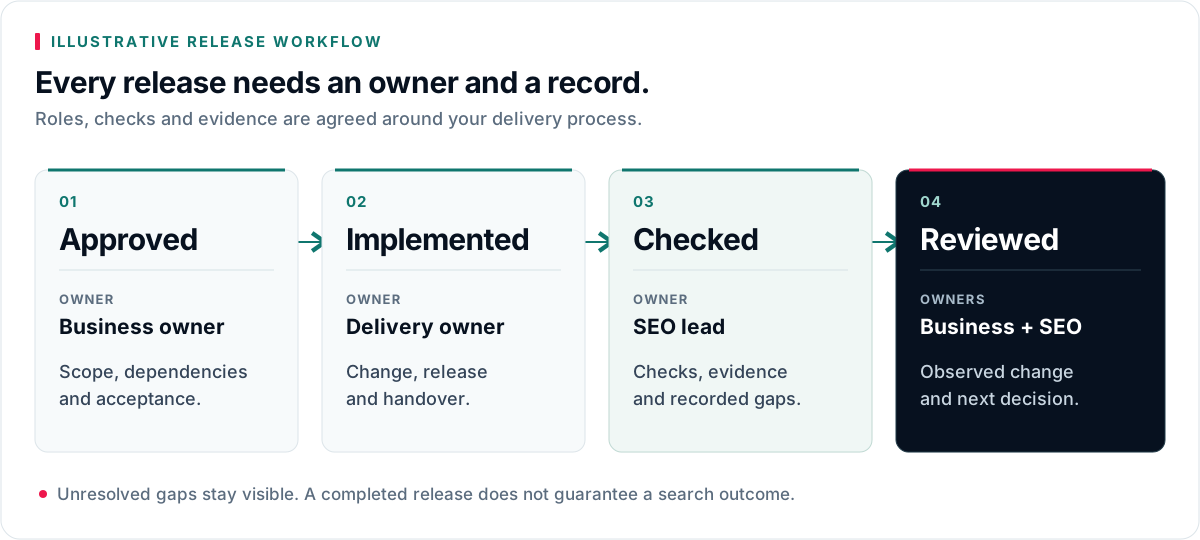
- 01ApprovedAgree the change and owner.
- 02ImplementedRecord what reached the site.
- 03CheckedCapture evidence and gaps.
- 04ReviewedChoose the next decision.
For broad automation, define a limited approved batch, required source fields, review criteria and a recovery option where feasible. Missing facts, repeated metadata or conflicting URLs should stop the affected items for review. Bulk production should follow a useful page plan and reliable inputs.
Where suitable traffic and comparable page groups exist, an SEO test can help assess a proposed template change. Other situations call for careful rollout and observation. Some tests remain inconclusive; a before-and-after increase alone does not isolate the cause.
07 / Shared definitions, useful decisions
Report progress in terms the business can use
Leadership needs to know what changed, which objective it supports and what decision is needed next. Delivery teams need the underlying URLs, findings and acceptance evidence. These views should use the same definitions.
We agree the reporting scope by business unit, product group, market or page family. Comparisons account for the selected property, search type, device, date ranges and data completeness. Seasonal demand, campaign activity, brand mix and overlapping releases can affect interpretation.
Google Search Console clicks, analytics sessions, recorded key events and CRM sales are different measurements. Where suitable authorized data exists, the review can connect these stages while explaining the attribution method and gaps. Third-party traffic and authority estimates remain estimates.
The delivery view also tracks approved work, implemented items, checked releases and unresolved dependencies. That helps explain whether a weak outcome needs a different strategy, more implementation or further investigation.
Investment scenarios can show how supplied conversion rates, revenue, contribution margins and costs affect a calculation. Assumptions stay visible. A scenario is not a forecast or a guarantee of incremental revenue. Custom dashboard development and CRM integration require their own agreed scope.
08 / Focused inputs, visible limits
Use focused tools to support the program
EduGuestPost’s free SEO tools can help prepare evidence and review selected tasks. Each has a defined input and coverage limit.
| Tool | Useful enterprise task | Important limit |
|---|---|---|
| Website SEO Analyzer | Inspect a small URL or sitemap sample for initial findings | At most 20 outcomes; no JavaScript rendering or indexing confirmation |
| SEO Log Analyzer | Review supplied server-log samples for request patterns | Declared bot names do not verify crawler identity; samples do not prove indexing |
| JavaScript SEO Checker | Compare initial HTML with supplied rendered evidence | Does not run a remote browser or reproduce Google’s rendering |
| Content Refresh Checker | Compare supplied page-level Search Console exports from two periods | Keep periods and filters comparable; missing rows are not automatically zeros |
| Programmatic SEO Planner and Checker | Review supplied datasets, templates and page samples before production | Does not fetch live pages, verify demand or publish to your CMS |
| SEO Planning Calculators | Explore CTR, contribution costs and ROI scenarios from supplied inputs | No analytics retrieval or proof of attribution; results depend on assumptions |
These tools support selected checks. A large-site program still needs an appropriate inventory, reliable measurement, suitable access and people who can implement the agreed work. Tool warnings are investigation prompts, and a traffic decline does not automatically mean a page needs rewriting.
Before we scope the work
Questions about enterprise SEO services
Can you work alongside our in-house SEO team
Yes. The engagement can support priorities, handoffs and agreed delivery work while your team retains internal ownership. The proposal identifies what EduGuestPost provides and what needs your developers, analysts, content specialists or regional reviewers.
Do we need a particular number of pages
No single threshold determines the fit. Multiple teams, templates, markets and release dependencies can create an enterprise coordination need. The starting discussion should establish whether that complexity justifies an ongoing program.
How soon should we expect results
Timing depends on the starting evidence, approval process, implementation capacity and changes involved. The proposal sets delivery milestones. Search engines then need to process changes, and business outcomes require suitable measurement. We do not promise a universal ranking or revenue deadline.
How much does enterprise SEO cost
Pricing requires a defined scope. Relevant factors include site and template coverage, available data, delivery responsibilities, specialist requirements, review cadence and the volume of agreed work. A scoped proposal makes those assumptions visible before the engagement begins.
Your next step / Prepare a useful brief
Build a program your teams can deliver
Bring your priority markets, page groups and current blockers. We will use them to shape a proposed enterprise SEO scope with clear deliverables, responsibilities and a practical review process.
You can also email [email protected] with your website, platforms, upcoming launches and the work your internal team can support.
Prefer to start directly? Use the contact page or email EduGuestPost.
Optional / Browser-only brief builder
Put the moving parts in one place.
Prepare a brief to copy, download or open in an email draft. Your entries stay in this page’s memory while it is open. This helper does not automatically send or store your information.
Brief builder loading. Direct contact links are available above.
Optional / Independent learning
Explore the thinking behind the work.
These independent resources provide additional context. They do not endorse EduGuestPost or verify a specific engagement.
Ahrefs
Enterprise technical SEO
Read about technical priorities, implementation and the systems behind a complex website.
Backlinko
Enterprise SEO
Explore how SEO work changes as content, templates and organizational responsibilities scale.
Neil Patel
Enterprise SEO strategy
Consider the connections between audience needs, technical work, collaboration and measurement.