
Website change / SEO continuity
Website Migration SEO Services
Plan your website move with SEO work defined before launch. Request a scope from EduGuestPost that connects the current website, the proposed changes, the people implementing them and the evidence needed to check the result.
Define the change before launch. Keep decisions, owners and evidence together.
Website migration SEO services can cover an agreed URL inventory, destination mapping, template reviews, launch checks and follow-up observations. The proposed deliverables give your website team specific decisions and tasks to work through as the move progresses.
Bring the move into one agreed scope
A migration may change the domain, page addresses, platform, hosting or several of these together. Start by identifying what will change and which parts of the website need to keep working. A new design can also affect navigation and content even when the addresses stay the same.
Share the current site, proposed destination or platform, available development environment and intended launch date. Explain who controls the CMS, hosting, DNS and release process. The quotation should identify which SEO tasks EduGuestPost would deliver and which implementation tasks remain with your developers or providers.
Start before the structure is fixed
Early review gives your team time to consider important pages, platform constraints and URL relationships before decisions become expensive to revise. Where practical, separate major changes or define a sequence that makes their effects easier to investigate.
If the existing website already has unexplained access or indexing problems, SEO audit services can establish a diagnostic starting point. Record those findings so they are distinguishable from problems first observed during the move.
Request a migration scope
Send your website migration brief, including the move type, current and proposed systems, known concerns and available team support. Ask for defined deliverables, responsibilities, validation coverage and follow-up arrangements.
Match the plan to the type of move
The work depends on what is changing. Use the areas below to define the proposed scope and identify decisions that need a developer, platform provider or business owner.
Swipe or scroll horizontally to read every column. Keyboard: focus the table region, then use the arrow keys.
| Project area | Planned change | SEO questions and proposed record |
|---|---|---|
| Domain or protocol | A new domain, hostname or move to HTTPS. | Intended variants, destination relationships, access and applicable Search Console tasks. |
| URL structure | New paths, folders, slugs or parameter behavior. | Old-to-new mapping, retained addresses, intended removals and redirect requirements. |
| CMS or templates | A new platform, framework or shared page output. | Content, metadata, navigation, rendering and generated-declaration comparisons. |
| Hosting or CDN | New infrastructure with unchanged public URLs. | Access, resources, verification continuity and hosting/DNS responsibilities. |
| Site consolidation | Pages or websites combined into a destination. | Content decisions, relevant replacements, overlaps and approved exceptions. |
| Language or regions | Changed localized URLs or relationships. | Intended variants, alternate annotations and links between appropriate destinations. |
Establish the baseline and its limits
Agree which current URLs, templates and assets will be recorded before the move. Available CMS exports, crawl data, sitemaps and authorized performance or log evidence can answer different questions. Keep each source’s date and coverage with the record.
For a hosting-only move, plan preparation and observation around the unchanged public URLs. A new provider alone does not require inventing a new address for every page.
Confirm the supported systems and required access in the quotation. Product, customer and order transfers, payment settings, email and infrastructure administration need their own assigned responsibilities. An SEO review does not establish that those operational tasks have been completed.
Build a map from the URLs that matter
Preserve the original URL list before preparing changes. Combine the available sources and note gaps, including unlinked pages, older redirects, important images and downloads. A sitemap is useful evidence, but it is only one source of addresses.
The XML Sitemap Checker checks a sitemap document and extracts inspected entries. For an index, those entries are child sitemap addresses. It does not open the child files or the listed pages automatically, so its output is not a complete migration inventory.
Give each address an intended outcome
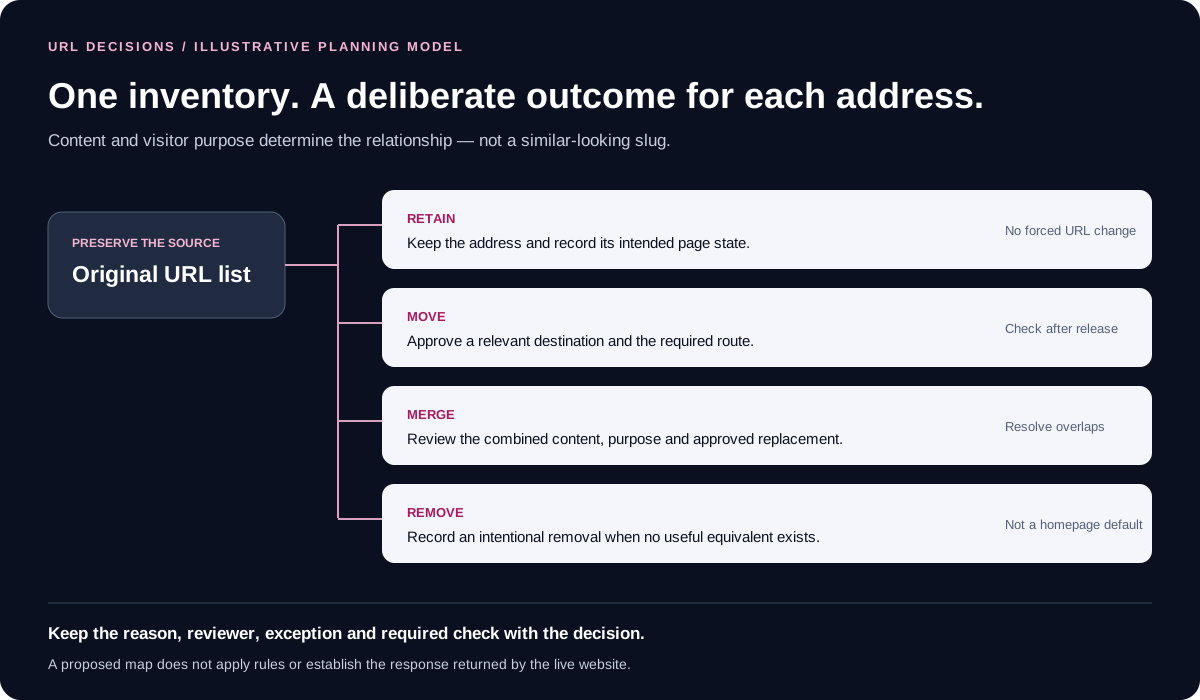
For each URL in scope, record whether it stays, moves, merges into a relevant destination or is intentionally removed. Include the proposed destination where applicable, the reason for the decision, the responsible reviewer and the required check.
A similar-looking slug does not establish that two pages serve the same purpose. Review the content and visitor task before approving a replacement. A removed page with no useful equivalent can need an appropriate removal response rather than a redirect to the homepage.
Include existing redirect rules and exceptions in the review. Preserve working routes until a deliberate replacement has been approved. Check rule precedence and platform constraints before assuming a broad pattern can safely cover every address.
Review the proposed rules before deployment
The Redirect Checker includes local analysis of up to 500 supplied mapping pairs. It can flag duplicate sources, conflicting destinations, chains and cycles within that plan. This mode makes no network requests and does not apply the rules.
Keep proposed map results separate from live HTTP evidence. A terminal destination derived from a spreadsheet still needs to be checked after the relevant rule is implemented. The handover should retain unresolved rows and the original source addresses.
Review the new site before launch
Compare representative page types with the agreed baseline and intended changes. Include important content, titles, headings, media, navigation and generated markup. For JavaScript-dependent templates, establish what the initial response and the relevant browser state show. A desktop screenshot does not establish the mobile experience.
Check the state intended for each environment
Private staging needs appropriate access protection. A public preview may intentionally use noindex. The crawler must be able to read that instruction; noindex does not make a public page private.
The Pre-Launch SEO Audit compares supplied final public URLs on one exact origin with your current expectations. It does not inspect private staging, bypass restrictions or certify launch readiness. A preview matching an intended noindex still needs review before the corresponding production page is released for search.
Identify the temporary development restrictions that need changing at launch, while retaining intentional exclusions. Name the system and owner responsible for each change.
Align declarations and navigation with the map
The Canonical Tag Checker reviews HTML and HTTP declarations, with bounded destination evidence where verification is enabled. It does not render JavaScript or establish Google’s selected canonical.
Review canonical URL signals together. Check that localized relationships and accurate structured data still describe the intended pages. Avoid copying old-domain values or adding conflicting template output.
Update relevant navigation and contextual links to the approved destinations. Internal linking services can be scoped around those connections. Confirm coverage and implementation ownership so redirect rules do not become the only route through the new website.
Coordinate release with defined responsibilities
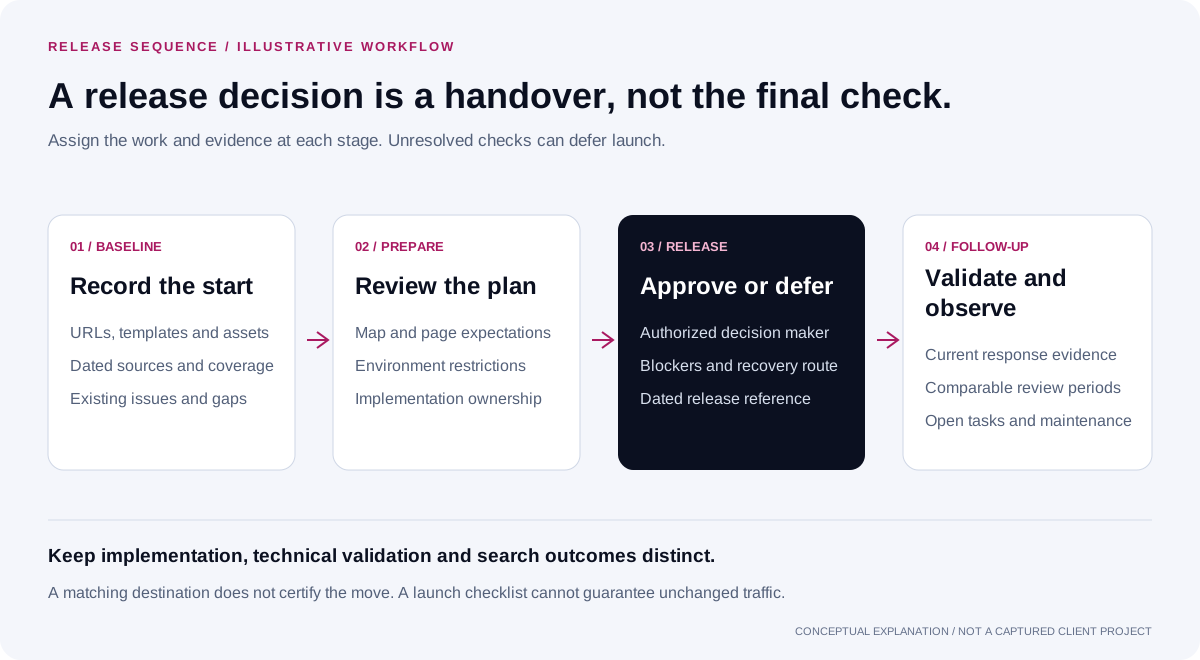
Agree who can release the changes and who can stop or reschedule the launch when important checks remain unresolved. The quotation should distinguish SEO review and prepared instructions from authorized CMS, server, DNS or deployment work.
Swipe or scroll horizontally to read every column. Keyboard: focus the table region, then use the arrow keys.
| Release item | Responsibility to assign | Evidence to retain |
|---|---|---|
| Map approval | Business/content owner and the agreed SEO reviewer. | Approved destinations, retained routes, removals and exceptions. |
| Implementation | Named developer, platform administrator or hosting provider. | The applied change, environment, release reference and known dependencies. |
| Launch decision | The person authorized to approve or defer the release. | Required checks, unresolved blockers and the recorded decision. |
| Validation | The person checking the agreed URLs, templates and journeys. | Dated observations, test conditions, coverage and incomplete results. |
| Follow-up | A named owner for issues, observations and maintenance. | Review dates, escalation route and work remaining in scope. |
Establish the recovery arrangements
Confirm that the responsible team has the required backups and understands what a rollback would restore. For a changing store or content site, clarify how new orders, edits or other writes would be handled. Restoring an older copy is not automatically a complete recovery plan.
Agree the handover route before launch so a failed check reaches someone who can act. Any out-of-hours availability or response commitment needs to be included in the quotation.
Check implemented URL moves
The SEO Migration Audit follows supplied old URLs and compares the reached addresses with expected destinations. It keeps redirect type, status, declarations and available page evidence separate. Expected URLs are not fetched independently, and supplied historical baselines are unverified. Stopped or incomplete traces remain unresolved; a matching address does not certify a completed migration.
Observe the move after launch
Agree the observation period, report sources and people responsible for follow-up. Compare affected sections and important old/new URLs with the retained baseline. Keep launch dates, content changes, data gaps and report settings visible when interpreting a change in performance.
Distinguish indexed information from a live test. A current technical response and an older indexed observation can differ. A passing check does not establish that Google has processed every moved page or that rankings have stabilized.
Use the relevant Search Console process
Google’s Change of Address tool has specific requirements for eligible domain or subdomain moves, including ownership of the old and new properties. It is not used for HTTPS-only changes, same-domain path moves, www/non-www switches or unchanged-URL hosting moves. Assign applicable account tasks to an authorized owner after the required move and redirects are in place.
Keep maintenance responsibility explicit
Plan to retain redirects as long as possible, generally at least a year. Agree who maintains the old domain and routing, and what evidence will inform later retirement decisions. This maintenance period does not automatically define the service’s follow-up coverage.
If your team needs help choosing a sequence or assessing competing recommendations, SEO consulting services can address that decision. Search outcomes have their own observation period; a launch checklist cannot guarantee unchanged traffic or a recovery date.
Request a website migration SEO quote
Share your migration requirements, including the current website, intended move, proposed platform, launch stage, available URL lists and development support. Ask for a scope that identifies deliverables, implementation owners, launch checks, dependencies and follow-up responsibilities.
Website migration SEO questions
Agree the work, the release decision and the follow-up coverage before the move.
Which website changes can migration SEO cover?
An agreed scope can address a domain or protocol change, new URL structure, a platform or template change, hosting or CDN changes, site consolidation, or localized URL relationships. Start with what changes and what must keep working; supported systems and implementation responsibilities are confirmed in the quotation.
Does every old URL need a redirect?
Each URL in scope needs an intended outcome: stay, move, merge into a relevant destination or be intentionally removed. Review the content and visitor task before approving a replacement. A removed page with no useful equivalent can need an appropriate removal response rather than a redirect to the homepage.
Will an SEO review apply the migration or change my DNS?
The quotation distinguishes SEO review, prepared instructions and validation from authorized CMS, server, DNS and deployment work. Developers, platform administrators or providers need named implementation responsibilities. Submitting an enquiry does not authorize access or changes to your website.
Can your tools certify that the website is ready to launch?
No. A proposed mapping analysis does not apply rules or establish live behavior. Public pre-launch checks have defined origins and coverage; they do not bypass private staging restrictions or certify readiness. The authorized release owner must review the agreed checks, unresolved blockers and launch decision.
Can you guarantee unchanged traffic or a recovery date?
No. Retain the baseline and agree an observation period so affected sections and important old/new URLs can be reviewed on compatible terms. A current response, a matching redirect destination or a launch checklist cannot establish that every page has been processed or that rankings have stabilized.
What should I include in a migration SEO enquiry?
Share the current website, intended move, proposed platform, launch stage or intended date, available URL lists, known concerns and development support. Identify who controls the CMS, hosting, DNS and release process. Keep passwords, access tokens and private staging credentials out of the initial enquiry.
Discuss your website migration
Describe the current website, intended change, launch stage and development support so a useful scope can be prepared.
- What is changing, and what must keep working?
- Which URL lists and development environment are available?
- Who can approve implementation, release and follow-up?
Keep credentials out of your initial enquiry. Do not send passwords, access tokens or private staging credentials. Agree authorized access separately.
Request a migration SEO scope
Submitting an enquiry does not authorize a migration, DNS change or access to your systems.