
Research that leads to a page decision
Keyword Research Services for Your Content Plan
Choose search topics that fit your customers, your offer and the pages your website needs.
EduGuestPost's keyword research services identify relevant search opportunities, investigate the need behind each query and organize related terms into a usable page plan. You receive recommendations for existing and proposed pages, with the evidence and priorities your team needs to decide what to work on next.
Bring a new website, a content backlog or a group of services you want to promote. We define the market, language, research sources and deliverables before building the keyword map.
Send your website, main products or services, target audience and countries. An existing keyword list or content plan is useful if you have one.
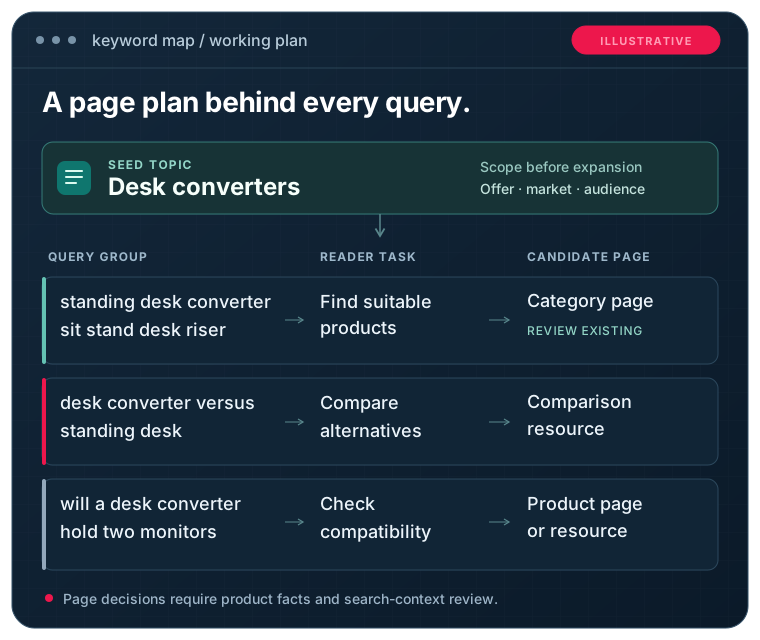
Illustrative planning example; no measured demand or client results.
A usable handoff
What you receive from the research
The research connects search opportunities to a page purpose and an action. Your writer should be able to see which questions belong together. Your marketer should be able to see why a topic was prioritized. Your website editor should know whether the recommendation concerns an existing URL or a proposed new page.
The proposal identifies the outputs included. A keyword research and mapping project can contain the following records.
| Deliverable | What it contains | How your team uses it |
|---|---|---|
| Relevant keyword list | Candidate terms, source notes and exclusions | Review the vocabulary and needs relevant to your offer |
| Intent and result review | Reader goal, observed page types and uncertain cases | Choose a suitable answer and content format |
| Keyword groups | Related terms with the reason for grouping | Plan useful coverage without one page per phrase |
| Keyword to page map | Existing or proposed URL, page purpose and recommended action | Decide what to improve, create or investigate |
| Priority and evidence notes | Business fit, demand indicators, competition and dependencies | Allocate writing and implementation time |
Where search-volume or difficulty data is included, the file identifies its provider, market and relevant dates or reporting period. We distinguish measured site performance, provider estimates and research observations so they can be interpreted correctly.
The handoff also records terms we set aside and the reason. An irrelevant product, unsupported country or search intent your business cannot satisfy should not become a publishing task simply because it appeared in an export.
Your offer, audience and market
Research shaped around your business
We begin with what you sell, who buys it and what makes a prospective customer suitable. Product limitations, service areas and eligibility requirements can change which keywords deserve attention.
For a service business, the research may need to distinguish general learning from searches for a provider. For an ecommerce store, a broad category, a product specification and a compatibility question may need different page treatment. A software company may need to understand the language of buyers comparing solutions, as well as the problems that lead them to that comparison.
Your team's knowledge helps identify those differences. Sales questions, support enquiries and the words customers use can reveal useful topics that a generic seed list misses. We also identify the content or subject expertise needed to answer each priority topic credibly.
The research scope stays connected to your ability to act on it. A small team may need a short, ordered set of page opportunities. A larger catalogue may need groups organized by product family and a way to identify repeated patterns across templates.
From search context to page purpose
How we build your keyword plan
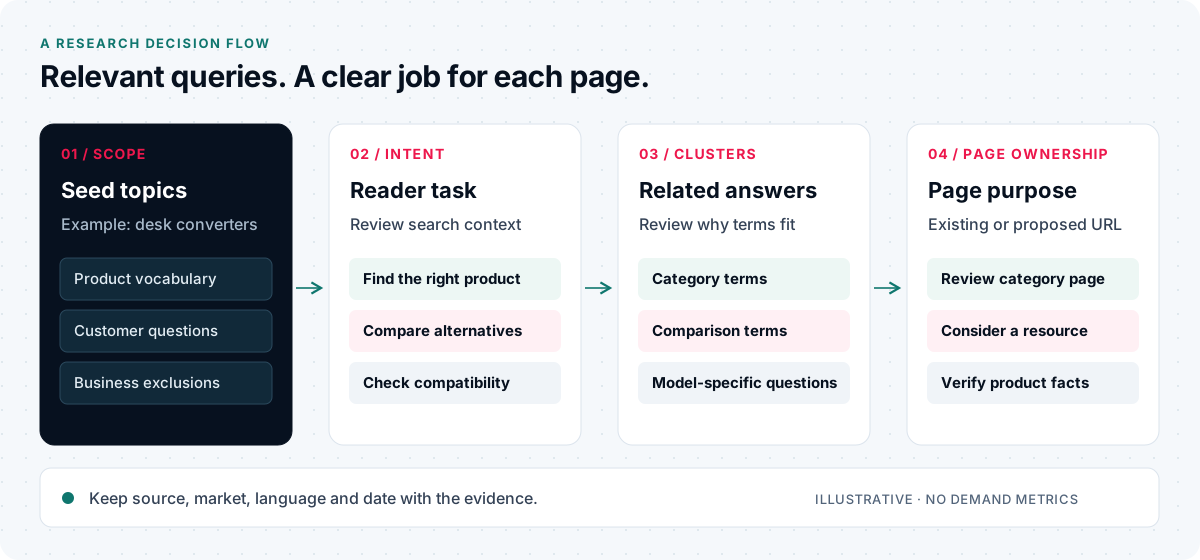
Understand intent
Identify what the reader needs to learn, compare or check.
Review the group
Connect phrases when one useful answer can serve the same task.
Choose a page action
Improve an existing page, propose a distinct resource or investigate an overlap.
Start with your offer and existing visibility
We agree on the products, services, audience, countries and languages to cover. Existing pages, keyword maps and content plans establish what the site already tries to answer.
When available, supplied Search Console exports show queries and pages associated with your current visibility. We keep the date range and filters attached to that evidence. Your existing impressions and clicks describe your site's performance in that context; they do not measure the entire market's demand.
The data sources and access arrangements are agreed before research begins. This can include your existing exports and suitable keyword datasets alongside public search observations. We identify limitations where a source cannot provide the detail needed for a reliable decision.
Expand seed topics and review competitors
Seed topics come from your offer and the audience's problems. We expand them into relevant variations, questions, comparisons and use cases, then remove ideas that do not fit the business.
Competitor research adds another perspective. Search competitors may include retailers, publishers or comparison websites as well as businesses selling the same service. We examine the relevant competing pages and query groups, rather than assuming that every keyword a rival ranks for is worth targeting.
A recorded gap is a candidate to investigate. The research may reveal that an existing page can answer it, that the topic needs a separate resource, or that it belongs outside your content plan. Those decisions are recorded in the map.
Investigate intent in the right search context
We review what people appear to need when they use a query. Broad labels such as informational or commercial can organize the list, but they do not describe the full task.
Someone searching for a product comparison may need evidence about suitability, not a generic product description. Someone asking about course entry requirements may need a precise answer on the course page. We record the useful distinction so the writer can plan the right content.
Search observations include their market, language, device where relevant and capture date. Results can vary, and some queries have mixed intent. We retain uncertain cases for review rather than assigning a confident label without enough evidence.
Assess demand and competition in context
Search volume helps compare opportunities, but it is an estimate with a defined scope. A monthly average can hide seasonal peaks, and some sources group close variants. Searches also do not translate directly into visits: the results shown and the pages competing for attention affect that opportunity.
We use trend evidence to investigate timing and changing interest where it is useful. Google Trends reports relative interest, not an absolute monthly search count. A score of 100 should not be entered into a keyword map as 100 searches.
Difficulty scores are provider estimates used to guide further review. They are not Google's assessment of your page or a probability of ranking. We consider the competing pages, their purpose and the quality of answer your business could produce alongside those scores.
Advertising figures are kept in their own context. Google Keyword Planner's competition field concerns advertisers. CPC and bid data can provide commercial clues, but they do not establish organic ranking difficulty or the revenue a topic will produce for your business.
Group queries and assign a page purpose
We group related terms by the answer they need, using wording and search-result evidence as appropriate. Similar words can point to different tasks, while differently worded queries may need the same page.
Each reviewed group is mapped to an existing or proposed page with a defined purpose. The recommendation may be to improve an existing page, create a distinct resource or investigate an overlap. A suggested new URL remains a planning entry until its route and relationship to the current site are checked.
Several terms in one group may refer to overlapping demand. We avoid presenting their combined search-volume estimates as a count of unique visitors or guaranteed traffic. The page decision and its supporting evidence matter more than the size of the exported list.
Decide what deserves attention
How we decide which opportunities come first
Priority reflects the topic's connection to your business and the work required to address it. We consider whether the right audience would use the page, whether your offer fits that need and whether you can supply a credible answer.
Existing visibility may support an opportunity to improve a current page. A relevant comparison might deserve attention because it helps buyers choose. A broad popular topic may have lower priority if it attracts an audience your business does not serve.
We also record dependencies. A page may need product-owner input, original evidence or a technical issue resolved before content work begins. An opportunity that depends on unavailable expertise can remain in the plan without being assigned to the next writing batch.
Low-volume or unmeasured terms are considered carefully. A specific customer question can still be useful, especially when it belongs within a topic the business already needs to explain. The reason for including it should be explicit rather than supported by an invented demand figure.
An illustrative page map
An example of keyword groups and page decisions
Imagine a store selling desk converters. Its research might include product-category searches, comparisons with full standing desks and questions about monitor compatibility.
| Illustrative query group | Reader need | Candidate page decision |
|---|---|---|
| Standing desk converter and sit stand desk riser | Find the right type of product | Review whether one category page can serve both terms |
| Desk converter versus standing desk | Compare two ways to change a workstation | Consider a useful comparison resource with accurate product distinctions |
| Will a desk converter hold two monitors | Check compatibility before buying | Answer using verified dimensions and load limits on the relevant product page or resource |
These phrases illustrate the research process; they are not a measured keyword dataset. The actual grouping depends on the store's products, target market and observed search results. A compatibility question may belong on a product page when the answer depends on a specific model.
The completed map would record the chosen page, related terms, evidence, missing information and next action. It would also identify which existing pages can be used, so the team can avoid commissioning duplicate explanations.
Useful inputs, documented limits
Tools that support the research process
EduGuestPost's SEO tool directory includes utilities for generating ideas, comparing supplied evidence and organizing the plan. Their outputs need to be used within the documented limits.
| Tool | Information it uses | Useful research role |
|---|---|---|
| Keyword Research Tool | Seed-based English suggestions and generated ideas in its free mode | Expand the initial vocabulary for further validation |
| Keyword Cluster Generator | Supplied terms or imported organic result URLs | Review candidate groups and the matches behind them |
| Competitor Keyword Gap Tool | Compatible supplied ranking datasets | Find recorded gaps to investigate for business relevance |
| Competitor SEO Analysis Tool | Observable evidence from selected pages | Compare page purpose, explanation and structure |
| Keyword Cannibalization Tool | Paired query and page metrics, with optional daily evidence | Investigate overlapping visibility before changing page ownership |
| Topical Map Generator | Researched topics and hierarchy choices you supply | Organize the relationships between proposed resources |
| Content Brief Generator | Supplied audience, goals, questions, outline and evidence | Prepare the writing handoff after the research decisions |
The free Keyword Research Tool does not supply measured volume, CPC, difficulty or country-specific demand. Its country selection does not localize the free suggestions. Research requiring those metrics needs an appropriate data source agreed for the project.
The cluster generator can compare wording or result URLs you import; it does not collect fresh Google rankings. Imported batches need a consistent search context. Each group is reviewed for the reader's task before it becomes a page recommendation.
An absent keyword row in a competitor export does not prove the competitor never appears for that term. Likewise, the cannibalization tool's overlap evidence needs intent and performance review. A topical map and a generated brief organize research inputs; they do not independently validate demand.
Independent learning resource
Keyword Research Tutorial: From Start to Finish
An independent tutorial by Ahrefs about keyword research. This educational resource is not an EduGuestPost service demonstration or endorsement.
Watch the Ahrefs tutorial on YouTube or read the tutorial overview.
The video loads from YouTube only when you choose to play it.
Questions with their own context
Keyword and question research for AI search
Customer questions can inform the research even when they are expressed conversationally. We identify the decisions and explanations behind those questions and connect them with useful topics your business can answer.
When AI answer observations are included, we define the platforms and question set, then retain the capture date and visible references. EduGuestPost's AI Visibility Checker can support review of dated evidence within the selected method's coverage. A single answer does not establish consistent visibility across platforms.
We keep question ideas and answer observations separate from search-volume estimates. A generated prompt should not acquire a monthly demand figure simply because a related search term has one.
Google's AI Overviews and AI Mode retain the normal SEO foundations and do not require special AI markup. Other platforms need their own assessment. Our generative engine optimization guide provides related background; a recurring monitoring or optimization program has a wider delivery scope.
Research your team can act on
Turn the research into a content and campaign plan
A useful handoff connects each priority group with its intended reader, page purpose, required evidence and next step. The map can then guide your team or appointed writers without requiring them to repeat the research from scratch.
EduGuestPost's existing SEO campaign service connects target-page readiness, content priorities, internal links and publisher planning. Keyword research can help identify which pages deserve attention before a campaign is organized around them.
Our editorial standards support the next stage by emphasizing useful original content and factual support. The guide to getting more value from SEO explains how those activities connect with links and measurement.
Research and implementation have different deliverables. Writing pages, applying CMS changes, managing outreach and ongoing performance tracking are included only when separately specified. If a proposed page overlaps an existing offer, the decision should be resolved before publishing it or changing established redirects.
If page readiness or existing site issues need a separate review, explore SEO Audit Services.
Before you enquire
Keyword research questions
What information do you need to start
Send your website, main offers, target audience, countries and languages. Include existing keyword research, priority URLs and any available search-performance exports. Tell us which products, services or markets should be excluded and who can confirm business details.
How much do keyword research services cost
The quote depends on the products or services covered, markets, languages, evidence sources, level of result review and mapping required. A focused page group differs from a large catalogue or several country datasets. Send your scope and approximate budget so we can define useful deliverables.
Can you research an existing keyword list
Yes. We can review relevance, source context, intent, grouping and page mapping. Existing terms may be retained, regrouped or set aside. Where metrics or assumptions are unclear, we identify the evidence needed before using them to make a recommendation.
Do you create one page for every keyword
No. Related phrases can share a page when they need the same answer. A separate page needs a distinct purpose and useful content. The map records that decision and flags uncertain overlaps for investigation.
Is the research suitable for local or international markets
The market and language coverage must be defined in the proposal. We keep country datasets and local intent in context rather than treating an English suggestion or translated phrase as verified local demand. Specialist multilingual or multi-country research can be scoped when that is the need.
Does keyword research include guaranteed rankings
No. The service supplies the agreed research, evidence and recommendations. Content quality, implementation, competition and changing search systems affect outcomes. Estimates and difficulty scores do not guarantee traffic, rankings, enquiries or AI citations.
Your website. Your research scope.
Request a keyword research plan
Tell us what you sell, who you want to reach and which pages or markets need attention. Include your website, existing research, available data, content capacity and any important deadline.
We can then define a research project that gives your team relevant query groups, clear page decisions and the evidence behind the priorities.
Request a keyword research quote
You can also email [email protected] with your website and research brief.
This form prepares a brief in your browser. It does not submit an enquiry. Choose “Open email draft,” review your message in your email app, and send it when you are ready.
You can also visit our contact page.
Create useful paths between related pages
Need visitors to reach the next useful answer on your website? Review the source context, choose a relevant destination and document the link placement and checks. Explore Internal Linking Services.