
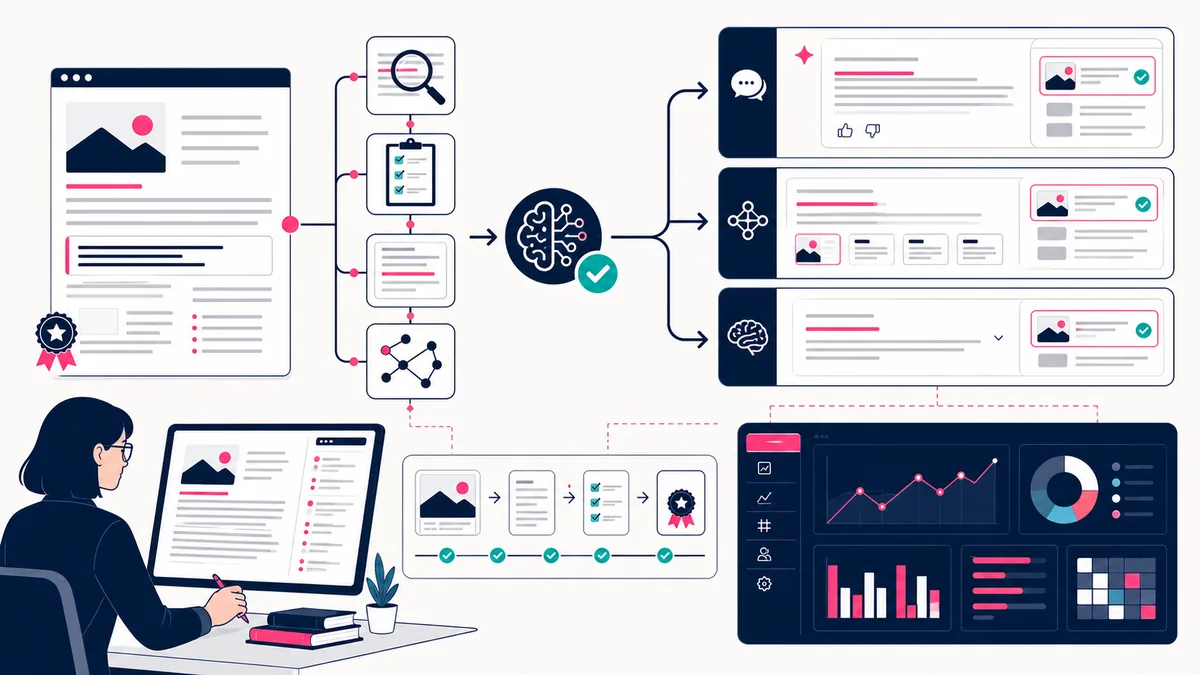
AI citation eligibility in brief
- A citation is a source attribution or link; it is not the same as a brand mention or recommendation.
- You cannot guarantee selection, but you can improve access, retrieval relevance, evidence, passage clarity, and corroboration.
- Audit the exact cited pages for a topic instead of copying generic “AI-friendly” formatting.
- Store complete responses and source lists because results vary across prompts, platforms, dates, and user context.
To get cited by AI search engines, create a page that an answer system can access, retrieve for a real question, understand at passage level, and trust enough to use. The page must offer something the answer needs: a clear explanation, original evidence, a current fact, a useful method, a comparison, or a practical tool. Formatting helps only after the source is worth citing.
What an AI Search Citation Is
An AI citation is a link or source attribution attached to a generated answer. Some interfaces place citations beside a sentence. Others show numbered references, a source panel, or a list after the answer. A cited page may supply one fact, support a summary, or help verify the response.
A citation does not prove the system endorses the whole website. It also does not guarantee the brand is named in the answer. Semrush’s 2026 ghost-citation study found that source links and visible brand mentions frequently diverge. Report them separately.
| Result | Visible to the user | Record | Do not assume |
|---|---|---|---|
| Citation only | A source link or attribution. | Page, answer claim, position, and platform. | The brand was named or remembered. |
| Mention only | The brand appears in the answer text. | Wording, context, accuracy, and recommendation status. | The brand website supplied the evidence. |
| Mention and citation | The brand is named and its page is sourced. | Both appearances and the supported claim. | A click or conversion occurred. |
| Referral visit | The user opens the source page. | Landing page, engagement, action, and outcome. | All citation value is captured by analytics. |
| No visible appearance | Neither brand nor source is shown. | Competitors and sources selected instead. | The content was never retrieved. |
You Can Improve Eligibility, Not Guarantee Selection
Generated answers are variable. The same question can return different sources after a model update, at another time, in another country, or within a different conversation. Query wording and follow-up context also change retrieval. No optimization can reserve a citation.
Work on observable stages instead: can the page be fetched, does it match the question, does the passage answer directly, is the evidence identifiable, is the information current, and do other credible sources support the topic relationship?
Follow the Citation Eligibility Pipeline
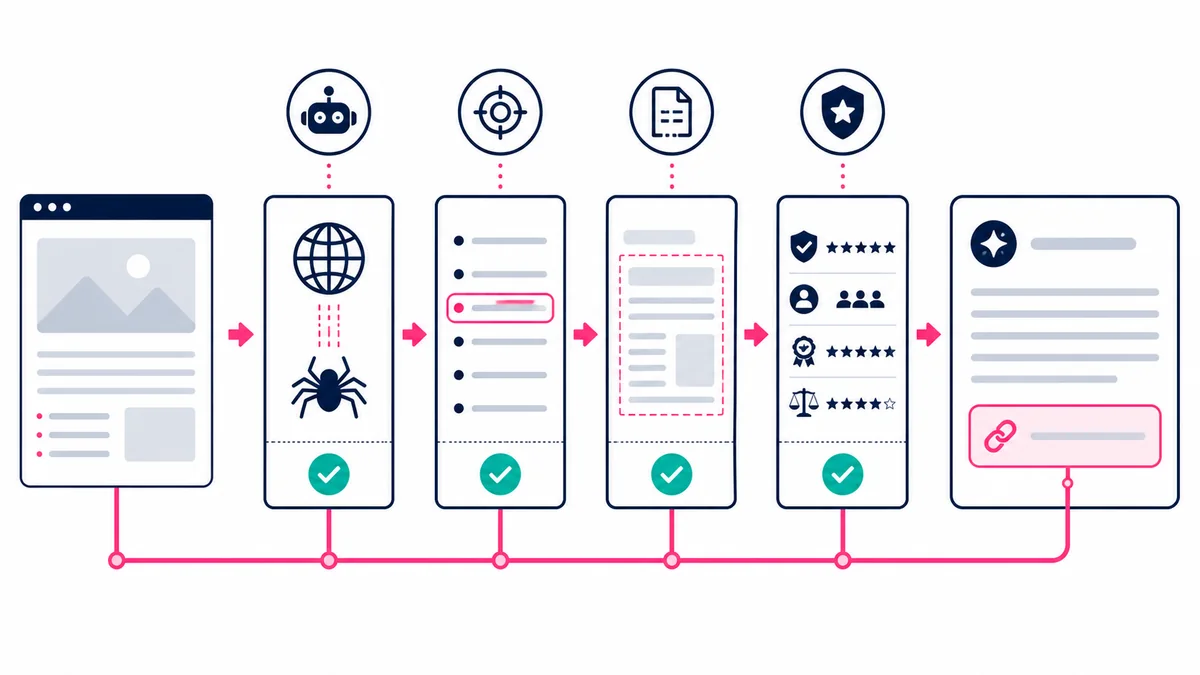
| Stage | Question | Evidence | Typical fix |
|---|---|---|---|
| Access | Can crawlers and users fetch the important content? | Status, robots rules, rendered HTML, canonical, and page speed. | Remove blockers and expose key information in HTML. |
| Retrieval | Does the page match the question and its likely sub-questions? | Query set, ranking footprint, cited competitors, and passage relevance. | Clarify scope or build the missing source. |
| Understanding | Can an extracted passage retain meaning? | Subject, claim, context, date, definitions, and headings. | Rewrite ambiguous or buried answers. |
| Evidence | Why should this source support the claim? | Method, data, expert, example, references, and limitations. | Add first-hand proof and transparent sourcing. |
| Corroboration | Do credible sources connect the brand or page with the topic? | Relevant links, mentions, reviews, coverage, and citations. | Promote the evidence to suitable audiences. |
| Selection | Was the page cited for the sampled question? | Complete answer, source list, platform, date, and context. | Compare selected sources and isolate the gap. |
| Outcome | Did the appearance produce accuracy, recognition, or useful visits? | Mention, citation, referrals, leads, and corrections. | Improve the page and next-step experience. |
Video reference
See Retrieval and Citation as a System
This official Ahrefs AEO lesson explains web retrieval, query fan-out, source freshness, and why citation visibility is probabilistic. Use it as the system view before auditing one page.
Check Technical Access Before Rewriting Content
Fetch the page without relying on a logged-in session. Confirm a 200 response, an indexable canonical, visible main text, useful title, one H1, internal routes, and images with alternatives. Check whether important facts appear in the HTML or only after a script runs. Review crawler rules deliberately; different products use different user agents and sources.
Semrush’s technical study found associations between crawlability and AI search appearances, but no single technical setting guarantees a citation. Treat technical health as eligibility: it gives a useful source the chance to be found.
| Check | Pass condition | Failure impact |
|---|---|---|
| Response and canonical | Stable 200 page with the intended self-referencing canonical. | The source may be unavailable or consolidated elsewhere. |
| Robots and access | Rules match the organization’s search and AI access policy. | Some crawlers or indexes may not fetch the page. |
| Rendered main content | Key answers and evidence appear in accessible HTML. | Retrieval may see an empty shell. |
| Internal discovery | Relevant hubs and pages link to the source descriptively. | The page remains isolated or weakly contextualized. |
| Page identity | Title, H1, byline, dates, organization, and schema agree. | Subject and ownership become ambiguous. |
| Usability | Fast, readable, mobile-safe page without intrusive barriers. | Users abandon the cited source even if selected. |
Research Which Pages Are Already Cited
Build a small, stable question set around one topic. Run it across the platforms that matter, save the complete answer and sources, and identify repeat citations. Open those exact pages. Note whether the system selected research, documentation, a glossary, a service page, a comparison, a news report, or a tool.
Do not copy the layout blindly. Find the information advantage: fresher data, clearer definition, stronger methodology, a better example, a narrower use case, or a source relationship your page lacks. The GEO Evidence and Visibility Map can hold the topic-level view.
Choose One Claim the Page Should Support
A page becomes easier to evaluate when its purpose is specific. “Complete guide to marketing” is too broad to make a useful citation target. “Average editorial lead times for regional guest posts, based on 600 completed orders” identifies a question, dataset, and reason to cite.
| Source type | Question it answers | Evidence expected | Useful update trigger |
|---|---|---|---|
| Definition | What does this term mean? | Precise scope, examples, distinctions, and expert review. | Terminology or practice changes. |
| Benchmark | What is typical? | Dataset, sample, collection date, method, and segments. | New period or material sample change. |
| How-to | How is the task completed? | Tested steps, prerequisites, outputs, and failure cases. | Tool, policy, or workflow changes. |
| Comparison | Which option fits these conditions? | Criteria, current facts, limitations, and transparent selection. | Product, price, or capability changes. |
| Case evidence | What happened in a real situation? | Starting point, intervention, timeline, outcome, and caveats. | New results or follow-up period. |
| Official fact | What does this organization offer or require? | Owned policy, documentation, pricing, or service details. | Business or policy change. |
Put the Direct Answer Where It Can Be Found
Use a descriptive heading and answer its question in the opening sentences. Follow with the evidence, examples, boundaries, and next decision. Long introductions are not more authoritative. A table can make criteria or data easier to compare, but important numbers and labels should remain in text rather than only inside an image.
Check the prose with the readability calculator, then use editorial judgment. Short sentences are not automatically clear; technical precision may require a well-built longer sentence.
Give Every Important Claim a Provenance
State who collected the information, when, how, and under what conditions. Link to primary evidence when it exists. Explain whether a number is an average, median, estimate, sample result, or modeled metric. Name the reviewer for regulated or high-stakes subjects.
| Evidence field | Record | Why it matters |
|---|---|---|
| Claim | The exact statement the evidence supports. | Prevents a source from being stretched beyond its meaning. |
| Origin | First-party dataset, primary document, expert observation, or external study. | Shows where the fact came from. |
| Method | Collection, calculation, sample, exclusions, and tools. | Allows the reader to assess reliability. |
| Time | Collection period, publication date, and review date. | Shows whether freshness matters. |
| Scope | Market, population, product, version, and conditions. | Prevents false universal claims. |
| Owner | Author, expert reviewer, and update responsibility. | Makes correction and maintenance possible. |
Create Original Utility Without Inventing Data
A business does not need a giant proprietary dataset to become useful. It can publish a tested checklist, a transparent decision framework, an annotated example, a calculator with documented assumptions, a glossary grounded in real practice, or a case study with honest limits. The case study library should show the starting point and work performed, not reverse-engineer a success story from a final metric.
Do not manufacture percentages, survey sizes, customer quotes, or experimental results. If evidence is not available, publish a method or framework and label it accurately.
Strengthen Authorship, Brand, and Entity Signals
Show who wrote and reviewed the page, why that person is qualified for this subject, and which organization is responsible. Keep company, product, founder, contact, policy, and service information consistent. Maintain a clear delivery explanation where readers need official business details.
An automated AI-content likelihood score cannot establish authorship or truth. Use it as a diagnostic, if at all. Accountability comes from the people, sources, methods, and review history behind the published page.
Build the Topic Around the Source Page
Support the main source with pages that answer adjacent questions, then connect them with descriptive internal links. Avoid dozens of near-duplicate articles aimed at minor phrase variations. A compact cluster helps readers move from definition to method, comparison, implementation, and evaluation.
Update the strongest page when the intent is the same. Create a new page only when the user needs a different decision or format. This article, for example, owns source-page citation eligibility; the wider GEO program and platform-specific AI Overviews work live elsewhere in the cluster.
Earn Corroboration Where the Audience Already Looks
Promote original evidence to journalists, industry publications, partners, associations, newsletters, podcasts, and communities that cover the subject. A useful guest article can explain one implication of the research and reference the full method. A partner case study can add independent context. An expert interview can clarify why the finding matters.
Use managed guest-post outreach and the publisher discovery route only where the audience and editorial story fit. Unrelated mentions add noise, not trustworthy corroboration.
Design the Cited Page for the Visit
If someone opens a citation, the page should immediately confirm the claim and offer the next useful layer: method, downloadable data, calculator, example, comparison, or service. Do not bury the cited fact beneath a sales wall. Make commercial routes visible without interrupting the evidence.
| Visitor need | Page response | Business route |
|---|---|---|
| Verify the claim | Direct answer, evidence, method, date, and scope. | Trust before conversion. |
| Understand the detail | Breakdowns, examples, definitions, and limitations. | Relevant guide or documentation. |
| Use the information | Template, tool, checklist, or downloadable record. | Product or service that supports implementation. |
| Assess the source | Author, organization, policies, and contact. | About, standards, and case evidence. |
| Take the next step | One clear CTA matched to the source question. | Quote, demo, order, contact, or subscription. |
Audit Citations With Complete Responses
Save the full question, answer, citations, platform, date, market, settings, and conversation context. Mark which sentence each citation appears to support. Record brand mentions separately. Repeat the portfolio on a stable schedule, not until the desired source appears.
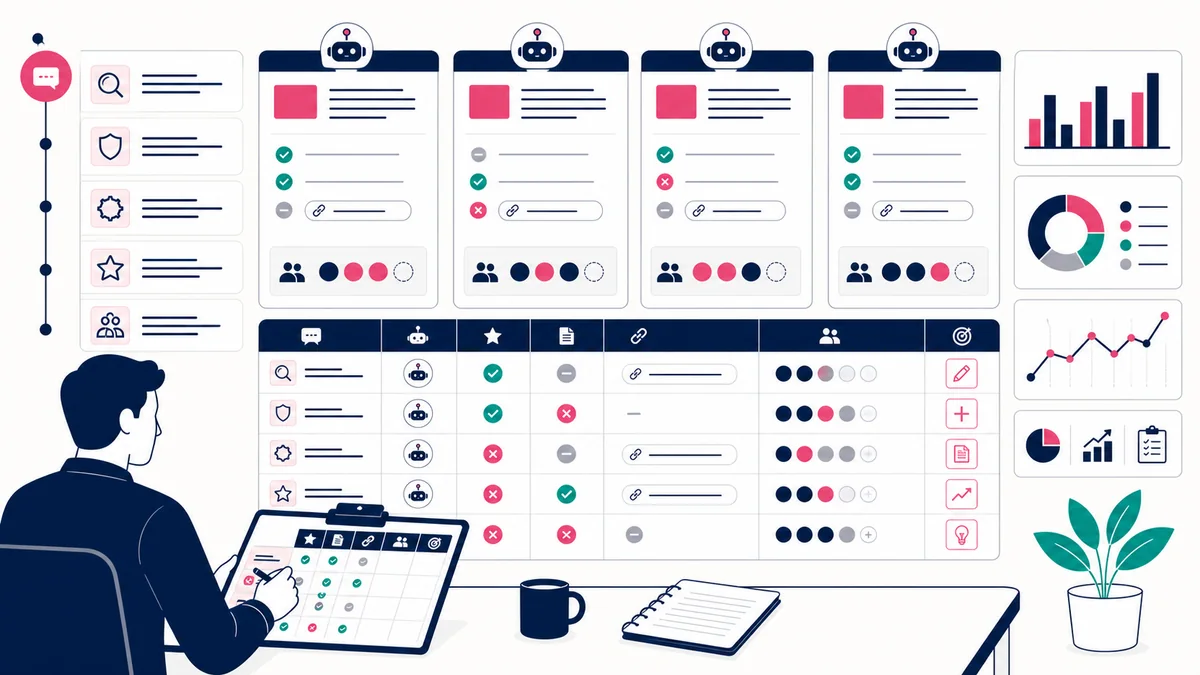
| Audit field | Record | Question answered |
|---|---|---|
| Test context | Prompt, variations, platform, model or mode, market, date, and conversation. | What exactly produced this answer? |
| Answer result | Complete response, recommendation, brand mentions, and accuracy. | How was the topic and brand represented? |
| Citations | All source URLs, positions, cited claim, page type, and domain. | Which evidence entered the answer? |
| Page audit | Access, relevance, passage, evidence, freshness, and corroboration. | Why might a source have been selected? |
| Outcome | AI referrals, landing behavior, leads, corrections, and brand demand. | Did the appearance create useful value? |
| Next action | Fix, update, create, promote, correct, test, or monitor—with owner. | What should the team do now? |
The EduGuestPost AI Citation Eligibility Record
This record follows one source page through the entire pipeline. It prevents a team from changing headings or adding schema without knowing whether access, evidence, relevance, or external corroboration is the real gap.
| Field | Record | Decision it supports |
|---|---|---|
| Target question | Audience, intent, topic, variations, platform, and priority. | Which answer should this page support? |
| Access | Status, canonical, robots, rendered text, internal links, and page identity. | Can the source enter retrieval? |
| Source value | Claim, evidence type, method, author, date, scope, and limitations. | Why is this page worth citing? |
| Passage | Direct answer, subject context, supporting evidence, and nearby source. | Can the useful section stand on its own? |
| Corroboration | Relevant mentions, links, coverage, reviews, communities, and partners. | Who else connects this source with the topic? |
| Citation result | Complete response, cited URL, supported claim, position, brand mention, and accuracy. | How did the source appear? |
| Outcome and action | Referrals, behavior, leads, correction need, owner, and next review. | What useful change should follow? |
A 60-Day Citation Improvement Sprint
Run the work inside the main SEO campaign plan so technical fixes, source content, internal links, distribution, and reporting share one owner.
- Days 1–10: choose one topic, build a stable question set, save full responses, and identify repeat cited pages.
- Days 11–20: audit access, retrieval fit, evidence, passage quality, authorship, freshness, and source gaps.
- Days 21–35: improve one source page with original utility, transparent provenance, direct answers, and better internal routes.
- Days 36–45: publish supporting pages only where intent differs, and promote the evidence to relevant third parties.
- Days 46–60: rerun the same test set, compare complete answers, review referrals and accuracy, and choose the next action.
AI Citation Mistakes to Avoid
- Guaranteeing citations: a variable selection system is presented as a booked placement.
- Counting citations as mentions: source visibility is reported as brand visibility.
- Rewriting before checking access: an inaccessible page gets more copy but remains ineligible.
- Hiding the useful fact: the direct answer sits beneath a long generic introduction.
- Inventing evidence: fabricated data creates apparent uniqueness and real reputational risk.
- Copying cited competitors: the page becomes less original without understanding the source advantage.
- Publishing thin query variants: near-duplicate pages dilute the strongest source.
- Adding schema as a cure: markup describes weak content instead of improving it.
- Ignoring the cited visit: the page confirms nothing and offers no useful next step.
- Testing until success: selective screenshots replace a repeatable measurement process.
The Practical Takeaway
AI citation work is source work. Make the page accessible, match a real question, answer directly, show provenance, add original utility, and earn relevant corroboration. Then test a stable question set and save the complete answers.
A citation cannot be promised, and a citation alone is not a customer. The durable goal is to become the page that deserves to support the answer and gives curious visitors a trustworthy place to verify, learn, and act.
FAQs About AI Search Citations
What is an AI search citation?
It is a source link or attribution attached to an AI-generated answer. The interface and placement vary by platform.
Can a citation be guaranteed?
No. Citation selection changes with the question, platform, model, date, location, sources, and conversation context.
Is a citation the same as a brand mention?
No. A citation links or attributes a source. A mention names the brand in the answer. Either can appear without the other.
Does a page need to rank in Google to be cited?
Strong search visibility can increase retrieval opportunities, especially in systems that use search indexes, but citations can draw from different sources and do not require one universal rank.
What pages are most citation-ready?
Pages with clear answers, original data, documented methods, useful tools, authoritative definitions, current facts, practical comparisons, or first-hand case evidence can make strong sources.
Does structured data improve citation eligibility?
It can clarify page and entity information, but it does not replace crawlable content, relevance, provenance, expertise, and useful evidence.
How important is freshness?
Freshness matters most when the question depends on current products, prices, policies, events, statistics, or practices. Update when the evidence changes, not merely to change a date.
Do backlinks and mentions help?
Relevant third-party links and mentions can improve discovery, search visibility, public corroboration, and brand-topic association. Unrelated volume is not a substitute for evidence.
How should citations be tracked?
Use a stable question portfolio and store the complete answer, sources, platform, date, context, brand mentions, accuracy, referrals, and uncertainty.
What should I fix first?
Fix access and inaccurate core facts first. Then improve one high-priority source page where the current cited results reveal a clear evidence or usefulness gap.
Research Behind This AI Citation Guide
These current studies and practitioner resources informed the source-selection, technical access, citation-versus-mention, ranking overlap, and audit sections.
- Ahrefs: earning and monitoring LLM citations
- Ahrefs: search ranking overlap with AI citations
- Ahrefs: AI visibility sampling and data methodology
- Semrush 2026 study: citations that do not produce brand mentions
- Semrush: technical SEO factors and AI search appearances
- Semrush: content patterns associated with AI search visibility
- Neil Patel: auditing brand visibility and accuracy in AI answers
Earn the Recognition Behind Citation-Ready Pages
Send your priority source pages, topics, markets, question set, and current third-party coverage. We will review the publisher and outreach opportunities that can put useful evidence in front of relevant audiences.