
YOUR BRAND. A REVIEWABLE DELIVERY SYSTEM.
White-Label
SEO Services.
More delivery capacity.
Your agency stays in control.
Give your agency additional SEO delivery capacity with work your team can review, explain and present under its own brand.
Defined scope · Agency approvals · Useful handoffs
SUPPORT BEHIND YOUR AGENCY OFFER
Clear work.
A stronger handoff.
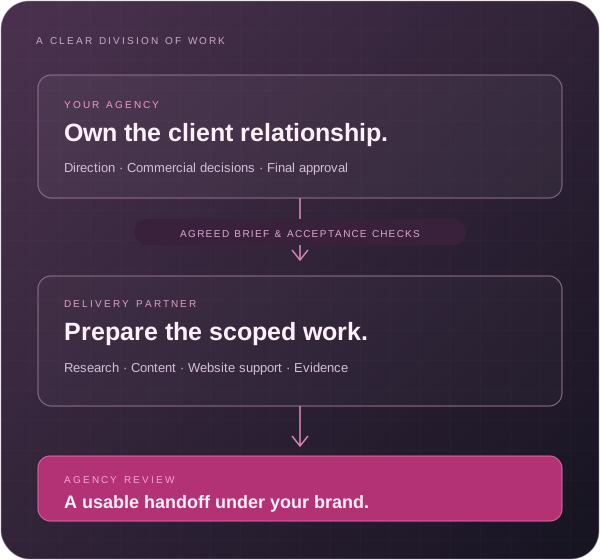
EduGuestPost’s white-label SEO services support agreed research, content, website improvement and campaign tasks behind your agency’s offer. You keep the client relationship, commercial decisions and final approvals. We define the work, inputs and handoffs with you before delivery begins.
The starting point can be a focused client project or a defined recurring scope. Each account keeps its own objectives, priorities and reporting requirements.
01 / AGREED DELIVERY
Choose the SEO work your accounts need
White-label SEO is a delivery arrangement: a provider performs specified SEO work that an agency supplies under its brand. The useful question is which responsibilities you want supported and what your account team should receive.
An engagement can draw on the following services, with deliverables and coverage confirmed in the proposal:
- Audit and prioritization: Our SEO audit services can provide findings, affected URLs, supporting evidence and a prioritized action plan. A diagnosis and the work required to implement it should be priced and assigned clearly.
- Keyword research and page planning: Keyword research services can connect relevant query groups with existing or proposed pages. The handoff should record the intended market, page purpose and reasoning behind the priorities.
- On-page and content improvements: On-page SEO services and SEO content optimization can support agreed page elements, missing explanations and useful next actions. Your team confirms product facts and approves the final copy.
- Internal linking: Internal linking services can review relevant connections between pages and prepare or implement the agreed changes. Recommendations should identify the source, destination and reason for each link.
- Existing-content updates: SEO content refresh services can address outdated instructions, changed offers and pages needing renewed evidence. The brief should identify what to retain, verify and revise.
- Coordinated delivery: SEO campaign management can connect related page, content, linking and publisher activities where a wider program is required.
The service mix follows the account. An audit project, a content backlog and a recurring campaign need different resources and acceptance checks.
02 / CONTROL & ACCOUNTABILITY
Keep agency decisions and delivery responsibilities clear
Your agency remains the client’s point of contact under the standard partner workflow. Strategy support can inform your decisions while your team retains control of the offer, budget and client commitments.
The proposal should turn that relationship into a practical division of work. A typical allocation looks like this:
| Responsibility | Your agency controls | EduGuestPost supports |
|---|---|---|
| Account direction | Client objectives, positioning and commercial commitments | Research and recommendations within the brief |
| Work approval | Priorities, scope, budget and permission to proceed | Defined deliverables, dependencies and review questions |
| Content accuracy | Product facts, permissions and final brand approval | Brief preparation, agreed writing or revisions and editorial checks |
| Website changes | Authorized access and release approval | Specified implementation or a documented handoff |
| Client presentation | Client communication, resale price and final reporting | Unbranded delivery information in the agreed format |
The exact allocation can change by account. Agree it before work starts so a task cannot disappear between your team, the client’s developer and the fulfillment provider.
A REVIEWABLE SEQUENCE
Keep every handoff visible.
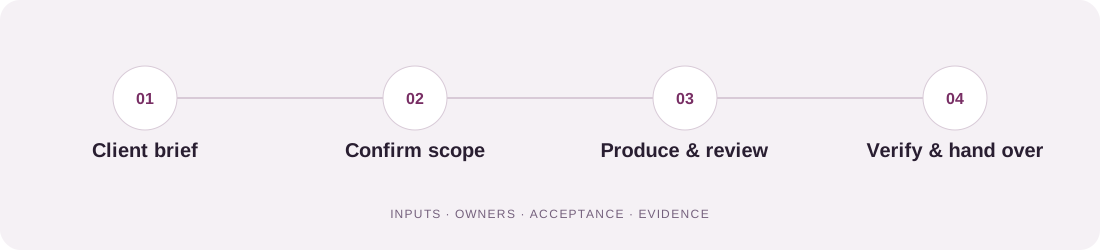
From a separate client brief to an agreed delivery record.
03 / DELIVERY WORKFLOW
Follow a reviewable delivery process
1. Supply a separate brief for each client
Share a client code, website, audience, market, objective and current priorities. Include existing research, previous work, important URLs and restrictions. State who will answer questions and approve deliverables.
2. Confirm scope and acceptance
Agree the URLs or templates covered, required outputs, data sources, review stages and dependencies. Identify whether the work ends with recommendations, approved copy, CMS changes or verified implementation.
3. Produce and review the work
Research and production follow the approved brief. Your reviewer checks the work against the client’s requirements and consolidates feedback. Changes to the objective or coverage should be assessed before the delivery plan is revised.
4. Verify and hand over
Record the completed work, verification evidence, unresolved questions and next recommended actions. A draft awaiting approval, an approved recommendation and a live change should have distinct statuses.
04 / INPUTS & ACCEPTANCE
Make the first brief useful to the delivery team
Good onboarding reduces the questions that interrupt production later. Beyond the website URL, the team needs to understand what the client offers, who it serves and which decisions the work should support.
For content work, supply current product or service information, brand guidance, useful customer questions and the evidence available for important claims. For website work, identify the CMS, development contact, intended public pages and any planned releases that could affect implementation.
Include existing page ownership and approved routes before requesting new URLs. Similar search wording can belong on one page; a new destination needs a distinct purpose. Existing useful content should be assessed before another article is commissioned.
Agree access and confidentiality at onboarding
Use client-owned accounts and named permissions appropriate to the task. An initial review may need read access; implementation needs a separate agreement about changes and authority. The client should retain ownership of its website and measurement accounts.
Your agency remains the communication route unless a separate written arrangement authorizes direct client contact. Confidentiality terms and any restrictions on subcontracting, references or reuse should be reviewed during onboarding. Client codes can help separate accounts while limiting unnecessary identifying information.
Define what a finished deliverable means
An audit should connect a finding to evidence, affected pages, a proposed action and a way to check it. A content revision should answer the intended reader’s question, reflect verified facts and identify anything still awaiting approval. An implementation task needs an agreed check against the live result.
Our editorial standards explain the principles applied to publisher and guest-post content. Account-specific instructions should also travel with each relevant brief, including prohibited claims, excluded topics and approval requirements.
A practical example of a first project
Imagine a web agency whose training-provider client needs clearer course pages after a redesign. The agency supplies the current offer, approved course information and priority URLs. A focused first project could review the page map, prepare revisions for selected pages and give the developer a separate list of implementation tasks.
The handoff would identify revised copy, outstanding factual questions, approved changes and checks still needed after publication. The agency can then assess the work before expanding the scope.
This is a fictional delivery example, with no implied client results or performance forecast.
05 / EVIDENCE & REPORTING
Receive reporting your account team can explain
Share your reporting fields and preferred format before the first delivery. Unbranded information should help your team build its own report while retaining the evidence and context behind the work.
A useful update distinguishes three things:
- Work delivered: The pages reviewed, briefs or revisions supplied, changes implemented, approval status and unresolved dependencies. Link each item to a usable output or verification record.
- Search observations: Relevant query and page performance, with the source, reporting period, market and filters. Separate measured first-party data from third-party estimates and note incomplete coverage.
- Business activity: The agreed enquiry, signup, purchase or other action, where appropriate tracking is available. A form submission, qualified lead and customer remain different observations.
Your agency controls the client-facing summary and conclusions. Changes in rankings or traffic should be considered alongside implementation dates, seasonality, product changes and measurement limits. A positive movement alone does not prove that one task caused it.
Agree reporting support and frequency
Delivery records, performance analysis and client meetings involve different work. Confirm which are included, how often updates are required and who answers follow-up questions. If your team uses a dashboard or reporting platform, share the required fields and handoff method; integrations and automated delivery need explicit confirmation.
The white-label arrangement should make account management easier to support. It should also leave your team able to inspect the underlying work and challenge a recommendation.
06 / CAPACITY & COMMERCIALS
Plan capacity and costs before expanding
The quotation should reflect the account’s requirements: site complexity, research depth, page coverage, writing or editing needs, implementation responsibilities, review process and reporting. Include your own account-management and approval time when assessing the full cost of delivery.
A defined first project lets both teams assess brief quality, revision handling, communication and the usefulness of the outputs. Recurring volume and turnaround should then be agreed against the actual service mix and available capacity.
When priorities change, identify the affected work and review its effect on cost, timing and dependencies before proceeding. Your agency controls the price and commitments presented to its client.
Keep the handover clear when work pauses or ends
Agree which current deliverables, change records, supporting exports and outstanding-task notes will be handed over. Identify who manages ongoing monitoring and who reviews access permissions. A completed project should leave the next owner able to understand what was delivered and what remains to be done.
07 / SUPPORTING TOOLS
Use tools to support the handoff
The EduGuestPost tools directory includes utilities for preparing inputs and reviewing specific evidence. They can support an agency workflow when the client’s data and the tool’s limits are understood.
| Tool | Role in the workflow | Evidence limit |
|---|---|---|
| Keyword Mapping Tool | Record supplied keywords, page assignments, priorities and owners | Planning checks use your inputs; they do not discover demand or verify current rankings. |
| Content Brief Generator | Assemble the reader, outcome, outline, evidence requirements and reviewer | It organizes supplied information, rather than verifying sources or writing the finished page. |
| SEO Content Optimizer | Review supplied copy or HTML for exact phrases, long passages and structural observations | Measurements support editing; they do not establish factual accuracy or a ranking score. |
| Indexability Checker | Inspect public responses, redirects, crawl rules and page directives | A successful check does not prove Google indexing or rendered-page behavior. |
| Backlink Gap Tool | Compare client and competitor backlink exports and prepare a source shortlist | Results depend on imported coverage. The tool does not discover or independently verify backlinks. |
| Backlink Monitor | Make a one-time public check of a known source-page and target-URL pair | It observes fetched HTML. Public checks do not create saved monitoring, discover links or prove indexing. |
Review exports before including them in a client report. Preserve collection dates, source information and coverage notes; keep unnecessary confidential information out of public tool inputs. A clean tool result and an accepted service deliverable are separate decisions.
08 / PUBLISHER FULFILLMENT
Choose the dedicated route for publisher work
For an agency that needs placement fulfillment, white-label link building is the broader publisher route. White-label guest posting services focus on reviewed guest-post opportunities, content coordination and delivery information.
Those engagements require their own publisher criteria, approvals, content responsibilities and placement terms. Exact domains and current conditions should be confirmed before commitment. For paid placements, Google’s guidance calls for appropriately qualified links; a commercial placement term does not establish ranking value or policy compliance.
For a deeper operating guide, see scaling agency link building. This broader SEO page helps define which website and campaign responsibilities your agency wants supported.
ONE CLIENT. ONE CLEAR BRIEF.
Prepare an agency delivery brief.
Bring the workstreams, acceptance checks, owners and reporting requirements into one draft for review.
BEFORE WE START
White-label SEO questions
Know how the relationship, work and review process fit together.
Can a web design or PPC agency use this service?
Yes. A focused scope can support an agency that owns the client relationship and needs SEO research or delivery capacity. Start with the account’s actual requirements and the work your team can review. Agree the service positioning and client expectations before selling a wider program.
Will EduGuestPost contact our clients?
Under the standard partner workflow, your agency remains the contact point. Direct communication needs a separate written arrangement. Identify who sends questions, consolidates client feedback and approves work so routine delivery can move through the agreed agency contact.
Can we start with one client or a single project?
A defined first project can be discussed around the services and capacity required. That might be an audit handoff, a page-research task or selected content improvements. Confirm the deliverables, inputs and acceptance process before deciding whether a recurring arrangement is suitable.
Can you use our existing strategy and reporting format?
Share the strategy, page map, brief templates and reporting fields you want followed. We can assess the requested work against those requirements and identify missing inputs or conflicts. Confirm file formats, data access and any platform integration separately; supplying unbranded delivery data does not automatically include a hosted client dashboard.
How are pricing, revisions and turnaround agreed?
Pricing is based on the defined work and delivery responsibilities. The proposal should specify the review process, revision coverage, dependencies and timing. New pages, changed objectives or additional implementation work may require a revised scope. There is no universal margin, unlimited-capacity promise or guaranteed ranking outcome.
YOUR NEXT STEP
Discuss a white-label SEO scope for your agency
Send your agency’s service model, client niches, intended markets and the work you need supported. Include an example brief, expected volume, implementation responsibilities, reporting requirements and budget range. Use a client code where practical.
We can review the requirements and discuss a starting scope your team can assess before expanding across more accounts.
Request a white-label SEO scope review
Start with a separate brief your account team can review.