
Content Brief Generator
Give your writer a clear starting point. Define the reader, the outcome and the evidence, then turn your notes into an editable brief with an outline, sources and review responsibilities.
Start with the reader
A keyword tells a writer what a page is about. It rarely tells them enough about the person reading it. Someone choosing their first accounting tool needs different explanations from a finance lead replacing a system used by thirty people. Name the reader’s situation, what they already know and the decision they need to make.
Then describe the outcome in plain language. “Understand email marketing” leaves almost every editorial decision open. “Choose a first welcome-email sequence and know what information to collect before writing it” gives the writer a useful boundary. Add the angle that makes your page worth reading: a worked example, a tested process, original observations or an explanation missing from your existing material.
Give each section a job
Build the outline around the questions the reader must resolve. Use H2 headings for the main steps or decisions and H3 headings when a section genuinely needs a smaller part. The notes beside a heading are where you explain what belongs there, what evidence is needed and what the writer should leave out.
A heading such as “Benefits” could produce almost anything. “When a shared calendar stops being enough” with a note to compare ownership, approvals and missed deadlines is much more useful. An outline is a handoff, not a requirement to cover every related phrase you have collected.
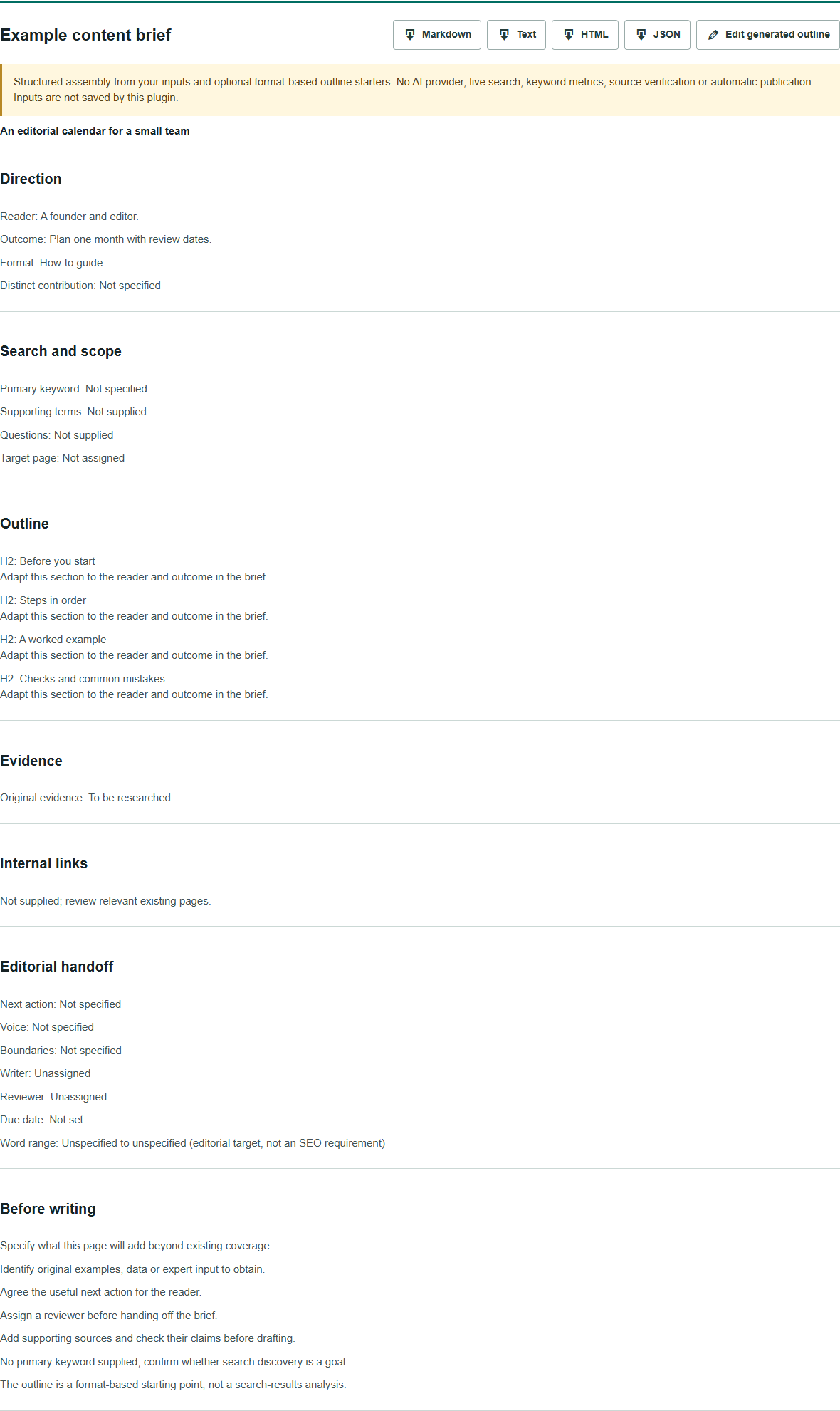
The format starter offers a basic structure for an article, how-to, comparison, case study or product page. It is not a researched outline for your topic. Replace generic sections with the questions and examples that matter to your reader. You can also generate a brief without an outline and edit the suggested structure afterward.
Supply the evidence
Separate what you can demonstrate from what still needs checking. A product specification, a documented interview and an independently measured result support different kinds of statements. Tell the writer which source supports which claim and whether permission, attribution or a fresh check is required.
The sources list stores the URLs and notes you enter. It does not open those links or confirm that the source says what you expect. Avoid adding a reference merely because it appears authoritative; read the relevant passage and record why it belongs in the brief. Do not paste private customer information, credentials or unpublished material you are not authorized to share.
For a case study, include verified dates, the starting conditions, what changed and any limits on the conclusions. When those details are missing, ask for them. A plausible number is not a substitute for evidence.
Keep SEO in context
Use the primary keyword to identify the main subject, then add supporting terms and reader questions that belong on this page. These are your inputs, not search-volume measurements or a list of phrases the writer must repeat. If another page already serves the same purpose, review that overlap before commissioning another article. The Keyword Mapping Tool can help you record which page owns each planned topic.
An optional word range helps with scope, budget and editing. It is not a Google minimum or a ranking target. Google’s people-first content guidance puts the emphasis on usefulness and a satisfying answer, rather than writing to a supposed preferred word count.
Choose internal links because their destinations help the reader take the next step. Add a note explaining that connection, rather than forcing an anchor phrase into a section where it does not fit. This generator does not measure competitor coverage, inspect search results or promise that the resulting article will rank or be indexed.
Make the handoff clear
Agree on the owner, reviewer and due date before the brief becomes a draft. Give the reviewer a specific responsibility where necessary: technical accuracy, product claims, legal review or editorial quality. Add the desired next action and any tone or content restrictions the writer should know.
Read the generated brief as though you had not attended the planning conversation. Could a writer tell who the page is for, why it is needed and which claims require evidence? Resolve those gaps before expanding the outline. The reminders identify missing briefing fields; they are not an SEO score or proof that a completed field contains good research.
Save your work
Save a draft JSON file to keep unfinished inputs, or download the generated brief as Markdown, plain text, HTML or a full JSON report. The HTML version can be opened and printed from a browser. Draft and report JSON files can both be restored to the editor for another round of changes.
There is no automatic draft saving. The plugin processes the submitted brief to create the response; it does not save your brief or report to your WordPress account. Shared abuse protection records a salted IP hash, tool identifier and usage date. Hosting and security-provider policies apply separately.
Questions
Does the generator research Google or write the article?
No. It assembles your inputs into an editable writing brief and can provide a format-based starter outline. It does not fetch search results, verify sources or write a finished article.
Can I save a brief and continue later?
Yes. Download the draft JSON and restore it in the form. The full report JSON also contains a restorable brief. Drafts are not automatically saved in the browser or to your WordPress account.
Is the word range an SEO recommendation?
No. You choose an optional editorial range. The tool does not calculate a ranking target or prescribe a minimum length for Google.
Discuss your content plan
Share the page and audience you want to support with publisher outreach.