
SEO Audit Services
SEO Audit Services That Show You What to Fix First
Find the problems affecting your important pages and give your team a clear order of work.
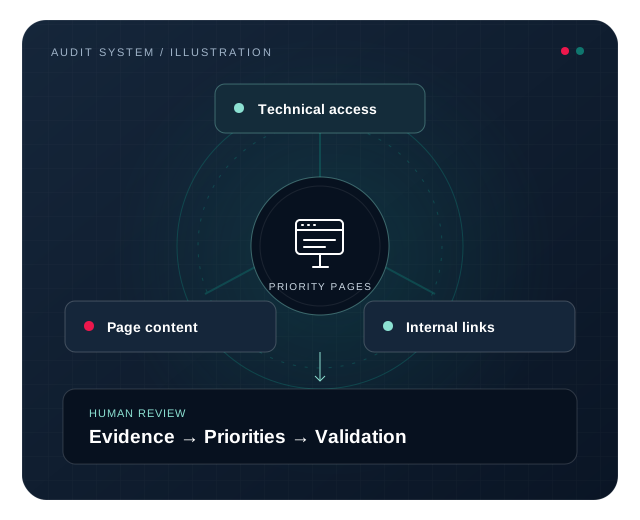
EduGuestPost reviews your website's search foundations, page content and internal connections, then turns the findings into a practical action plan. Our SEO audit services help you decide where to repair access, improve an existing page, clarify competing content or investigate a performance change before committing more budget.
You receive recommendations tied to the pages that matter to your business, with supporting evidence and a way to check each agreed fix.
Share your website, target market, priority pages and the problem you want to understand. We will review the requirements and confirm the proposed scope, price and timing.
Start with your business
Start with the question your website needs answered
A website can attract visitors and still struggle to generate useful enquiries. It can publish regularly while its commercial pages remain difficult to find. A redesign can look better to customers while changing URLs, navigation or indexing instructions that previously supported search visibility.
Those situations need different investigations. We begin with your business model, audience and priority pages, then use the available evidence to decide what deserves attention.
An audit is useful when:
- Important service, product or category pages are receiving little relevant organic traffic.
- Traffic or enquiries changed after a redesign, migration, content update or other website change.
- Several reports point to different problems and your team needs a defensible priority list.
- You are planning new content or outreach and want to check the destination pages first.
- A large content archive has become difficult to navigate, maintain or assign to distinct search needs.
For a course provider, the priority might be a program page that leaves prospective students unsure about entry requirements. For a SaaS business, it might be a product page competing with a guide that answers a different question. For a local business, it might be inconsistent location information or a mobile enquiry path that is difficult to use.
The audit starts with that context. The number of warnings in a tool report comes later.
Agreed coverage
What our website SEO audit can cover
The quotation defines the URLs, templates, markets and data sources included. A focused website review and a complex international storefront require different coverage. We make that distinction before the work begins.
Crawl access and indexing readiness
We examine whether the pages you want discovered return usable responses and present consistent instructions to search engines. The review can include redirects, robots.txt rules, noindex directives, canonical declarations, sitemap entries and crawlable navigation.
A page opening in a browser does not establish that Google has indexed it. Where Search Console data is available, we compare public-page evidence with Google's recorded indexing and canonical information. Declared canonicals are preferences; Google can select a different URL.
We also distinguish deliberate exclusions from mistakes. An account page may correctly remain outside search. An important service page carrying a staging noindex instruction needs a different decision.
Page purpose and content
We review whether a page answers the search task it is intended to serve. That includes its title, main heading, introduction, supporting sections, descriptions, evidence and next step for the visitor.
A buyer looking for a service provider needs scope, process, deliverables and a way to enquire. A reader researching a problem may need an explanation and examples. Copy that treats both visits as the same task can leave each audience poorly served.
Recommendations explain what the page needs to make clearer. That might mean adding a prerequisite, correcting an outdated claim, showing a relevant example or removing sections that repeat information without helping the reader.
Internal links and topic relationships
We examine how visitors and crawlers reach your important pages. Navigation, category structures, supporting articles, contextual links and descriptive anchors should create useful routes through the website.
A helpful guide should make its related service or product easy to discover when that is a sensible next step. Equally, a commercial page can link to a guide that answers a question too detailed for the landing page itself.
The review can identify broken destinations, links pointing through unnecessary redirects and pages missing from the observed internal navigation. Orphan-page investigation needs a wider URL inventory, such as sitemap and Search Console records, because a crawl cannot discover every unlinked page by itself.
Content overlap and refresh priorities
Two pages mentioning the same phrase are not automatically competing with each other. We compare their purpose, search-result context and available query-to-page performance before recommending a change.
Where overlap appears unhelpful, the plan may recommend clearer differentiation, stronger internal signals or consolidation after reviewing the value each page still provides. Existing backlinks, useful visits and legitimate reader needs belong in that decision.
For older content, we look for the reason behind a change in performance. A page with fewer clicks might need an updated answer, but it could also be affected by seasonality, lower demand, a technical problem or a different search-results layout. A rewrite should follow the diagnosis.
Mobile experience and performance evidence
We review representative page templates and important visitor journeys, including whether key information and actions remain usable on mobile. For JavaScript-dependent pages, initial HTML and rendered content may need separate inspection.
When performance reports are included, we distinguish real-user field data from Lighthouse lab tests. Core Web Vitals cover loading, interaction responsiveness and visual stability. Their usual good thresholds are LCP at or below 2.5 seconds, INP at or below 200 milliseconds and CLS at or below 0.1, assessed with the appropriate field-data context.
Missing data stays an open question. A whole-origin result should not be presented as proof that every individual page performs well.
Structured data and search presentation
We review whether relevant structured data accurately describes the visible page and whether reported validation problems need attention. Markup should reflect the business, product or content that is actually present.
The audit also reviews title and description consistency. Search engines may generate different title links or snippets, so metadata recommendations focus on an accurate, distinctive promise for the visitor.
Valid markup can support eligibility for certain search features. It does not establish that a rich result will appear, and an ordinary service page should not carry invented reviews or unsupported business details.
Authority context and AI search foundations
Where backlink data is included, we review the available source pages, destinations, anchors and link attributes in context. Lost references and links to retired destinations can be worth investigating. A third-party risk score alone is insufficient grounds to remove or disavow legitimate links.
For AI search, we assess foundations such as accessible content, clear answers, identifiable sources and consistent business information. A readiness review and an observed citation are different kinds of evidence. Google's AI search features use the established SEO foundation; there is no special schema that guarantees inclusion.
If answer captures are included, we record the prompt, platform, market, date and citations. A finding from one captured answer remains a finding about that sample. Our guide to getting cited by AI search engines explains the source-page considerations in more depth.
A usable handoff
What you receive from the audit
The deliverables are agreed with the scope so your team knows what it will be able to use. An audit engagement can include:
A management summary explaining the most consequential findings and the decisions they require.
An issue register identifying affected URLs or templates, supporting evidence, the recommended action and any uncertainty.
A page-purpose map showing priority destinations, their intended search needs and relevant supporting content.
A prioritized work plan with dependencies, suggested owners and a practical sequence for implementation.
Validation instructions explaining how to check that the agreed changes work and which performance measures to monitor afterward.
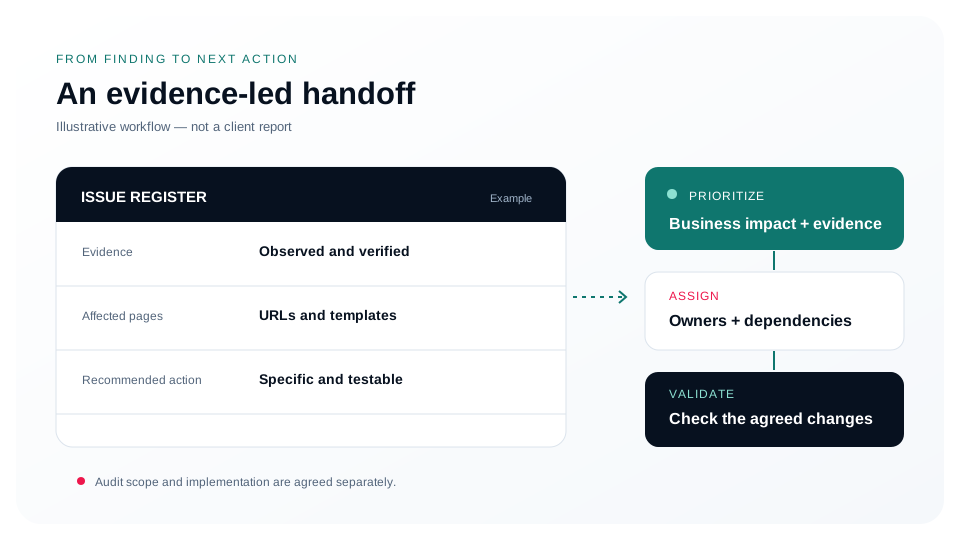
An actionable finding is specific enough for the next person to work with. Instead of “improve internal linking,” it should identify the source page, intended destination, proposed context and reason for the change. Instead of “fix indexing,” it should show the observed instruction or report evidence and explain what needs verification.
You can use the plan with your developer, content team or current SEO provider. Any implementation support and follow-up review are defined separately in the approved scope.
Decisions with context
How we decide what should be fixed first
We weigh business importance, supporting evidence, the number of affected pages, implementation effort and dependencies. A repeated template problem may deserve attention before dozens of isolated cosmetic improvements.
For example, an accidental noindex on a priority service page generally deserves investigation before rewriting low-traffic blog descriptions. If an old product URL has relevant incoming links, choosing the correct replacement destination matters more than sending every retired product to the homepage.
Not every warning needs a change. Repeated metadata across a paginated sequence can be intentional. A redirect may correctly preserve an old URL's destination. A low-traffic page may still help existing customers complete an important task.
The plan explains which findings need action, which need additional evidence and which can remain as they are. That makes it easier to spend the available time on work that serves the website's actual goals.
Evidence within clear limits
Use EduGuestPost tools to collect useful evidence
Our SEO and content tools help you investigate focused questions before or alongside a manual audit. Their reports work best when the inputs, coverage and limits remain visible.
| Audit question | EduGuestPost tool | Evidence it can contribute |
|---|---|---|
| Which issues appear across a selected page set | Website SEO Analyzer | Initial HTML and response findings from a bounded sample with a maximum of 20 outcomes |
| What does an individual page declare | SEO Checker | Page titles, headings, robots signals, canonicals and other returned-HTML observations |
| Which links need verification | Broken Link Finder | Source URLs, destinations, anchors and response outcomes within crawl limits |
| Do several URLs appear for the same query | Keyword Cannibalization Tool | Analysis of supplied paired query-and-page records, with daily comparisons when provided |
| Which existing pages deserve a closer look | Content Refresh Checker | Comparison of supplied page-level Search Console performance periods |
| What do performance reports show | Core Web Vitals Checker | Imported CrUX field reports and Lighthouse lab evidence kept distinct |
| Which sources appear in an AI answer | AI Citation Checker | Citation mapping from supplied answer text and references |
These tools contribute evidence within their stated scope. The Website SEO Analyzer does not inspect an unlimited website, render JavaScript or confirm Google indexing. The cannibalization tool needs records that connect each query with a page; separate query and page totals cannot be reliably joined into that relationship. The AI Citation Checker analyzes supplied answers and does not run a fresh platform search.
A manual audit connects those observations with business priorities, first-party data and the actual page experience. It also investigates the questions a focused checker cannot settle.
Optional learning resource
Independent tutorial by Ahrefs
A general introduction to an SEO audit from Ahrefs. This independent educational resource is not an EduGuestPost service demonstration or endorsement.
Read the Ahrefs SEO audit guide
The video loads from YouTube only when you choose to play it.
A defined sequence
A clear process from website brief to action plan
Share the business context
Send your website address, important pages, target countries and languages, main enquiry or purchase goals and the problem prompting the audit. Include recent launches, URL changes or migrations that could affect the investigation.
Agree the coverage and inputs
We define the page set, templates, competitors, data sources, deliverables and expected timing. Where useful, the review can use Search Console exports or appropriate account access, analytics reports, known backlink exports and supplied performance evidence.
Public-page evidence can support an initial review. Missing account data limits the conclusions that can be drawn about queries, Google-selected canonicals and measured business outcomes; the scope makes those gaps clear.
Investigate and check the findings
We compare tool observations with the affected pages and available reports. A failed request is recorded as unverified unless its cause is established. Estimates remain separate from first-party measurements, and a suspected issue remains distinct from a confirmed one.
Deliver the priorities and handoff
The agreed report connects each material finding to an action, an owner or team and a validation step. Where the right action depends on another decision, such as choosing the retained page before consolidating content, that dependency is recorded.
Turn the plan into agreed work
You can implement with your own team or discuss a suitable follow-on engagement. Our SEO campaign management service connects target-page readiness, content priorities, internal-link planning and relevant publisher activity around agreed objectives.
The next investment
Connect the audit to the right next service
An audit should help you choose the next investment. That may be a technical correction, a clearer commercial page, a better supporting guide or more reliable measurement.
If publisher outreach fits the findings, EduGuestPost can help with guest posting and blogger outreach. Education-focused businesses can also review education publisher options for relevant academic, learning, training or EdTech audiences.
Those services have their own selection and approval process. Publisher fit, article direction, target URL, current price and link terms are reviewed before a placement proceeds. An SEO audit does not include a publisher placement unless it is specifically part of the agreed engagement.
This reflects our editorial standards: the reader, content and destination should make sense together, and important claims should be supported. For a website audit, the same care means explaining a recommendation and showing the evidence behind it.
Before you enquire
SEO audit questions
How much does an SEO audit cost
The price depends on the agreed coverage, number of templates, platform complexity, markets, available data and depth of investigation. A small service website and a large store with variants and filters need different work. Send your requirements for a scoped quote. Implementation and follow-up checks should be identified separately when included.
How long does the audit take
Timing depends on coverage, access to the necessary reports and the questions being investigated. We confirm the expected delivery schedule with the scope. Tell us about a launch or migration deadline before the quotation is finalized.
Is this different from using a free SEO checker
A checker answers the questions its inputs and methodology allow. A manual audit compares those observations with page purpose, business importance and additional evidence, then explains the recommended order of work. A diagnostic score is useful context, but it cannot predict a ranking outcome.
Will you fix the issues identified
The audit provides the agreed findings and action plan. Content work, technical implementation and post-change validation can be discussed as additional scope. Your team can also use the recommendations with its existing developer or SEO partner.
Can an audit explain a traffic drop
It can investigate likely causes and identify what further evidence is needed. We compare the affected pages and periods with site changes, indexing information, demand patterns and available performance data. A traffic decline alone does not establish a Google penalty.
Does the audit include backlinks and AI search
Those areas can be included at an agreed depth. Backlink analysis needs an appropriate dataset and source-level review. AI readiness focuses on the pages themselves; observed visibility needs dated answer evidence with its prompts and references. A full specialist investigation can be scoped separately when required.
Will the audit guarantee better rankings
No. The deliverable is an evidenced diagnosis and a prioritized plan. Search results depend on implementation, competition, demand and search-engine decisions. We judge the audit by the quality of its findings and the usefulness of the next steps.
How often should a website be audited
Use major website changes, unexplained performance shifts and the pace of publishing to guide the schedule. A stable small website may need fewer broad reviews than a frequently changing store. Focused checks between larger audits can help catch regressions without repeating the entire investigation.
Your website. Your priorities.
Get a clear plan for your website
Tell us which pages matter and what is making the next SEO decision difficult. We will review the requirements and propose an audit that gives your team useful answers and a workable sequence of actions.
Request an SEO Audit Quote
You can also email [email protected] with your website, target market, priority URLs and the problem you want reviewed.
This form prepares a brief in your browser. It does not submit an enquiry. Choose “Open email draft,” review your message in your email app, and send it when you are ready.
You can also visit our contact page.
Create useful paths between related pages
Need visitors to reach the next useful answer on your website? Review the source context, choose a relevant destination and document the link placement and checks. Explore Internal Linking Services.
Plan the search topics your business can answer
Need a research-backed plan for the next pages your team should improve or create? Keyword research connects customer needs, search intent and the pages that can answer them. Explore Keyword Research Services.