A visible evidence trail
Inspect the pinned model manifest, source provenance and the inspected and omitted intervals. A failed source stays unknown, not an empty successful result.

Educational guest post services, EDU backlinks, and publisher outreach for SEO campaigns.
Select your sites, then enter your name and email.
ENGLISH NAMED-ENTITY REVIEW
Find predicted names in English content and inspect the passages that support them. Review one source or compare a target with up to two references to see which named forms were detected in the inspected text.
Browser inference · No paid inference API or key · English sources
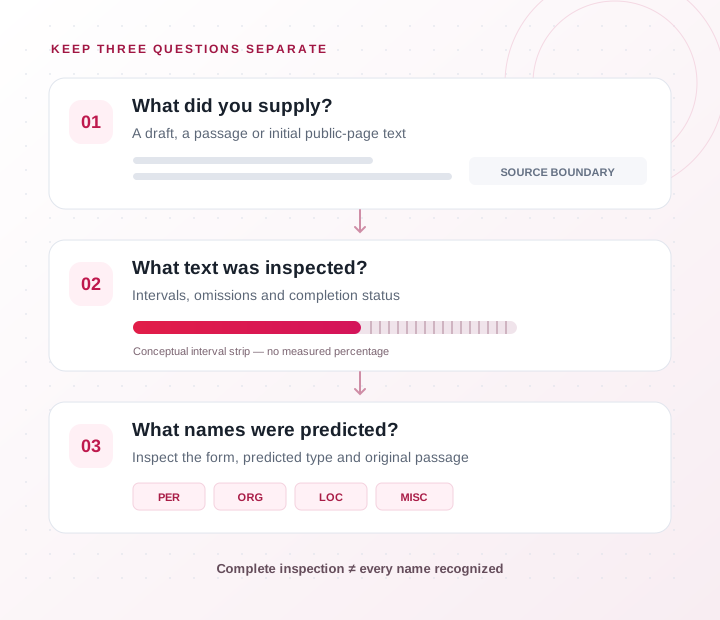
The tool is designed for people, organizations, locations and miscellaneous named entities. It offers a focused review of names rather than a complete account of everything a page means. A prediction can be wrong, incomplete or assigned the wrong type.
Use the evidence to ask a useful editorial question: does this name belong in the answer your page is trying to provide? A reference can mention many people or organizations that would add little value to your target. The goal is an accurate, helpful explanation, not a longer list of names.
01 / YOUR WORKSPACE
Start with pasted English text, or prepare a public page. You can explore the tool’s clearly labelled illustrative sample without downloading a model or requesting any source website.
Find people, organizations, locations and other named entities in English text. Compare a target with reference content to see which names were detected in the inspected text.
Exports contain all report rows, including detected names and source URLs, regardless of filters. Full source text is not included. Keep downloads private if your sources are sensitive.
Inspect the pinned model manifest, source provenance and the inspected and omitted intervals. A failed source stays unknown, not an empty successful result.
Review same-form type conflicts and record reviewer decisions or alias notes without silently merging names or changing the detected evidence.
Versioned JSON and CSV exports retain source status, evidence and review notes. Display filters do not narrow the exported report.
02 / A DELIBERATE REFERENCE SET
Choose sources that help answer the same question, explain an important example or supply evidence your reader actually needs.
Choose extraction when you want to inspect a single draft or page. Choose comparison when you have a target and one or two relevant references. Select sources because they help answer the same question, explain an important example or provide evidence your reader needs.
This workflow complements the Topical Gap Analyzer when you also need a broader review of subject coverage. A named person and a missing explanation are different findings. The presence of a name cannot show whether the surrounding explanation is useful or correct.
Keep the reference set deliberate. Two selected pages are a small comparison set, not an automatic survey of competitors or all search results. Record why each source is relevant and whether you are using a live page, a draft or a copied passage.
If the review supports a rewrite, the Content Brief Generator can turn the decision into an assignment. Give the writer the question, intended audience, factual sources and reason for including a particular name. Avoid instructions that merely demand every detected reference name.
03 / SOURCE BOUNDARIES
The selected source, the admitted text and the text actually inspected can have different boundaries. Keep those boundaries with your review.
Each source can use pasted English text or a public page URL. Pasting is useful for unpublished work and for a particular passage you are authorized to review. Keep the selected passage’s scope in your notes; a result for an excerpt does not describe the whole document.
The text fields display a 12,000-character limit. Their browser limit uses UTF-16 units, so an emoji can occupy two displayed units. These are not model tokens, words or bytes. Shortening text to fit the field changes the source being reviewed.
URL mode sends the supplied address to this website’s server. It retrieves initial HTML text and returns extracted content for analysis in your browser. It does not provide a JavaScript-rendered browser view. The documented URL requirements are public English HTML with at least 100 and at most 8,000 extracted words.
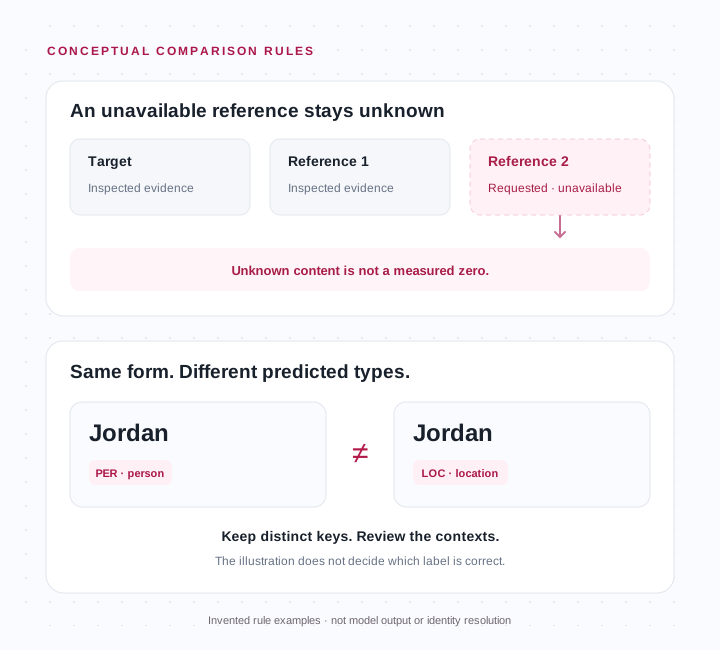
Request limits and text limits can reduce what is available. Keep an unavailable source separate from an inspected source with no detected names. If an important passage was omitted, the report cannot establish what the model would have found there.
URL checks use shared human verification and check limits. A prepared URL batch can consume a check even if model processing later fails; pasted text does not consume server check quota. Review the stated limits before starting a URL-based comparison.
04 / BEFORE YOU ANALYZE
A local browser model avoids a paid inference API. It does not remove the download, memory or device requirements of running a model.
Analysis uses a browser model rather than a paid inference API. No inference API key is required. The page estimates an approximately 135 MB first-use download for the BERT q8 model and runtime after you select Analyze.
Read the download acknowledgement and the English-language acknowledgement before starting. Cached model assets may be reused, but processing still depends on the device, available memory, browser and network. A phone can struggle with work that is more practical on a desktop.
The sample report lets you inspect the interface without downloading a model or requesting source websites. Its names, passages and scores are illustrative. It helps explain the report layout; it does not demonstrate prediction accuracy or device performance.
Browser inference and URL retrieval are separate parts of the workflow. Pasted text is documented as staying in the browser for inference. URL mode necessarily sends addresses to the server. Model/runtime downloads contact their configured asset hosts, with the page stating that submitted text is not included in those requests.
05 / MENTIONS BEFORE METRICS
A supported text location is useful evidence. It is not proof that the predicted type, fact or editorial relevance is correct.
In the mention view, review the predicted name, type, source and highlighted passage together. A name may be a person in one context and a location in another. The surrounding sentence can reveal a mistaken label or a boundary that omitted part of a name.
The report labels source positions as zero-based UTF-16 offsets with an exclusive end. These positions refer to the original supplied text. They are useful for locating evidence, but a correctly located span can still be a mistaken prediction.
Mean model scores and minimum token scores are not probabilities of correctness. The illustrative sample shows both values and explicitly warns against reading them as certainty. A high score does not verify a fact, identify a real-world person or prove that a name matters to a reader.
The documented method uses bounded, overlapping windows and keeps unresolved evidence visible. Character coverage describes the text inspected by the process. Even complete inspected-text coverage does not mean that every real name was recognized or correctly classified.
Review the source-coverage section before reading a comparison as an editorial gap. Omitted passages, unresolved evidence and failures can limit what an apparent absence means.
06 / COMPARISON, NOT ENTITY LINKING
A matching spelling, an inferred label and a real-world identity are not interchangeable.
Coverage comparison matches normalized name text together with the predicted type. It does not automatically merge aliases or establish that two occurrences refer to the same real-world entity.
For example, an organization written as Aster Lab and Aster Laboratory can remain two different forms in a name-based comparison. A human reviewer may know that they refer to one organization, but that relationship needs evidence outside a simple matching key.
Likewise, identical spelling with different predicted types should not be silently treated as an agreement. Review the contexts and labels before changing either page. Type mistakes can create apparent differences even when both texts discuss the same subject.
A reference-only row means that the form and type were detected in inspected reference text and were not detected in inspected target text. It does not establish a missing topic, a gap in Google’s understanding or a requirement to add the name.
07 / AN INDEPENDENTLY AUTHORED EXAMPLE
Invented sentences. Stipulated mentions.This independently authored example is not output from the model. The statements are invented for explanation, and do not demonstrate what the model will recognize.
| Source | Authored text or status |
|---|---|
| Target | 😀 Aster Lab met Mira Chen in Bristol. |
| Reference 1 | Mira Chen visited Aster Lab in York. Aster Lab hosted Omar Reed. |
| Reference 2 | Unavailable; no inspected text or supported mentions |
Assume Aster Lab is labelled ORG, Mira Chen and Omar Reed are labelled PER, and Bristol and York are labelled LOC. The target has three mention occurrences. Reference 1 has five because Aster Lab appears twice.
| Name and stipulated type | Target mentions | Inspected Reference 1 mentions | Limited comparison |
|---|---|---|---|
| Aster Lab — ORG | 1 | 2 | Detected in both |
| Mira Chen — PER | 1 | 1 | Detected in both |
| Bristol — LOC | 1 | 0 | Target only within this inspected set |
| York — LOC | 0 | 1 | Not detected in inspected target |
| Omar Reed — PER | 0 | 1 | Not detected in inspected target |
There are eight mention occurrences across the two readable sources and five distinct name/type keys. Repeating Aster Lab adds an occurrence, not another distinct comparison key.
Reference 2 contributes unknown evidence. Its failure must not become zero mentions, an empty successful reference or proof that its names agree with the target. The table describes only the target and inspected Reference 1.
Deciding whether York or Omar Reed belongs in the target requires an editorial reason. Adding both simply to imitate the reference could make the target less focused.
08 / MAKE AN EDITORIAL DECISION
Useful coverage starts with the reader’s question, not a target count of reference names.
Ask whether each reference-only name supports an explanation, example, attribution or source the target actually needs. Verify names, roles and factual relationships separately. The model does not fact-check the sentences around its predictions.
If your concern is repeated wording rather than named forms, use the Content Similarity Checker for that separate comparison. Matching entities and matching language answer different questions.
When deciding whether an existing page needs revision, the Content Refresh Checker can support a separate performance-period review. A changed name list does not explain changes in clicks or impressions.
After agreeing on the reader’s needs, the SEO Content Optimizer offers a separate review of a supplied draft against supplied requirements. Keep the assignment grounded in useful information and reliable evidence.
Use the SEO tools hub to select further checks around the decision you are making. No individual tool result establishes complete content quality or a guaranteed ranking outcome.
09 / EXPORT WITH CONTEXT
A useful handoff preserves unknowns, source status and sample identity—not just a list of names.
The report offers CSV and JSON downloads. Filters help inspect a subset on screen; exports retain all report rows rather than only the current filtered view. This behavior is also available in the illustrative sample.
Review which file records describe the report, sources, individual mentions and comparison rows. Keep the sample flag, source status and inspection time with the evidence. An illustrative report’s preparation time is not the time of a live source inspection.
Full source text is documented as excluded from exports. Names, offsets, counts and source URLs can still disclose information about the material reviewed. Share the downloaded evidence only with the people who need it.
Reset returns the form to extraction mode and clears its fields and displayed report. That interface action does not by itself establish that cached model assets, service logs or other browser data have been removed.
The page states that this module does not store source text or reports. Treat that as a specific processing claim, not proof that the whole website has no network activity. Avoid supplying sensitive information or credentials.
10 / CONTENT FIRST, CAMPAIGN SECOND
The entity review informs a content decision. It does not establish placement quality, availability or a ranking benefit.
If the review identifies content work needed before outreach, the SEO services overview provides a route for discussing the destination page, audience and campaign scope.
When the page is ready, compare the guest post purchasing options against your audience and placement requirements. Sending a brief requests review; confirmation comes through the approved order and its terms.
For a confirmed order, preserve the agreed dofollow-link and Google indexing guarantee, including the review period and remedy in the approved order. Rankings, traffic, leads, sales and authority-score gains are not guaranteed.
Google recommends sponsored qualification for paid placements and accepts nofollow for that purpose. Reconcile any dofollow requirement with that guidance and the publisher’s actual terms before approval. An entity comparison does not establish paid-link compliance, publisher availability or Google’s future indexing decisions.
11 / QUESTIONS & LIMITS
Use the predictions as a starting point for review, with the inspected source and the tool’s English-language scope in view.
No. The English model predicts four kinds of named entities and can miss or misclassify them. It is not a general concept, product, relationship or fact extractor. Inspect the evidence and use a separate editorial review for the completeness of an explanation.
It means the named form and type were not detected in the inspected target text. The source may use an alias, the model may miss a mention, or the name may be irrelevant to the target’s purpose. Check those possibilities before editing.
The current workflow asks you to acknowledge that sources are primarily English. It does not provide a multilingual coverage check. Names from another language can appear in English text, but that does not establish reliable recognition across other languages or domains.
No. Model scores are not calibrated correctness probabilities. The sample’s scores are invented illustrations, not measurements from a model run. Real predictions need context review and appropriate evaluation before numerical scores can support stronger claims.
No. Character coverage concerns inspected text, while detection recall concerns names the model successfully identifies. A source can be fully inspected and still contain missed or wrongly typed names. An incomplete source adds a further limit to any absence claim.
No. It displays invented passages and predictions without model inference or website requests. Use it to understand evidence views, filters and downloads. Real processing requires the model download, appropriate inputs and review of the resulting coverage and limitations.
Select your sites, then enter your name and email.
YOUR NEXT PUBLISHING OPPORTUNITY
If you want full list of available sites share your email here.
Our team will email you the available sites list.