
Local visibility / Business moves
Business Relocation Listing Update Services
Help customers find the right location throughout your move.
For businesses moving premises, changing their service base or updating one branch.
EduGuestPost’s business relocation listing update services coordinate the business information that needs to change when a location moves. We organize the old and new details, review the appropriate route for each platform and document the work needed to bring the agreed listings up to date.
Your move may involve a new street address, building, phone number, service area or customer opening date. Those changes need a shared plan, especially when several people manage the website, directory accounts and customer communications.
Request a relocation listing review with your website, old and new locations, planned dates and known listing URLs. We will define the platforms, owner responsibilities, update stages and follow-up included in the quote.
A coordinated transition for the location that is moving
A listing can still show the old address after the website has changed. Another may have the right street but the wrong map position, hours or branch link. Some platforms require verification before they will accept the new information.
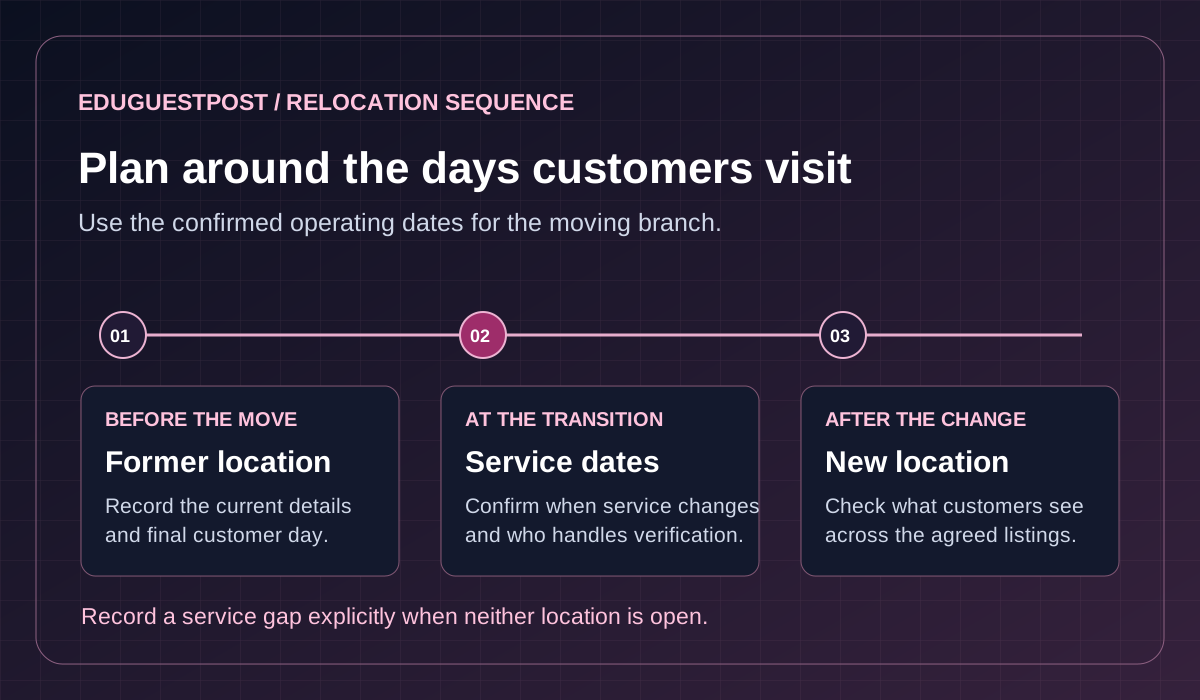
The relocation plan connects those tasks to the actual move. It records when customers stop attending the former premises, when the new location can receive them and whether there is a period of interrupted service. Future-location information needs clear dates so customers can distinguish an announcement from a location already open.
For a business with several branches, each location keeps its own identity and operating details. We isolate the moving branch and identify shared website or provider data that could accidentally affect the others.
If you also need new directory coverage or a broader repair campaign, our local citation building service provides that wider route. The relocation quote defines the transition work your business actually needs. For inaccurate records outside the move, see local citation cleanup services.
Agree the move facts before changing listings
We begin by establishing whether the same business is relocating. A new branch, a replacement business at the former premises, a major rebrand and a permanent closure can require different records and platform procedures.
Your approved move brief connects the current location to the intended new one. Historical information remains available for finding old records, while the current publishable details are kept separate.
Swipe or scroll to read all columns. Keyboard: focus the table, then use the arrow keys.
| Move detail | What your team confirms | How it guides the work |
|---|---|---|
| Business continuity | Whether the name, operation, ownership or services are also changing | Determine whether each platform treats the case as a move, new business or other change. |
| Premises and map position | Full address, unit, postcode and the actual building or service base | Prepare accurate location details and review the pin separately. |
| Operating dates | Last customer day at the old premises, first day at the new site and any closure gap | Plan the sequence of announcements, hours and listing actions. |
| Contact and website | Phone, branch page, booking links and the people responsible for them | Identify connected information that also needs review. |
| Access and evidence | Current profile manager, available verification contact and premises evidence | Assign owner tasks and identify blocked actions before scheduling. |
Keep the operating model accurate
A staffed location receiving customers needs different treatment from a business that travels to customers and does not serve them at its base. We review address-display and service-area requirements for the platforms included.
A mail-forwarding address or unstaffed virtual office does not automatically establish an eligible Google business location. A change in coverage should describe where the business genuinely serves customers; it should not be used to manufacture extra branches.
If part of the move is still undecided, the plan records that dependency. A provisional opening date should not become a promise that every directory will display the new address on that date.
Choose the correct platform route
Google Business Profile and Maps
For a standard move by the same business, we start by reviewing whether to update the existing Google Business Profile. The plan accounts for the address, the map pin and any verification required after the move.
Some venues are closely tied to their premises. Dining, lodging and entertainment businesses may need a different route when they move. We check the category and the platform’s current instructions before proposing whether to retain, close or replace a profile.
We review the business category and circumstances before recommending either route. Where the instructions do not clearly fit the case, the plan identifies the support question to resolve before a consequential change.
Owner verification and review continuity
Available verification methods depend on the profile. Your owner or authorized representative may need to demonstrate the new premises, signage, equipment or management access. The proposal identifies what to prepare and who handles verification.
A business that keeps the same name and operation may retain review history when it moves. Category and significant business changes can affect what carries over. We record the existing profile and review information, then check what appears after the update. Other content and historical metrics may need separate checks.
Apple Maps and other directories
Apple’s location attribute guidance distinguishes the public address from building coordinates. We confirm the current relocation route for the account and how the former place card should be handled before proposing changes.
Other directories may use an owner edit, support request, provider workflow or replacement location record. The action plan names the intended result for each platform. Removing an entry from a management account alone does not demonstrate that the public old-location record has disappeared. If overlapping records need separate investigation, see duplicate business listing removal services.
What your relocation update plan includes
The scope identifies the moving locations, selected platforms, known profiles and any additional discovery required. It also states who approves the business facts and who controls website publication or owner verification.
Swipe or scroll to read all columns. Keyboard: focus the table, then use the arrow keys.
| Work area | Included record | Completion check |
|---|---|---|
| Move brief | Approved old and new facts, operating dates and location relationships | The business confirms the transition and any remaining uncertainty. |
| Listing inventory | Agreed platforms, original public URLs, access and observed details | Each record is matched to the correct business and branch. |
| Update plan | Platform route, required fields, owner tasks and proposed sequence | The action is appropriate to the business and authorized scope. |
| Agreed casework | Prepared changes, authorized submissions or owner instructions | Dates and references distinguish requests from accepted results. |
| Outcome report | Public URL, visible address, status, hours, pin observation and next action | The report shows which facts were checked and what remains unresolved. |
Website evidence can support the move brief
Your own location page can help show the address, contact information and hours the business currently publishes. EduGuestPost’s Local Website Evidence tool reads a limited sample of public website HTML for supported business declarations, explicit phone links and address elements.
Use its findings as prompts for reviewing the website. The tool does not inspect off-site listings, verify real-world identity or submit updates. It does not render JavaScript, and an unobserved or unsupported declaration is not proof that a business fact is absent.
Separate branches and departments also need separate interpretation. A difference between two location pages can be intentional. The approved move brief and direct listing checks remain the basis for the relocation work.
If a paid listing-management account is already involved, tell us which provider controls the data and which locations are connected. Any required subscription, third-party charge or additional integration is identified separately before purchase or activation.
Plan the sequence and check the public result
Prepare before the transition
We review the known records, access and required business facts before scheduling changes. The plan identifies which tasks can be prepared in advance, which depend on the premises being ready and which require a decision from the owner or platform.
Your website owner receives the agreed address, hours, contact links and location-page requirements. Selected on-page SEO updates can be scoped where copy or page information needs changing. A move does not automatically require a new website URL or a site migration.
Coordinate the agreed changes
The engagement can include approved listing edits or submissions where supported, case preparation and instructions for actions the owner must complete. A source system may support scheduled updates, but its schedule does not guarantee simultaneous publication across directories.
Keep the current business facts and effective dates clear. A changed move date needs to be reflected in the plan before further actions proceed. Any temporary closure or special hours should describe the real interruption in customer service.
Review each destination
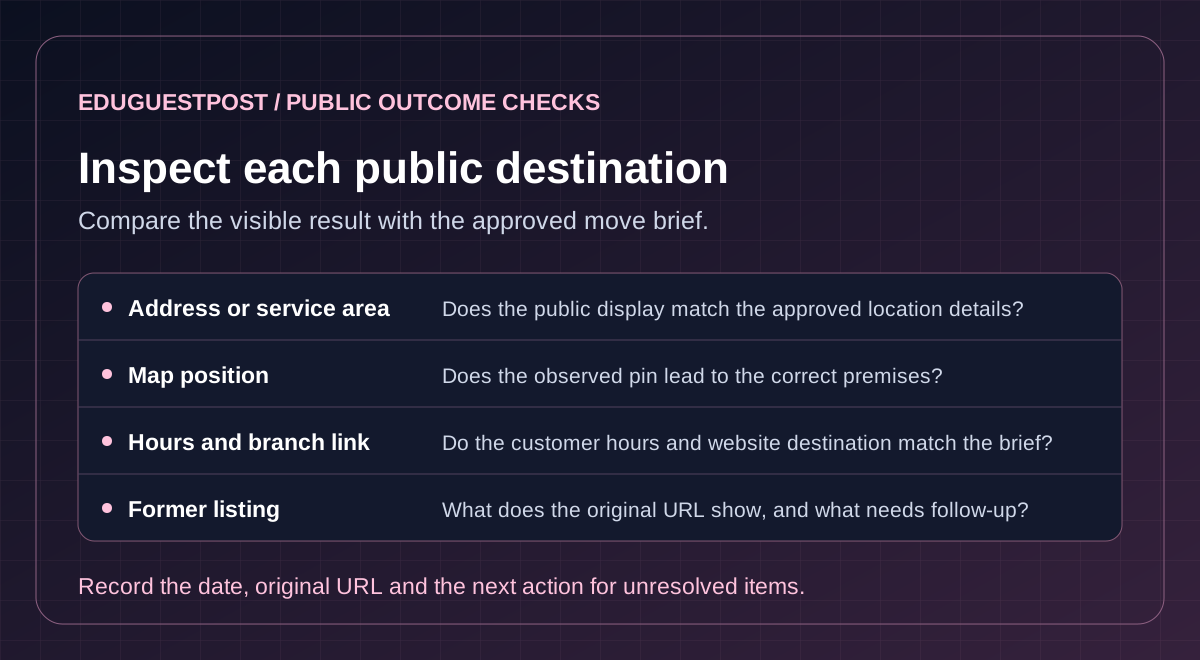
After the agreed actions, we check the relevant public fields and original listing links. We record the new address or service-area display, observed map position, hours, branch website link and any old-location status that remains visible.
Connected apps need their own checks where included. Foursquare’s partner-app guidance explains that a source change does not instantly update partner apps; partners control refresh and inclusion. A corrected source record therefore cannot prove every downstream destination is current.
An illustrative office move
Consider an accountancy firm moving one of two offices while keeping its name and phone. Its brief would identify the moving office, new premises, customer dates and verification contact. The second office would keep its existing details. The report would distinguish the updated branch page and accepted listing changes from an outstanding owner verification task or directory review.
This example illustrates the workflow rather than a client result or guaranteed outcome.
Questions about relocation listing updates
How early should we prepare?
Start planning once the location and likely dates are known. Access recovery, evidence preparation and website coordination can take place before the public transition. The action schedule then follows the actual move and each platform’s requirements. Preparation does not mean presenting a future location as already open.
Can you update every listing at once?
The proposal defines the platforms and discovery coverage. Publisher reviews, owner verification and connected-provider limitations can produce different completion dates. No single dashboard action establishes that every listing or app has updated.
What happens to the old location?
That depends on the platform route. An existing profile may receive the new details, an old record may redirect or show a closure, or a support case may remain open. We report the observed outcome and any necessary next step. A former occupant at the new address is a separate business whose record must be assessed on its own facts.
Will our local rankings stay the same?
A move changes the business’s location relative to customers and competitors. Listing accuracy can help people reach the right premises, but the update work cannot guarantee stable rankings, traffic or enquiries. Any wider measurement or market strategy needs its own scope.
What determines the quote and follow-up period?
The quote depends on location count, selected platforms, existing records, discovery needs, access, verification dependencies and required casework. We agree on the review period and reporting points before work begins. Later discoveries or recurring monitoring can be added through a defined follow-up arrangement.
What should I send for an initial review?
Send your website, the old and new location details, planned operating dates and example listing URLs. Include your country, location count and which platform tasks need an owner. Keep passwords, verification codes and private documents out of the initial enquiry.
Request a business relocation listing update quote
Send your website, old and new addresses or service bases, country, branch count and expected move dates. Include known profile links, your current listing provider, existing support cases and the person who can approve facts and complete owner tasks.
- Which branch or service base is moving?
- When will the old and new premises serve customers?
- Who manages the existing listings and website?
Send the relocation details for review to discuss deliverables, responsibilities and a practical quote. For a wider decision about markets, website priorities or measurement after the move, SEO consulting provides a separate planning route.
Use public listing examples in your first enquiry. Keep passwords, verification codes and full private documents for your own records. Agree any necessary private evidence sharing and access separately.
Request a relocation listing review
We use your enquiry to scope the transition, owner tasks and public checks.