
Search Intent Checker
Check what a search result set is asking your page to do. Bring a dated snapshot, review the result types and intent labels, then compare the full mix with the top three. Your report keeps the evidence behind your content decision.
Start with the results
A keyword can sound like a buying query while the results are mostly comparison articles. It can also look informational while searchers expect an interactive tool. Before choosing a page format, look at what the query actually returns for the market and device you care about.
This checker reviews results you supply. Enter them individually or import CSV or TSV with rank, URL and title columns. Add snippets and your classifications when available. Record the search engine, language, observation date and source of the snapshot. Results from different queries or markets should be reviewed separately.
Read before labeling
Open the result pages and ask what the visitor can accomplish. An informational page answers or explains. A commercial page helps compare options. A transactional page lets someone take an action, such as ordering or booking. A navigational result helps someone reach a particular website or destination. A brand appearing in a title does not make every query navigational.
Choose the main purpose as the primary intent. Add a secondary purpose only when the page genuinely supports it. A buying guide may teach readers how a product works while helping them compare alternatives. A store page with a short FAQ is still likely to have a different main job.
Keep a result unknown when its title and snippet are not enough. English clue matches, such as “best” or “how to,” are prompts for inspection, not automatic classifications. The report never turns those clues into accepted labels.
Separate purpose and format
Intent describes the need. Content type describes the page: an article, product, category, service page, tool, video or discussion. Format describes its presentation, such as a guide, comparison, review or reference. The angle records a useful distinction, perhaps budget, experience level or a specific audience.
For “best workbench lighting,” a comparison article and a product page could both be relevant. A comparison for a small rented workspace might answer a different need from a guide to wiring a permanent workshop. Record those differences instead of treating every mention of lighting as the same content opportunity.
Read the mix
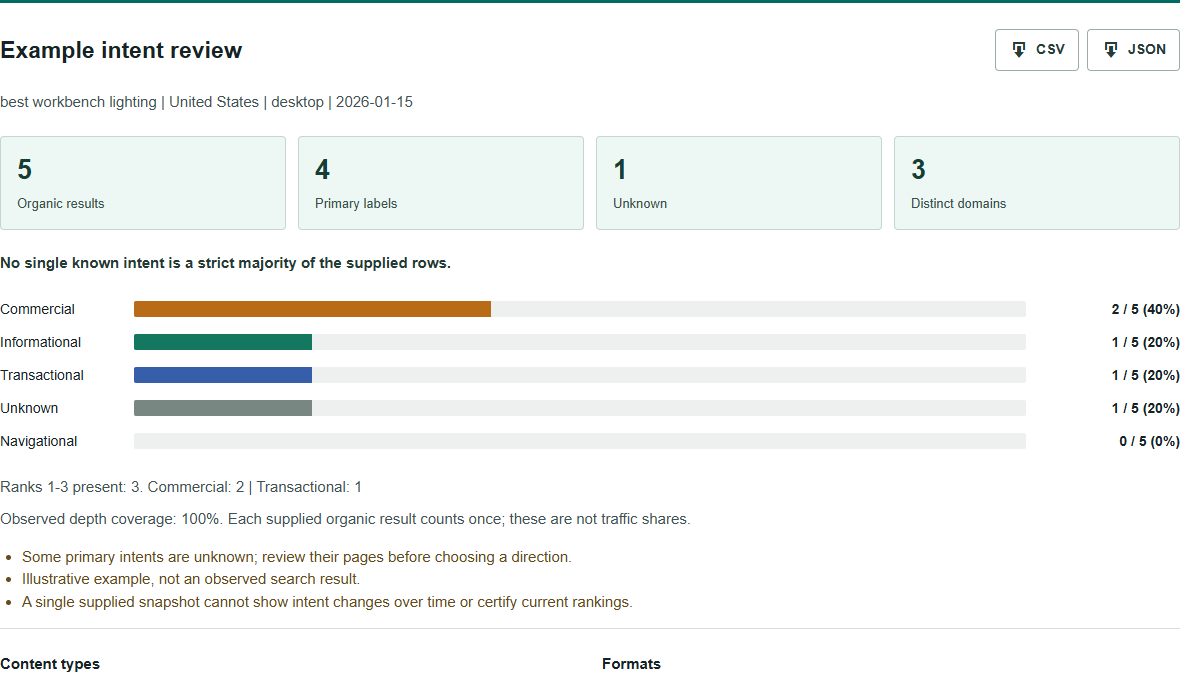
The percentages count supplied organic results, not searches or clicks. If two of five results are commercial, that is 40% of these rows. It is not a 40% probability that a searcher wants a commercial page. Unknown results remain in the denominator, so incomplete review cannot inflate a known category.
The top-three comparison uses observed organic ranks 1, 2 and 3. Missing ranks stay missing; a result at rank 6 is not promoted because your import contains only three rows. Ads and other SERP features are recorded separately and do not count as organic votes. Distinct domains show how much the sample repeats publishers, not how independent or authoritative those publishers are.
A strict majority means more than half of the supplied organic rows share one known primary label. Without that majority, the report leaves the choice open. Even a majority can be misleading when your export leaves out results, the labels are weak, or the query has several audiences.
Make a decision
Write down the need you will serve, the page type, the format and the reason for that choice. Tie the reason to specific results and your own audience. Avoid copying headings just because they recur. Look for missing explanations, useful evidence or a task that your page can complete more clearly.
Mixed results do not necessarily call for a page that tries to do everything. A guide and a product category may deserve separate URLs when their jobs are distinct. Use the Keyword Mapping Tool to record those assignments, then build the editorial handoff in the Content Brief Generator.
Keep the context
CSV and JSON downloads retain the snapshot context, result evidence and your content decision. The tool does not fetch current search results, visit the supplied URLs, measure search volume or predict rankings. Revisit your source when a query is seasonal, ambiguous or changing. One dated review cannot show a trend.
Duplicate organic ranks and normalized duplicate URLs are rejected to prevent accidental double-counting. Imported labels are identified as imported; edits are attributed to the reviewer. No submitted search evidence or report is saved in WordPress. Shared abuse protection uses a salted IP hash, tool identifier and usage date; hosting and verification-provider policies apply separately.
Questions
Does this fetch current Google results?
No. It reviews the search results you enter or import, with their observation date, market and device. It does not connect to Google or check current rankings.
Are the intent labels automatic?
No. You review or import the primary and optional secondary label for each result. English wording clues are shown separately as hints, not accepted classifications. Unknown rows stay in the totals.
What does a mixed result mean?
The supplied results may serve several needs. Inspect the leading pages and their audiences before choosing your page type. Mixed evidence is not an instruction to combine every format into one page.
Plan relevant outreach
Share the page and audience your campaign needs to support.