

Key takeaways
- A backlink is a link from another website to one of your pages; its value depends on the source, context, destination, and audience.
- Count referring domains as well as individual backlinks, because many links can come from the same website.
- Relevance, editorial quality, page access, natural anchor wording, and a clean link environment matter more than one authority score.
- Record every intentional placement so you can check status, referral activity, and campaign results over time.
A backlink is a hyperlink from another website to one of your pages. The useful question is not simply how many links you have, but who linked, from which page, in what context, and whether the destination genuinely helps that publication’s reader.
What Is a Backlink?
A backlink is created when a page on one website links to a page on another. If an industry publication cites your research, a university resource page lists your tool, or a partner article points readers to your guide, your page has received a backlink.
Ahrefs uses the same practical definition in its backlink guide: one site has created a route to another. That route can help a crawler discover the page, help a reader continue the topic, and provide context about how the two pages relate.
The strongest links feel like part of the author’s explanation. A respected domain does not rescue an irrelevant article, and a natural anchor does not rescue a weak publication. Review the source, destination, and sentence together.
Why Are Backlinks Important for SEO?
Backlinks are one part of search visibility, not a substitute for a useful page. Content quality, search intent, technical access, internal links, and the site’s broader subject coverage still matter. Links contribute by creating discoverable connections between pages and publications.
| Contribution | What to examine | Why it matters |
|---|---|---|
| Discovery | Whether the source page is crawlable and linked within its own site | The link gives crawlers another route to the target page. |
| Context | The topic, paragraph, anchor, and destination | A reader should understand why the referenced page belongs there. |
| Authority support | The publication, exact source page, and its link environment | A credible citation carries more weight than a placement on a weak or unrelated page. |
| Referral discovery | Audience overlap, page visibility, placement, and call to action | People can visit the target directly, even when rankings are not the immediate goal. |
| Brand proof | Publication identity, author, editorial presentation, and mention quality | A useful third-party reference can make an unfamiliar brand easier to trust. |
Referral value deserves its own line in the campaign report. A well-placed citation can produce newsletter signups, demos, enquiries, downloads, product visits, and branded searches even when a ranking change cannot be attributed to that single link.
Do Backlinks Still Matter in 2026?
Yes, useful backlinks still matter. What has aged badly is the idea that every link carries equal value or that a large count can compensate for weak content. Current backlink analysis is more concerned with unique referring domains, topical fit, source-page quality, anchor context, and the pattern created across the profile.
| Decision | Volume-first approach | Evidence-led approach |
|---|---|---|
| Publisher choice | Any available domain with an attractive metric | A publication with the right topic, readers, market, content, and link environment |
| Target page | Mostly homepages and commercial pages | The page that best extends the article, including guides, tools, research, and services |
| Anchor wording | The same exact keyword repeated across placements | Language that describes the destination naturally inside each sentence |
| Review method | Count links and record the domain metric | Record source page, target, context, status, market, traffic evidence, and result |
| Campaign mix | One tactic used at scale | Guest articles, useful resources, PR, partnerships, citations, and selective insertions |
A durable campaign therefore starts with a page worth citing. It then finds publications whose readers already care about the subject and gives the author a legitimate reason to reference that page.
How a Backlink Works
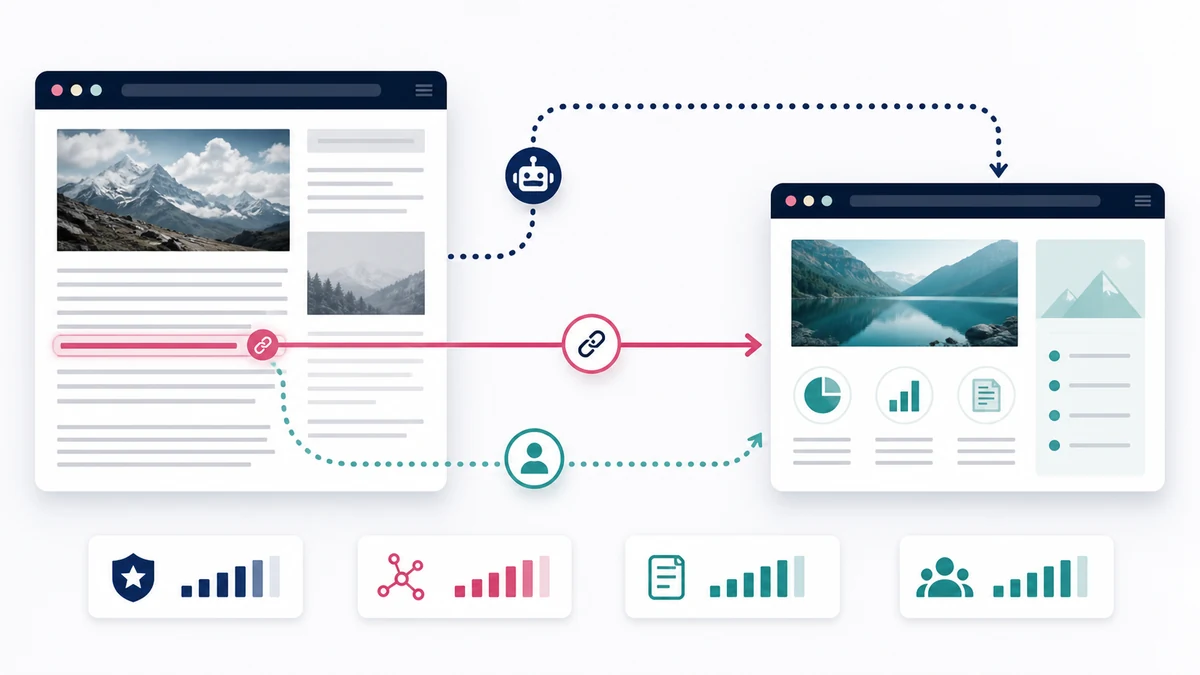
Every backlink has a source, a destination, clickable wording, surrounding context, and an HTML treatment. Looking at only the domain-level metric hides most of the decision.
| Part | Review question | Example |
|---|---|---|
| Source page | Is the linking article useful, relevant, accessible, and supported by its own site? | An active marketing publication’s guide to outreach |
| Target page | Does the destination genuinely help someone reading the source article? | A detailed guide, original study, tool, comparison, or appropriate service |
| Anchor and context | Do the clickable words and surrounding sentence explain the destination? | A descriptive phrase that fits the author’s point |
| Link attribute | How is the link marked in the page’s HTML? | A regular link or one carrying a nofollow, sponsored, or UGC attribute |
Anchor text should explain the destination in the author’s natural voice. The anchor text optimization guide covers branded, URL, topical, partial-match, and exact-match wording in more detail, while dofollow and nofollow links explains how link attributes differ.
Common Types of Backlinks
Backlinks are usually described by how the reference was earned or placed. The label is less important than whether the source page, audience, and destination fit.
| Backlink type | How it appears | Best use |
|---|---|---|
| Editorial citation | An author references a useful page while making a point. | Original research, tools, statistics, and definitive resources |
| Guest article | A contributor publishes a useful article for another publication. | Reaching a relevant audience with a new, well-supported topic |
| Link insertion | An existing article adds a resource that improves its current explanation. | Pages that already answer part of the reader’s question |
| Digital PR mention | A journalist or industry writer cites a story, expert, or dataset. | Newsworthy evidence, commentary, and original findings |
| Resource page | A curated list includes a useful guide, template, or tool. | Evergreen assets with a clear practical purpose |
| Directory or citation | A relevant business or industry listing references the organization. | Local discovery and legitimate niche associations |
| Broken-link replacement | A dead reference is replaced with an accurate live resource. | Content that closely matches the missing source |
| Unlinked mention recovery | An existing brand mention gains a helpful destination link. | Brands already discussed by the publication |
A guest article creates a new page, while a link insertion adds a resource to an existing one. Both can be useful when the editorial reason is clear; neither is automatically high quality.
What Makes a Backlink High-Quality?
A high-quality backlink brings several signals into agreement. The publication covers the subject, the exact article is useful, the destination continues the discussion, and the anchor fits the sentence. Traffic and authority metrics can support that review, but they cannot make the decision alone.
| Signal | Stronger evidence | Reason to pause |
|---|---|---|
| Topical relevance | The publication and source article serve readers who could use the target. | The article needs a forced transition to mention the destination. |
| Organic visibility | Relevant pages show a stable, believable pattern of discovery in the intended market. | Traffic comes mainly from unrelated topics or one temporary spike. |
| Editorial quality | The article is edited, useful, current, attributable, and internally connected. | Pages are thin, copied, templated, or published without accountable authorship. |
| Placement context | The link sits inside a paragraph where it helps the reader continue. | The anchor is added to an unrelated sentence or isolated list. |
| Outbound links | References are selective and connected to the publication’s subject. | Recent articles repeatedly link to unrelated commercial offers. |
| Anchor wording | The words accurately describe the target and fit the author’s voice. | The same promotional keyword appears unnaturally across placements. |
| Page access | The source page is publicly accessible and intended for search discovery. | The page is orphaned, blocked, broken, or unavailable after publication. |
| Publication trust | Ownership, authors, contact details, subject focus, and publishing history are identifiable. | The site exists mainly to sell disconnected placements. |
The DA versus organic traffic guide shows why an authority score and a traffic estimate answer different questions. For an intentional placement, keep written evidence for both instead of treating either metric as approval.
What Makes a Backlink Low-Quality?
A weak link usually fails on relevance, editorial responsibility, or page quality before it fails on a metric. Common warning signs include:
- No clear subject or audience
- Thin, copied, or mass-produced articles
- Traffic that comes from unrelated topics or unstable spikes
- Repeated exact-match commercial anchors
- Large numbers of unrelated outbound links
- Hidden, broken, orphaned, or inaccessible source pages
- No identifiable authors, ownership, contact route, or editorial standard
- A publication built mainly to host disconnected paid articles
One unfamiliar link is not enough to diagnose a problem. Look for repeated patterns across referring domains, anchors, targets, and source pages. The toxic backlinks guide separates weak placements from patterns that deserve a closer audit.
How Many Backlinks Do You Need?
There is no universal number. A page competing for a narrow local query and a new finance guide competing nationally do not face the same link landscape.
Estimate the work from the exact search result and target page. Review:
- How many unique referring domains link to the pages already ranking
- Whether those links come from relevant, credible sources
- How strong and complete the competing pages are
- Your site’s existing topical coverage and internal links
- The target page’s current impressions, rankings, and link history
- Whether the search intent favors the kind of page you plan to promote
Use the backlink gap analysis for the full calculation workflow. It keeps this article focused on what backlinks are while giving the number question the detail it deserves.
Practical Ways to Build Backlinks
Start with a destination worth recommending, then choose the outreach method that matches it. The safe link-building strategy turns these methods into a complete plan.
1. Publish Linkable Assets
People are more likely to link to useful resources.
Useful linkable assets include:
- Original research and industry statistics
- Free tools, templates, checklists, and calculators
- Practical guides and comparison studies
- Expert roundups and documented case studies
If your site only has sales pages, link building becomes harder. Create resources people actually want to reference.
2. Use Guest Posting Strategically
Guest posting works when you publish useful content on relevant websites. Do not write generic articles just to place links. Choose topics that help the publisher’s audience and naturally support your target page.
3. Try Link Insertions Carefully
Link insertions can work when your content improves an existing article. Avoid forced insertions and unrelated pages. A good link insertion should feel editorial.
4. Reclaim Unlinked Brand Mentions
Search for websites that mention your brand without linking. Then reach out politely and ask if they can add a link. This is usually easier than cold outreach because the website already knows you.
5. Build Resource Page Links
Find resource pages in your niche and suggest your useful content. This works best if your content is genuinely helpful and not overly promotional.
6. Use Digital PR
Create stories, data, or expert insights that journalists and bloggers may want to reference. Digital PR can earn high-authority links, but it usually requires a strong angle.
7. Fix Broken Backlinks
If your site has broken pages with backlinks, redirect them to relevant live pages. This helps recover lost link equity. You can also use broken link building to suggest your content as a replacement for broken external links on other websites.
8. Build Relationships
Long-term relationships with publishers, bloggers, journalists, and industry partners can lead to natural mentions and links. Good link building is often relationship building.
How to Check and Monitor Your Backlinks

Backlink software can show the profile from several angles. Ahrefs distinguishes backlinks from referring domains, while Semrush shows how to review source pages, targets, anchors, and link attributes. Use the reports as evidence, then open important source pages yourself.
| Metric | What it answers | What it cannot prove |
|---|---|---|
| Backlinks | How many individual links point to the site or page? | How many separate websites are represented |
| Referring domains | How many unique websites link at least once? | Whether each source is relevant or useful |
| New and lost links | How is the profile changing over time? | Why a link appeared or disappeared |
| Anchor distribution | What clickable wording links use most often? | Whether the surrounding paragraph reads naturally |
| Authority metric | How does a third-party tool estimate domain or page strength? | Editorial quality, audience fit, or guaranteed performance |
| Source-page traffic | Does the exact page show signs of organic discovery? | Whether readers will click your particular link |
Keep a placement record you can audit
The table below is the record EduGuestPost uses as a practical review structure. It does not invent a score or promise an outcome; it preserves the evidence needed to explain why a placement was selected and what happened afterward.
| Field | What to record | Review use |
|---|---|---|
| Source | Publisher, live URL, article title, author, and publication date | Confirms where the placement exists and who owns the page |
| Destination | Target URL, page purpose, and campaign goal | Shows whether the link supports the intended page |
| Link context | Anchor, surrounding sentence, location, and link attribute | Makes relevance and natural wording reviewable later |
| Publisher evidence | Niche, market, traffic trend, editorial notes, and outbound-link review | Preserves the reason the publisher was approved |
| Status checks | Live status, accessibility, indexation check, and last review date | Identifies removed, changed, or inaccessible placements |
| Business result | Referral visits, assisted conversions, ranking movement, and notes | Separates campaign activity from outcomes without claiming causation |
Check intentional placements after publication and again on a sensible review cycle. A live URL alone is not enough: confirm that the page remains accessible, the agreed context is intact, and the target still serves the reader.
Common Backlink Mistakes
- Chasing quantity over quality. A large count can hide repeated links from the same weak sources.
- Ignoring relevance. The publication, article, anchor, and target should belong in the same reader journey.
- Repeating exact-match anchors. Wording should fit each sentence rather than reproduce a campaign keyword mechanically.
- Linking only to commercial pages. Guides, tools, research, and comparisons often provide a more natural destination and can support services through internal links.
- Buying cheap links in bulk. Low prices often remove the editorial review needed to protect relevance and page quality.
- Approving a publisher from one metric. Open recent articles, ranking pages, author profiles, and outbound links before deciding.
- Forgetting internal links. A backlink can introduce authority and visitors, but internal links help them reach the next useful page.
- Failing to measure. Without a placement record, referral data, and review dates, activity is easy to confuse with progress.
Before paying for a placement, use the publisher evaluation workflow to inspect the exact site and page environment.
Backlink Quality Checklist
Website checks
- Is the publication relevant to the topic and intended audience?
- Do relevant pages show believable organic visibility?
- Are ownership, authors, contact details, and editorial standards identifiable?
- Does the site publish useful work consistently?
- Are outbound links selective and connected to the site’s subject?
Source-page checks
- Does the exact page answer a real reader question?
- Is it publicly accessible and internally linked?
- Does the article remain accurate, edited, and attributable?
- Does the destination improve the paragraph where it appears?
- Are nearby citations and commercial links credible?
Anchor and destination checks
- Does the anchor describe the target accurately?
- Would the sentence still sound natural if read aloud?
- Does the destination deliver what the anchor promises?
- Does the wider anchor mix avoid mechanical repetition?
- Is the target page useful enough to earn the referral?
Campaign and reporting checks
- Is every intentional placement recorded with its source and target?
- Are link status, context, and attributes checked after publication?
- Are referral visits and conversions reviewed separately from rankings?
- Are lost or materially changed links flagged for follow-up?
- Can the approval reason be explained from saved evidence?
The Practical Takeaway
Backlinks still matter because they connect useful pages, publications, readers, and crawlers. The link count is only the surface. Quality lives in the source page, audience, editorial context, destination, anchor wording, and pattern across the wider profile.
Build the page worth citing first. Then choose the publication and method that make sense for that page. Keep a record of every intentional placement, review the live context, and measure referral and business results alongside search visibility.
For a complete campaign sequence, continue with the safe link-building plan, compare authority metrics with organic traffic, and calculate the opportunity with a backlink gap analysis. When you want a reviewed publisher shortlist, send EduGuestPost your target pages and campaign brief.
Backlink FAQs
What is a backlink in simple terms?
A backlink is a link from another website to your website. If another site links to one of your pages, your page has received a backlink.
Why are backlinks important for SEO?
Backlinks can help search engines discover pages, understand authority, and evaluate relevance. They can also bring referral traffic and brand visibility.
Are backlinks still important in 2026?
Yes, backlinks still matter, but quality is more important than quantity. Relevant, natural backlinks from trustworthy websites are much more useful than low-quality links from spammy sites.
What is a high-quality backlink?
A high-quality backlink usually comes from a relevant, trustworthy website with useful content, real traffic, natural anchor text, and clean outbound links.
What is a bad backlink?
A bad backlink often comes from a spammy, irrelevant, low-quality, or link-farm website. Bad backlinks may use unnatural anchors or appear in thin content created only for SEO.
How many backlinks do I need to rank?
There is no fixed number. It depends on your keyword, competitors, content quality, website authority, and niche. Review top-ranking pages to estimate how many quality referring domains may be needed.
Should I build backlinks to my homepage or blog posts?
Both can make sense. However, useful blog posts, guides, tools, templates, and research pages often attract more natural links. You can then use internal links to support commercial URLs.
Are nofollow backlinks useless?
No. Nofollow links may not pass ranking signals in the same way as normal links, but they can still bring referral traffic, brand visibility, and a natural backlink profile.
Can backlinks hurt my SEO?
Low-quality backlink patterns can create risk, especially if they are manipulative or spammy. Focus on relevance, quality, and natural link placement.
What is the safest way to build backlinks?
The safest approach is to create useful content, publish on relevant websites, use natural anchors, avoid spammy sites, and build links as part of a broader content marketing strategy.
Editorial references
Sources used for this guide
- Ahrefs: What Are Backlinks in SEO? covers backlink definitions, discovery, and the attributes used to assess a link.
- Ahrefs: Backlinks vs. Referring Domains distinguishes individual links from the unique websites that provide them.
- Semrush: How to Find Backlinks explains practical reports for reviewing sources, targets, anchors, and link attributes.
- Semrush: How to Do a Backlink Audit provides a workflow for reviewing backlink patterns and source quality.
Need this turned into a real placement plan?
Send the URL you want to promote, the market you care about, and the type of publishers you prefer. EduGuestPost will review fit, availability, anchor options, and reporting before quoting.