

Backlink gap analysis in brief
- Compare search competitors, page competitors, and business competitors separately.
- Inspect the exact referring page and reason for each link instead of exporting a domain shopping list.
- Match every qualified opportunity to an asset, target page, and credible outreach angle.
- Record rejected prospects and repeated patterns so the research becomes a reusable strategy.
A backlink gap is the set of useful websites or pages that reference competitors but do not reference you. Finding that gap is easy with modern SEO tools. Turning it into good decisions takes more work: the competitors must be relevant, the source pages must be reviewed, and your site must have a genuine reason to earn a similar citation.
What a Backlink Gap Analysis Actually Finds
At domain level, a gap report shows websites that link to one or more competitors but not to your domain. At page level, it shows exact articles, directories, studies, roundups, or resource pages that cite a competing page but not yours. Both views are useful, but neither is a finished outreach list.
Ahrefs defines the job as finding quality competitor links you do not have, then evaluating whether similar links could help your site. Semrush follows the same basic pattern: compare several competitors, reveal the missing referring domains, and inspect the source pages and target URLs. The value comes after the export, when you remove irrelevant history and identify repeatable reasons for the links.
A competitor may have links from an acquisition, old brand name, scholarship, affiliate relationship, news event, customer, integration, or discontinued campaign. Copying the domain without understanding that reason produces weak outreach. A good analysis turns raw links into a map of audiences, assets, relationships, and editorial openings.
Choose Competitors That Can Teach You Something
Do not begin with the five companies named most often in sales meetings. Choose competitors for the question being studied. A small site can rank beside a marketplace, publisher, university, directory, or news site for one query without sharing the same business model.
| Competitor type | How to identify it | What it can reveal | Main caution |
|---|---|---|---|
| Search competitor | Ranks for the same topic or keyword set. | Links associated with current search visibility. | The site may serve a different audience or intent. |
| Page competitor | Has a page solving the same specific problem. | Exact source pages, assets, and citation angles. | One strong page does not make the whole domain comparable. |
| Business competitor | Sells a similar service or product to the same market. | Partnerships, reviews, directories, and commercial coverage. | It may not compete for the target search results. |
| Audience peer | Reaches the same buyers with a different offer. | Associations, podcasts, newsletters, communities, and publishers. | Its linkable assets may require expertise you do not share. |
| Aspirational peer | Has a mature content or PR system worth studying. | Patterns to build toward over time. | Budget, brand demand, and team capacity may be very different. |
Use three to five comparable competitors for the first pass. Add a page-level set for the priority topic. If one giant brand dominates the export, keep it as a pattern source but do not let it distort every priority.
Separate Referring Domains From Referring Pages
| View | Best for | Question to ask | Output |
|---|---|---|---|
| Referring domains | Seeing which sites cite several competitors. | Does this publication regularly cover the market? | Publisher and audience patterns. |
| Referring pages | Finding the exact article or resource. | Why did this page include the competitor? | Concrete context and contact angle. |
| Competitor target pages | Understanding what earns links. | Is the destination a tool, study, guide, product, profile, or event? | Asset and content ideas. |
| Best-by-links pages | Finding assets that attract unusual volumes or quality. | What is genuinely useful or newsworthy here? | Investment themes, not copies. |
Start broad with domains, then switch to exact pages before approval. A high-authority publication can contain excellent reporting, old user-generated pages, thin sponsored archives, and irrelevant categories. The domain name alone cannot tell you which one you found.
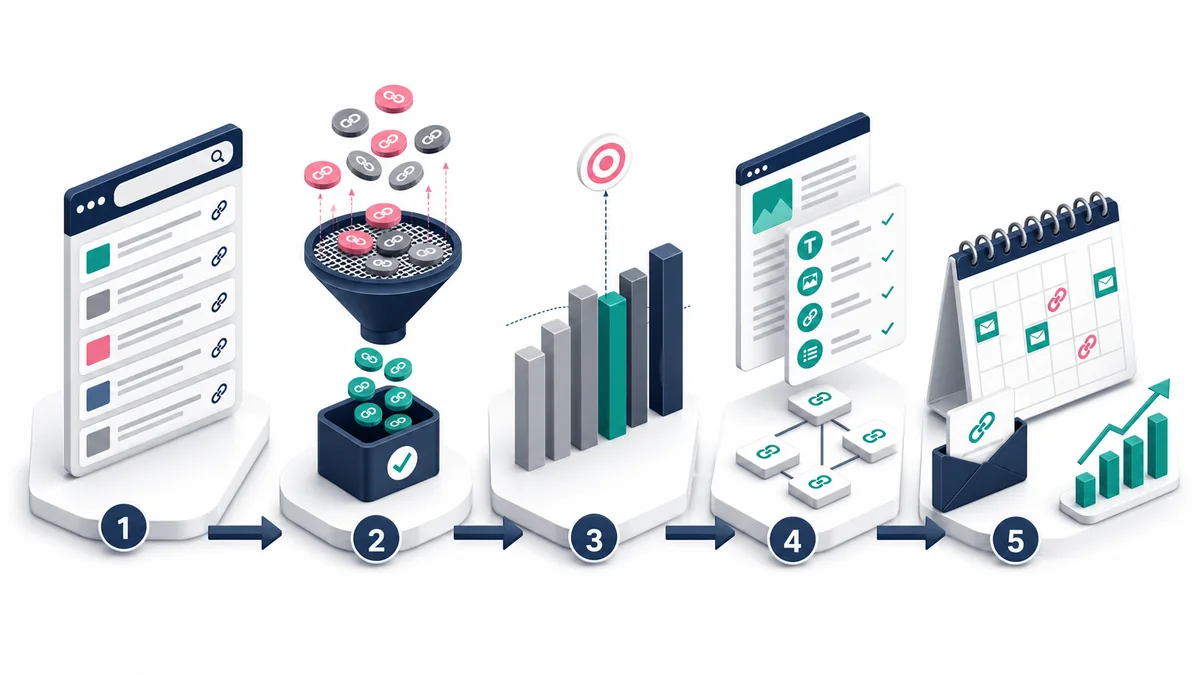
Collect the Data Without Treating It as Truth
Ahrefs Link Intersect, Semrush Backlink Gap, and Ubersuggest Backlink Opportunity can all compare your domain with competitors. Their indexes, freshness, deduplication, and classifications differ, so the totals will not match exactly. Use one tool consistently for the main workflow and a second source when an important prospect needs confirmation.
Export the linking domain, exact source URL, source title, competitor target URL, anchor text, link attributes, first-seen or last-seen date when available, estimated traffic, and authority metrics. Keep the raw export unchanged in one tab. Put reviewed prospects in another. This preserves the evidence when filters and decisions change.
Metrics help sort a large set, but do not let an aggressive DR, traffic, or dofollow filter erase relevant niche sources. A specialist association or local publication may have modest numbers and an excellent audience. The authority and traffic guide explains how to use these signals without confusing them with quality.
Classify Why Each Competitor Link Exists
The reason for the link determines whether you can earn something similar. Label the opportunity before writing a pitch.
| Link reason | Evidence on the source page | Possible response | Do not assume |
|---|---|---|---|
| Editorial citation | The competitor supplies a useful fact, explanation, or example. | Create a clearer, fresher, or more complete source. | That the editor will add a second identical citation. |
| Tool or template | The page helps readers complete a task. | Build a distinct utility for your audience. | That a visual redesign makes a copied tool better. |
| Original research | The competitor owns data, a survey, or methodology. | Answer a different question with transparent evidence. | That summarizing their data makes it yours. |
| Roundup or review | The competitor meets stated selection criteria. | Provide verifiable fit, specifications, and access. | That every list is open to additions. |
| Relationship | Customer, partner, integration, supplier, member, or sponsor context. | Activate a genuine relationship of your own. | That a cold email can reproduce private history. |
| Guest contribution | An author teaches the publication’s audience. | Pitch an original angle grounded in experience. | That the publication still accepts contributions. |
| Directory or resource | The site curates providers, locations, tools, or education. | Check eligibility and submit accurate information. | That inclusion is useful merely because it is easy. |
| Broken or outdated reference | The source points to a dead or stale resource. | Offer a genuinely suitable replacement. | That every broken link should point to your homepage. |
Review the Exact Source Before Approving a Prospect
Open the page. Read enough to understand the audience, section, competing citation, and editorial standard. Check whether the page is indexed, internally reachable, maintained, and relevant today. Inspect the site’s recent publishing pattern and obvious outbound-link behavior. Then use the publisher due-diligence checklist for the final decision.
| Check | Clear | Review | Reject |
|---|---|---|---|
| Topic and audience | Directly serves the people the target asset helps. | Broad site with one relevant section. | No credible audience connection. |
| Page quality | Original, useful, readable, and maintained. | Useful but dated or uneven. | Thin, copied, incoherent, or automatically assembled. |
| Link context | The competitor citation solves a clear reader need. | Context exists but is weak or crowded. | The link is unrelated or hidden. |
| Site behavior | Consistent topics and defensible editorial standards. | Mixed history requiring closer review. | Accepts unrelated content at obvious scale. |
| Opportunity fit | Your asset can add distinct value. | Requires a substantial asset improvement first. | No honest reason for inclusion. |
Map the Opportunity to an Asset and Target Page
Do not put “homepage” in the target column merely because the right page is not obvious. Decide what the source reader needs next. If your current page does not satisfy that need, improve it or create the missing asset before outreach.
| Observed pattern | Asset you may need | Best target route | Outreach premise |
|---|---|---|---|
| Several competitors cited in a comparison | Current facts, transparent criteria, and proof of fit. | Qualified service, product, or comparison page. | Correct or expand the reader’s options. |
| Competitor study cited by journalists | Original dataset addressing a fresh question. | Stable research page with method. | Supply evidence for future coverage. |
| Tool cited across tutorials | Reliable calculator, checker, template, or workflow. | Utility plus a relevant learning cluster. | Help the article’s reader complete the task. |
| Experts quoted in niche media | Named specialist, experience, examples, and concise commentary. | Author profile, case evidence, and relevant service context. | Offer useful expertise, not a backlink request. |
| Competitor guest posts | Original angle built from first-hand work. | Supporting guide with natural commercial path. | Teach something the publication has not covered well. |
| Links from existing guides | A missing definition, example, tool, or updated source. | Exact page that fills the gap. | Improve an existing article for its readers. |
Use guest-post outreach when a new contribution is the best route and link insertions only when an existing page has a genuine missing resource. The source-page need should determine the route.
Prioritize by Fit, Feasibility, and Value
A site linking to all competitors is interesting, not automatically important. Give priority to opportunities where the audience fits, the page is credible, your asset can improve the reader’s experience, and the destination supports a current business or content goal.
| Priority factor | Question | Evidence to record |
|---|---|---|
| Audience fit | Would these readers benefit from our source? | Relevant section, examples, search topics, country, and language. |
| Editorial fit | Can the mention appear naturally in this exact page or publication? | Existing citations, article gap, author, and contribution policy. |
| Asset readiness | Do we already have something worth citing? | URL, owner, proof, freshness, and required improvements. |
| Acquisition feasibility | Is there a legitimate contact and a plausible route? | Relationship, editorial contact, submission path, or update opportunity. |
| Business value | Does the target support a current priority? | Topic, funnel stage, market, conversion role, and internal path. |
| Maintenance risk | Can we keep the asset and destination useful? | Update owner, replacement rule, and review date. |
Run the Analysis Without an Expensive Tool
A specialist platform makes large comparisons faster, but the thinking can begin manually. Search the target query, identify comparable pages, inspect who cites them through available backlink checkers, and note recurring publication types. Search competitors’ brands with terms such as research, review, interview, podcast, resources, partners, or “best.” Review the competitor’s most-linked content where a free report exposes it.
The result will be smaller and less complete, but a carefully reviewed list of 20 opportunities is more useful than an untouched export of 20,000 domains. Store the source URL, competitor target, reason for the link, your proposed value, and decision. The site’s publisher marketplace can then be used for commercial inventory research where that route fits.
Video reference
See Competitor Link Research in Practice
This Ahrefs walkthrough demonstrates how competitor backlink patterns can surface ideas. The important step is the human review after the report: understand the source page and link reason before deciding what to build or pitch.
A 30-Day Backlink Gap Workflow
| Period | Work | Output |
|---|---|---|
| Days 1–5 | Choose the target topic, page, and three to five comparable competitors. | Written scope and competitor rationale. |
| Days 6–10 | Export referring domains, source pages, anchors, and competitor targets; preserve the raw data. | Unedited evidence set. |
| Days 11–15 | Remove irrelevant history, classify link reasons, and review exact pages. | Clear, review, and reject decisions. |
| Days 16–20 | Group recurring patterns and map each approved opportunity to an asset and target. | Asset gaps and prioritized prospects. |
| Days 21–25 | Improve the source asset, prepare proof, verify contacts, and write page-specific premises. | Outreach-ready evidence. |
| Days 26–30 | Test a small batch, record replies, objections, corrections, and required content work. | Decision on which pattern deserves a wider campaign. |
The EduGuestPost Backlink Gap Opportunity Ledger
This is a research ledger, not a guarantee that a competitor link can be replicated. It keeps the reasoning visible and stops an export from becoming an unreviewed order list.
| Field | Record | Decision it supports |
|---|---|---|
| Research scope | Target page, topic, market, date, tool, and selected competitors. | Can someone reproduce the comparison? |
| Source evidence | Domain, exact page, author, relevant section, traffic context, and status. | Is the opportunity current and credible? |
| Competitor evidence | Target URL, anchor context, link reason, first seen, and observed relationship. | Why does this link exist? |
| Our value | Asset, evidence, expertise, relationship, update, or missing resource. | Do we have an honest reason to contact the source? |
| Target route | Primary URL, internal cluster, natural anchor context, and maintenance owner. | Will the citation lead somewhere useful? |
| Decision | Clear, review, reject, wait, asset needed, or relationship needed, with reason. | What happens next and why? |
| Outcome | Contact date, response, publication, verification, referral evidence, and learning. | Should this pattern be repeated? |
Backlink Gap Mistakes That Waste Time
| Mistake | Why it misleads | Better move |
|---|---|---|
| Using only business competitors | They may not compete for the target search intent. | Add search and page competitors. |
| Copying every competitor link | Many links depend on history, assets, or relationships you do not share. | Classify the reason before approval. |
| Filtering only by authority | Relevant niche and local opportunities disappear. | Use metrics for sorting, then inspect context. |
| Stopping at domain level | The exact page may be irrelevant or low quality. | Review referring pages and competitor targets. |
| Pitching without an asset | The email asks the editor to help you, not the reader. | Create or improve the missing value first. |
| Ignoring rejected prospects | The same bad domains return in future exports. | Keep rejection reasons and review dates. |
| Confusing a gap with a target count | An opportunity list does not predict how many links a page needs. | Use the dedicated backlink-needs analysis separately. |
| No outreach experiment | Research grows while the team learns nothing about feasibility. | Test a small, well-prepared segment. |

Measure the Quality of the Decisions
| Layer | Measure | Question |
|---|---|---|
| Research | Comparable competitors, reviewed pages, classified reasons, and rejection rate. | Did the analysis remove noise? |
| Strategy | Recurring link patterns, asset gaps, relationship gaps, and target clusters. | Did the data reveal what to build or activate? |
| Execution | Qualified prospects, verified contacts, personalized premises, replies, and objections. | Were the opportunities feasible? |
| Delivery | Live relevant pages, accurate context, retained links, and required replacements. | Did approved opportunities become useful references? |
| Business | Qualified referrals, assisted conversions, target-page discovery, relationships, and reusable assets. | Did the pattern create value beyond the report? |
The number of missing domains is not a performance score. A site can have a large gap because competitors are older, broader, or more newsworthy. Use the pricing guide to estimate the work behind approved routes and the safe strategy guide to sequence the campaign.
The Practical Takeaway
A backlink gap analysis is competitor research with an editorial purpose. It shows where similar sites are being cited, what earned those citations, and where your own evidence, tools, expertise, relationships, or content are missing. The best output is not a giant spreadsheet. It is a short, explainable set of opportunities and asset decisions.
Keep the scope narrow, preserve the raw export, inspect exact pages, and write down the link reason. Build value before outreach. When the analysis uncovers commercial publisher routes, compare them through the publisher marketplace; when it uncovers editorial contributions, use the reviewed outreach workflow. Scale only after the first pattern produces useful results.
FAQs About Backlink Gap Analysis
What is a backlink gap analysis?
It compares your link profile with relevant competitors to find websites and exact pages that cite them but not you, then evaluates which opportunities are relevant and realistically attainable.
Is a backlink gap the number of links I need?
No. A gap report finds missing sources and patterns. The number of backlinks a page may need depends on competition, intent, content, internal links, site strength, and link quality.
Which competitors should I compare?
Use search competitors, exact page competitors, business competitors, and audience peers according to the question. Three to five comparable sites are enough for a focused first pass.
Should I copy every backlink a competitor has?
No. Many links come from relationships, events, old campaigns, unique assets, or irrelevant history. Replicate the underlying value pattern only when it fits your audience and capabilities.
What is the difference between referring domains and referring pages?
A referring domain is the website linking to a competitor. A referring page is the exact article or resource containing the link. Domain overlap finds publisher patterns; page review reveals the actionable context.
Which tools can run backlink gap reports?
Ahrefs, Semrush, and Ubersuggest offer competitor backlink comparison features. Their indexes differ, so use one consistently and verify important opportunities at page level.
How do I prioritize backlink gap opportunities?
Prioritize audience and editorial fit, source-page quality, asset readiness, acquisition feasibility, business value, and maintenance capacity. Record the evidence instead of relying on one score.
Can backlink gap analysis find content ideas?
Yes. Competitors’ most-linked pages can reveal demand for tools, studies, guides, comparisons, expert commentary, or resources. Use the pattern to answer a distinct question rather than copying the asset.
How often should I repeat the analysis?
Review priority topics when competitors, results, or campaigns change. A quarterly or campaign-based refresh is often more useful than a constant unreviewed export.
What should the final deliverable contain?
Keep the scope, raw export, reviewed source pages, link reasons, decisions, asset needs, target routes, contacts, outreach status, results, and rejection reasons so the research can be audited and reused.
Research Behind This Backlink Gap Workflow
These current resources informed the competitor selection, link-intersect, source-page review, pattern classification, and opportunity-mapping process.
- Ahrefs: backlink gap analysis and template workflow
- Ahrefs: competitor link analysis and recurring strategy patterns
- Semrush: finding competitor backlinks and missing sources
- Semrush: current SEO competitor analysis and backlink-gap reporting
- Neil Patel: Ubersuggest backlink analysis and opportunity comparison in 2026
Turn a Backlink Gap Into a Reviewed Campaign
Send the target page, topic, market, known competitors, existing assets, and campaign capacity. We will separate useful source patterns from noise and map the approved opportunities to realistic editorial routes.