
Indexation diagnosis / Checkable repairs
Website Indexation Issue Fixing Services
EduGuestPost's website indexation issue fixing services help you investigate why intended public pages are absent from Google's index and identify repairs supported by the evidence. The proposed engagement connects affected URLs to specific findings, implementation tasks and checks your team can use after a release.
Start with the important destination. Keep the evidence beside the finding.
Find the cause behind missing important pages
A newly launched service page, an established category that disappeared or an entire template affected after a redesign can require different work. Start with the destinations your business needs people to find, when the problem appeared and what changed around that time.
Google's technical requirements establish minimum conditions for consideration. Meeting those conditions does not guarantee indexing. The review therefore distinguishes an identifiable technical fault from a case that needs further investigation into discovery, duplication or the content itself.
Your proposed project can include:
- An affected-page inventory with intended behavior and dated observations.
- Findings that separate confirmed faults from unresolved questions.
- A prioritized repair plan with named implementation responsibilities.
- Acceptance checks and a handover showing completed and open work.
Not every URL belongs in the index. Private account pages, removed content and equivalent variants may already have the right treatment. Agree which public destinations matter before changing exclusions or attempting to increase indexed-page totals.
Share your website, several affected URLs, approximate scope and the date you noticed the issue. The quotation confirms the evidence review, deliverables, access requirements and whether you need implementation support or a handoff to your team.
Request an indexation issue fixing quote with that brief to define the work around your website.
Turn the reported state into a useful investigation
The first task is to identify the exact URL and its intended role. Record the property, report date and available crawl information alongside any current response check. Two observations made at different times can describe different page versions without either being wrong.
Swipe or scroll to read all columns. Keyboard: focus the table, then use the arrow keys.
| Reported situation | Question to resolve | Evidence to compare |
|---|---|---|
| Discovered but not indexed | Has Google crawled this URL yet | Recorded state, discovery paths and access evidence |
| Crawled but not indexed | What requires investigation beyond retrieval | Indexed inspection, actual content and relevant duplication |
| Duplicate or alternate | Is the chosen representative appropriate | Intended relationship and Google's recorded canonical |
| Access or directive exclusion | Is this behavior deliberate | Response, applicable rules, page purpose and change history |
The Page indexing report includes expected exclusions as well as problems. Its example lists are bounded, so they are not a complete website inventory. A discovered or crawled label identifies an observed state; it does not independently prove overload, poor content or a need for more crawl budget.
Compare the indexed record with the current page
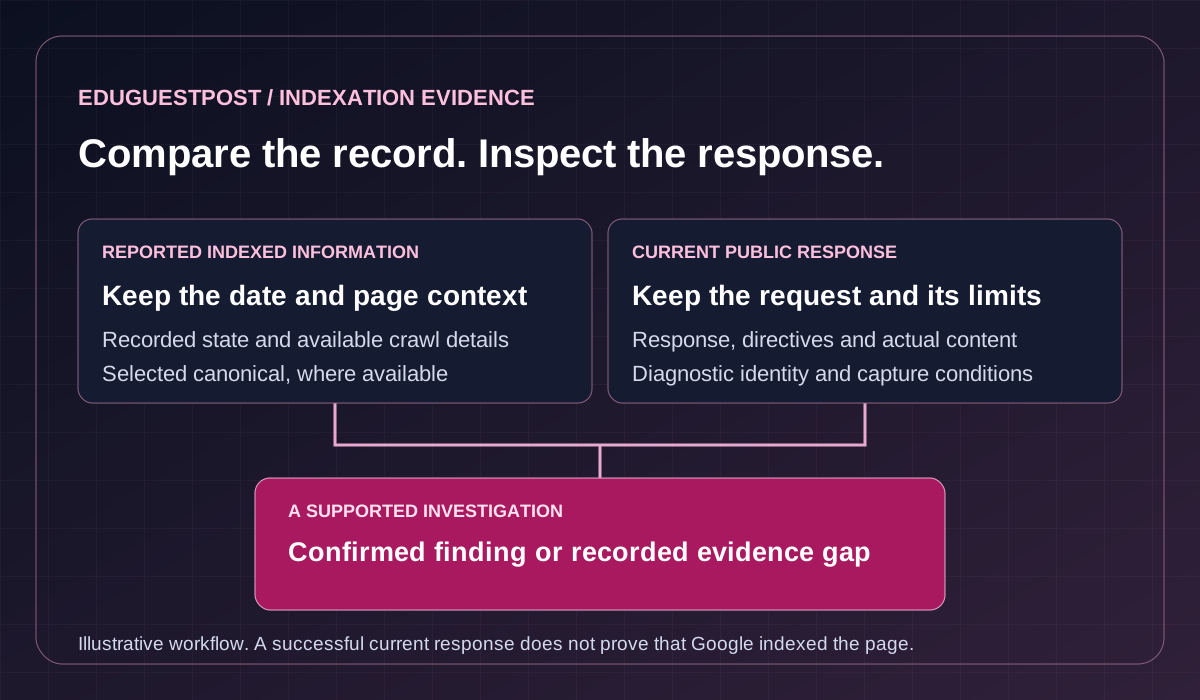
URL Inspection separates Google's indexed information from a live test. Keep the dates and available evidence attached to each finding. A positive live result cannot establish Google's selected canonical or clear every quality, security, manual-action or removal condition.
An absent result in a site query, a smaller report total or missing performance rows can prompt a closer look. None independently proves that a particular page was deindexed. The investigation should end with a supported finding or a clearly stated evidence gap.
Repair verified access and response problems
For an important public page, examine the response, applicable crawler rules and indexing directives together. Establish which CMS setting, template, plugin or delivery layer owns the behavior before proposing a change. An accidental production exclusion and an intentional private-page restriction need different decisions.
The Indexability Checker can inspect bounded public response evidence and supplied rules. Its requests use EduGuestPost's diagnostic identity, while rule matching uses the Googlebot web token. It does not reproduce Google's network identity, history or indexing decisions.
Keep access controls and indexing instructions consistent
Google's noindex guidance explains that the crawler must be able to read the instruction. A robots block can prevent that reading, and a known blocked URL can still appear in Search without fetched content. Noindex also does not protect private information from visitors.
Where an exclusion is accidental, the repair plan names the setting and affected public examples. It also identifies deliberate exclusions and authenticated areas that must remain protected. A site-wide change needs checks beyond the first successful page.
Check what the response actually represents
Google's HTTP response guidance distinguishes successful retrieval from indexing. An error-looking page returned as 200 can be treated as a soft 404. Preserve correct missing-page responses and investigate the application context rather than converting every error into a homepage redirect.
Use the Redirect Checker for bounded current route evidence and the Canonical Tag Checker for declared preferences. Check that destinations represent the intended content. A working route or canonical declaration alone does not prove Google's selection.
Check content delivery and discovery paths
A page that opens successfully can still deliver incomplete content in the state being investigated. Compare the initial response with a relevant browser capture and the available Google-specific evidence. Keep the final URL, capture time, consent choices, login state and product variant consistent.
Investigate the missing content itself
Google's JavaScript guidance separates fetching, rendering and indexing. An initial noindex can prevent rendering, so removing it later with JavaScript is not a dependable repair for an intended public page. Required scripts and data resources also need appropriate access.
The Rendered HTML Checker compares initial HTML with a browser DOM snapshot you supply. The JavaScript SEO Checker supports a repair review with optional imported Lighthouse evidence. Neither executes remote JavaScript or confirms what Google indexed.
Find the actual missing passage, destination link or application state before assigning developer work. Parser text counts do not measure content usefulness or explain an individual indexing decision. Where technical evidence is clean, review whether the page provides a clear, useful destination for its intended audience.
Give important destinations usable paths
Relevant navigation and contextual links can expose pages that are otherwise difficult to discover. Internal linking services can define a wider placement plan where the agreed scope requires one. Preserve access to later collection pages when reviewing filters or load-more interfaces.
Google's sitemap guidance supports accurate significant-change dates rather than artificial freshness. The XML Sitemap Checker checks a bounded document and extracts entries; it does not recursively inspect child sitemaps or test listed pages. Sitemap presence supports discovery, not proof of indexing.
Give the implementing team a checkable repair plan
Each recommended change should identify the affected examples, supporting observation, intended behavior and responsible owner. Group shared template faults where the evidence supports that relationship. Keep an isolated URL issue separate from an assumption that every page on the platform needs the same repair.
Swipe or scroll to read all columns. Keyboard: focus the table, then use the arrow keys.
| Change area | Example acceptance check | Evidence to retain |
|---|---|---|
| Public-page directives | Intended response and rules agree | Dated headers, source and relevant rule scope |
| Routing and page state | The correct destination and content are served | Route evidence and representative page states |
| Content delivery | The identified missing content is available | Comparable response and browser captures |
| Discovery | Agreed pages have usable links and intended sitemap entries | Source paths, inspected files and coverage limits |
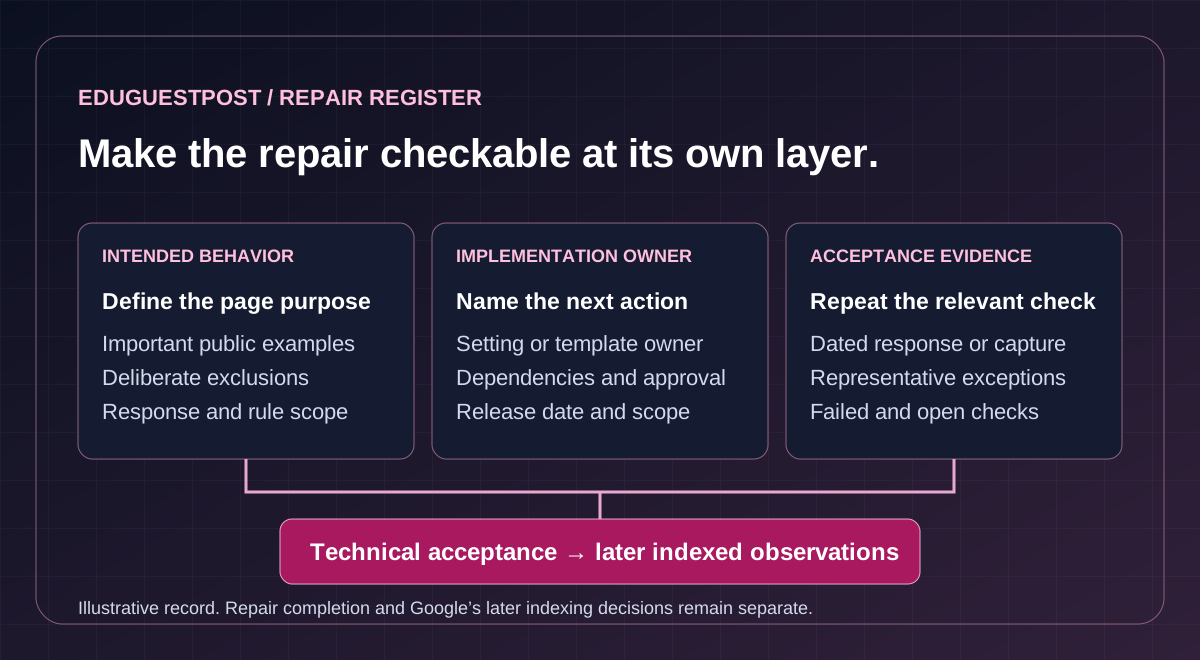
The quotation defines who can implement each change and who accepts it. Your website team may receive the instructions, or separately agreed support may cover specified implementation work. Access, release approval and dependencies need owners before changes are scheduled.
Verify the repair at the relevant layer
After implementation, repeat the checks that exposed the fault. Retain the release date and response context, and account for cached versions where relevant. Include representative exceptions so a repaired service page does not conceal a newly exposed private area or broken error state.
Record technical acceptance separately from Google's later observations. A corrected initial response confirms that change in the tested context. A new indexed inspection can provide subsequent Search evidence when Google has processed the page. Neither record should be used to invent a processing deadline.
The handover identifies completed tasks, failed checks and unresolved questions. It also states which examples were sampled and which sections still need review, so a limited verification is not presented as a site-wide result.
Agree the scope and request your quote
A useful quotation names the affected sections, approximate URL volume, available evidence and questions included. It confirms deliverable formats, implementation responsibilities and follow-up arrangements. Report collection, development work and continuing monitoring need an explicit scope and agreed timing.
Begin with a descriptive brief. Include the website, important affected URLs, when the issue appeared and any relevant migration, release or settings change. State which Search Console evidence is available and who can authorize access. Agree an appropriate exchange method and retention arrangements before sharing private exports or credentials.
Separate repair completion from indexing decisions
Google's recrawl guidance explains the available request methods and their limits. Repeated requests for the same URL do not accelerate processing, and a request does not guarantee inclusion. Any submission should have an authorized owner and a defined purpose after the relevant work is ready.
The engagement should be assessed against the agreed diagnosis, changes and verification evidence. Google determines whether and when to index a page, which canonical to select and how results appear. A service cannot responsibly promise every URL will be indexed or rankings will recover by a fixed date.
Where available account evidence identifies a manual action, security issue or temporary removal, agree the specialist review and responsible owner. A positive live test does not resolve those conditions, and an ordinary exclusion label does not establish that they exist.
For a wider visibility question, SEO audit services can establish priorities. SEO consulting services can support decisions involving several teams. For a focused technical diagnosis, technical SEO audit services can define the investigation.
Questions about indexation issue fixing
Can you guarantee that every URL will be indexed?
No. Google decides whether and when to index a page, which canonical to select and how results appear. The engagement is assessed against the agreed diagnosis, changes and verification evidence. It does not promise indexing or ranking recovery by a fixed date.
Should every excluded URL be changed?
No. Private account pages, removed content and equivalent variants may already have the right treatment. Agree which intended public destinations matter before changing exclusions. Deliberate access controls and authenticated areas must remain protected.
Does a successful live check prove that Google indexed the page?
No. Current public-response evidence and Google’s indexed information describe different observations. Keep their dates, context and coverage with the finding. A positive live result cannot establish Google’s selected canonical or clear every quality, security, manual-action or removal condition.
Does the service include implementing the repairs?
The quotation defines implementation responsibilities and who accepts each change. Your website team may receive the repair instructions, or separately agreed support may cover specified implementation work. Access, release approval and dependencies need named owners.
How will you verify a repair?
Repeat the checks that exposed the fault and retain the release date, response context and coverage. Include representative exceptions and account for cached versions. Record technical acceptance separately from later indexing observations, and keep failed checks and unresolved questions in the handover.
What should I send for an initial quote?
Share the website, important affected URLs, approximate scope, when the issue appeared and relevant migration, release or settings changes. Identify available Search Console evidence and implementation resources. Agree an appropriate exchange method before supplying private reports or credentials.
Request your indexation issue fixing quote
Request your website indexation issue fixing quote with the affected-page brief. The scope can then reflect the evidence and implementation resources available.
- Which important public URLs are affected?
- When did the issue appear, and what changed?
- What evidence and implementation support are available?
Use public page links in your first enquiry. Keep passwords, verification codes and private customer records out of the initial brief. Agree authorized access and private report exchange separately.
Request an indexation issue fixing quote
We use your brief to define evidence, affected sections, deliverables and implementation responsibilities.