

What you will leave with
- A repeatable way to discover publishers your audience may actually read.
- A qualification process that checks the publication, not just a marketplace label.
- A prospect record your team can use to explain why a site was approved or rejected.
- A focused pitch that starts with the publisher’s readers rather than your backlink.
A useful guest-post prospect is not simply a website that accepts outside articles. It is a publication where your topic, audience, target page, and contribution can sit together without explanation or strain. This guide shows how to find those publications and turn a broad list into a shortlist worth contacting.
Why Niche Relevance Matters in Guest Posting
Relevance is the reason a placement belongs in the campaign. If an article about student recruitment appears on a higher-education publication, readers understand why it is there. If the same article appears on an unrelated recipe site, the connection has to be manufactured. Authority scores cannot repair that mismatch.
Start with the target page and work outward. Who needs that page? What question does it answer? Which industries, job roles, countries, or use cases naturally surround it? Those answers create a relevance map before you open a prospecting tool.
| Target page | Direct publication fit | Useful adjacent fit | Angle that connects them |
|---|---|---|---|
| University admissions service | Higher education and student recruitment | Career, relocation, or international student media | Helping students compare programs or move between markets |
| SaaS SEO platform | SEO and content marketing | B2B software, startup, or product-led growth | How software teams build discoverability around a product category |
| Ecommerce analytics tool | Ecommerce and retail technology | Finance, operations, or conversion optimization | Using customer and margin data to improve store decisions |
A good bridge is specific enough that the article still helps if the backlink is removed. That is a useful test because it forces the contribution to earn its place on the publisher’s site.
What Is a Niche-Relevant Guest Posting Site?
A niche-relevant guest posting site covers the same subject as your business or reaches people who face the same problem. Exact category matches are useful, but they are not the only valid option. An adjacent publication can be a stronger choice when its readers, geography, or use case overlaps with the page you want to support.
Ask one plain question: would a real member of our intended audience choose to read this publication? Then look for evidence in recent articles, author backgrounds, category depth, comments, newsletters, and the topics that attract organic search traffic. A category tag alone is weak evidence.
- Topic fit: the site repeatedly covers the subject, not just one isolated post.
- Audience fit: readers plausibly include customers, peers, decision makers, or influencers in the campaign.
- Market fit: country and language align with the target audience where geography matters.
- Problem fit: the article can solve a problem the publisher already discusses.
- Editorial fit: the idea matches the depth, tone, and format of recent content.
The strongest prospects usually satisfy several kinds of fit at once. That is more defensible than calling every general business site relevant to every B2B company.
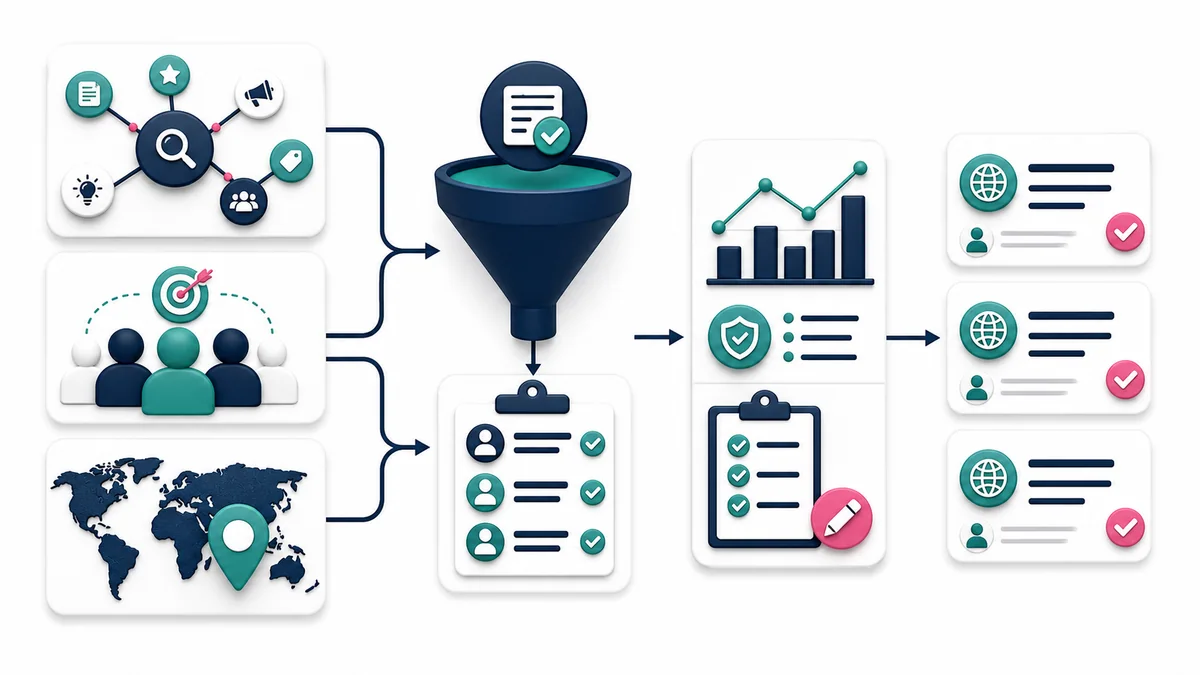
Eight Practical Ways to Find Relevant Guest Post Sites
No discovery method produces an approval list by itself. Use several routes to find candidates, record where each prospect came from, and qualify the same website only once. This prevents a large team from contacting the same editor through three different lists.
Video reference
Watch a prospect list become a focused outreach shortlist
This official Ahrefs tutorial demonstrates guest-post prospecting at scale. Pay attention to the narrowing process: broad discovery is useful, but every publication still needs a human review before outreach.
Treat every result as a lead to inspect, not a site to approve automatically.
1. Use Search Operators as a Starting Point
Search operators reveal contributor pages, author archives, and publications already discussing your subject. Begin with a small set of audience words rather than one broad industry label. A student recruitment campaign, for example, might search for international admissions, study abroad, college careers, and education technology separately.
"student recruitment" "contributor guidelines"intitle:"write for us" "higher education"site:example.com "guest author""your topic" "contributed by"
Open recent articles, not just the submission page. A site may accept contributors while having stopped publishing in your category. Another may have no public application page but regularly feature outside experts. Search is discovery; the publication itself is the evidence.
2. Look Beyond Public “Write for Us” Pages
Public contributor pages attract the same pitches from many marketers. Search for outside bylines, expert interviews, partner research, data contributions, podcasts, and recurring columnists. These formats reveal publications that collaborate without advertising an open inbox.
When a site does not invite guest posts publicly, the pitch needs a credible reason to exist. Reference a genuine gap between two recent articles, offer original data or experience, and explain why you are qualified to write it. A generic request for “a dofollow guest post” tells the editor nothing about the reader.
3. Reverse-Engineer Relevant Competitor Links
Use backlink gap analysis to find publications that already cite or feature organizations serving a similar audience. Review direct competitors, search competitors, industry associations, and respected tools. The objective is not to copy their links. It is to identify editorial neighborhoods where your subject is already welcome.
For each candidate, open the linking page. Check whether it is a contributed article, an editorial mention, a resource list, a partner page, or a press story. These formats require different outreach. Also check whether the publisher still covers the topic and whether the article receives internal links. Old competitor placements are clues, not standing invitations.
4. Follow Authors, Not Just Domains
Writers leave an editorial trail. Search a respected contributor’s name with phrases such as “guest author,” “contributed by,” and a distinctive sentence from the biography. You may uncover a group of publications that accept informed outside voices in the same subject area.
Do not assume every site in an author’s portfolio has equal value. Some writers contribute to both rigorous trade publications and open submission networks. Read the surrounding content and note whether the author has genuine subject expertise. This method works best when you follow people whose audience resembles yours.
5. Watch Editors and Communities
Editors often announce contributor calls on LinkedIn, newsletters, professional groups, Slack communities, and niche forums before a formal page appears. Follow content leads and publication founders, then watch what they ask for. An editor requesting data, examples, or expert commentary is offering a clearer opening than a cold “write for us” page.
Participate before pitching. A thoughtful response to an editor’s question or a useful comment on a recent article creates context for the later email. Avoid public messages offering placements or asking for links. They signal that the publication is interchangeable.
6. Read Industry Blogs and Newsletters
Build a reading list of publications your customers already trust. Review who writes for them, which formats recur, and where external expertise appears. A newsletter may not accept a full guest article, but it might cite original research, feature a founder interview, or invite a practical case example.
This route often produces stronger brand opportunities because it starts with audience behavior rather than a contributor keyword. Record the publication even when the immediate opportunity is a quote or data contribution. Relationships can lead to deeper editorial work later.
7. Use a Marketplace to Filter, Then Review
A publisher marketplace can reduce research time by filtering niche, country, language, traffic, authority, timing, and editorial terms. It is useful when you need to compare many available options quickly. It should not replace the review.
Open the publication, read current articles, inspect the relevant category, and check the editorial conditions. Compare authority with organic visibility using our DA versus traffic guide. The manual outreach versus marketplace comparison explains where each acquisition route fits.
8. Mine Roundups, Resource Pages, and Events
Lists of industry blogs, conference speakers, association members, podcast guests, award finalists, and resource libraries can reveal publications that ordinary guest-post searches miss. Search for collections maintained by organizations with a reason to know the field, then visit each site directly.
Roundups age quickly, so confirm that the publication is active and still covers the relevant subject. Also separate a good publication from a good placement opportunity. A respected journal may be valuable to follow even when it does not accept contributed content.
How to Qualify Guest Posting Sites
Finding a domain is the easy part. Qualification protects the brand, the target page, and the outreach budget. Review the site in a browser and compare current evidence across the same dimensions for every prospect.
| Signal | Evidence to review | Reason to pause |
|---|---|---|
| Niche and audience | Recent topics, authors, categories, and readers overlap with the target page. | The article needs a strained angle to justify the link. |
| Organic visibility | Relevant pages and keywords show stable discovery in the intended country. | Traffic is concentrated in unrelated topics or has fallen sharply. |
| Editorial quality | Useful articles, visible authors, consistent editing, and original examples. | Thin posts, duplicated layouts, vague authorship, or contradictory topics. |
| Outbound links | Sources and commercial references appear where they help the reader. Sample pages with the outbound link counter. | Unrelated commercial links dominate recent articles or anchors look forced. |
| Indexability and discovery | Recent articles are crawlable, indexed, and connected from categories or related content. | New posts disappear from the site architecture or cannot be found in search. |
| Commercial and editorial fit | Current availability, timing, corrections, authorship, and content rules are clear. | Terms change during approval or the publisher cannot confirm the final format. |
Read at least five recent articles in the relevant section. One strong article does not prove a healthy publication, and one weak article may not represent the whole site. Compare patterns. If the evidence conflicts, mark the prospect for review instead of forcing a yes or no.
For a deeper site-level review, use the guest posting site selection framework and the publisher website evaluation guide.

The EduGuestPost Prospect Evidence Record
A prospect list becomes useful when another person can understand it without asking the researcher to explain every row. We use a compact evidence record to keep discovery, qualification, and outreach separate. It is an operating record, not a ranking formula.
| Field | What to record | Why it matters |
|---|---|---|
| Discovery route | Search operator, competitor, author, community, marketplace, event, or referral. | Shows which prospecting sources produce worthwhile sites. |
| Audience bridge | One sentence connecting the publisher’s readers to the target page. | Exposes weak relevance before time is spent on outreach. |
| Proof URLs | Three to five recent articles that demonstrate topical and editorial fit. | Turns a category label into reviewable evidence. |
| Quality snapshot | Relevant traffic, search trend, authorship, outbound-link pattern, and publishing cadence. | Prevents one authority metric from deciding the placement. |
| Pitch angle | A specific reader problem, proposed title, and what the contributor can add. | Keeps outreach focused on editorial value. |
| Decision | Approve, revise, hold, or reject, with a plain-language reason and review date. | Creates accountability and avoids duplicate reviews. |
Add contact details only after the site passes the first review. That keeps the outreach team from spending time on prospects that should never have reached an editor. For a campaign-ready handoff, pair this record with the guest posting checklist.
How to Pitch Niche-Relevant Guest Posting Sites
A strong pitch sounds as though it was written for one publication because it was. Name the editor when possible, refer to a recent article without empty praise, and propose an idea that advances the subject rather than repeating what is already there.
Subject: A practical admissions-content idea for [Publication]
Hi [Name], your recent piece on international enrollment explains the application side clearly. I noticed the resource does not cover how smaller universities can compare recruitment channels when they lack reliable attribution.
I can contribute a practical article on that decision, including a simple channel comparison, examples from university campaign planning, and a checklist readers can use with their own data. I lead [relevant role or project], so I can write from direct experience rather than summarize public advice.
Would that fit the readers you are planning for this quarter?
The pitch works because it identifies a real reader, a visible gap, a useful contribution, and a credible reason for the writer to handle it. It does not begin with a backlink request. Discuss links, bylines, timing, and corrections after the editor shows interest or according to the published contributor rules.
Keep follow-ups brief and spaced sensibly. If there is no response after a small number of respectful attempts, close the record and move on. Repeated emails do not improve a weak fit.
Common Mistakes to Avoid
| Mistake | What it causes | Better decision |
|---|---|---|
| Searching only for “write for us” | The same crowded, public opportunities appear in every list. | Combine contributor footprints, competitor pages, communities, and editorial research. |
| Treating a niche label as proof | General sites are approved even when recent content does not reach the intended audience. | Save several recent proof URLs and write the audience bridge. |
| Sorting by DA or price first | A convenient number replaces relevance, traffic quality, and editorial review. | Use metrics as supporting evidence after the publication fits the campaign. |
| Pitching a generic topic | The editor sees no reason to choose this contributor over dozens of similar emails. | Find a visible content gap and add firsthand experience, data, or a useful tool. |
| Sending the same email at scale | Personal details are wrong, editorial context is absent, and the brand looks careless. | Contact fewer prospects with specific, human pitches. |
| Ignoring outbound links | A visually polished site can hide an incoherent commercial-link pattern. | Sample recent posts and record where, why, and how external links appear. |
| Failing to track decisions | Teams duplicate outreach, forget follow-ups, and repeat rejected reviews. | Keep one owner, one status, one reason, and one next action for every prospect. |
| Forcing a commercial target page | The article angle becomes promotional and the link interrupts the reader. | Improve the target resource or choose a page that answers the surrounding question. |
Most prospecting errors begin before the email is written. A clear target page, audience definition, and evidence standard prevent far more waste than another list of domains.
Final Checklist: Finding Niche-Relevant Guest Posting Sites
| Stage | Questions to answer |
|---|---|
| Campaign | Which page are we supporting? Who should read it? Which countries and languages matter? What would make the contribution useful without the link? |
| Discovery | Where did this prospect come from? Is the publication active? Does it feature credible outside expertise? |
| Relevance | Do recent topics and actual readers overlap with the campaign? Can we explain the audience bridge in one sentence? |
| Quality | Are relevant pages visible in search? Is authorship clear? Are articles edited? Do outbound links make sense? |
| Editorial fit | Can we offer a specific angle, firsthand value, and a draft that matches the publication’s depth and tone? |
| Outreach | Do we have the right contact, a personal pitch, a tracking owner, and a sensible follow-up plan? |
If an important answer is missing, mark the prospect for review instead of inventing certainty. A shorter defensible list is more useful than a large spreadsheet nobody trusts.
What to Remember Before Choosing Niche-Relevant Sites
The best prospect is not always the site with the largest metric or the easiest order path. It is the publication where the audience, article, and target page make sense together, and where current evidence supports the quality claim.
Search operators are useful for opening doors. Competitor links reveal proven editorial neighborhoods. Authors, newsletters, events, and communities expose opportunities that public contributor pages miss. Marketplaces make filtering faster. None of these routes removes the need to read the publication.
Build the prospect pool broadly, qualify it consistently, and pitch it selectively. Then use natural anchor planning and a documented campaign strategy after the site is approved. That order keeps the editorial decision ahead of the link decision.
FAQs About Finding Guest Posting Sites
How do I find guest posting sites in my niche?
Use Google search operators, competitor backlink analysis, guest author research, social media searches, industry blogs, resource pages, and guest posting marketplaces. Then qualify each site for relevance, traffic, content quality, and outbound links.
What are the best search operators for guest posting?
Useful searches include your niche + write for us, your niche + guest post, intitle:"write for us" your niche, inurl:write-for-us your niche, and your niche + contributor guidelines.
Are “write for us” sites good for guest posting?
Some are good, but many are overcrowded or low quality. Do not rely only on public “write for us” pages. Also look for sites that publish external contributors without advertising it openly.
How do I know if a guest posting site is relevant?
A site is relevant if it covers your niche, an adjacent niche, or a topic your audience cares about. Your guest post should fit naturally into the site’s content.
Should I choose guest posting sites by DA?
No. DA, DR, and authority metrics are useful, but they should not be the only factor. Check niche relevance, organic traffic, content quality, outbound links, and editorial standards.
How much traffic should a guest posting site have?
There is no fixed number. A smaller niche site with relevant traffic can be better than a larger site with irrelevant traffic. Check traffic quality, not just traffic volume.
How do I find guest posting sites from competitors?
Analyze competitor backlinks and look for guest posts, contributor articles, author bios, resource links, listicles, and industry mentions. Then qualify each site before pitching.
Can I use social media to find guest post opportunities?
Yes. LinkedIn, X, Facebook groups, Slack communities, Reddit, and niche forums can reveal editors, publishers, contributor calls, expert quote requests, and collaboration opportunities.
Are guest posting marketplaces safe?
Marketplaces can be useful if they provide filtering and quality signals, but you still need to review each website manually. Do not buy placements blindly.
What should I check before pitching a guest posting site?
Check relevance, organic traffic, content quality, outbound links, editorial standards, indexing, publishing frequency, and whether your topic would help the site’s audience.
Research Behind This Publisher Discovery Guide
These current resources informed the discovery, qualification, and outreach methods above.
Need publisher options for this campaign?
Tell us the target page, audience, country, and topic. We will return a reviewed publisher shortlist with the evidence needed to compare the options.