
Page purpose / Documented decisions
Keyword Cannibalization Audit and Fix Services
Find the overlap that deserves a fix
Several pages appearing for the same query can be useful. A service page may help someone choose a provider while a guide explains the work. The problem needs investigation when pages appear interchangeable, the intended destination remains unclear or visitors reach content that does not meet their needs.
Define the investigation
Request a keyword cannibalization audit that connects search evidence with the actual purpose of your pages. The proposed engagement identifies which groups deserve attention, documents a decision for each reviewed group and sets out suitable implementation and follow-up checks. The quotation confirms the URLs, data, work and responsibilities included.
Begin with a business question
You may have an expanding article archive, several similar service pages or a traffic change after content was consolidated. Name the affected section and the outcome you want to understand. A repeated keyword, changing impression leader or similarity percentage does not establish the cause of a performance problem.
The Keyword Cannibalization Tool reviews supplied paired query-and-page records. It can surface overlap and preserve the reporting context, but it does not fetch your pages, connect to your Search Console account or decide that one URL should replace another. Its observations support an editorial and technical review.
Agree a reviewable scope
Define representative page groups, the reporting period, available evidence and the decisions required. A small local site and a large international catalog need different coverage. Record missing data and unreviewed sections so that a sample does not become a whole-site diagnosis.
Request a cannibalization audit quote with your website, the pages causing concern and any relevant content changes. Scope, deliverables, implementation responsibilities, price and timing should be confirmed before work begins. Private exports and account evidence can use a separately agreed exchange arrangement.
Keep each query connected to its page
A useful performance export preserves the relationship between a query and the page associated with it. Separate query totals and page totals cannot show how a particular query’s impressions were distributed among pages. Joining those lists would create relationships that the source never observed.
Google’s Search Analytics method groups rows by the dimensions requested. For this review, retain query and page together, plus the relevant date and consistent reporting context. Keep search type, property scope, country and device explicit where available. Do not mix totals with their overlapping breakdowns.
Record what the export can show
The API has internal limits and does not guarantee every row. Privacy omissions, filters and samples can also leave gaps. “All returned rows” means the returned dataset, rather than a census of every search or every page that could appear.
Daily observations and date-range totals answer different questions. A total for a month cannot establish when a page led or how often the leader changed. Missing dates should remain missing rather than being converted into invented zero observations.
Interpret the measurements carefully
The tool’s page-impression share uses the imported page impressions for its segment as the denominator. It is not market share or a percentage of every search. Average position and impression leadership are also different: a page receiving more impressions has not necessarily moved above another page in rank.
Google’s canonical reporting announcement explains why performance can be attributed to a selected canonical rather than the exact address a visitor requested. That announcement is historical; use current property evidence when investigating a specific URL.
For related business outcomes, keep Search clicks separate from sessions and enquiries. Google’s Search Console and Analytics guidance explains their different perspectives. Agree which evidence can support the decision before comparing numbers or forecasting a recovery.
Choose the response from the page purpose
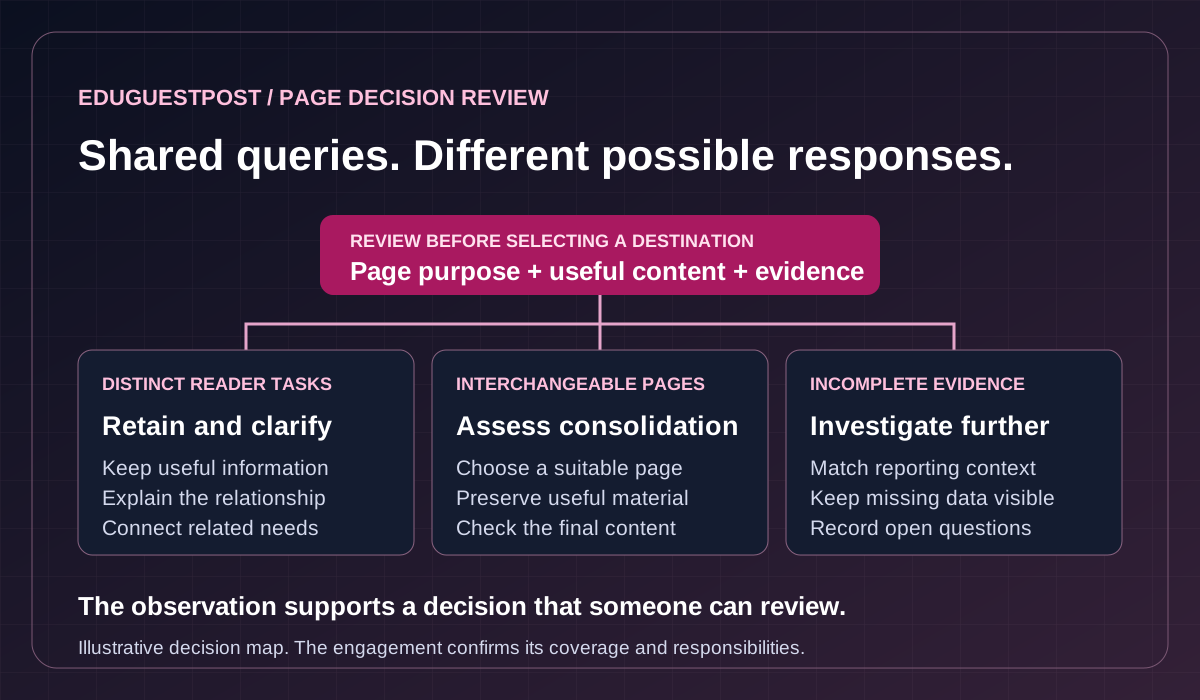
Open the affected pages and identify what each helps a reader do. Compare their useful information, audience, wider query coverage, links and available business evidence. A preferred destination should follow that review rather than simply being the page with the most impressions in one export.
Scroll across to explore all columns.
| Observed situation | Possible response | Evidence needed first |
|---|---|---|
| Useful pages serving different needs | Keep them and clarify their relationship. | Distinct reader tasks, content and relevant navigation. |
| Interchangeable pages with useful material split between them | Consider consolidation into a suitable destination. | Preserved information, wider traffic, links and business value. |
| Duplicate URL versions of equivalent content | Align the preferred address and technical signals. | Actual responses, equivalence and canonical or redirect behavior. |
| Incomplete or inconsistent observations | Gather better evidence before selecting a fix. | Matching dates, dimensions, source coverage and page state. |
Preserve what still helps
Consider a hypothetical accounting website with an invoice-template page and a guide to issuing an invoice. Both may appear for a broad invoice query while serving different tasks. Removing the guide because the template receives more impressions could discard useful instructions. Two near-identical guides answering the same question would need a different assessment.
The Content Similarity Checker compares wording in two selected sources. Shared templates, quoted instructions and a short excerpt contained within a longer page can influence the result. Its percentage does not establish identical meaning, plagiarism, Google duplication or commercial harm.
Google’s people-first content guidance provides a useful test for proposed revisions: make the content more helpful to its intended reader. Changing headings or replacing repeated words without improving the page’s purpose is not a complete fix.
Make the selected change consistent
Some findings call for clearer copy and links; others need a technical decision. The implementation plan should name the affected URLs, intended behavior, content to preserve, responsible owner and checks required after the change. Advice, copy editing, configuration and development should be distinguished in the quotation.
Clarify pages that should remain
Give each retained page a clear job. Revise introductions, headings, examples and next steps where they blur that purpose. Google’s title-link guidance supports descriptive titles that reflect the actual page, while recognizing that Google can choose different result text.
Use Internal Linking Services when the agreed solution needs a wider link plan or implementation. Links should connect related needs and point to the intended destination. Repeating one anchor everywhere does not establish that a page is the right answer.
Consolidate only after preserving value
If consolidation is appropriate, identify the destination and useful material that must survive. Review other queries, visits, enquiries and existing links before removing a source page. Map old addresses explicitly and check the final content; a successful redirect to the wrong page does not satisfy the plan.
For an existing page that needs substantial editorial work, SEO Content Refresh Services can define the revisions separately. The decision should explain why the changes help rather than promise a particular ranking response.
Separate canonical preferences from redirects
Google’s canonical guidance concerns duplicate or very similar pages. It does not mean every page sharing a query should point elsewhere. The Canonical Tag Checker observes declarations and conditional destination evidence; it cannot identify Google’s selected canonical. Establish the intended relationship before changing tags, rules or sitemap entries.
Leave an auditable decision for each group
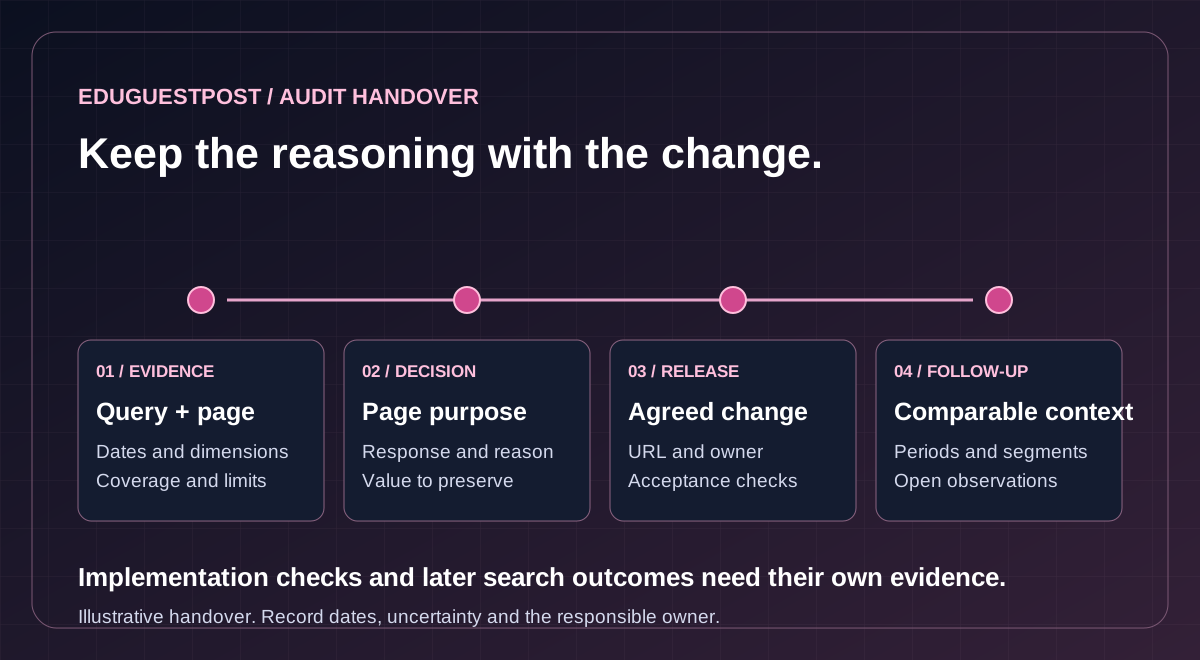
The handoff should let another person understand the observation, proposed response and remaining uncertainty. A long list of overlapping queries is useful only when your team can connect it to a concrete decision and verify the agreed work.
Scroll across to explore all columns.
| Deliverable | What it records | Acceptance check |
|---|---|---|
| Evidence register | Source, dates, dimensions, coverage and reviewed page groups. | The relationships and limitations can be traced to supplied records. |
| Page decision map | Retain, clarify, consolidate or investigate, with a reason. | Useful content and distinct visitor needs are accounted for. |
| Implementation requirements | Selected URLs, copy or link changes, dependencies and owners. | The intended response and destination are unambiguous. |
| Follow-up plan | Checks, comparison context, unresolved items and review timing. | Implementation evidence stays separate from later search outcomes. |
Verify the actual implementation
Compare the released content with the approved plan. Check preserved information, meaningful links, intended canonical declarations and relevant indexing instructions. If a URL moved, use the Redirect Checker for bounded route evidence and compare the reached page with the intended destination.
The Indexability Checker provides current response and instruction evidence. A public diagnostic request does not establish that Google indexed the page or selected its preferred URL. Keep incomplete checks and deliberate exclusions visible.
Define the handover responsibilities
Agree who supplies the data, approves content preservation, implements changes and verifies the release. Confirm backups or rollback where appropriate, the sample covered and any separately quoted observation period. Private reports should use agreed access and retention arrangements.
No tool report authorizes a merge, redirect, deletion or indexing submission. Those are implementation decisions for the agreed project. The audit’s purpose is to make the reasoning and next action concrete enough to review.
Assess the result with a comparable baseline
A completed change and a later search response are different observations. Technical checks can confirm that the agreed copy, links or URL behavior were released. Crawling, indexing, search presentation and business performance need subsequent evidence and may change at different times.
Compare the right periods and segments
Retain the original export and a dated change log. Compare the same property scope, search type and relevant country or device segments. Check source coverage and missing data before interpreting a change in the number of pages or queries observed.
Look beyond the intended keyword. A retained page may support other useful searches or customer tasks. A consolidated destination should be assessed alongside what happened to the old pages, with wider enquiry and content evidence where available. Do not average unrelated percentages or treat a change in the impression leader as proof of improved ranking.
Google’s traffic-drop guidance identifies several possible causes, including technical issues, demand, algorithms and reporting anomalies. A before-and-after change can support investigation without isolating one cause. Rankings, traffic and enquiries cannot be guaranteed.
Match the engagement to the problem
The proposed work can include a defined overlap investigation, a decision map, implementation requirements and agreed verification. Copy revisions, development, deployment and continuing monitoring need their actual responsibilities and scope confirmed.
For a wider question about access, content and internal connections, SEO Audit Services can frame the broader investigation. A cannibalization review should not become an instruction to remove every page that shares terminology with another.
Questions about the audit and fix engagement
Do several pages appearing for one query always need a fix?
Several pages can serve distinct reader needs. The review investigates page purpose, the search evidence and useful content before recommending which pages to retain, clarify, consolidate or investigate further.
What should I send for a keyword cannibalization quote?
Share your website, the affected section, example page groups, recent changes and available performance evidence. The quotation confirms coverage, outputs, responsibilities, price, timing and follow-up.
Does the Keyword Cannibalization Tool connect to Search Console?
The tool reviews supplied paired query-and-page records. It does not fetch your pages or connect to your Search Console account. The engagement can use separately agreed evidence and page review.
Will every overlapping page be merged or redirected?
The response depends on the reviewed page purpose and evidence. Useful distinct pages may remain. Consolidation requires a suitable destination and a plan to preserve useful information and check the resulting content and URL behavior.
Does the audit include implementation?
Implementation responsibilities are confirmed in the quotation. Copy revisions, development, deployment and continuing monitoring each need an agreed scope and owner.
How are results checked after a change?
Technical checks confirm the agreed copy, links and URL behavior. Later search observations are assessed with comparable periods, property scope and segments, keeping coverage limits and other possible causes visible. Rankings, traffic and enquiries cannot be guaranteed.
Request your keyword cannibalization quote
Request your keyword cannibalization quote with the affected section, example page groups, available performance evidence and recent changes. The quotation should confirm the review coverage, outputs, implementation responsibilities, price, timing and follow-up before work begins.
- Which page groups or site sections concern you?
- What changed, and which evidence is available?
- Do you need a review, implementation or follow-up?
Use public URL examples in your first enquiry. Arrange private reports and authorized access separately.
Tell us about the pages you want reviewed
We use the brief to agree page coverage, deliverables, responsibilities and timing.