
Discoverable products / Consistent catalog states
Ecommerce Technical SEO Services
Make your catalog easier to discover and maintain
A store can look complete while important products sit beyond an internal search box, filtered links create unnecessary URLs, or a template publishes conflicting stock information. Ecommerce technical SEO starts by identifying which pages customers need, how those pages are reached and what each system actually delivers.
Request a scoped review of your storefront’s categories, products, variants and technical templates. The proposed engagement turns observed issues into priorities, implementation requirements and checks your team can use before and after a release. The quotation confirms whether you need investigation, developer specifications, supported configuration changes or release support.
Start with a defined store problem
A useful enquiry names the affected platform, markets and page families. You might be launching a catalog, investigating missing product discovery, changing variant URLs, managing discontinued stock or checking a theme release. The evidence and work required will differ for each situation.
The free Ecommerce SEO Audit offers an initial look at supported product declarations in a small public HTML sample. It does not run JavaScript, verify live inventory or inspect your entire catalog. Its results can help frame an enquiry; they do not establish the cause or extent of a store-wide problem.
Agree the work before implementation
Your scope should identify representative pages and states, access requirements, implementation owners, expected outputs and the checks required for acceptance. Price, timing and any follow-up are confirmed in the quotation. Platform documentation alone does not establish which development work can be supplied for your particular installation.
Request an ecommerce technical SEO quote with your store URL, main concern and planned changes. You can begin with public examples and agree any private evidence separately.
Give important products a discoverable route
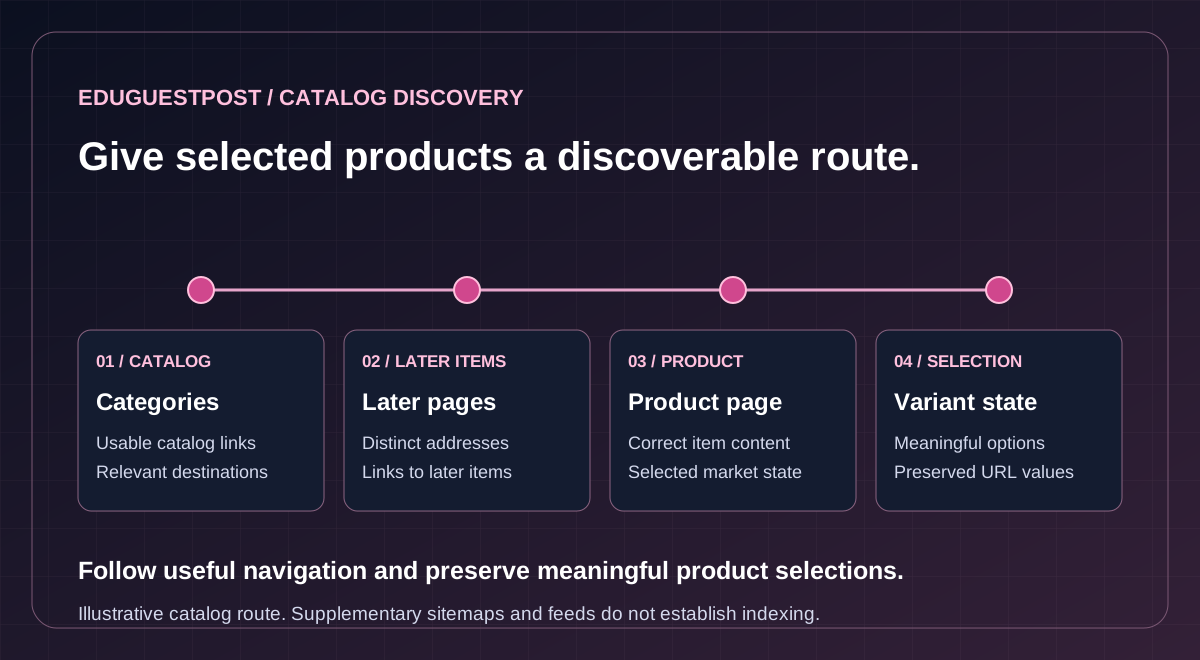
Customer navigation and crawler discovery need to work together. Google’s ecommerce site-structure guidance recommends links through categories and subcategories to products. An internal search feature alone does not provide that route: Google generally does not submit searches into a store’s search box.
The review should trace representative journeys through the catalog and record where discovery depends on a click, script or unavailable link. A sitemap or product feed can supplement discovery without proving that every intended URL has been crawled or indexed.
Scroll across to explore all columns.
| Page family | Review question | Evidence to retain |
|---|---|---|
| Categories | Can visitors and crawlers reach the intended products through usable links? | Navigation paths, link destinations and sampled responses. |
| Pagination | Does each later page have a distinct address and discoverable links? | Page-one and later-page URLs, canonicals and product links. |
| Filters | Which combinations deserve a useful landing page, and which create excess URLs? | Customer purpose, URL patterns, result states and crawl evidence. |
| Products and variants | Does the address preserve the intended item and selected option? | Product identity, meaningful parameters and selected-page state. |
Set rules by page purpose
Google’s pagination guidance treats paginated pages as separate URLs with their own canonical addresses. Sending every page’s canonical to page one can misrepresent the relationship. Infinite scrolling also needs a discoverable route to later content; a working “load more” button is insufficient evidence by itself.
Review faceted-navigation guidance against the store’s actual filters and demand. Some combinations may serve a distinct customer need; others may produce redundant or empty results. Decisions should describe the affected patterns, prerequisites and verification method. Broad parameter removal or blocking can also affect useful product selections, pagination and existing index-exclusion instructions.
Preserve product identity through changing states
Temporary unavailability, a future release, an accepted backorder and a permanently retired product describe different customer situations. Record the intended behavior for each state before changing URLs or index controls. An empty filter result does not establish the right treatment for a temporarily sold-out product.
For an unavailable item, consider whether the page still provides useful specifications, support information or a credible return-to-stock path. A replacement product needs a defensible relationship to the old item. Redirecting unrelated retired products to the homepage can leave both customers and crawlers without the expected information.
Keep variants and market versions distinct where needed
Google’s product-variant documentation describes different single-page and multipage arrangements. Confirm the actual model before setting canonical rules. A meaningful variant parameter may select a size or color; removing it can change what the visitor sees.
Merchant Center’s landing-page link can select a specific variant, while its canonical-link attribute serves a different matching purpose. Preserve those distinctions when reviewing feeds and URLs. Language, currency, regional availability and alternate-page relationships also need explicit mapping. A cookie or geographic redirect can conceal a version from a visitor or crawler in another context.
Check the platform’s delivered behavior
Shopify product status and sales-channel availability are separate controls. WooCommerce can track stock at different product or variation levels. Adobe Commerce URL rewrites and redirects also have configuration-specific behavior. Check the installed version, theme and extensions before recommending a change.
The Shopify SEO Audit observes supported product-link patterns in one public source page. It does not verify Shopify detection, linked-product content or collection membership. The Canonical Tag Checker provides declaration evidence and conditional destination checks; it does not identify Google’s selected canonical. Use these observations to define further checks, including actual selected options and responses.
Reconcile the page, markup and product data
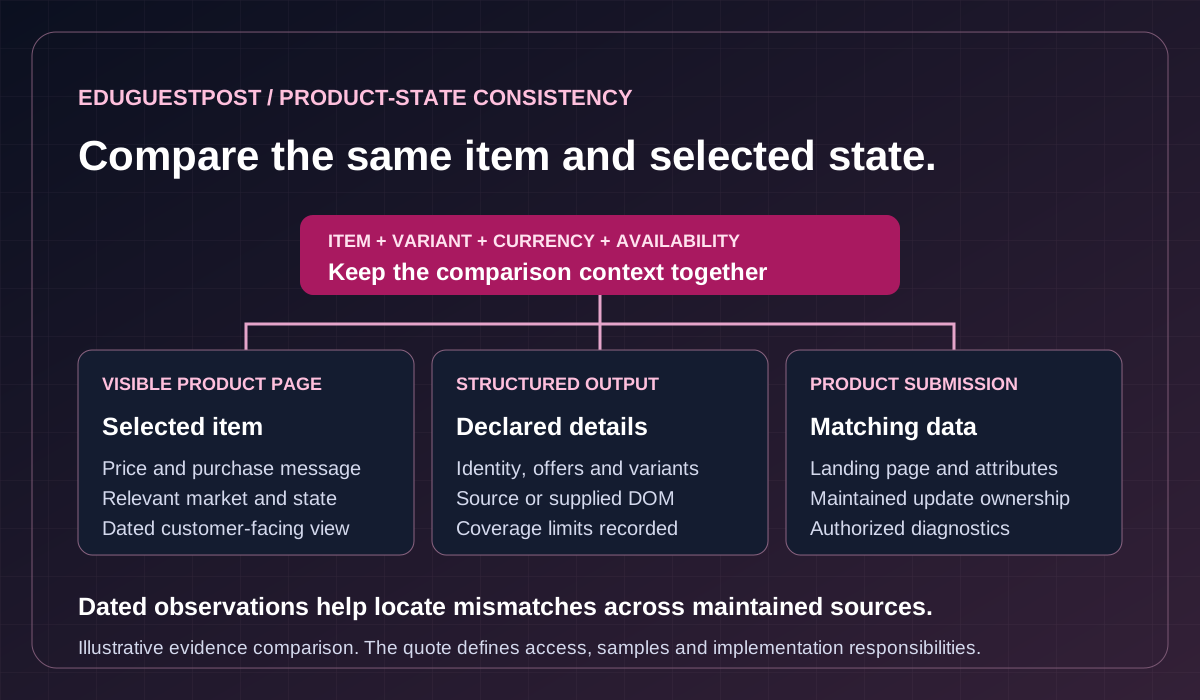
A product page can display one price while its structured data or feed declares another. Review the same item, variant, currency and availability state across the relevant systems. Google’s merchant-listing documentation sets feature-specific conditions; valid Schema.org vocabulary alone does not establish eligibility or accurate facts.
Scroll across to explore all columns.
| Evidence layer | What the review checks | Acceptance evidence |
|---|---|---|
| Visible product page | The selected item, price, currency and purchase message. | Dated examples in the relevant market and state. |
| Structured declarations | Product identity, offers, variant relationships and factual consistency. | Source or rendered output with exact fields and unresolved limitations. |
| Product data submission | Matching landing-page selections, attributes and update ownership. | Agreed feed samples and account diagnostics, when authorized. |
| Released templates | The intended changes across the agreed page and state sample. | Before-and-after checks, exceptions and responsible owners. |
Google’s availability attribute guidance distinguishes in-stock, out-of-stock, preorder and backorder conditions. Automatic item updates can help reconcile supported mismatches, but they do not replace accurate source data and timely feed maintenance.
Validate the output you actually publish
Inventory existing theme, app and plugin generators before adding another product block. Google recommends initial-HTML product markup for Shopping reliability; dynamically generated declarations need their own delivery checks. The Structured Data Checker examines supported JSON-LD parsing and vocabulary relationships. It does not validate every property value, visible fact or Google requirement, and it does not execute JavaScript.
API advice also needs a date check. Google’s Content API sunset guidance supersedes older integration recommendations: the sunset date passed on 18 August 2026, with progressive shutdown and extension arrangements documented separately. Confirm the supported Merchant API path and any existing extension before planning integration work. Account access, feed imports and migration execution require a separately agreed scope.
Check mobile behavior and performance with context
A desktop inspection can miss navigation, product information or variant controls that behave differently on mobile. Google’s mobile-first indexing guidance calls for equivalent primary content and relevant instructions. Content needed for indexing should not depend on a user interaction to load.
Review representative category and product templates at the relevant viewport and state. Check whether people can find product details, choose an option and understand availability without content disappearing or controls becoming unusable. Any transactional test, private session or checkout investigation needs its own authorized plan.
Separate observed performance from a test score
Field and laboratory performance data answer different questions. Field data reflects an observed user population over a collection period; a lab run investigates a particular controlled load. A Lighthouse score does not certify field Core Web Vitals, and Total Blocking Time is not an Interaction to Next Paint measurement.
The current Core Web Vitals Checker works with supplied CrUX JSON and/or supported Lighthouse JSON evidence. Its live CrUX connection and separate automatic PageSpeed/Lighthouse panel are not enabled pending setup. A URL record, an origin record and a lab report must remain clearly labeled; missing field evidence stays unavailable.
Diagnose the affected template
Priorities might include a delayed main product image, slow server delivery, expensive scripts, interaction delays or shifting promotional elements. Review the actual bottleneck and test the proposed change. Lazy-loading an above-the-fold image can delay the content the customer needs first.
Where content depends on JavaScript, the Rendered HTML Checker compares source with a supplied DOM snapshot for a matching final URL and relevant state. It does not run a remote browser or reproduce Google’s rendering. Record capture conditions and incomplete evidence so that a sampled comparison does not become a claim about every shopper or crawler.
Leave a practical plan for the next release
A useful engagement connects each recommendation to an observed problem, an affected page family and an acceptance check. The handoff should make it clear what your team can implement now, what needs further evidence and what remains outside the agreed sample.
Proposed deliverables
- Catalog and state map: agreed categories, products, variants, markets and availability states, with representative URLs and coverage limits.
- Prioritized issue register: observed behavior, supporting evidence, customer or discovery implications, dependencies and a proposed owner.
- Implementation requirements: approved rules for relevant templates, links, URL handling or product declarations, with configuration or development responsibilities confirmed.
- Release checks: expected responses, navigation, selected states, canonical instructions and data consistency for the agreed sample, with exceptions recorded.
- Maintenance handoff: data owners, update triggers, repeatable checks and any separately quoted follow-up.
Before deployment, agree access, backups, rollback responsibility and how changes will be verified. A template fix can affect many products, so include meaningful variations in the sample rather than assuming one successful page proves the whole catalog. Private reports, feeds or account diagnostics should use an agreed exchange and retention arrangement.
Match the enquiry to your store
If the main question is broader diagnosis, SEO Audit Services can frame the wider investigation. Detailed filter policy, URL migrations and structured-data implementation may need their own work packages. The ecommerce scope should identify those dependencies and the responsibilities you actually want quoted.
Technical acceptance confirms the agreed implementation behavior. Crawling, indexing, search appearances and commercial performance need subsequent observation; no ranking, traffic, rich-result or sales outcome is guaranteed.
Questions about ecommerce technical SEO
Is an internal search box enough for product discovery?
Useful category and subcategory links provide a route to products. Google generally does not submit store searches, and a sitemap or feed can supplement discovery without proving that every intended URL was crawled or indexed.
Should all product parameters or later pages be consolidated?
The review follows the page purpose and actual variant model. Meaningful selections and later pagination pages need appropriate URLs and declarations; broad parameter removal can change the item or content a visitor receives.
Are sold-out, preorder and retired products the same case?
They describe different customer states and need an intended treatment. A temporarily unavailable page may retain useful specifications or a return-to-stock path, while a replacement for a retired item needs a defensible relationship.
How are product-page and feed mismatches investigated?
Compare the same item, variant, currency and availability state across the visible page, structured declarations and agreed product-data samples. Retain dated evidence, source ownership and any authorized account diagnostics.
Does a Lighthouse score certify field Core Web Vitals?
A lab run investigates a controlled load, while field data reflects an observed user population and period. Their sources remain labelled, Total Blocking Time is not INP, and missing field evidence stays unavailable.
Does one passing product page establish catalog-wide success?
The agreed sample includes meaningful product and state variations. Technical acceptance records the checked behavior; crawling, indexing, search appearances and commercial outcomes need later observation and are not guaranteed.
Request an ecommerce technical SEO quote
Request your ecommerce technical SEO quote with your platform, public store URL, affected markets, main concern and release plans. The quotation should confirm deliverables, implementation responsibilities, evidence needs, price, timing and follow-up before work begins.
Tell us about your ecommerce technical SEO requirements
Share public store examples, affected markets and the support needed. Agree private evidence and access arrangements separately.