
Canonical URL policy / Consistent signals
Canonicalization Cleanup Services
EduGuestPost's canonicalization cleanup services help you identify equivalent URL versions, agree which destination should represent the content and address conflicting signals across your website. The proposed engagement turns those decisions into prioritized repairs, with clear implementation responsibilities and checks for the agreed changes.
Resolve the relationship before changing the declaration.
Give duplicate content a consistent preferred URL
A product reached through several routes, a template declaring an outdated address or competing HTTP and HTTPS versions can create different problems. Start with the affected pages and their purpose, then examine the content and the systems producing each URL signal.
Google's canonicalization guidance explains that ordinary duplication is normal. Google selects a representative from similar pages and can choose a different URL from the one you declare. Cleanup should therefore clarify intended relationships and correct supported faults, with Google's subsequent selection assessed separately.
Your proposed project can include:
- An inventory of relevant URL families and their intended destinations.
- A decision map explaining what should consolidate and what should remain distinct.
- Repair tasks for conflicting declarations, routes, links or sitemap output.
- Acceptance checks and a handover showing completed work and open questions.
The scope can focus on a particular template, website section or known set of conflicting URLs. A report of missing canonicals alone does not establish that every page needs a new tag or that all duplicates should disappear.
Share your website, representative alternate URLs, preferred destinations and relevant release history. Explain whether you need findings for your developers, specified implementation support or a review of work already completed. The quotation confirms coverage, deliverables and responsibilities.
Request a canonicalization cleanup quote with that brief so the proposed work reflects your website's needs.
Establish which URLs should represent the content
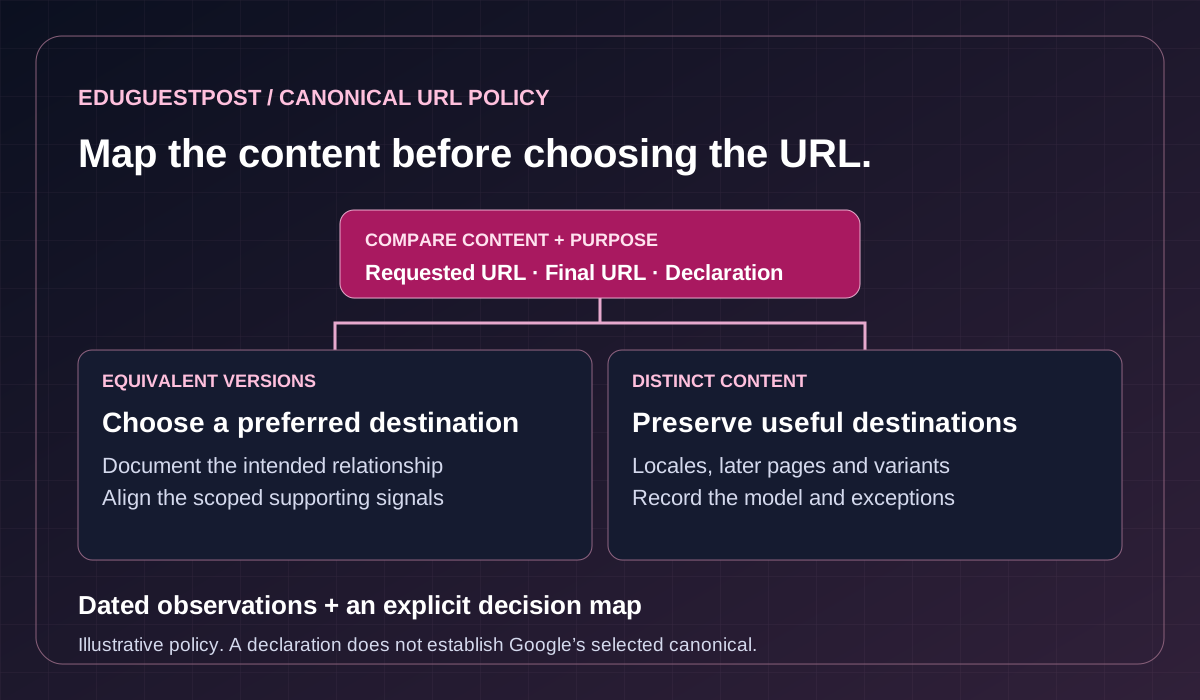
Begin with an inventory that preserves the requested address, the final response URL and any declared canonical as separate observations. Record the relevant template, purpose and evidence date. Similar-looking addresses can serve different content, while very different paths can return the same page.
Swipe or scroll to read all columns. Keyboard: focus the table, then use the arrow keys.
| URL family | What to establish | Decision to document |
|---|---|---|
| Tracking or sorting versions | Whether the main content is equivalent | Preferred destination and permitted alternates |
| Host or protocol versions | Which origin and routes are intended | Consistent public destination and required redirects |
| Old and current addresses | Whether content moved or remains distinct | Appropriate mapping or independent treatment |
| Locales and collection pages | Intended audience and actual content differences | Preserved destinations and explicit exceptions |
The canonical link specification relates a preferred resource to duplicate content or content that includes the referring resource's material. Sharing a subject alone does not justify sending a guide, product and service page to the same destination.
Compare declarations with Google's recorded choice
Where authorized evidence is available, URL Inspection can show Google's selected canonical in the indexed record. The live test cannot predict that selection. Keep the inspection date and reported crawl information alongside current page checks, because a release may have changed the response since Google's observation.
A different selected URL deserves investigation into whether it represents the content appropriately. The decision map should explain why a proposed destination fits the page, which alternatives remain useful and what evidence is still missing. A tool label alone cannot make that content decision.
Correct the system producing conflicting declarations
Once the intended destination is agreed, locate the setting or code that generates the current canonical. A theme, SEO plugin, application layout or response-header rule may own it. Adding another tag without finding that owner can leave the original conflict in place.
Google's implementation guidance describes canonical link elements and supported HTTP response headers. Use a consistent implementation with an absolute intended destination, and review any existing declarations before introducing another source. A self-referencing canonical can reinforce the chosen representative; its presence does not prove Google selected it.
Inspect the target as well as the declaration
The Canonical Tag Checker reads public or supplied HTML and header declarations, with destination evidence where verification is enabled. It can surface conflicts and incomplete checks. It does not establish content equivalence, Google's selected canonical, robots access or sitemap membership.
Review whether the target serves the intended content, redirects elsewhere or declares another destination. The Indexability Checker can support a separate bounded review of public responses and indexing directives. A successful response still needs content and context checks; neither utility confirms Google indexing.
Compare the initial response with browser output
Google's JavaScript guidance advises keeping canonical information consistent when scripts generate or modify metadata. Check the actual route and deployed framework behavior before changing a shared template.
The Rendered HTML Checker compares source with a browser DOM snapshot you supply. Keep the final URL, capture time and page state consistent. This comparison does not execute remote JavaScript or reproduce Google's rendering and selection.
Preserve pages that need different treatment
The cleanup plan should state its exceptions as clearly as its preferred destinations. Removing every parameter or pointing all related pages to one commercially important URL can erase distinctions your visitors need. Classify representative examples before extending a template rule across a collection.
Keep later collection pages accessible
Google's pagination guidance recommends a distinct URL and its own canonical for each component page. Later pages should not all point to page one. Preserve usable sequential links so visitors and crawlers can reach products or articles beyond the first segment.
A sort order, a useful filtered landing page and the next collection page can have different roles. The policy should explain which variations remain public, which are equivalent and where another access or indexing decision is needed.
Respect language and regional intent
Google's guidance for multilingual and regional sites calls for decisions that reflect the actual audience and content. Fully translated primary content should not be collapsed merely because the pages share a topic. Similar same-language regional copies need coordinated canonical and language-alternate annotations.
Record the intended destinations for each market before changing a global default. A consistent annotation pointing to the wrong language is still the wrong implementation for that policy.
Follow the actual product variant model
Google's product variant guidance distinguishes a group presented on one page from variants distributed across equally important pages. Those models do not share one universal group-canonical rule.
Confirm how the store exposes variants and what each destination contains. Preserve meaningful product choices and align the implementation with that model rather than assuming every color, size or product-family URL should consolidate identically.
Align supporting signals and verify the changes
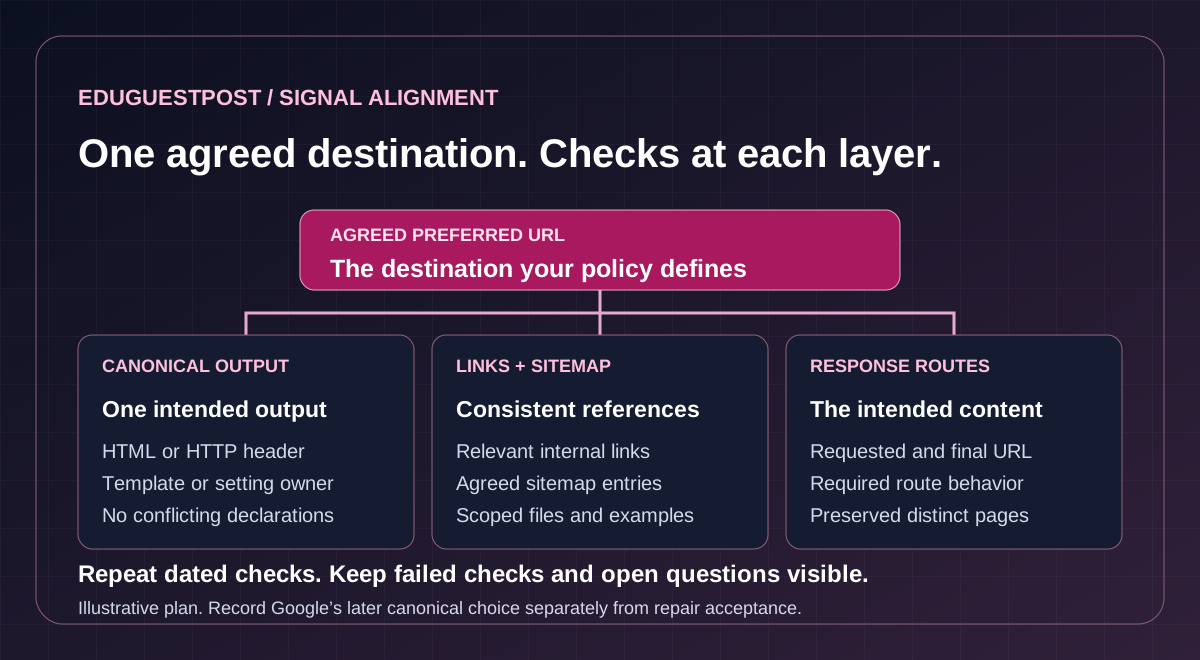
The preferred destination should agree with the routes and references your website generates. Review relevant internal links, sitemap entries and necessary redirects alongside the declaration. A correct tag can coexist with navigation that repeatedly points visitors to an outdated address.
Internal linking services can define a wider placement plan when the scope requires one. The Redirect Checker provides bounded current HTTP route evidence and supplied-map review. Destination match, observed redirection and HTTP success remain separate observations.
Google's sitemap guidance recommends the preferred URLs for duplicate content. The XML Sitemap Checker inspects a bounded document; it does not recursively fetch child sitemaps or test listed pages. Agree which files and page examples the project will actually cover.
Swipe or scroll to read all columns. Keyboard: focus the table, then use the arrow keys.
| Change area | Example acceptance check | Evidence to retain |
|---|---|---|
| Canonical output | Scoped declarations match the agreed destination | Dated HTML or header evidence and template owner |
| Target behavior | The intended content and response are available | Requested URL, final response and relevant page state |
| Links and sitemap | Agreed references use the intended URL | Source placements, inspected files and coverage limits |
| Exceptions | Distinct pages and protected behavior still work | Representative locales, later pages and required routes |
Make the handover usable after release
Assign each task to the responsible website or infrastructure owner and agree who accepts the result. After implementation, repeat the observations that exposed the fault, accounting for cached versions where relevant.
Record completed repairs, failed checks and unresolved questions. State which examples were sampled so a limited verification is not presented as a complete website result. Google's later canonical choice belongs in a separate observation.
Agree your scope and request a quote
A useful quotation names the website sections, URL families and questions included. It confirms the evidence needed, deliverable formats, implementation responsibilities and follow-up arrangements. Development work and continuing monitoring need an explicit scope, with access and release approval assigned to the appropriate owners.
The proposed handover can include the inventory, destination decisions, supporting observations, prioritized tasks and acceptance checks. Each recommendation should identify the affected examples, the reason for the change and any dependencies your team must resolve.
Set expectations for Google's processing
A corrected declaration confirms the intended output in the checked context. It does not guarantee Google will choose that URL, consolidate every signal, index the page or improve rankings. An expected alternate or duplicate can remain excluded without indicating a new fault.
Google's recrawl guidance describes request methods, access requirements and quotas. Repeated requests for the same URL do not accelerate crawling. Any future submission needs an authorized owner; processing examples are not fixed service deadlines.
Start with representative URLs and your intended outcome
Send your website, approximate scope, several affected addresses and the destinations you believe should represent them. Include relevant migration or release dates and describe the Search Console evidence available. A public description is enough for an initial brief; agree permitted access, appropriate exchange and retention before sharing private exports or credentials.
For a broader unexplained visibility problem, SEO audit services can establish priorities. SEO consulting services can support decisions involving several implementation teams. For missing-page concerns, website indexation issue fixing services can define a separate investigation.
Questions about canonicalization cleanup
Can you guarantee Google will choose the declared canonical?
No. A corrected declaration confirms the intended output in the checked context. It does not guarantee Google will select that URL, consolidate every signal, index the page or improve rankings. Record Google’s later choice separately from implementation acceptance.
Which URLs should be consolidated?
Start with the actual content and purpose of each URL family. Equivalent versions may have a preferred destination, while distinct content and useful alternatives need documented treatment. Sharing a subject alone does not justify sending a guide, product and service page to one destination.
Should pagination, locales and product variants all point to one URL?
No universal consolidation rule fits these cases. Later collection pages, language or regional destinations and product variants can require different treatment. Record the audience, content and product model, and preserve the explicit exceptions in the agreed URL policy.
Can the public checkers confirm Google’s selected canonical?
No. Public and supplied-page checks provide bounded declaration, response or route evidence. Where authorized account evidence is available, URL Inspection can show Google’s selected canonical in the indexed record. Its live test cannot predict that selection.
Does the service include implementing the cleanup?
The quotation defines coverage, deliverables and implementation responsibilities. You may need findings for your developers, specified implementation support or a review of completed work. Assign the appropriate website or infrastructure owner, release approval and acceptance checks before changes begin.
What should I send for a canonicalization cleanup quote?
Send the website, approximate scope, representative alternate URLs and your intended destinations. Include relevant migration or release dates and describe the Search Console evidence available. A public description is enough for an initial brief; agree permitted access, appropriate exchange and retention before sharing private exports or credentials.
Request your canonicalization cleanup quote
Request your canonicalization cleanup quote with that brief. The scope can then reflect your URL policy, available evidence and implementation resources.
- Which alternate URLs and preferred destinations are involved?
- What changed in the site, template or routing?
- What evidence and implementation resources are available?
Use public URL examples in your first enquiry. Keep passwords, verification codes and private customer records out of the initial brief. Agree permitted access and private report exchange separately.
Request a canonicalization cleanup quote
We use your brief to define URL families, intended destinations, evidence, deliverables and implementation responsibilities.