

Anchor text still matters in SEO.
But anchor text optimization is not about finding a perfect percentage of exact-match, branded, partial-match, and URL anchors.
It is about creating links where the clickable wording, surrounding content, publisher, target page, and wider backlink profile all make sense together.
A strong anchor should help answer:
What am I going to find if I click this link?
For link building, there is another question:
Does this anchor look like something a real writer or editor would naturally use in this particular sentence?
That is where effective anchor-text planning begins.
Exact-match anchors can be useful.
Branded anchors can be powerful.
Partial-match anchors can create strong topical context.
URLs, page titles, product names, and descriptive phrases can all belong in a healthy backlink profile.
The mistake is not using keywords.
The mistake is forcing the same commercial keyword into backlink after backlink because a spreadsheet says that is the term you want to rank for.
Key Takeaways
- Anchor text provides context about the page being linked to.
- Exact-match anchors can be useful when they fit naturally.
- Repeating the same optimized anchor across many placements can create an obviously engineered pattern.
- There is no universal anchor-text percentage that works for every website.
- Your existing backlink profile should influence future anchor choices.
- Competitor anchor profiles can provide useful benchmarks, but should not be copied blindly.
- Commercial pages naturally attract different anchor types from research, tools, statistics, and editorial resources.
- Branded anchors can strengthen the relationship between your brand and the topics surrounding it.
- Surrounding text can provide topical context even when the anchor itself is branded or simple.
- Guest-post anchors should be planned together with the article topic.
- Niche-edit anchors must fit the existing page rather than forcing the page to fit the keyword.
- Internal anchor text deserves deliberate planning as part of topical clustering.
- Evaluate anchor text across the entire campaign—not one backlink at a time.
What Is Anchor Text?
Anchor text is the clickable wording of a hyperlink. If the wider link vocabulary is new, start with what backlinks are and how they work, then return here for the wording and context decisions.
For example:
Read our guide to guest post pricing in 2026.
The clickable phrase:
guest post pricing in 2026
is the anchor text.
Anchor text gives readers information about what they should expect after clicking.
It also creates semantic context between:
source page → anchor → destination page
That makes the wording strategically important.
Ahrefs defines anchor text as the visible clickable text of a hyperlink and emphasizes its role in explaining the destination to users and search systems.
But anchor text should not be considered by itself.
The entire linking environment matters.
Anchor Text Is Only One Part of Link Context
Suppose you want to rank a page about:
enterprise cybersecurity software
You acquire a backlink using the exact anchor:
enterprise cybersecurity software
That sounds highly optimized.
But imagine the link appears inside an article about:
10 Interior Design Trends for Apartments
Does the exact-match anchor make this a strong backlink?
Probably not.
Now imagine another link.
Publisher:
A respected cybersecurity publication.
Article:
How Enterprises Are Reducing Ransomware Exposure
Paragraph:
Discusses security monitoring platforms.
Anchor:
EduGuestPost client’s brand name
Destination:
A relevant enterprise-security platform.
The second anchor is less keyword-heavy.
The overall link is far more contextually coherent.
That is because backlink relevance is created across several layers:
Domain relevance
↓
Article relevance
↓
Paragraph relevance
↓
Anchor relevance
↓
Target-page relevance
Anchor text strengthens that relationship.
It does not replace it.
Why Anchor Text Still Matters
Anchor text is small, but it does four useful jobs at once. It tells a reader what is behind the click, gives the link a topical setting, connects related pages, and can reinforce the way a brand is associated with a subject.
| Job | Weak wording | More useful wording | Why it helps |
|---|---|---|---|
| Set an expectation | click here | compare Domain Authority and organic traffic | The reader knows what the destination covers before clicking. |
| Add topical context | this page | guest-post pricing research | The wording and surrounding sentence describe the subject together. |
| Connect a cluster | read more | how to evaluate guest-post publishers | Related pages become easier for people and crawlers to understand. |
| Build brand association | website | EduGuestPost’s publisher review | The brand and the work being referenced appear in the same editorial context. |
The wording is not a substitute for a strong page or a credible publisher. It is one part of the relationship between a source page, a destination, and the reason the link belongs there. That wider relationship is why the article also considers backlink quality, follow status, placement, and referring-domain diversity.
The Main Types of Anchor Text
Understanding anchor categories helps you audit a backlink profile.
But categories should describe what naturally exists.
They should not become a rigid formula.
| Anchor Type | Example | Typical Use |
|---|---|---|
| Branded | EduGuestPost | Brand references |
| Exact match | guest posting services | Direct keyword relevance |
| Partial match | professional guest posting services | Keyword within natural wording |
| Descriptive | this guide to evaluating backlink quality | Editorial references |
| Page title | How Much Should You Pay for a Guest Post? | Articles and research |
| Naked URL | eduguestpost.com | Profiles, citations, direct references |
| Brand + keyword | EduGuestPost guest posting services | Commercial brand context |
| Generic | learn more | Navigation where context is obvious |
| Product/service name | Anchor Text Analyzer | Tools and products |
| Image anchor | Alt text of linked image | Images used as hyperlinks |
None of these is universally “best.”
The best type depends on:
- The target page
- Publisher
- Sentence
- Existing backlink profile
- Brand recognition
- Article purpose
- Search intent
1. Branded Anchor Text
A branded anchor uses a company, product, person, or website name.
Examples:
EduGuestPost
Ahrefs
Semrush
Nike
Adobe
Branded anchors often appear naturally because writers commonly reference companies by name.
For example:
According to research from Ahrefs, referring-domain diversity is strongly associated with competitive search performance.
Using “Ahrefs” is natural.
Changing it to:
best backlink analysis SEO software
would make the sentence worse.
Why Branded Anchors Matter
Brand anchors can support:
- Brand recognition
- Entity association
- Natural link diversity
- Referral trust
- Brand discovery
- Topic-to-brand relationships
Suppose EduGuestPost repeatedly appears across relevant discussions of:
guest posting
backlink analysis
publisher outreach
EDU backlinks
link-building strategy
Even when the clickable text is simply:
EduGuestPost
the surrounding article can still establish strong topical associations.
That is why brand building and link building increasingly overlap.
2. Exact-Match Anchor Text
An exact-match anchor is identical or nearly identical to the target keyword.
Target keyword:
guest posting services
Exact-match anchor:
guest posting services
Exact-match anchors are not automatically bad.
They can be highly descriptive.
For example:
Businesses that do not want to manage publisher outreach manually may consider professional guest posting services.
The phrase fits the sentence.
The destination presumably matches.
The user understands where the link goes.
Nothing about that is inherently unnatural.
The Problem Is Repetition
Now imagine 35 backlinks all use:
guest posting services
Especially when:
- Publishers are unrelated
- Sentences feel manufactured
- Commercial pages receive almost all the optimized anchors
- Links were acquired through one repeatable campaign
The individual anchors may look reasonable.
The collective pattern looks much more engineered.
Ahrefs’ guide to SEO over-optimization specifically identifies building links with repeated exact-match anchor text as a pattern worth avoiding.
The practical lesson is not:
never use exact match.
It is:
do not make exact match your default setting.
3. Partial-Match Anchor Text
Partial-match anchors contain the target keyword or part of it within a larger phrase.
Target:
guest post pricing
Possible anchors:
- guide to guest post pricing
- current guest-post costs
- guest post pricing benchmarks
- how guest posts are priced
- guest-post pricing in 2026
Partial anchors often provide a useful middle ground.
They communicate the subject clearly without requiring the same wording every time.
They also help good writers construct sentences naturally.
Partial Match Should Still Sound Human
Bad:
You can see our cheap best guest post pricing SEO guide 2026.
Better:
Our analysis of guest-post pricing in 2026 explains how publisher quality affects cost.
The second anchor still contains meaningful topical language.
It simply belongs in the sentence.
4. Descriptive Anchor Text
Descriptive anchors explain the destination without trying to mirror one keyword exactly.
Examples:
- our analysis of publisher quality
- this backlink evaluation framework
- a comparison of authority and traffic
- the complete link-building checklist
- current guest-post cost data
These are extremely useful because they allow the writer to optimize for meaning rather than one fixed keyword.
A descriptive anchor can also support several related terms simultaneously.
For example:
this comparison of authority and organic traffic
naturally relates to:
- Domain Authority vs traffic
- DR vs organic traffic
- backlink quality metrics
- publisher evaluation
That is often more useful than repeating one exact term.
5. Naked URL Anchors
A naked URL uses the destination itself:
These commonly appear in:
- Profiles
- Resource lists
- Citations
- Direct references
- Business directories
- Forum discussions
- Contact information
They provide little keyword information in the clickable text itself.
But remember:
the anchor is not the only context.
The surrounding sentence and page can still tell readers exactly what the site represents.
Naked URLs therefore have a legitimate place in natural link profiles.
6. Brand + Keyword Anchors
These combine brand and topic.
Examples:
EduGuestPost backlink marketplace
Ahrefs backlink checker
Semrush SEO toolkit
They can be especially useful for:
- Products
- Tools
- Services
- Branded categories
These anchors create both:
brand context + topical context
without hiding the identity of the destination.
7. Page-Title Anchors
Research, guides, statistics, and editorial resources often earn anchors close to their title.
Suppose you publish:
Domain Authority vs Organic Traffic: What Matters More for Backlinks?
A writer may naturally link using:
Domain Authority vs Organic Traffic
or:
EduGuestPost’s Domain Authority vs Organic Traffic analysis
That is a strong reason to create compelling, descriptive titles.
The title itself can become the natural anchor.
8. Generic Anchors
Generic anchors include:
- click here
- this site
- learn more
- read more
- visit the website
They provide little topical information.
That does not mean every generic anchor is bad.
Sometimes the surrounding sentence makes the destination completely obvious.
But when you control the wording—particularly internally—a descriptive phrase usually gives the reader more information.
Is There a Perfect Anchor Text Ratio?
No universal percentage makes sense across every website.
You may encounter formulas such as:
70% branded 10% URL 10% partial match 5% exact match 5% generic
The problem is false precision.
Why should a famous ecommerce brand, an anonymous affiliate site, a local law firm, an academic research resource, and a newly launched SaaS company all have identical anchor distributions?
They shouldn’t.
Natural anchor profiles are influenced by:
- Brand recognition
- Business model
- Industry
- Page type
- Publicity
- Content format
- Existing backlinks
- Audience
- Publisher style
- Marketing strategy
Example: Famous Brand
A company like Adobe may naturally attract large numbers of brand and product anchors.
Example: Statistics Page
An SEO statistics article may naturally attract anchors such as:
- SEO statistics
- search statistics
- Ahrefs SEO data
- recent SEO research
Example: Calculator
A mortgage calculator might naturally earn:
- mortgage calculator
- calculate mortgage repayments
- this calculator
- company-name mortgage calculator
Different assets attract different anchors.
That is exactly what we should expect.
Use Competitors as a Benchmark—Not a Formula
Instead of asking:
“What exact-match percentage is safe?”
I prefer:
“What anchor patterns naturally exist among successful pages in this SERP?”
Analyze the top-ranking pages.
Look at:
- Branded anchors
- Exact-match anchors
- Partial-match anchors
- URLs
- Page-title anchors
- Descriptive anchors
- Referring domains
- Link quality
- Page-level backlinks
You may discover that competitor commercial pages receive mostly brand and URL anchors.
Or:
Their ranking guides attract many keyword-rich descriptive anchors because writers naturally cite the article by topic.
That is useful intelligence.
But do not blindly reproduce competitor percentages.
Their:
- Brand strength
- Link history
- age
- PR
- target pages
- content assets
may differ substantially from yours.
Competitor profiles provide context.
They do not provide universal rules.
Anchor Strategy Should Begin With the Target Page
Start with the page, not a keyword spreadsheet. A homepage, service page, research report, and calculator earn different language because people refer to them for different reasons.
| Destination | Anchor directions that usually fit | Editorial question |
|---|---|---|
| Homepage | Brand, URL, company plus category, product or company reference | How would someone introduce this organization? |
| Service page | Brand, service name, brand plus service, descriptive phrase, occasional exact match | Does the sentence genuinely discuss the service? |
| Informational guide | Article title, descriptive topic phrase, partial match, brand plus article description | What question does the guide answer? |
| Original research | Study name, data description, statistic, brand plus research topic | Which finding is the writer citing? |
| Tool | Tool name, brand plus tool, description of the task it performs | What can the reader do after clicking? |
For example, the Anchor Text Optimizer can be cited by its name or as a way to analyze anchor distribution. Both can be natural; the sentence decides which is clearer. Commercial pages deserve extra care because a repeated sales keyword can look forced even when every individual placement appears acceptable on its own.
Commercial Pages Need More Careful Anchor Planning
Commercial pages often have obvious target keywords.
That creates temptation.
Suppose a service page targets:
high DA guest posts
A careless campaign might send repeated anchors such as:
high DA guest posts
buy high DA guest posts
high DA guest post service
across dozens of publishers.
You may be technically creating keyword relevance.
But you are also creating a much more obvious optimization pattern.
A stronger campaign might naturally include:
- EduGuestPost
- EduGuestPost’s high-authority placements
- high-authority guest posting
- publisher placements with strong DA/DR
- guest posting options
- the service
- URL references
- occasional exact-match wording where appropriate
The distribution should emerge from editorial opportunities and campaign context.
Not from an arbitrary ratio.
The Surrounding Text Matters More Than Many SEOs Realize
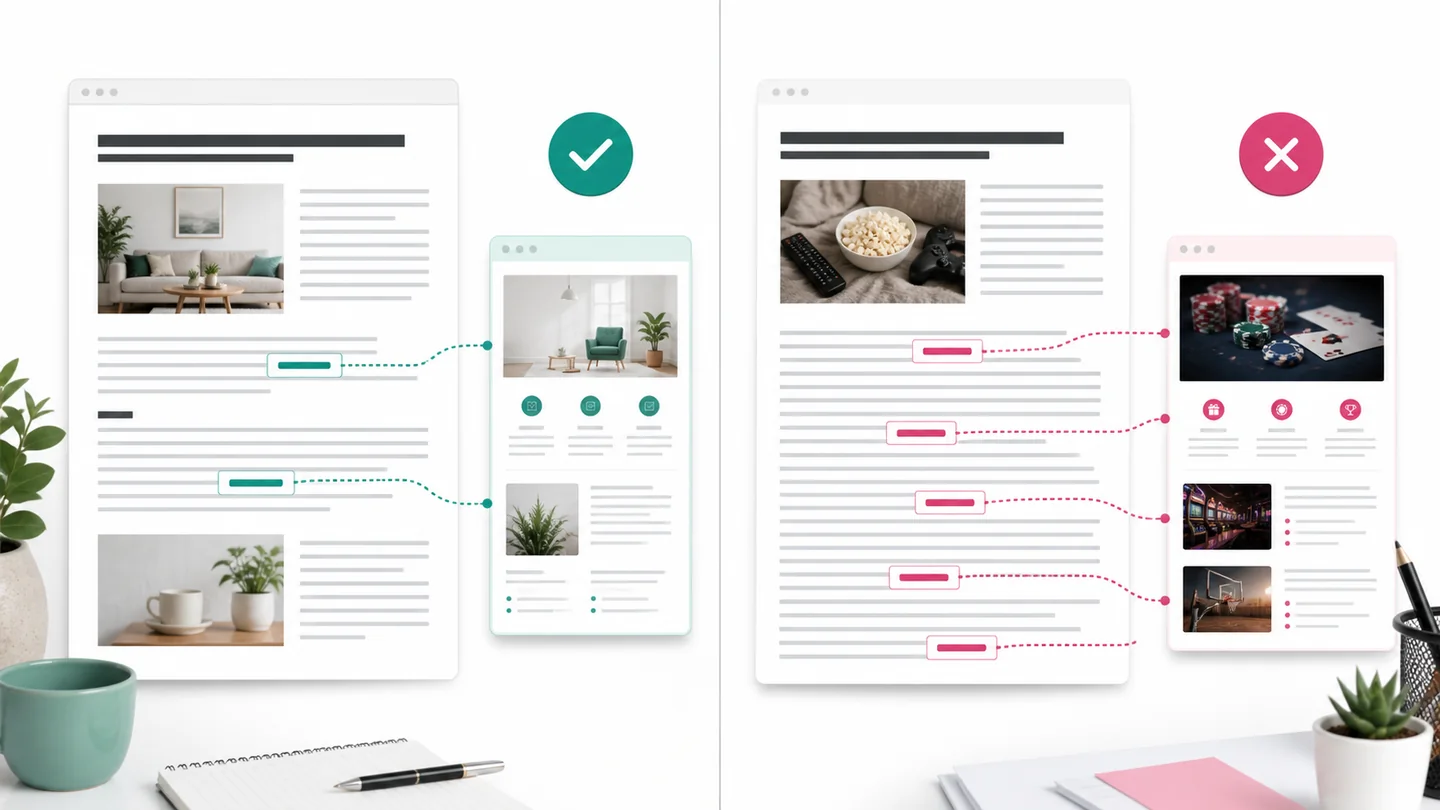
You do not need to force every keyword into the anchor when the paragraph already creates context.
Consider:
When comparing publishers, businesses should review topical relevance, organic visibility, authority, and editorial quality rather than relying entirely on DR. EduGuestPost provides a detailed publisher evaluation framework for making that comparison.
The anchor does not say:
Domain Authority vs organic traffic
word for word.
But the sentence surrounding it clearly establishes the topic.
That gives us a powerful writing principle:
Optimize the paragraph, not only the clickable phrase.
A natural sentence with a descriptive anchor is often better than an awkward sentence containing the “perfect” keyword.
Anchor Text for Guest Posting
Guest posts give you more control because a new article is being created.
That creates both opportunity and risk.
The weak workflow is:
choose anchor → force article around anchor
The stronger workflow is:
choose publisher → understand audience → choose topic → select target page → find natural reference point → choose anchor
Example
Target:
A guide to ecommerce SEO.
Weak guest-post topic:
10 Ways to Become a Successful Entrepreneur
Forced sentence:
Entrepreneurs should also learn about ecommerce SEO services.
There was no real reason for the link.
Better guest-post topic:
Why Large Ecommerce Stores Lose Organic Visibility as Their Catalog Grows
Now a section about crawlability, categories, filters, duplicate pages, and optimization can naturally reference a useful ecommerce SEO resource.
The backlink becomes part of the article.
Not an interruption inside it.
Plan the Link Before Writing—but Don’t Write Only for the Link
This is the balance.
The writer should know:
- Target URL
- Target-page purpose
- Publisher
- Audience
- Possible anchor types
before drafting.
But the article should still be built around reader value.
That is how anchor planning and editorial quality work together.
Anchor Text for Niche Edits
Niche edits require a different approach.
The article already exists.
You cannot reasonably invent any anchor you want and expect the existing paragraph to accommodate it.
Suppose the page says:
Backlink quality depends on several factors, including publisher authority and topical relevance.
Trying to insert:
cheap guest post services agency
would damage the sentence.
Instead, perhaps the editor adds:
Businesses comparing publishers can also use this guest-post quality checklist to evaluate traffic, relevance, and placement context.
Now the insertion improves the article.
That is what an existing-content placement should do.
When evaluating niche edits and contextual link insertions, anchor choice should therefore happen after understanding the existing page.
Anchor Text for Internal Links
Internal anchors deserve more attention than they usually receive.
Your own site gives you far more control over:
- Destination
- Source page
- Anchor
- Placement
- Surrounding paragraph
That makes internal linking one of the easiest ways to reinforce topical relationships.
Ahrefs’ 2026 internal-linking guidance recommends descriptive anchor text and natural variation instead of repeatedly linking to the same destination with identical wording.
Example
Suppose this article needs to link to your backlink-quality guide.
Instead of repeatedly using:
safe link building strategy
everywhere, natural internal variants might include:
- our complete link-building strategy
- how to build backlinks from scratch
- this link-building framework
- the safe link-building guide
All four can lead to the same resource while preserving natural prose.
Internal Anchors Should Support Topic Clusters
For EduGuestPost, a topic cluster could look like:
Safe Link Building Strategy
↓
Anchor Text Optimization
↓
Domain Authority vs Organic Traffic
↓
Guest Post Pricing
↓
Guest Posting Mistakes
↓
Niche Edits
↓
Publisher Marketplace
The internal anchor should tell readers why the next page is relevant.
That is stronger than filling every article with identical commercial keywords.
How Anchor Text Supports Topical Authority
Anchor optimization becomes more powerful when combined with content architecture.
Imagine a website has 40 disconnected articles.
They all discuss backlinks.
But none links logically to the others.
Now compare that with a structured cluster.
Pillar
Complete Link-Building Strategy
Supporting Pages
- Anchor Text Optimization
- Domain Authority vs Organic Traffic
- Guest Post Pricing
- Guest Posting Mistakes
- Niche Edits
- Publisher Selection
Each page links to the pillar where relevant.
The pillar links into the supporting pages.
Supporting articles also connect laterally when the reader’s next question makes sense.
Now descriptive internal anchors help establish relationships among:
link building
publisher quality
anchors
pricing
traffic
guest posting
niche edits
That is how internal anchor text becomes part of topical architecture rather than merely navigation.
Our safe link-building strategy explains how external authority and internal clusters can work together.
How to Audit Your Backlink Anchor Profile
You cannot choose the next anchor intelligently until you know what already points to the site. Ahrefs’ anchor-text study and guide is a useful reminder that correlation is not a prescription, while Semrush’s backlink-analysis workflow shows the fields available for checking real referring pages and anchor variation. Review link attributes separately with the dofollow versus nofollow guide; follow status does not replace a contextual quality review.
- Export the links. Keep the referring domain, referring URL, destination URL, anchor, link attribute, first-seen date, and the traffic or authority fields you actually use.
- Group the wording. Classify branded, exact, partial, descriptive, title, URL, generic, and brand-plus-topic anchors. The categories are there to expose patterns, not to win a labeling argument.
- Analyze each destination. A diverse domain can still have one service page receiving the same commercial phrase repeatedly.
- Count independent sources. Ten relevant referring domains tell a different story from hundreds of links on one network.
- Open the important pages. Read the sentence, inspect the article, and check whether the link is genuinely useful at that point.
- Compare the ranking pages. Use competitors to understand the language and assets the market tends to cite, not to copy a percentage.
For a campaign-level worksheet and a repeatable monitoring routine, continue with the separate guide to building and tracking a natural anchor-text profile. This page remains the broader anchor-text reference; that guide is the operational companion.
Use the Anchor Text Analyzer Before Ordering Links
For larger campaigns, manual classification becomes tedious.
The EduGuestPost Anchor Text Analyzer can help organize anchors into patterns so you can review:
- Repeated phrases
- Commercial anchors
- Branded anchors
- URLs
- Generic wording
- Anchor diversity
The useful workflow is:
analyze existing profile
↓
review target page
↓
compare SERP competitors
↓
choose relevant publishers
↓
plan several acceptable anchor directions
↓
let the final article determine the best wording
That is much better than handing a writer one exact keyword with:
“Use this exactly.”

How to Choose the Next Anchor
When a new placement is ready, make the decision in this order:
- Name the destination. Is it a homepage, service, guide, study, tool, product, or comparison?
- State what the page actually offers. The anchor should prepare the reader for that specific answer or action.
- Read the publisher. Use the terminology its audience already understands.
- Read the article. The topic and sentence should create the link opportunity; the backlink should not dictate a thin article.
- Check the existing page-level profile. If one commercial phrase is already common, branded, title, or descriptive wording may be the more honest choice.
- Use the editor test. Ask what a careful editor would write if there were no anchor spreadsheet in front of them.
This sequence creates variety as a consequence of different pages, publishers, and editorial settings. It is more defensible than manufacturing diversity from a fixed ratio.
How Exact-Match Anchors Should Be Used
Exact-match anchors still have a place.
I would consider them when:
- The keyword naturally describes the destination
- The sentence reads perfectly normally
- The publisher accepts the wording
- The wider profile is not dominated by that anchor
- The page is genuinely relevant
- The backlink itself is high quality
Example
Article:
How SaaS Companies Build Authority in Competitive SERPs
Sentence:
Relevant SaaS guest posting services can help brands secure placements within publications their target audience already reads.
If the linked page genuinely offers SaaS guest posting, the anchor can make sense.
There is no need to fear a phrase merely because it is a target keyword.
The question is whether the placement looks editorial or engineered.
When I Would Avoid Exact Match
I would usually choose something else when:
- The same keyword already dominates the page’s anchor profile
- The sentence becomes awkward
- The publisher is only loosely relevant
- The page is aggressively commercial
- The placement exists mainly to carry the anchor
- Several recent campaign links already use similar wording
- A brand or descriptive reference would communicate the destination better
Anchor optimization should improve the link.
Not make the link harder to justify.
Brand Anchors Are More Valuable Than Many Campaigns Assume
SEOs sometimes view branded anchors as a missed opportunity because they do not contain the target keyword.
I think that is shortsighted.
A link saying:
EduGuestPost
inside an article discussing guest posting, backlinks, publisher selection, or SEO still connects the brand with the subject.
And it can create value through:
- Referral clicks
- Brand recognition
- Citation
- Brand searches
- Topical association
- Third-party presence
Ahrefs’ research into AI Overview visibility found branded web mentions and brand anchors among its strongest observed off-site correlations.
Again, correlation is not causation.
But it supports a broader SEO direction:
build the brand as well as the keyword profile.
The most defensible backlink campaigns do both.
Don’t Ignore the Words Around the Anchor
The anchor is only the clickable part. The sentence and paragraph explain why the reference belongs there.
| Placement | Anchor | Surrounding context | Review |
|---|---|---|---|
| Contextual reference | guest post pricing | A paragraph comparing publisher costs, editorial work, and turnaround | The anchor and explanation prepare the reader for the destination. |
| Forced insertion | guest post pricing | A paragraph about an unrelated product with no reason to discuss publishing costs | The same words do not repair the contextual mismatch. |
Review the whole sentence aloud. If the destination feels surprising after the click, revise the wording, the paragraph, or the placement itself.
Anchor Text and Publisher Quality Must Be Planned Together
A perfectly optimized anchor from a terrible publisher is still a weak strategy.
Suppose you have:
exact-match anchor
on:
DR 72
but the site has:
- No relevant traffic
- Random niches
- Thin articles
- Hundreds of commercial links
- Weak editorial standards
Now compare it with:
branded anchor
on:
DR 55
with:
- Strong niche relevance
- 20,000 relevant visitors
- Good articles
- Real readership
- Credible editorial standards
I would not select the first backlink merely because its anchor looks more “SEO optimized.”
Our guide to Domain Authority vs organic traffic explains why publisher quality needs to be evaluated together with authority and current search visibility.
Anchor Text and Guest-Post Pricing
Anchor control also has economic value.
Some publishers:
- Accept your requested anchor exactly
- Edit anchors
- Allow only brand anchors
- Reject commercial phrases
- Allow one contextual link
- Charge extra for additional links
- Restrict specific industries
Those rules affect what you’re actually buying.
But do not automatically assume:
more anchor control = better publisher.
In fact, strict editorial publishers may offer less anchor flexibility precisely because they protect their writing standards.
When evaluating cost, our guest-post pricing guide recommends comparing the entire opportunity rather than treating one link characteristic as the product.
Common Anchor Text Mistakes
Most anchor problems are ordinary planning mistakes repeated across several placements:
- Using the same keyword everywhere. Different writers and articles should not all produce identical language.
- Choosing the anchor before the topic. That reverses the editorial process and often creates a forced angle.
- Ignoring the destination. The wording must accurately describe what appears after the click.
- Looking only at domain-wide percentages. Review important URLs separately, especially commercial pages.
- Treating branded anchors as weak. A relevant brand reference can support recognition, trust, and topical association.
- Copying a competitor’s exact-match pattern. You rarely know how those links were earned, whether they still matter, or whether the pattern is helping.
- Ignoring the paragraph. The surrounding explanation can carry more context than a short anchor alone.
- Forcing wording into a niche edit. An existing paragraph limits what can be added naturally.
- Optimizing a poor placement. Better wording cannot rescue an irrelevant or low-quality page.
- Forgetting internal links. Internal anchors should reinforce the same topic relationships as the external campaign.
- Inventing a universal natural percentage. A famous brand, a new SaaS company, and a statistics page should not have identical profiles.
- Never reviewing the profile again. New links change the distribution and may change the next sensible choice.
Several of these overlap with the broader guest-posting mistakes that waste budget, particularly weak publishers, forced topics, and decisions made from one metric.
What to Do With an Overoptimized Anchor Profile
Do not treat one or two keyword-rich links as a crisis. First establish whether there is a repeated page-level pattern, then improve what happens next.
- Identify the affected URLs. Review service and product pages separately from the whole domain.
- Stop repeating the phrase. Future placements do not need to recreate the same commercial wording.
- Create assets people can cite. Useful guides, original research, statistics, and tools naturally invite title, brand, and descriptive anchors.
- Earn more relevant brand references. These can broaden the profile while making the company easier to recognize.
- Add new referring domains. Diversity of credible sources matters more than cosmetic variation from the same network.
- Improve internal routes. Connect cited resources with the commercial and informational pages they support.
- Request an edit only when it improves the article. Fix an obviously awkward anchor when a publisher relationship allows it, but do not force every historical link into a calculated ratio.
The practical goal is a better future pattern, not a graph that merely looks tidy.
A Practical Anchor-Text Planning Framework
EduGuestPost uses the following five-part review before approving anchor wording. It is a decision aid, not a ranking formula.
| Review layer | Question to answer | Evidence to record |
|---|---|---|
| Destination | What does the page actually cover and what intent does it serve? | Target URL, page type, primary subject |
| Existing profile | Which anchor families and referring domains already point to this URL? | Page-level anchor export, repeated phrases, source diversity |
| Publisher | Which terminology fits the publication and its readers? | Niche, market, audience, editorial style |
| Article context | Which phrase belongs naturally in this sentence? | Proposed sentence, paragraph, article angle |
| Campaign context | Does this placement add useful variation across pages, sources, and language? | Campaign log, destination mix, next review date |
The final anchor comes after those questions, not before them. Recording the evidence also gives a client or editor a clear reason for the choice.
Example Anchor Plan
Suppose the destination is the EduGuestPost guest-post pricing guide. These are possible directions, not a quota:
| Anchor family | Example | Where it may fit |
|---|---|---|
| Branded | EduGuestPost | A sentence crediting the publisher or service |
| Brand plus topic | EduGuestPost’s guest-post pricing guide | A direct editorial citation |
| Page title | How Much Should You Pay for a Guest Post in 2026? | A reading list or named resource |
| Descriptive | current guest-post pricing benchmarks | A discussion of market costs |
| Partial match | guest-post pricing in 2026 | A sentence where the year and subject are both relevant |
| Natural topic | what publishers charge for guest posts | An answer-led paragraph |
| URL | eduguestpost.com/guest-post-pricing-guide/ | A raw citation or profile |
| Exact match | guest post pricing | Only when the short phrase reads naturally |
The publisher, sentence, and existing profile decide which direction is appropriate. A useful plan preserves options instead of assigning an exact percentage to each row.
How Anchor Strategy Changes by Site Maturity
Anchor Text for a New Website
A new website usually has little backlink history.
That means you should avoid trying to create an artificially perfect profile from day one.
Instead:
- Build your brand
- Publish strong content
- Earn relevant referring domains
- Use varied editorial wording
- Create linkable assets
- Build citations and mentions
- Link to different useful pages
- Let publishers write naturally
A young brand may not initially attract the same branded-anchor percentage as a globally recognized company.
That is normal.
Your profile should reflect what your website actually is.
Anchor Text for Established Websites
Established sites should first audit what already exists.
You may discover:
- Commercial pages already have many keyword anchors
- Homepage anchors are mostly branded
- Old blog posts attract descriptive phrases
- Research pages earn title anchors
- Product pages receive brand + product anchors
Now you can plan new acquisitions around actual gaps.
The larger the backlink profile becomes, the less useful simplistic percentages become.
Context becomes more important.
Anchor Text and Referring-Domain Diversity
Anchor diversity is useful.
Referring-domain diversity is equally important.
Imagine:
100 varied anchors from one mediocre website
versus:
20 contextually relevant anchors from 20 strong independent publishers
The second campaign may create a much broader authority footprint.
Anchor text should therefore be evaluated alongside:
- Referring domains
- Publisher authority
- Topical relevance
- Traffic
- Page context
Strong anchors do not turn weak backlink sources into strong ones.
Anchor Text and the Future of Guest Posting
I expect high-quality, relevant guest posting to remain useful in 2027 and beyond, and anchor text will continue to matter as part of the context connecting brands, topics, and pages.
But the strongest campaigns will probably become less obsessed with exact-match keywords and more focused on:
- Relevant publishers
- Strong referring domains
- Brand mentions
- Natural topical language
- Useful third-party articles
- Audience discovery
- Referral visibility
- Contextual links
- Brand-to-topic associations
Search experiences will continue evolving.
AI-driven discovery will continue expanding.
But a credible brand being cited and linked from relevant third-party content is a durable form of web presence.
That is bigger than one exact-match anchor.
Anchor Text Optimization Checklist
Use this final review before approving an external placement:
| Area | Questions |
|---|---|
| Destination | Does the page deserve the link, and does the wording accurately describe it? |
| Publisher | Is the site relevant, visible, credible, and appropriate for the target audience? |
| Article | Does the topic create a real reason to reference the destination? |
| Anchor | Does it fit grammatically, sound editorial, help the reader, and avoid unnecessary repetition? |
| Context | Does the paragraph reinforce the subject, and is the link useful at that exact point? |
| Profile | What already points to this URL, and does the new source add meaningful diversity? |
| Internal architecture | Do related pages link to one another in ways that help readers continue the topic? |
| Reporting | Are the anchor, destination, referring page, publisher, placement type, and date recorded? |
If those answers are clear, the campaign is doing more than selecting clickable words. It is designing a contextual backlink that can be reviewed later.
Anchor Text Optimization FAQs
What is anchor text optimization?
Anchor text optimization is the process of selecting and evaluating clickable link wording so it accurately describes the destination, fits the surrounding article, supports topical context, and works naturally within the wider backlink or internal-link profile.
Does anchor text affect SEO?
Yes, anchor text provides contextual information about the relationship between pages.
But it should be evaluated with publisher quality, topical relevance, surrounding content, referring domains, and the destination page.
Is exact-match anchor text good for SEO?
Exact-match anchors can provide clear keyword relevance and may fit naturally in some articles.
The problem is repeatedly manufacturing the same keyword-rich anchor across many placements.
What percentage of exact-match anchors should I use?
There is no universal percentage.
Review your target page, backlink history, competitors, publisher context, brand recognition, and current profile instead of applying one fixed formula.
Are branded anchors good?
Yes.
Brand anchors are natural for editorial references and can contribute to brand recognition, authority, referral visibility, and topical associations.
Are partial-match anchors better than exact match?
Neither is universally better.
Partial-match anchors often provide more writing flexibility, while exact-match anchors can be useful when the wording naturally describes the destination.
What is the best anchor for a guest post?
The best anchor usually describes the target page accurately while fitting naturally into an article specifically written for the publisher’s audience.
What anchor should I use for a niche edit?
Start with the existing article.
Choose wording that improves or naturally completes the current paragraph rather than forcing an unrelated commercial keyword into it.
Should internal links use exact-match anchors?
Internal links can use highly descriptive keyword-focused anchors when they fit naturally.
However, repeated identical wording is unnecessary. Natural variations can reinforce related topics while improving readability.
Should I copy competitor anchor ratios?
No.
Analyze competitors for patterns and context, but remember that their brand, backlink history, content assets, and acquisition channels may differ from yours.
What should I do if my anchors are overoptimized?
Audit the affected target pages, stop repeating the same keyword, expand relevant referring domains, earn branded and descriptive references, build links to useful informational assets, and improve future acquisition rather than attempting to mathematically manufacture a perfect profile.
Is anchor text more important than backlink quality?
No.
A strong anchor on an irrelevant, low-quality publisher does not become a great backlink.
Publisher quality, relevance, referring-domain strength, organic visibility, page context, anchor text, and destination quality should be evaluated together.
Final Takeaway
Anchor text matters.
But the strongest anchor-text strategy does not begin with:
“What keyword do we want to rank for?”
It begins with:
What page are we promoting?
What does that page actually offer?
Who is linking to it?
What is the article about?
What does our current backlink profile look like?
What wording would a real editor naturally use?
Then choose the anchor.
Use exact-match anchors when they genuinely fit.
Use partial matches when they improve the sentence.
Use branded anchors confidently.
Let research and guides earn descriptive or title-based anchors.
Allow URLs where URLs make sense.
And pay attention to the surrounding paragraph because a relevant sentence can provide more useful context than stuffing one keyword into the clickable text.
Most importantly:
don’t optimize the anchor while ignoring the backlink.
A great backlink should connect:
the right publisher
to:
the right article
through:
the right context
to:
the right page
with:
anchor text that naturally explains the connection.
That is anchor text optimization worth building a link strategy around.
Need this turned into a real placement plan?
Send the URL you want to promote, the market you care about, and the type of publishers you prefer. EduGuestPost will review fit, availability, anchor options, and reporting before quoting.