
Defined coverage / Maintainable sitemap output
XML Sitemap Optimization Services
Keep your sitemap aligned with your website
New pages can be missing from a sitemap while old redirects remain listed. An export may look complete but draw from only part of your content, or assign fresh dates to pages that have not changed. EduGuestPost’s XML sitemap optimization services help you identify these gaps and prepare a maintainable plan for the URLs you want discovered.
The proposed engagement connects your sitemap files with the intended public pages, their search directives and the system generating the output. It can cover a particular content type, a platform change or an agreed set of sitemap files, with coverage and implementation responsibilities confirmed in the quotation.
Google’s sitemap overview explains that sitemaps support discovery without guaranteeing that every listed item will be crawled or indexed. Useful navigation, accessible content and consistent URL decisions remain important alongside a readable XML file.
Your proposed deliverables can include:
- A file inventory showing the index, child files and generation owners.
- A coverage review identifying intended inclusions, exclusions and unresolved gaps.
- Prioritized repair tasks for URL selection, XML output and update information.
- Acceptance checks and a handover explaining what passed and what remains open.
Start with the pages that matter to your business and the evidence that prompted the review. A new product collection missing from the output needs a different investigation from a file that cannot be fetched. The plan should make that distinction clear before recommending changes.
Share your website, current sitemap address, affected content types and representative missing or outdated entries. Explain whether you need recommendations, implementation support or verification of work already completed.
Request an XML sitemap optimization quote to agree the scope and next steps.
Establish the files and the expected coverage
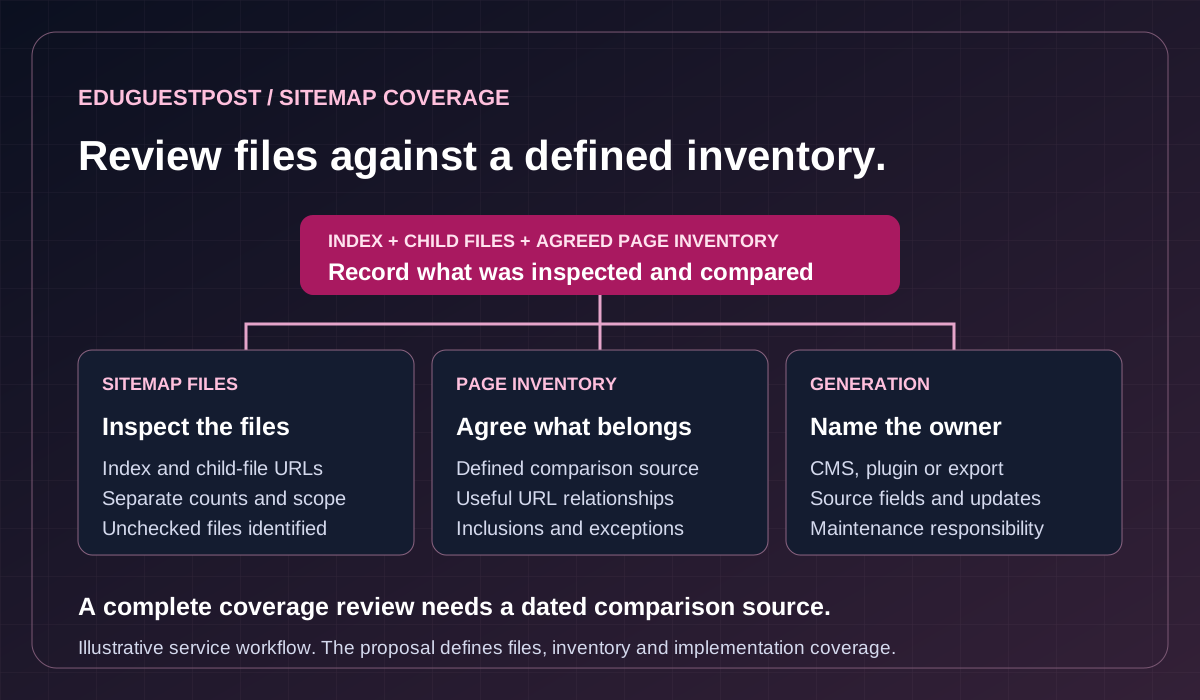
Begin with the sitemap index and the individual files it references. An index containing a handful of addresses may represent thousands of pages through its child files. Count those levels separately and record which files have actually been inspected.
Identify the source of each file before proposing a replacement. A CMS, SEO plugin, application route or scheduled export may already maintain it. A manually uploaded file can become stale or compete with that existing output if ownership is unclear.
Scroll across to explore all columns.
| Review area | Evidence to establish | Decision to document |
|---|---|---|
| Public location | Exact file URLs, hosts and responses | Which site and sections the files cover |
| Index structure | Referenced child files and inspection coverage | What has been reviewed and what remains unchecked |
| Content inventory | Agreed CMS records, URL list or crawl evidence | Which intended pages should be represented |
| Generation source | Active configuration and update process | Who owns the output and its maintenance |
Google’s build-and-submit guidance explains how location and submission setup affect scope. A root location is generally recommended, while verified cross-site arrangements need their own review. Mixed hosts deserve investigation without an automatic conclusion that every such setup is invalid.
Compare against a defined inventory
The XML Sitemap Checker examines one public or supplied document for structural and entry issues. For an index, it extracts child-file addresses without opening those files. It does not visit listed pages, inspect their directives or confirm Google indexing.
A missing-page assessment requires a comparison source. Agree whether that source is a supplied inventory, selected CMS records or a separately scoped crawl, and record its date and limits. A successful check of one file cannot establish that every intended page on the website is included.
Choose the URLs that belong in the sitemap
The proposed inclusion policy should describe which public destinations represent your content and which addresses serve another purpose. Preserve meaningful product choices, language versions and useful landing pages while investigating stale routes, accidental duplicates and deliberate exclusions.
Google’s canonical guidance treats sitemap inclusion as a canonical signal, with less influence than redirects or canonical annotations. Listing a preferred URL should support the rest of the implementation. It does not force Google to select that address or establish that similar pages are equivalent.
Review declarations and destination evidence
The Canonical Tag Checker reads public or supplied declarations, with destination evidence where verification is enabled. Use its findings to investigate conflicts; it does not decide content equivalence or Google’s selected canonical.
The Redirect Checker can examine observed HTTP routes within its limits. A destination match, an observed redirect and a successful response are separate results. Confirm the intended final page before replacing an old entry with a different address.
Respect deliberate indexing and access decisions
Google’s noindex guidance explains that a supporting crawler must be able to fetch a page to read the instruction. Adding the address to a sitemap does not cancel that instruction or override a crawl restriction. Private content still requires appropriate access controls.
The Indexability Checker supports bounded public-response and directive checks. It does not crawl the whole site, verify sitemap membership or confirm Google indexing. Keep its findings beside the intended page purpose and any authorized search-report evidence.
Do not remove every parameter or later collection page simply because its URL differs from the main listing. The inclusion decision should follow actual content, navigation and canonical relationships. Broader faceted-navigation or URL-consolidation work can be specified separately.
Produce readable XML and truthful update information
The repair plan should address the output visitors and crawlers actually receive. Confirm that the public file returns the intended document, uses the correct structure and preserves the exact destination addresses. A browser stylesheet or attractive preview does not establish that the XML and URL choices are correct.
The sitemap protocol defines the required elements, namespace, UTF-8 encoding and escaping. Each individual sitemap can contain up to 50,000 URLs and must be no larger than 50 MB uncompressed. Larger inventories require an appropriate split and index. A checker or generator can have much smaller operating limits than those publishing allowances.
Use dates that describe the content
Google’s guidance on lastmod calls for the last significant page change. Rebuilding the file does not justify assigning today’s date to every entry. Leave uncertain optional dates out until the publishing system can provide reliable values.
Distinguish a listed page’s modification date from an index entry’s date for the corresponding child sitemap file. Review the actual source field and update process before changing many values. Google ignores priority and changefreq, so those fields should not become a promised route to faster crawling or better rankings.
Match the generation method to the website
The XML Sitemap Generator formats a reviewed list into downloadable XML. It accepts supplied addresses and optional dates, preserves meaningful URL differences and exports one origin at a time. It does not visit those pages, discover missing URLs or establish indexing.
A supplied-list export can suit a small, stable set of pages. A changing catalog usually needs a maintained generation source. Agree how new pages, moves and removals reach that source so a correct file remains useful after the initial cleanup.
Define specialized content and maintenance responsibilities
Language alternatives, media and news can require information beyond a basic page list. Include that work when the website’s content and intended search use justify it. The quotation should identify the extensions covered, required source data and checks that will be performed.
Preserve equivalent language and regional versions
Google’s localized-version guidance describes sitemap annotations that list the relevant variants, including each page itself. The intended relationships, supported codes and reciprocal entries need to agree across the supplied set.
The Hreflang Checker can review one supplied sitemap urlset and compare matching alternate entries within that input. This mode does not fetch those pages or discover other files. It cannot judge translation quality, establish content equivalence or prove that Google uses the annotations.
Validate media and news requirements separately
Google publishes distinct requirements for image sitemaps, video sitemaps and news sitemaps. A general XML parser recognizing an extension does not validate its complete schema, media accessibility or search eligibility.
For example, a video entry needs the appropriate host-page relationship and required metadata. News entries have publication and recency rules that differ from a general article archive. Keep original publication information distinct from later page updates, and preserve content that belongs in a standard sitemap after its news-specific treatment changes.
Name the system responsible for future updates
Record the active CMS, plugin, framework or export owner and how its configuration reaches the public response. Build-time generation, dynamic routes and caching can affect which changes appear. A software example using the current time is not evidence that a page changed then.
Confirm whether implementation and continuing monitoring are included. The handover should explain the agreed maintenance process and the situations that require another review.
Verify the change and agree the next step
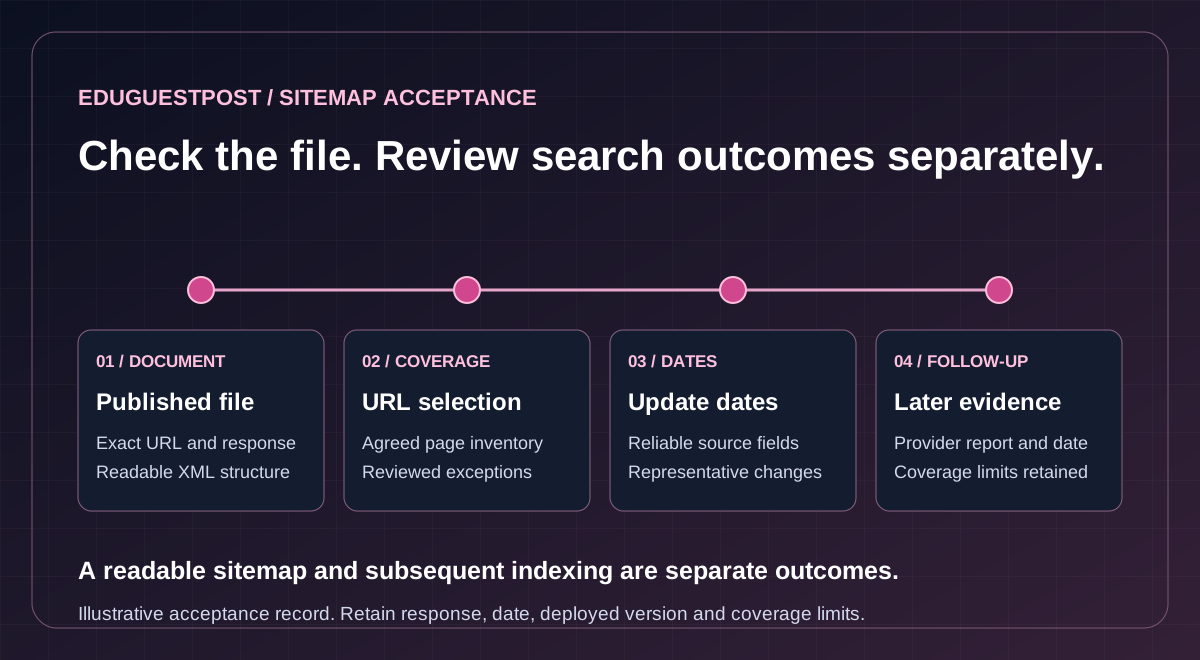
Acceptance should connect each repair to evidence that can be reviewed. Retain the relevant file address, observation time, deployed version and coverage limits. Confirm the implementation owner and rollback approach before an authorized release.
Scroll across to explore all columns.
| Check | Evidence to retain | Acceptance question |
|---|---|---|
| Published document | Exact URL, response and parsed structure | Is the intended file available and readable? |
| URL selection | Agreed inventory and reviewed exceptions | Does the output represent the intended pages? |
| Update information | Source fields and representative changes | Are dates accurate and maintainable? |
| Follow-up evidence | Processing result, date and report coverage | What has the search provider actually reported? |
Search Console’s Sitemaps report shows processing information for sitemaps submitted through the report or API in the current property. It does not list every sitemap Google may have discovered. A successful read and discovered-page count do not establish that every listed page was crawled or indexed.
Where authorized evidence is available, URL Inspection can help investigate individual pages. Indexed data and a live test differ; a live result cannot predict Google’s selected canonical. Record dates so older observations are not mistaken for checks of the latest release.
The quote should confirm file and URL coverage, deliverable formats, access, implementation responsibilities, follow-up, price and timing. If the problem extends beyond sitemaps, SEO Audit Services or SEO Consulting Services provides a route to a separately defined investigation or policy review.
Common questions about XML sitemap optimization
Does checking one sitemap establish complete website coverage?
A missing-page assessment needs an agreed comparison inventory with a date and defined limits. The XML Sitemap Checker reviews one document; an index review extracts child-file addresses without opening those files.
Should every different URL be removed from the sitemap?
The inclusion policy follows actual content, navigation and canonical relationships. Meaningful product choices, language versions and useful landing pages are preserved while stale routes, accidental duplicates and deliberate exclusions are investigated.
Should every entry receive the date the sitemap was rebuilt?
A lastmod value should describe the last significant page change, rather than the file rebuild. Page dates and dates describing child sitemap files are different; uncertain optional dates can be omitted until reliable values are available.
Does the XML Sitemap Generator discover missing pages?
The generator formats supplied addresses and optional dates into downloadable XML, one origin at a time. It does not visit those pages, discover missing URLs or establish indexing.
Are image, video, news and language requirements included automatically?
Specialized work is included when the content and intended search use justify it. The quotation identifies covered extensions, source data and checks; a general parser recognizing an extension does not validate every feature requirement.
Does successful sitemap processing mean every page is indexed?
A successful read or discovered-page count does not establish that every listed page was crawled or indexed. Search Console processing reports and individual URL observations retain their own dates, scope and limits.
Request an XML sitemap optimization quote
Request your XML sitemap optimization quote with your website, current sitemap and representative concerns. Agree the work and acceptance criteria before proceeding; subsequent crawling, indexing and search performance remain separate outcomes.
Tell us about your sitemap work
Share the public sitemap address, affected content and support needed. Agree private evidence and access arrangements separately.