
Hreflang Checker
Check language annotations, conflicting URLs and return links. Inspect a live page or review HTML, HTTP Link headers and sitemap XML before publishing.
Start with one page
Choose a page with an equivalent version in another language or region. An English product page and its French translation belong together; an English product page and a French homepage usually do not. Hreflang describes that relationship. It does not translate the content or make an unrelated destination equivalent.
Enter the exact page address, including its trailing slash and any meaningful query string. URL mode inspects the returned HTML and HTTP Link headers, then checks a bounded set of directly listed alternatives. Start with a representative product, article or category page when reviewing a template change.
Check the return link
Suppose /en/size-guide/ lists /fr/guide-des-tailles/ as its French alternative. Inspect the French page too: does it list the English address under the English language code? A link in the visible language switcher is useful for visitors, but it is not the same as an alternate declaration.
The report keeps each page’s annotations beside its response evidence. If a destination times out or returns an incomplete response, the result says it was not fully checked. That is different from finding a complete page without the expected return annotation. Fix the fetch problem before drawing conclusions about the missing evidence.
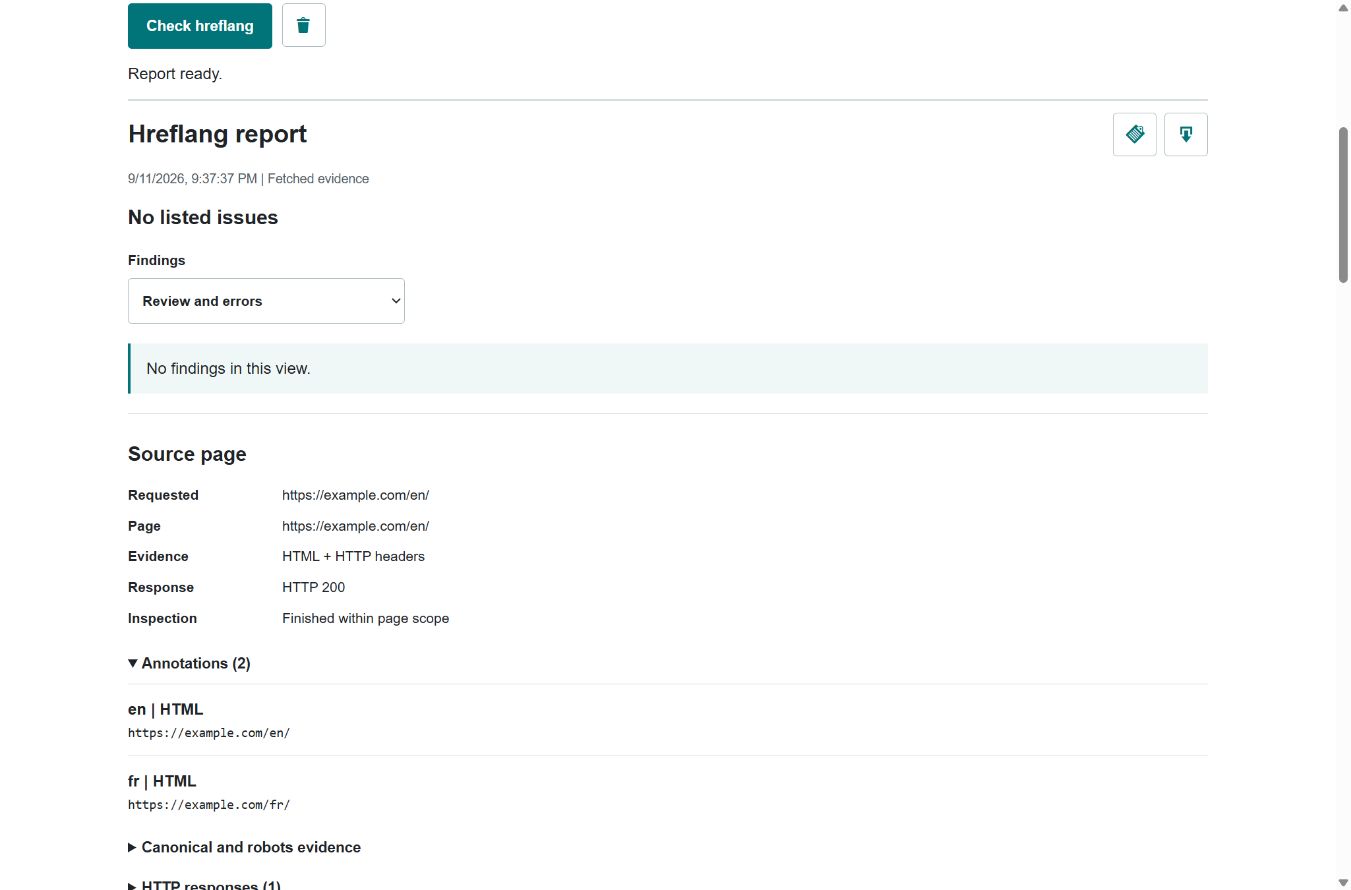
Read the code
Use a language code such as en, optionally followed by a region such as en-GB. en-UK and a country code on its own are not valid substitutes. Script identifiers, such as zh-Hant, can distinguish writing systems. The checker uses a bundled registry to review language, script and country codes.
Google’s localized-version documentation explains self-references, reciprocal annotations and fully qualified URLs. It also describes x-default as a fallback for unmatched audiences. Its absence alone is not a broken implementation. When a code points to two different URLs, resolve the conflict instead of adding another declaration.
Choose the right source
Full HTML is useful for a draft or saved response. Supply the whole document so head placement can be evaluated. HTTP Link headers suits header-based implementations, including PDFs. Supply the Link values or lines beginning with Link:. Neither pasted mode visits the addresses in your input.
XML sitemap reviews one supplied urlset. Include the requested page and the relevant alternate entries if you want return comparisons. It does not discover other sitemap files or fetch their URLs. Page mode cannot rule out a separate sitemap implementation, so review the source your site actually uses. Google treats HTML, headers and sitemaps as equivalent implementation methods.
Follow the evidence
An alternate address may redirect after a migration. The report shows the requested URL and final response separately; update the declaration when the final address is the intended destination. Also review any noindex directive or different declared canonical. These are separate signals, not problems hreflang can automatically cancel.
Multiple regional codes sharing one language URL may be deliberate. A shared destination for different languages needs closer inspection of what visitors actually receive. Read the page before changing it. For wider site audits, Screaming Frog’s hreflang workflow covers sitewide crawling and exports; this checker is for a focused page-level review.
What this covers
Inputs are UTF-8 and up to 256 KiB. Inspections cover up to 60 declarations per page and 30 supplied sitemap entries. URL checks follow up to two redirects per target within an overall time budget. Unchecked targets and processing caps are disclosed in the report.
The tool does not render JavaScript, detect the content’s language, judge translation quality, discover sitemaps or query Google’s indexing data. Requests use the checker’s user agent and an English language preference. A different response to another visitor is possible. Submitted markup and report bodies are not cached or logged by this module; avoid submitting sensitive information.
Download the JSON report to keep the observed evidence with your change notes. After fixing the template, check both sides again. Use the Hreflang Generator to prepare a new annotation set, or the Indexability Checker to review crawl rules and indexing directives separately.
Common questions
Does every page need hreflang?
No. It connects equivalent language or regional versions. A page with no localized alternatives does not need invented annotations just to make a checker look complete.
Can I check annotations in a sitemap?
Yes. Supply one sitemap urlset and the page URL to inspect. Return checks use matching entries in the supplied XML; they do not fetch the pages or discover other sitemap files.
Does a clean report prove Google uses my tags?
No. The report covers the inspected declarations and responses. It does not detect the actual content language, judge translation equivalence or access Google indexing and canonical-selection data.
Planning outreach?
Share your target page and campaign requirements for a publisher outreach review.