
Matched evidence / Reproducible developer tasks
JavaScript SEO Services
Make important pages easier to process
EduGuestPost’s JavaScript SEO services help you investigate how important pages deliver their content, expose links and communicate indexing preferences. We turn the findings into prioritized development tasks, with agreed checks for the pages and templates included in your project.
A product page may display its description only after a data request. A category may reveal later items through a button. A shared template may send one canonical URL and replace it after loading. Each situation needs evidence about the actual behavior before choosing a repair.
The proposed engagement can include:
- A defined sample of public routes, templates and relevant page states.
- Comparison of initial responses, supplied browser snapshots and available Google-specific evidence.
- Investigation of content, navigation, metadata and resource dependencies.
- Prioritized implementation tasks with owners, acceptance checks and a verification record.
Your quotation identifies which deliverables EduGuestPost will prepare, who can implement the changes and what review support is included. Development, hosting and release responsibilities are confirmed around your actual system and available access.
Bring the affected URLs and a clear symptom, such as missing page content, inconsistent declarations or a route that fails when opened directly. Include your framework, deployment setup and any dated reports or recent releases that help reproduce the problem.
If the cause remains unclear across the website, SEO audit services can define a broader diagnostic review before a specialist repair project begins.
Request a JavaScript SEO quote with your priority pages, the evidence you have and the person who can implement work. We can then agree the proposed sample, deliverables and verification arrangements.
Establish what each source can show
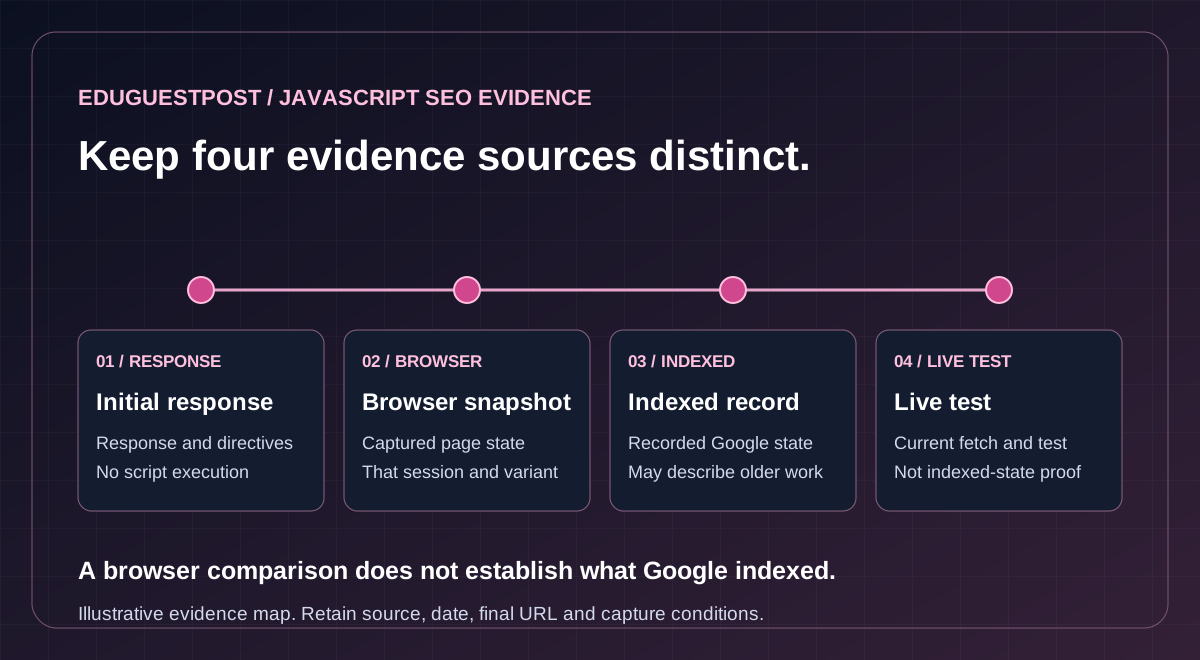
Google can execute JavaScript, but crawling, rendering and indexing remain different stages. Google’s JavaScript SEO guidance explains why a working browser page and a successful server response answer only part of the investigation.
We keep the source and date attached to each observation. A useful comparison also preserves the final URL, device context, consent choice, login state and selected variant. Otherwise, a difference may come from the captured session rather than a broken template.
Scroll across to explore all columns.
| Evidence source | Useful question | Boundary to retain |
|---|---|---|
| Initial response | What content, headers and declarations did the request return? | Does not execute the page’s JavaScript |
| Browser DOM snapshot | What markup existed in the captured page state? | Represents that browser session and capture |
| Google’s indexed record | What does Google report from its recorded processing? | May describe an earlier version |
| Google live test | Can the current page be fetched and processed within the test? | Does not establish indexing or canonical selection |
The JavaScript SEO Checker compares supplied source and rendered snapshots and can review imported Lighthouse evidence. It does not execute JavaScript or independently confirm what Google indexed. Its findings provide questions to reproduce and investigate.
For a detailed comparison, the Rendered HTML Checker retains observed changes to titles, directives, headings and links. It requires a matched full DOM snapshot you supply; parsed text counts do not measure visible layout or content quality.
The baseline identifies the exact missing passage, changed declaration or unavailable destination. It also records evidence gaps so the next reviewer can distinguish an observed problem from an untested possibility.
Review content discovery and application routes
Begin with the information a visitor needs from each public page. Check whether its main description, supporting details and important destinations arrive reliably on a direct visit. Repeat the relevant in-app navigation when it uses a different loading path.
Give useful destinations working URLs
Changing the address bar does not prove that the new address works when opened separately. Route review can include direct requests, refreshes, navigation between pages and the intended behavior for missing items. The proposed task should identify which application, server or hosting rule owns any disagreement.
Google’s link best practices favor real anchors with resolvable href destinations. A click handler without a suitable destination can leave navigation difficult to discover. Ordinary links to sections within a page remain useful; they serve a different purpose from fragment-based application routes.
If the wider issue concerns where important pages are linked, internal linking services can define that planning and placement scope. Repairing a component’s link output does not automatically provide a complete linking strategy.
Make later content discoverable
Load-more controls and infinite collections need an appropriate route to later items. Google’s lazy-loading guidance describes persistent component URLs and sequential links that support discovery without relying on Google clicking a button or scrolling.
The review distinguishes meaningful public pages from sort orders, filters and private application states. Each needs an intended policy before canonical, access or routing changes are proposed. A catch-all that returns the same application shell for every unknown address needs careful error-state review.
The deliverable records affected examples and the proposed template change, including useful states that must continue to work.
Align directives metadata and required resources
An indexing instruction can come from the initial HTML, a response header or later application code. For a page intended for search, investigate an initial noindex at the system producing it. Google may skip rendering after seeing that instruction, so removing it later with JavaScript is not a dependable repair.
Keep deliberate exclusions where they belong. Private account pages, duplicate variants and genuine error states need different decisions from public service or product pages. The Indexability Checker reviews bounded response and directive evidence; it does not reproduce Google’s network identity or confirm indexing.
Keep page preferences consistent
Review route-specific titles, descriptions and canonical declarations alongside the content they describe. A shared default may be appropriate for site-wide facts while an individual page needs its own values. The Canonical Tag Checker can inspect declarations and optional supplied DOM evidence, with destination checks where enabled. Google’s selected canonical remains a separate question.
Framework behavior matters. Next.js metadata documentation describes version-specific streaming and bot-sensitive delivery. Inspect the actual response, resulting document and applicable framework behavior before treating a missing value in one initial snapshot as a complete diagnosis.
Trace the dependency that matters
A failed request for the article body has different consequences from failed analytics telemetry. Investigate the resources needed to produce useful content and reproduce relevant hydration or data-loading errors. A console message alone does not establish the cause of a search problem.
The Structured Data Checker can review supported JSON-LD evidence, but its URL mode does not render scripts. Markup added later needs appropriate captured evidence and feature-specific testing. Accurate visible content remains essential.
Turn findings into an agreed implementation plan
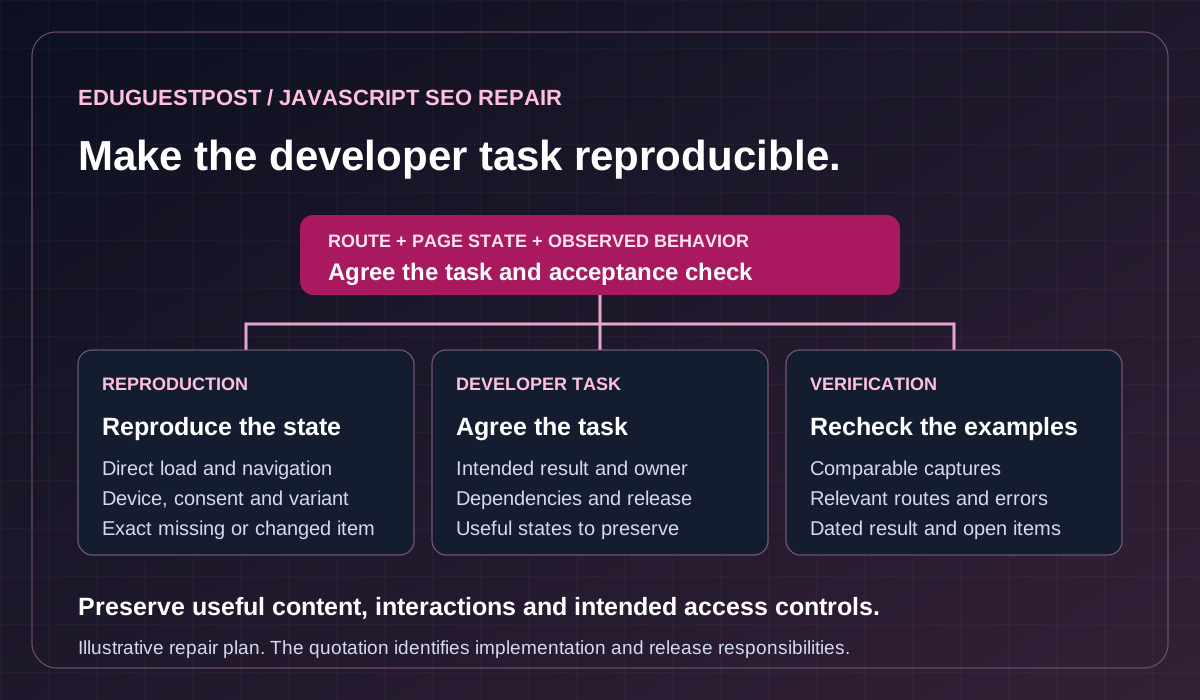
Each task should tell the implementer what to change, why it matters and how to verify it. The proposal identifies the affected template, example URLs, observed behavior, intended result and relevant dependencies. Priorities reflect business importance, supporting evidence and the effort needed to deliver a useful repair.
Scroll across to explore all columns.
| Project stage | Proposed deliverable | Responsibility to confirm |
|---|---|---|
| Scope and evidence | Route sample, page states and dated observations | Website owner and review lead |
| Repair planning | Prioritized tasks and acceptance checks | Review lead and implementer |
| Implementation | Agreed application or configuration changes | Named authorized developer or platform owner |
| Verification and handover | Rechecked examples, unresolved items and follow-up tasks | Agreed reviewers and receiving owner |
Choose changes around the actual system
A repair might correct a navigation component, stabilize page metadata or make required content available earlier. Larger rendering changes need an assessment of content freshness, personalization, hosting requirements and maintenance costs.
Google describes dynamic rendering for bots as a workaround rather than a recommended default solution. A framework name or one incomplete snapshot is insufficient reason to commission an architecture replacement.
The quotation confirms supported systems, required access, quantities, external costs and the included review period. It distinguishes prepared recommendations from changes an authorized implementer will deliver. Release approval and rollback responsibilities belong with the named owners.
Where your team needs help choosing between competing approaches, SEO consulting services can define the decision and handoff scope. Agree the evidence needed to make that choice before expanding the project.
Keep useful content, important interactions and intentional access controls in the acceptance checks so a technical repair preserves the page’s purpose.
Verify the repair and request your scope
After an agreed change, request the affected routes again and capture comparable browser evidence. Confirm that the missing passage, destination or declaration now behaves as intended. Repeat relevant direct loads and in-app transitions, including the error or variant state that exposed the problem.
Keep a record of the release, final URLs, capture conditions and unresolved observations. A useful handover connects the implementation to the evidence that was rechecked. It also identifies which additional templates need review before the change is extended.
Review Google evidence separately
Search Console URL Inspection distinguishes indexed information from a live test. Compare the reported crawl or test date with the release date. A successful live test can support verification of the current version while the indexed record still describes earlier processing.
Canonical selection, indexing and search appearance require their own evidence. A matching snapshot, clean parser report or completed deployment does not establish those outcomes. The project handover should make clear which technical checks are complete and which observations need later review.
Common questions about JavaScript SEO
How is evidence from different captures compared?
Each observation retains its source and date. Comparisons also keep the final URL, device, consent choice, login state and selected variant visible, so session differences can be separated from a template problem.
Do the comparison tools execute JavaScript for us?
The JavaScript SEO Checker compares supplied snapshots and imported Lighthouse evidence. The Rendered HTML Checker needs a matched full DOM snapshot you supply. Those comparisons do not independently establish what Google indexed.
Why check a route both directly and after navigation?
An address-bar change does not establish that the address works when opened separately. The agreed route review can check direct requests, refreshes, in-app navigation and relevant missing-item or variant states.
Does one incomplete snapshot require an architecture replacement?
A repair may concern a component, metadata or content delivery. Larger rendering changes need an assessment of freshness, personalization, hosting and maintenance. A framework name or one incomplete capture is insufficient grounds for replacement.
Who implements and releases the agreed work?
The quotation separates prepared recommendations from changes delivered by an authorized implementer. It confirms supported systems, access, quantities and review coverage, with release approval and rollback assigned to named owners.
What does successful repair verification establish?
Comparable route and browser checks can show that the intended content, destination or declaration now behaves as agreed. Google’s indexed record, live test, canonical selection and search appearance require their own dated evidence.
Send the details needed for a useful quote
Share your website and priority routes, framework and version where known, deployment model and the behavior you want investigated. Include recent changes and available dated evidence. Explain whether the problem occurs on a direct visit, after navigation or only in a particular page state.
Tell us who can implement changes and any release constraints. Keep credentials and confidential account content out of the initial enquiry.
Request your JavaScript SEO scope and quote. Agree the template sample, written deliverables, implementation responsibilities and verification coverage before the project begins.
Tell us about your JavaScript SEO work
Share public routes and the behavior to investigate. Keep credentials and confidential account content out of the initial enquiry.