
Crawler policy / Checkable changes
Robots.txt Optimization Services
An outdated robots.txt rule can restrict an important section, leave unwanted crawl paths open or conflict with a newer crawler policy. EduGuestPost's robots.txt optimization services help you review those decisions and prepare changes that preserve your website's intended access rules.
Define intended access. Test the examples. Verify the delivered file.
Give crawlers clear access instructions
The proposed engagement connects the file served on each agreed host with representative URLs, crawler purposes and the system responsible for generating it. You receive a defined change plan and acceptance checks, with implementation responsibilities confirmed in the quotation.
Google's robots.txt introduction explains the central limitation: these rules control crawler access. A known blocked URL can still appear in Search without fetched page content. Review the intended outcome before choosing a crawl restriction, an indexing instruction or a private access control.
Your proposed scope can include:
- An inventory of relevant files, hosts and affected URL families.
- A crawler policy with representative allowed and blocked examples.
- Prioritized changes assigned to the appropriate implementation owner.
- Verification results, remaining uncertainties and an agreed handover.
The work can focus on an accidental block, a platform change, inconsistent rules across hosts or a policy review for particular crawlers. A missing file alone does not establish a fault, and adding more directives does not automatically improve crawling.
Share your website, the affected section, example URLs and what each crawler should be able to reach. Include relevant launch or release dates and explain whether you need recommendations, implementation support or a review of changes already made.
Request a robots.txt optimization quote to agree the coverage, evidence and deliverables before work begins.
Establish the file and the affected URLs
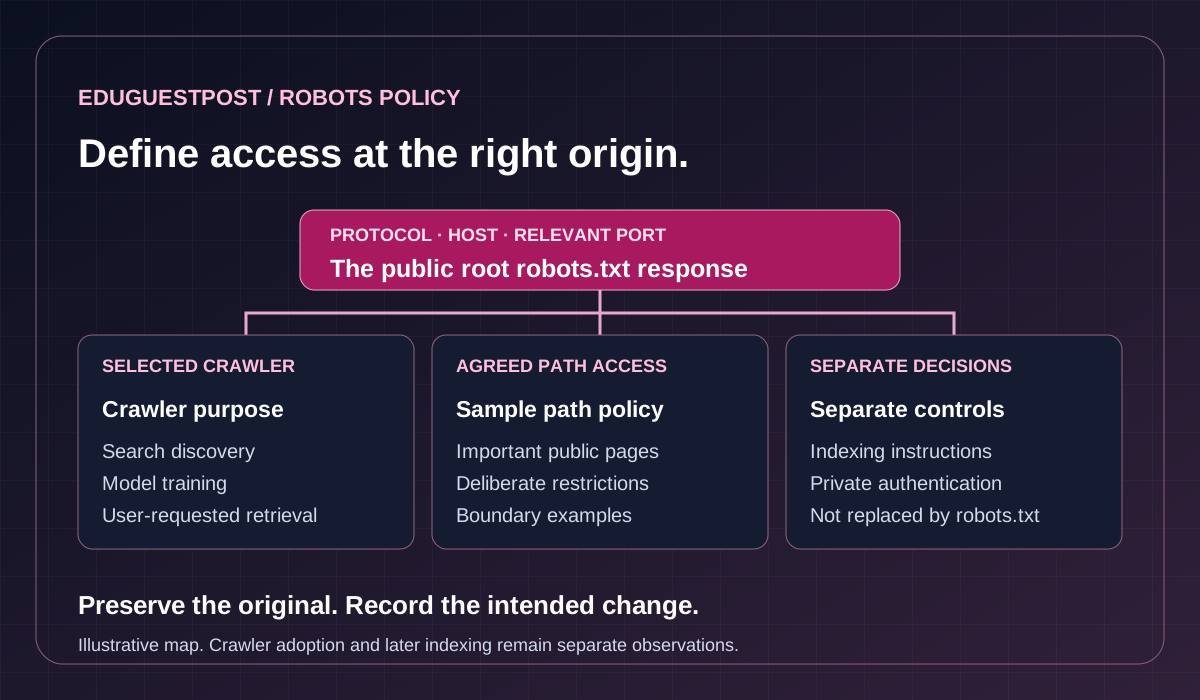
The first decision is which public robots.txt response applies to each URL in scope. Rules on one protocol, host or port do not automatically cover another. A staging host, store subdomain and main website may need separate decisions even when they share a platform.
Record the public response and its observation date alongside the source that generates it. A CMS setting, theme template, application route or edge configuration can produce the delivered file. The editable source's location does not change the public robots.txt address.
Swipe or scroll to read all columns. Keyboard: focus the table, then use the arrow keys.
| Review area | Evidence to establish | Decision to record |
|---|---|---|
| Website scope | Protocol, host and relevant port | Which origin each file governs |
| Public response | Status, redirects and delivered text | Whether the intended file is reachable |
| Generation owner | CMS, application or edge configuration | Where an approved change belongs |
| URL families | Important pages and restricted examples | What each crawler should reach |
Google's file creation guidance describes a UTF-8 plain-text file at the site's root. A file uploaded inside a content folder does not govern that folder as a separate robots policy. Confirm the actual public response rather than relying on a filename in a deployment package.
Keep response evidence in context
The Redirect Checker can support a bounded review of observed HTTP routes. It distinguishes a destination match, an observed redirect and a successful final response. Its local map workspace reviews supplied plans without checking live routes.
Use the Indexability Checker for a separate bounded examination of public responses or supplied evidence. Its diagnostic requests do not establish real crawler identity or Google indexing. Record unavailable checks as unresolved evidence, with the next owner or action stated clearly.
Match the rules to the intended crawler
A policy needs to identify which crawler it addresses and why. Search discovery, model training, advertising checks and user-requested retrieval can involve different agents and different documented behavior. Agree those purposes before combining crawler groups or adding restrictions.
Google's detailed robots.txt specification explains its group selection and path matching. Google selects the most specific matching user-agent group, combines repeated groups for that agent and does not add the wildcard group's rules to a more specific group. Group order alone does not decide which policy applies.
Within the selected rules, the most specific matching path governs; equally specific conflicting rules favor access. Paths are case-sensitive. Review wildcards, end markers, query strings and encoded characters against actual examples before applying a broad pattern across a website section.
Test representative decisions before extending a rule
The proposed decision record should include each sample URL, selected crawler token, intended result and matching rule. Include important public pages, deliberately restricted paths and boundary examples that could be caught accidentally. Preserve the original file alongside the proposed version so reviewers can see what changed.
The Robots.txt Generator can prepare draft text and test rules against supplied paths. Its testing workspace can use pasted or fetched robots text, but tested paths are not visited and the selected bot is not impersonated. A parser result cannot reproduce a crawler's cached file, request history or indexing decisions.
Keep crawler purposes separate
OpenAI's crawler documentation distinguishes OAI-SearchBot for search from GPTBot for model training. Their controls are independent; user-triggered ChatGPT requests have separate behavior. Other providers also publish their own rules and exceptions. Confirm the current product documentation rather than treating every AI agent as one policy, and avoid promising inclusion, citations or universal compliance.
Preserve important content and intentional restrictions
An effective change plan states what must remain accessible and what must remain restricted. Review the purpose of each affected section before removing existing rules. Private areas still need appropriate authentication or authorization because a public robots file cannot protect confidential content.
Separate access from index exclusion
Google's noindex guidance explains that Google must be able to fetch a page to read its indexing instruction. Blocking that fetch can prevent the instruction from being seen. A crawl restriction and an indexing exclusion therefore need different acceptance checks, with the intended outcome agreed first.
The review should preserve existing private access controls and identify deliberate exclusions explicitly. It should also distinguish stale search evidence from the current response before recommending another change. An excluded URL is not automatically a defect.
Keep necessary resources available
Stylesheets, scripts and other resources may be needed to understand a public page. Google's JavaScript guidance describes how blocked resources can affect rendering. Check representative templates and dependencies before restricting an entire asset directory.
The Rendered HTML Checker compares source with a browser DOM snapshot you supply. Keep the final URL, capture time and page state consistent. It does not execute remote JavaScript or reproduce Google's rendered copy, so additional evidence may be needed for a rendering fault.
Classify filtered paths and discovery signals
Google's faceted navigation guidance supports decisions based on whether filtered URLs need crawling. Preserve useful landing pages and navigation before applying a parameter pattern. A blanket ban on every query string can capture pages that serve a legitimate purpose.
A Sitemap declaration helps discovery; it does not override a blocked path. The XML Sitemap Checker examines one supplied document within its limits. It does not recursively crawl an index, test listed pages or prove Google processed them. Broader sitemap optimization remains a separate scope.
Assign the change and verify the delivered result
The implementation plan should identify the configuration owner, proposed edit, release dependency and rollback approach. Confirm whether recommendations, implementation or post-release checks are included. A draft file prepared for review is not a deployed change.
A CMS may generate robots.txt dynamically, while a hosting or edge service can modify the response. Cloudflare's managed robots.txt documentation describes conditional managed content. Establish whether such a feature is enabled and inspect the delivered response before editing another layer that might not control the final output.
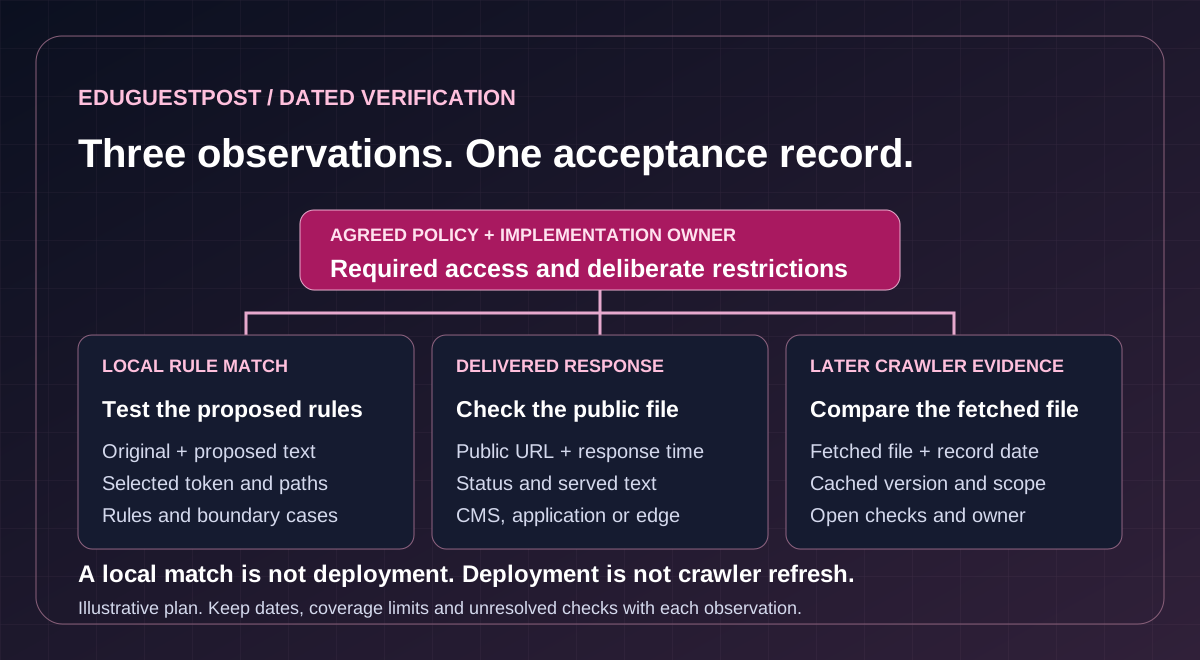
The proposed acceptance record connects the agreed policy with observed evidence:
Swipe or scroll to read all columns. Keyboard: focus the table, then use the arrow keys.
| Check | Evidence to retain | Acceptance question |
|---|---|---|
| Public file | URL, time, status and response text | Is the intended version being served? |
| Important paths | Sample URLs, crawler and matched rules | Do required pages remain permitted? |
| Restricted paths | Deliberate exclusions and boundary examples | Are intended restrictions preserved? |
| Page resources | Representative dependencies and access checks | Can required resources be fetched? |
Distinguish deployment from crawler refresh
Google's update guidance explains that Google caches robots.txt and provides a process for requesting a refresh. A successful deployment or cleared browser cache does not prove Google has fetched the new version. Record those observations separately.
Robots-file retrieval errors also need their own interpretation. Google generally treats most 4xx responses other than 429 as having no crawl restrictions, while server or network failures can involve cached rules and interrupted crawling. Those rules concern fetching robots.txt; they do not describe how an ordinary content page with the same status is indexed.
The handover should distinguish a successful local match, the current public response and later crawler evidence. Agree any follow-up window in the quote without turning a provider's cache behavior into a guaranteed project timetable.
Request a review with clear acceptance criteria
Start with the decision you need to make: restore access to a public section, preserve a deliberate restriction, reconcile competing configuration layers or evaluate a crawler policy. Representative URLs and the intended result are more useful than a request to make every checker warning disappear.
For an initial enquiry, provide:
- The public website and relevant hosts or subdomains.
- Example pages and resources that should remain accessible.
- Restricted examples, the relevant crawlers and any known recent changes.
- Whether you need advice, implementation support or verification of completed work.
The quotation should confirm the systems covered, sample coverage, deliverable formats, implementation owner, required access and follow-up checks. Agree any secure evidence exchange, retention requirements, price and timing before sharing private material or starting work. Access requirements depend on the selected scope.
Assess later evidence with its date and coverage
Where authorized property access is available, Search Console's robots.txt report can show Google's fetched files and reported issues within the report's coverage. Compare its file version and fetch information with the current response. A refresh request does not guarantee an immediate page crawl, indexing or a ranking change.
If the cause extends beyond crawler rules, SEO Audit Services can frame a broader diagnostic scope. SEO Consulting Services provides a relevant route for policy and prioritization discussions. Confirm any additional work in the proposal rather than assuming it is included in a file review. For missing-page concerns beyond crawler rules, website indexation issue fixing services can define a separate investigation.
The useful outcome is an agreed policy, an accountable change plan and evidence showing whether the specified checks passed. Crawler adoption, later processing and search performance remain separate observations.
Questions about robots.txt optimization
Does a robots.txt block keep a page out of Google?
Not necessarily. Robots.txt controls crawler access, and a known blocked URL can still appear in Search without fetched page content. Google needs to fetch a page to read its noindex instruction. Private material needs appropriate authentication or authorization. Agree the intended outcome before choosing a control.
Which robots.txt file applies to my website?
Establish the protocol, host and relevant port for every URL in scope. A file on one origin does not automatically govern another. Review the public root robots.txt response, its date and the CMS, application or edge system that generates it.
Can you test a proposed rule before deployment?
The decision record can compare the original and proposed file against representative allowed, restricted and boundary examples for the selected crawler token. A local parser result is separate from a deployed change, a crawler’s cached file, its request history and indexing decisions.
Should search and AI crawler controls be treated as one policy?
No. Search discovery, model training and user-requested retrieval can involve different agents and documented behavior. Record each intended purpose, check the provider’s current documentation and test the relevant tokens. Do not assume every agent follows one policy or promise inclusion, citations or universal compliance.
Does the service include making the robots.txt changes?
The quotation confirms whether recommendations, implementation or post-release checks are included. Name the configuration owner, proposed edit, release dependencies, rollback approach and acceptance checks. A draft file prepared for review is not a deployed change.
What should I send for a robots.txt optimization quote?
Share the public website and relevant hosts, example pages and resources that should remain accessible, deliberate restrictions, relevant crawlers and recent changes. Explain whether you need advice, implementation support or verification. Agree permitted access, secure evidence exchange and retention before sharing private material.
Request your robots.txt optimization quote
Request your robots.txt optimization quote with your website and examples. EduGuestPost can discuss the proposed coverage and next steps before you decide how to proceed.
- Which hosts, crawlers and URL families are in scope?
- What must remain accessible or deliberately restricted?
- Do you need recommendations, implementation or verification?
Use public URL examples in your first enquiry. Keep passwords, verification codes and private customer records out of the initial brief. Agree permitted access and private evidence exchange separately.
Request a robots.txt optimization quote
We use your brief to define origins, crawler purposes, sample coverage, deliverables and implementation responsibilities.