
Franchise search / Clear authority
Franchise Local SEO Services
Give franchise operators a clear process for local SEO that fits the brand.
One agreed process for brand decisions, local facts and delivery.
EduGuestPost’s franchise local SEO services help franchisors, franchise operators and authorized agencies turn local search priorities into work that people can approve and carry out. We define the brand requirements, confirm who supplies location facts and record the authority needed for the agreed changes.
The result is a franchise SEO playbook and a scoped delivery plan. Your team can see which decisions belong to the brand, which need an operator’s confirmation and where implementation depends on account access or website support. Selected location work, onboarding instructions and reporting can be included in the proposal.
Request a franchise local SEO plan with your brand website, participating locations and the problems you need to address. Tell us whether you represent the franchisor, an operator group or an agency, and who can approve the project.
Make local work easier to approve and deliver
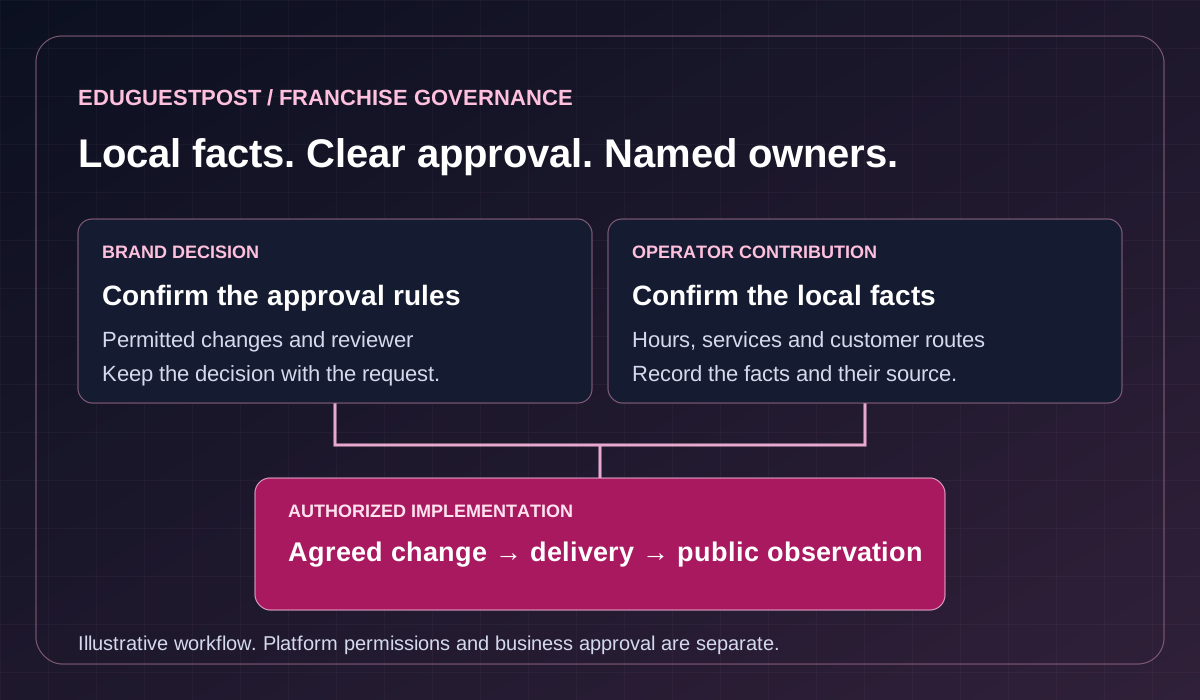
A franchise operator knows when services, opening hours or appointment arrangements change. The brand team may need to approve how those facts appear in public copy. A website supplier or profile manager then needs enough information and authority to publish the update.
We connect those responsibilities in one working process. An operator should know what information to provide, which changes they may request and how a pending decision will be resolved. The brand team should receive specific questions and supporting facts, so it can review the proposal without reconstructing the request.
This service suits a franchise program that needs clearer participation and delivery arrangements, as well as defined local SEO work. Your proposal names the operators and locations included, the outputs required and the people responsible for the next action.
What your franchise SEO program includes
We start with the brand’s existing requirements and the participating operators’ responsibilities. The playbook turns those decisions into instructions for the agreed local work. It can support a new program or clarify an existing arrangement involving several teams and suppliers.
Swipe or scroll to read all columns. Keyboard: focus the table, then use the arrow keys.
| Work area | Included record | How your team uses it |
|---|---|---|
| Responsibilities | Decision owners, permitted local changes, approval requirements and escalation contacts | Route a request to the person who can resolve it. |
| Operator onboarding | Required business facts, page and profile links, access tasks and supporting material | Bring participating locations into the agreed process. |
| Content rules | Shared brand elements, editable local sections and facts that need confirmation | Prepare useful local content within the supplied brand requirements. |
| Change register | Proposed update, affected assets, approver, current stage and next action | Follow a request through review and implementation. |
| Location reporting | Covered work, available measurements, participation gaps and unresolved dependencies | See where the program needs a decision, support or further work. |
Define the agreement before the rollout
The proposal states whether EduGuestPost provides the playbook, prepares local work, implements approved changes or coordinates a handoff. It identifies the locations, websites, platforms and languages included. A sample review of selected operators is described separately from checks on every participating location.
Your team supplies the applicable brand requirements and confirms who may approve assets and local claims. We also identify existing suppliers so the program does not issue conflicting instructions to different people working on the same page or profile.
Where listings need work, our local citation building service provides the broader route for suitable directory coverage, corrections and verification tasks. The franchise plan specifies the location records and sources included. For wider branch coordination, explore our multi-location SEO services.
Software, account connections, additional development and specialist platform cases are identified separately. A written approval process can operate through agreed records; it does not imply that a particular approval product is installed.
Establish profile access for the actual business
Brand oversight and account permissions need separate confirmation. We record the existing profile owners, the people allowed to manage each location and the approvals required for proposed work. The business retains the appropriate ownership or co-ownership of its profiles.
Platform owner and manager roles have different permissions. Users should work through their own accounts, with the current permissions confirmed before changes. A person’s franchise title does not automatically give them a platform role, and a platform role does not settle which business decisions they may approve.
Group access also needs care. Permissions can cover multiple profiles, so confirm which existing or newly added locations an account can affect. The access plan should reflect the locations and work that person is actually responsible for.
Check eligibility and representation
Proposed profile work starts with the actual business and the platform’s current eligibility and representation requirements. Brand names and categories must reflect the real operation, including permitted differences between locations. A franchise territory or target city is not, by itself, an eligible office or storefront.
Storefronts, service-area businesses and other models have their own conditions. We identify unresolved location facts and owner evidence before treating a profile as ready. Account access, verification, submitted edits and public information remain distinct stages.
Bulk verification is a separate platform process with current business-model, account and profile-count conditions. We assess eligibility for the participating locations before proposing that route. A franchise network is not automatically bulk-verified, and preparing or uploading a spreadsheet does not establish that a verification request has been submitted or approved.
If an operator joins, leaves or changes ownership, we prepare a specific handover brief. It records the confirmed business change, affected assets, authorized contacts and outstanding tasks. We assess continuity and the applicable platform route before recommending a transfer, closure or new profile. For an agreed move project, see business relocation listing update services.
Give local pages a useful customer purpose
Franchise recruitment pages and customer-facing location pages serve different readers. We identify which pages should help someone choose, contact or visit an operating location, then map the relevant local search needs to those pages.
The brand can supply approved descriptions, visual assets and wording requirements. Operators confirm the local facts that make a page useful, such as available services, opening hours, facilities and the correct enquiry route. We record who confirms each claim before preparing the agreed copy.
Use templates with meaningful local information
A shared layout can make pages easier to maintain. Each location still needs information that helps its own customers. We do not invent staff, local expertise, facilities, awards or availability to make a template appear different.
The plan avoids producing low-value city variants solely to funnel visitors to the same destination. Each page needs a useful customer purpose and confirmed location information. Shared brand wording can remain where it helps the reader; useful local information determines the page’s purpose.
For a focused wording review, our Duplicate Content Checker compares supplied page URLs or imported snapshots and shows matching passages. It does not discover every page or decide which URLs should be merged. Similarity is a reason to inspect the content and its purpose.
Agree on the website work
Our on-page SEO services support defined improvements to existing pages. Relevant navigation and connections to location pages can be covered through internal linking work.
We review the existing corporate and operator websites before proposing structural changes. Domain consolidation, URL migrations, new templates and development need their own evidence, scope and approvals. The franchise playbook records who maintains each asset and which website team can implement the agreed work.
Roll out the work with visible decisions
We can begin with an agreed group of participating locations to check whether the instructions, approvals and handoffs work in practice. The first group should reflect the situations the program needs to handle. Reviewing it does not establish that every other operator or location has been checked.
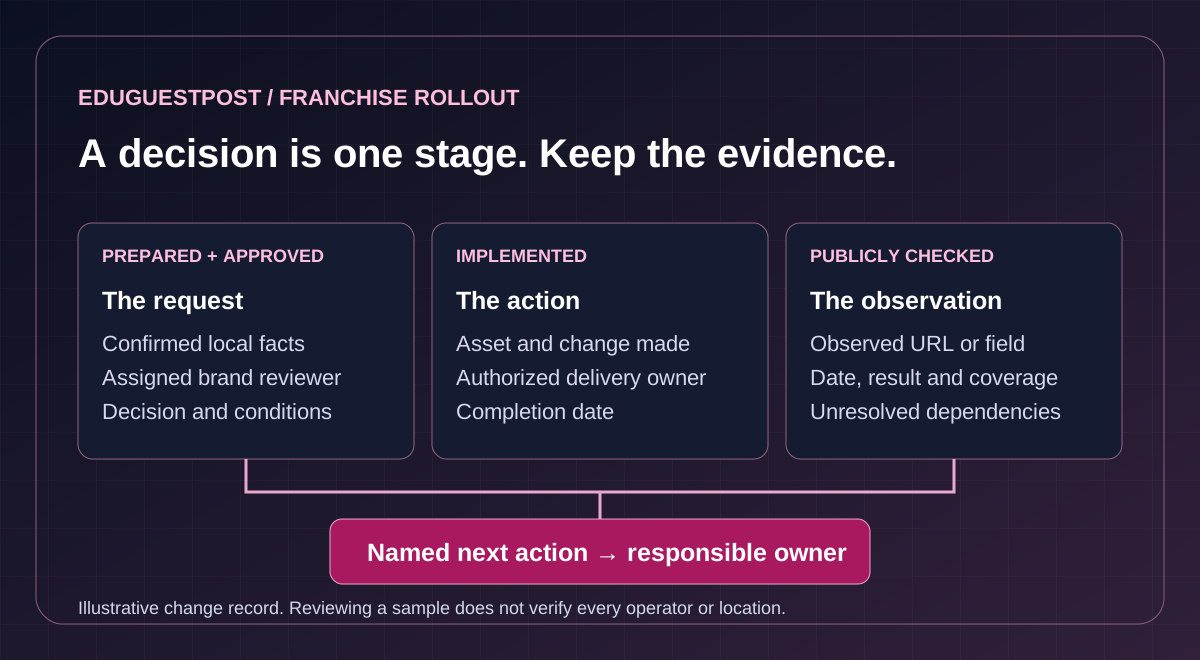
The delivery record keeps the request and its current stage together. This helps the brand team distinguish work waiting on a decision from work already carried out.
Swipe or scroll to read all columns. Keyboard: focus the table, then use the arrow keys.
| Stage | What the record shows | What still needs checking |
|---|---|---|
| Prepared | Proposed change, supporting facts and affected location assets | Correct reviewer and sufficient evidence |
| Awaiting approval | Pending question and assigned decision owner | The business decision needed to proceed |
| Implemented | System changed, action taken and completion date | Any platform review or publication dependency |
| Publicly checked | Observed URL or field, check date and result | Coverage limits and any remaining differences |
| Unresolved | Access issue, missing facts or external dependency | Named next action and responsible person |
Report local progress and participation
The report can show whether operators supplied the required facts, which approvals remain open and where additional guidance is needed. Those measures describe program delivery. They should not be presented as proof of increased enquiries or sales.
Where measurement is included, we keep website search data, profile activity and recorded business outcomes separate. Available profile metrics and their definitions can include activity from organic results and ads. The report keeps the source, date range and missing-data limits with each observation. Call-button clicks are not completed calls, and direction requests are not confirmed visits.
Search Console can support reporting for selected location pages when access is available. The report states its page coverage, dates and missing data. Comparisons also need context such as opening dates, services, seasonality and changes to tracking; a network average does not explain every operator’s results.
Questions about franchise local SEO
Who can request this service?
A franchisor, franchise operator group or authorized agency can enquire. Tell us which locations and assets you represent and who can authorize the proposed work. We agree on the participating parties and responsibilities before implementation.
Can operators contribute local content?
Yes, within the agreed process. Operators can supply confirmed local facts, permitted images and useful customer information. The playbook identifies what they may update, what needs brand review and which claims require further confirmation. The business confirms permission to use supplied material.
Can the program include review management?
The proposal can define monitoring, response preparation and permitted request planning. Customer issues need a responsible local contact, and sensitive replies need the appropriate approval. We plan fair review requests without incentives, selective requests for positive feedback, prescribed review wording or staff solicitation quotas. Platform conditions are checked for the proposed workflow. Our local review management services provide a dedicated route for this work.
Do all websites need to move onto one domain?
That decision needs a separate assessment of the existing websites, customer needs, ownership and performance evidence. A shared brand does not justify an automatic migration. The local SEO scope can define approved work within the current arrangement while wider decisions are reviewed.
Can you guarantee the same results for every operator?
No. Demand, competition, distance, business circumstances and available evidence differ. We agree on deliverables and reporting without promising a ranking, review quantity, footfall or sales result. The quote depends on participating operators, locations, websites, languages and the work included.
What should I send for an initial review?
Send the brand website, participating operator and location list, relevant countries and languages, and the main local search problems. Identify the brand approver, operator contacts and existing website or profile suppliers. Include public page links, access limitations and upcoming operator changes or moves. Keep passwords, verification codes and private customer records out of the initial enquiry.
Request a franchise local SEO quote
Send your brand website, participating locations, operator structure and current local marketing process. Include the main problems, existing suppliers, relevant brand requirements and people who can approve work. Tell us about upcoming openings, operator changes or relocations.
- Which operators and location assets are participating?
- What brand requirements and local facts need confirmation?
- Who approves the work and who can implement it?
Send your franchise SEO brief to discuss a scope and quote. If the first task is choosing the wider direction, SEO consulting can help your team define the priorities and decisions required.
Use public page and profile links in your first enquiry. Keep passwords, verification codes and private customer records out of the initial enquiry. Agree any necessary account access and private evidence sharing separately.
Request a franchise local SEO plan
We use your brief to define participation, approval responsibilities, location work and reporting.