
Local reputation / Review operations
Local Review Management Services
Give customer feedback a clear route to the right person and a considered response.
For review backlogs, response approvals and ongoing feedback monitoring.
EduGuestPost’s local review management services help businesses organize incoming reviews, prepare appropriate replies and follow a defined process for review requests and policy concerns. Your team keeps control of business facts, customer resolutions and the responses published in its name.
Bring the review profiles you want covered, the locations they represent and the problems you need to address. We can scope an initial review backlog, establish a response workflow or plan ongoing monitoring and reporting around the access and approval arrangements available.
Request a local review management plan with your website, profile links, location count and current review process. The proposal will define coverage, responsibilities, review points and the work included in the quote.
A practical workflow for local customer feedback
Reviews can arrive across different profiles while the people who know the facts are busy running the business. A missed response, an unsupported promise or a reply posted to the wrong branch can create another problem for the customer.
The service connects each review to its source and location, identifies the person who can confirm the incident and records the next action. Routine acknowledgments, service complaints, sensitive matters and suspected policy violations receive appropriate handling rather than the same automatic reply.
For several locations, we agree on which decisions belong to the local manager and which need a central reviewer. Each branch keeps its own records, contact route and approval responsibilities.
Review management can sit alongside accurate business information. If profiles also contain outdated names, addresses or contact details, our local citation cleanup services provide the related correction route. For suitable new listings, see our local citation building service. The proposal separates listing work from the review workflow.
What your review management plan includes
We start with the profiles and locations that matter to your customers. The scope states whether you need a defined backlog reviewed, a workflow for your own team or ongoing support over an agreed period.
Swipe or scroll to read all columns. Keyboard: focus the table, then use the arrow keys.
| Work area | Included record | How your team uses it |
|---|---|---|
| Coverage and access | Selected platforms, profile URLs, locations, available access and check schedule | Understand what is monitored and which sources remain outside the scope. |
| Review register | Source link, observation date, location, feedback summary and assigned owner | Follow each item through its next action without losing the original context. |
| Response preparation | Draft reply, facts to confirm, required approver and publication responsibility | Review the wording before the business makes a public statement. |
| Review request plan | Permitted platforms, eligible customer group, neutral wording and approved channel | Make requests consistently without filtering for expected positive feedback. |
| Escalation and reporting | Policy concern, evidence needed, case status and unresolved owner tasks | Distinguish a prepared or submitted case from a platform decision. |
Define coverage before relying on the report
The plan names the platforms, languages, locations and review period included. It also distinguishes checking public profiles from working through an authorized account or an existing review-management product.
We record the check schedule and agreed handling hours. Monitoring at set intervals leaves gaps between checks; a platform or provider may also delay an update. An inaccessible source is recorded as a coverage limitation, rather than treated as confirmation that no reviews arrived.
Your business identifies the person who can approve replies and the person responsible for resolving customer concerns. For sensitive or urgent matters, the plan defines the escalation contact and the information they need. It does not imply round-the-clock crisis support.
Any software subscription, connected account or additional publishing access is identified separately. Naming a review platform or tool does not establish that every feature is available for your location or already included in the service.
Prepare replies around verified facts
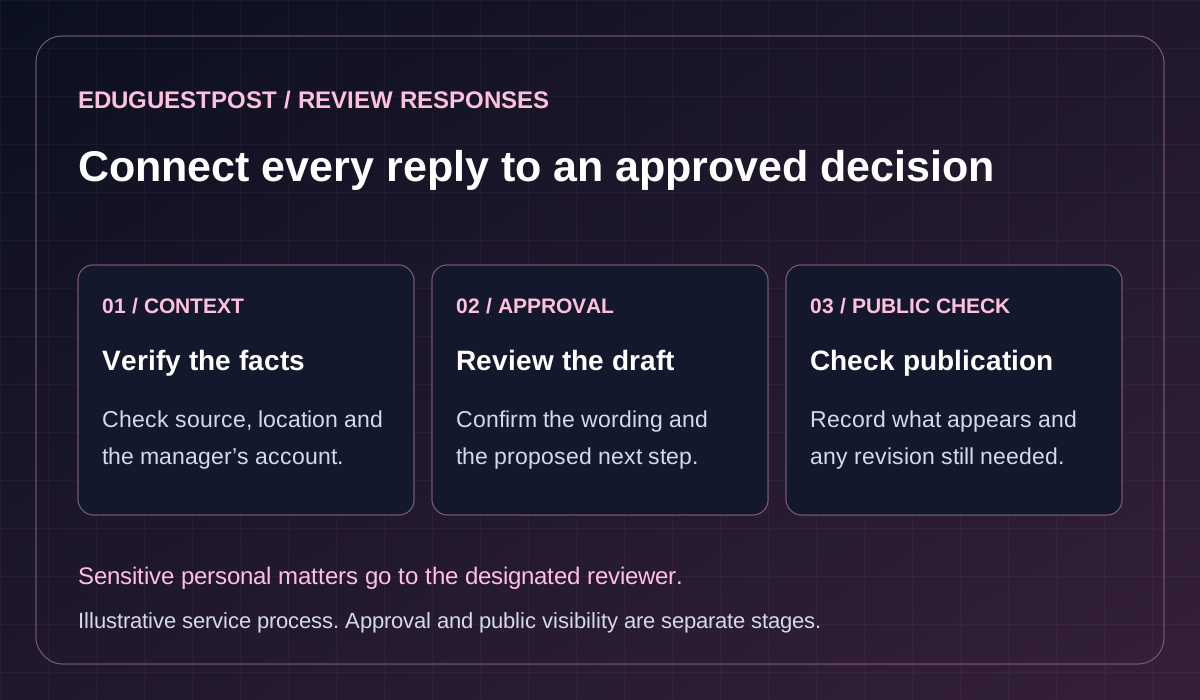
A useful response acknowledges the feedback and gives the reader an appropriate next step. It should fit the review, reflect your business’s voice and stay within the facts and decisions your team has approved.
Replying can require an appropriately verified profile and authorized account access. The platform may review a submitted reply before it appears publicly. We keep draft approval, submission and confirmed publication as separate stages.
Swipe or scroll to read all columns. Keyboard: focus the table, then use the arrow keys.
| Review situation | First action | Response decision |
|---|---|---|
| Specific positive feedback | Confirm the relevant location and context | Prepare a concise acknowledgment that fits what the customer actually wrote. |
| Service complaint | Ask the responsible manager to check the facts | Address confirmed information and offer an approved contact route. |
| Sensitive personal matter | Refer it to the designated owner or specialist | Assess whether a public reply is appropriate and what it may safely say. |
| Reviewer not recognized | Check the context without making accusations | An unfamiliar name alone does not establish that the experience is false. |
| Suspected policy violation | Record the content and potential policy reason | Assess a report separately from deciding whether to reply publicly. |
Keep private details and commitments under control
Public replies should not reveal information from bookings, customer files, medical records or private conversations. A review mentioning an incident does not authorize the business to publish everything it knows about that person.
We also avoid inventing refunds, investigations, guarantees or corrective actions. Your team confirms what happened and what it is prepared to do. Sensitive cases may require an appropriate internal reviewer before any response is drafted or published.
Templates can provide a starting structure. Each proposed reply still needs a context check so it does not thank someone for a service they never mentioned or promise an action nobody has authorized. The same fact and approval checks apply if AI assists drafting.
Request reviews fairly where the platform permits it
The request plan begins with the destination platform’s current rules. We define who may be invited, when a request is appropriate and which channel your business is authorized to use. A method accepted by one platform should not automatically be copied to another.
Where the platform permits requests, a direct review link or QR code can help customers reach the correct profile. The destination should represent the business or location they experienced. We check the link before preparing any request materials.
Our request plan uses neutral wording and invites customers fairly. It excludes incentives, selective requests based on expected positive feedback, pressure to review on the premises, prescribed review content, required star ratings, keywords, staff mentions and staff review quotas. Each destination receives a current policy check before inclusion.
For Trustpilot, its business guidelines likewise require fair, neutral invitations without incentives. Other destinations may restrict solicitation or offer different methods, so their inclusion needs a separate policy check.
Keep private feedback separate from eligibility to review
A private feedback channel can help the business understand a complaint. It should not decide who receives an opportunity to leave a public review. We do not use a positive survey response as the condition for showing a public review link, or put extra obstacles in front of dissatisfied customers.
Customer service also remains separate from review outcomes. A refund, support response or other remedy should not depend on the customer deleting criticism or changing a rating.
Before any sending activity is included, the business confirms the customer group, contact permissions, approved message, channel and handling of further requests. Customers write their own reviews in their own accounts. Drafting a request plan does not itself send messages, collect reviews or activate a campaign.
Assess policy concerns and track the actual result
A low rating or an account of poor service can be legitimate feedback. We assess whether the content has a specific policy problem, rather than treating every unfavorable review as a removal case.
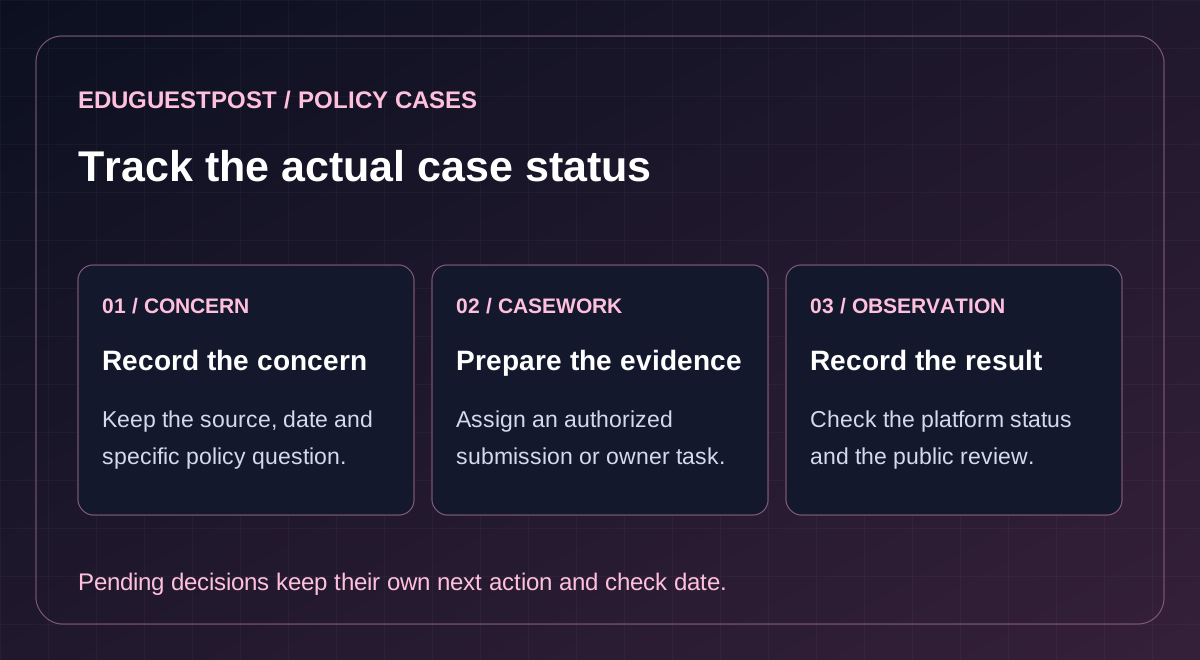
For a suspected policy violation, we review the platform’s available reporting, status and appeal routes for the actual case. Account access and eligibility can affect which steps are available. The case record identifies the review, relevant policy concern, supporting context and the person authorized to submit it.
Suspected extortion needs a separate assessment. Preserve any demand for money, goods or services alongside the relevant review links, dates and correspondence. The owner can use that evidence with the platform’s applicable reporting route. A sudden low rating by itself does not establish extortion.
Report what happened rather than what was requested
The handoff can show a reply awaiting facts, awaiting approval, submitted, publicly visible or needing revision. Policy cases are recorded as prepared, reported, awaiting a decision, appeal eligible or resolved with an observed outcome.
We retain the source and check date. A review disappearing from a dashboard is not, by itself, proof of removal from the public platform. Where a review shown on Google originates elsewhere, the underlying source and applicable reporting route must also be checked.
The report can summarize recurring themes for the owner, such as missed appointments or unclear service information. If an agreed website page needs clearer facts, selected on-page SEO work can address that separately.
An illustrative service complaint
Imagine an appliance-repair business receiving a complaint about a late visit. The manager would first confirm what happened. A draft could then acknowledge the confirmed concern and offer the approved business contact route, without publishing the customer’s booking details or promising a refund that has not been agreed.
This example explains the workflow; it is not a client result or a prediction that a rating will change.
Questions about local review management
Can you remove negative reviews?
We can scope an assessment of suspected policy violations and the casework appropriate to the platform. The platform decides whether to remove a review. Disagreement, an unfamiliar reviewer name or a low rating alone does not establish a violation, and removal is not guaranteed.
Can your team publish replies for us?
The proposal defines whether we prepare drafts for your team or also handle specifically authorized publishing. Your business retains ownership of its profiles and approves the facts and response rules. Access should use the platform’s supported user roles rather than shared passwords.
How do you report ratings and progress?
We keep each platform’s displayed rating, review count and observation date together. Different platforms may calculate or update scores differently, so a combined score can conceal useful context. Progress reporting focuses on coverage, completed response work, approval delays, policy cases and customer-service themes alongside the published measurements.
Will the service guarantee more reviews or better rankings?
No. Customers decide whether to review, and platforms control moderation and display. The service provides agreed monitoring, preparation, request planning and follow-up. It does not promise a star rating, review quantity, customer change of mind, search position or sales result.
What determines the quote?
The quote considers locations, platforms, languages, review backlog, monitoring schedule, response work, approval requirements and any included case preparation. We agree on reporting and follow-up before work begins. Wider crisis communications, legal disputes, website changes and new software require their own scope.
What should I send for an initial review?
Send your public website and review-profile links, country, location count and the workflow you need help with. Identify the person who can confirm facts and approve replies. Keep private customer records, passwords and verification codes out of the initial enquiry.
Request a local review management quote
Send your website, country, location count and public review-profile links. Explain whether you need help with a backlog, response approvals, ongoing monitoring, review requests or particular policy concerns. Identify who can confirm business facts and approve responses; keep private customer records out of the initial enquiry.
- Which platforms and locations need coverage?
- Is the priority a backlog, ongoing monitoring or review requests?
- Who can verify facts and approve public responses?
Send your review management brief to discuss a practical workflow and quote. If review operations are part of a wider local marketing decision, SEO consulting can help prioritize the related work.
Use public review-profile links in your first enquiry. Keep passwords, verification codes and private customer records out of the initial enquiry. Agree any necessary private evidence sharing and access separately.
Request a local review management plan
We use your enquiry to agree coverage, approvals and reporting.