
Google AI Overview Checker
Check captured Google AI Overviews for your website’s citations, brand mentions and source pages. Compare competitors and see what changed between matching search snapshots.
Was your page cited?
An AI Overview can mention your business without linking to it. It can also link to a useful article without naming the business that published it. Neither result is the same as your position among the ordinary search results.
Keep those three questions separate: was the brand named, was the website cited, and which page received the citation? This checker compares your domain and optional target page with the reference URLs in a captured Overview. Organic positions, when supplied, appear as separate evidence.
The available observation and JSON modes analyze captured data. They do not run a fresh Google search. A live lookup option appears only when the site’s SerpApi connection is configured and enabled. An imported capture keeps its original time and source; it never becomes a live measurement simply because you process it today.
A missing answer
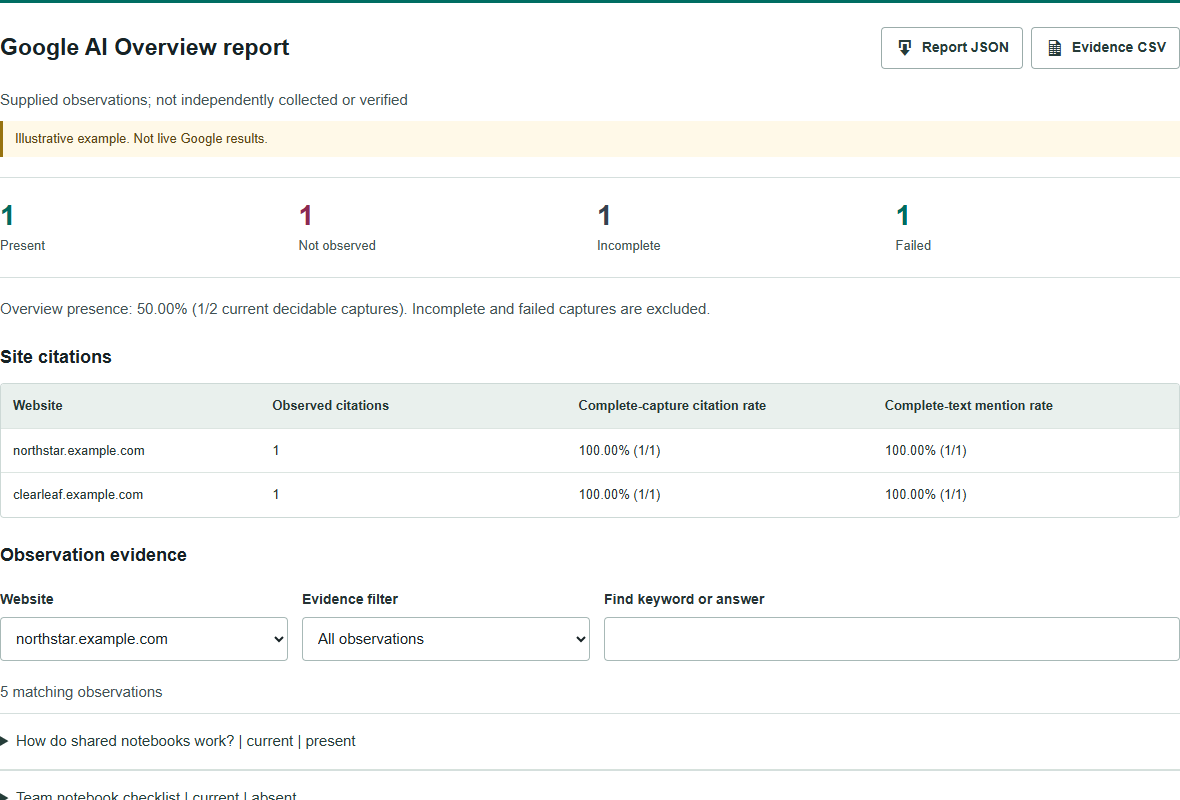
There is a difference between a search that did not show an Overview and an Overview that failed to load. The report keeps present, not observed, incomplete and failed captures separate. A partial answer can establish that an Overview was present, but cannot establish everything it said or cited.
Suppose four searches produce one Overview, one complete search without an Overview, one unfinished capture and one error. The observed presence rate is 50% of the two decidable captures. It is not 25%, and it says nothing about searches outside that sample.
Citation rate uses a narrower sample: present Overviews with complete answer capture and complete reference lists. A link found in a partial capture is still useful evidence and remains visible, but that capture stays outside the complete-capture percentage. When there is no eligible sample, the rate is unavailable rather than zero.
Keep the evidence
Location, country, language, device and collection time belong beside the keyword. Keep the query Google actually showed too, especially when it corrected the original search. Without this context, two apparently identical keyword checks may describe different searches.
The observation format retains answer blocks and their reference IDs. Provider reference numbers need not be consecutive: source 7 is matched to reference 7, not to the seventh item in an array. A missing reference stays marked as unmapped. That avoids turning a broken export into a confident citation claim.
SerpApi’s main Google web-search JSON is supported. A response that still contains an Overview continuation token is incomplete until the extra content is available. Standalone token responses and AI Mode responses are not interchangeable with the main search capture. Unsupported tables and media can also leave the analysis partial. The provider’s response reference documents these structures.
Compare fairly
A useful before-and-after check repeats the same keyword, shown query, location, country, language, device and collection source. Both snapshots need complete evidence, and the previous capture must actually be older. Otherwise, a list of supposedly gained or lost citations would hide too many assumptions.
For a matching pair, the report lists added and removed citation URLs. It does not claim that a content edit caused the change. Answers can vary between observations; one new citation is a reason to inspect the source, not proof of a lasting increase in traffic.
Domain matching includes subdomains but respects hostname boundaries. Target-page matching ignores URL fragments while retaining path, query, scheme and trailing-slash differences. No redirects are followed. A tracking URL and its destination may therefore remain different until you inspect them with the Redirect Checker.
What to improve
Start with the cited pages, not a visibility score. Does the answer need a definition, a comparison, current product details or first-hand evidence? Read what the sources actually contribute. Then decide whether your relevant page is unclear, outdated or missing information readers need. Adding words solely to resemble a cited page is not the same as improving it.
Google’s guidance for AI features says established SEO practices still apply. A supporting page needs to be indexed and eligible for a search snippet, but meeting those requirements does not guarantee inclusion. Check technical evidence with the Indexability Checker; this Overview report is not an indexing test.
For answers from several AI products, use the AI Visibility Checker. Keep this report focused on Google AI Overviews. Neither tool verifies that a citation supports every nearby claim, estimates search volume or promises a ranking improvement.
Common questions
Does this check AI Mode?
No. AI Mode is a separate search experience. This report evaluates captured Google AI Overviews and their supplied references.
Why can I see a citation but no citation percentage?
A partial reference list can establish that a link was observed. It cannot establish the full list. The positive evidence remains visible while the incomplete capture is excluded from the rate.
Are reports saved?
This plugin does not store the submitted queries, answer text or generated reports. Downloads include the supplied evidence, so keep sensitive material out of uploads and handle exported files appropriately. If live lookup is enabled, the query and search context are sent to SerpApi, which has its own retention policy.