
Duplicate Content Checker
Check a batch of page URLs for repeated wording. Find matching pages, review the passages they share and see which sources could not be checked.
Start with a page set
Choose pages that have a reason to be compared: service pages for nearby locations, product descriptions in one category, old and new versions of a guide, or articles that answer much the same question. A focused set is easier to review than a score detached from the pages behind it.
Enter the full page addresses in Live URLs, one per line. The audit requests those addresses and compares their selected content. It does not follow every link on the site, discover URLs or search other websites for copies. To gather a larger review list, export the relevant addresses from your own site or use the XML Sitemap Checker, then audit related batches.
For unpublished or access-restricted work, import snapshots as CSV or TSV. Each row needs a url and content; the optional type column accepts text or html. Use quoted cells for paragraphs containing commas or line breaks. These are your supplied snapshots, not a claim about what those URLs currently contain.
Keep templates out
A navigation menu repeated across ten pages is not ten repeated articles. Auto selection looks for the first main element, then the first article, then the body. You can select an area explicitly. Navigation, headers, footers, sidebars and forms are excluded by default.
Open a page’s details to inspect the extracted text. Check that it contains the whole intended article and not just a teaser or sidebar. Some templates put useful introductory copy inside a header; excluding that element also excludes its text. If the markup cannot identify the right section, import the copy you actually want reviewed.
Live checks read server-returned HTML. They do not run JavaScript, use your browser’s cookies or log in. A blocked response, an oversized source or an unavailable content area is reported as uninspected. It is never counted as a unique page.
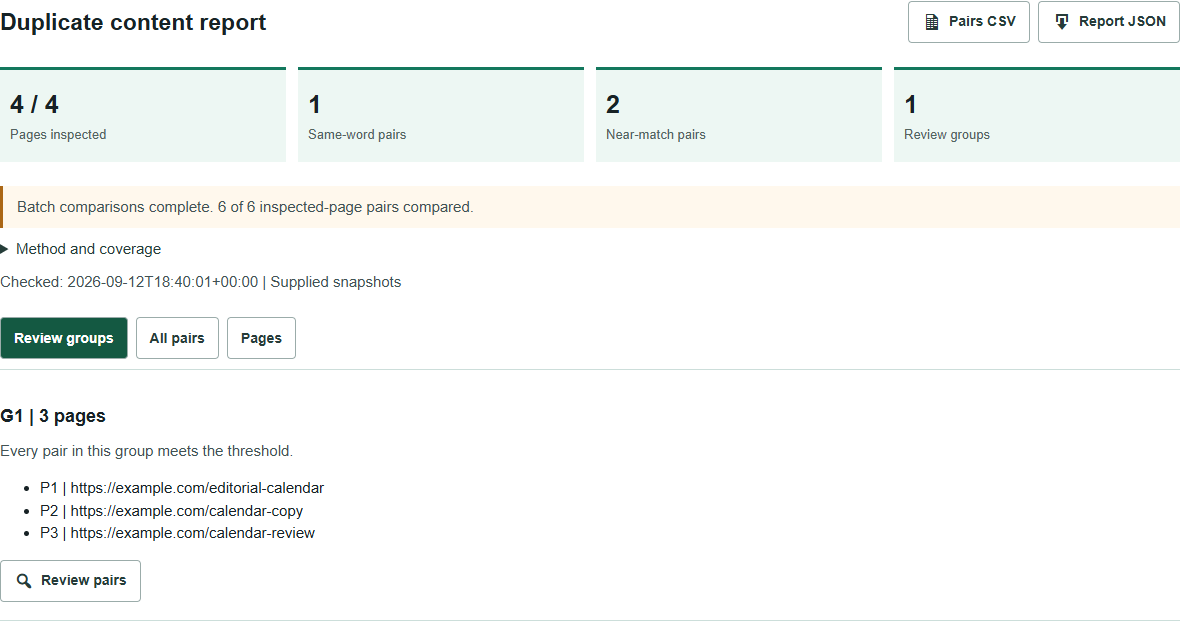
Read the findings
Same word sequence means the selected texts match after word segmentation and normalization. Spacing and punctuation are ignored, and letter case is ignored unless you switch that option off. This is not a byte-for-byte HTML comparison. Different layouts can carry the same words.
Near match means a pair reaches your selected review threshold. The percentage is twice the number of aligned words divided by the two word counts combined. For example, 80 aligned words across two 100-word pages produces an 80% match. Changing the threshold changes which pairs are flagged; it does not change their underlying comparison.
Word order matters, so moving paragraphs can lower the result. A paraphrase may preserve an idea with little matching wording. Short pages can also produce high percentages from a few standard phrases. Open the pair details for the aligned passages, word positions and separate coverage figures for each page.
Groups connect qualifying pairs. Page A may match B, and B may match C, without A matching C. The report marks those indirect groups and keeps every completed pair available. Treat a group as a review queue, not an instruction to combine all its pages.
Choose the next step
Start with any pairs that resolve to the same final URL. Two addresses may simply be aliases after a redirect. Then check the pages with identical wording: are both versions intended to remain available, or has an old version survived a migration?
For similar but separate pages, compare their job. A location page can earn its place through different availability, service details, local evidence or useful instructions. Merely swapping a place name rarely helps a reader. Keep pages that answer genuinely different needs, and improve the information that makes the distinction clear.
Google’s canonicalization guidance explains ways to identify a preferred URL when duplicate versions exist. A matching-text report does not tell you which URL Google selected or whether either page is indexed. Review canonical declarations with the Canonical Tag Checker and verify indexing evidence separately. No percentage here is a Google penalty threshold.
Keep a review record
The pairs CSV includes the URLs, inspection time, source mode, match percentage and audit completeness. The JSON report also includes selected text, source notes and page failures. Review the coverage summary before sharing a conclusion: incomplete batches cannot establish that the remaining pages are different.
This tool makes no changes to the pages it checks. Submitted content and reports are not stored in WordPress. Avoid supplying confidential information or credentials; hosting and verification-provider policies apply separately. For a closer look at one pair, use the Content Similarity Checker to inspect its wording differences.
Questions
Does this check my whole website?
It checks the page URLs you supply as one batch. It does not follow links, discover pages from a sitemap or search the wider web. A result applies only to the inspected sources and completed comparisons.
What does same words mean?
The selected content has the same normalized word sequence. Punctuation and spacing are ignored, and you choose whether letter case matters. This is not a byte-for-byte comparison of HTML or proof that one page copied another.
Is there a safe duplicate percentage for Google?
No. The review threshold filters this report; it is not a Google threshold. Shared wording can be appropriate for product variants, quotations and reusable instructions. Review the purpose and canonical signals of the pages before deciding what to change.
Can I check content behind a login?
The URL checker does not log in or run JavaScript. You can import text or HTML snapshots that you are authorized to use. Imported content is compared as supplied and is not verified against the live URL.
Discuss your content
Share the page and audience you want to reach through publisher outreach.