
Agreed reviews / Dated evidence / Named owners
Technical SEO Maintenance Services
Give technical issues a regular review and a clear owner
A website can work well after launch and change quietly afterward. A theme update can alter important links, a template can start sending an unintended indexing instruction, or an old destination can stop reaching the page it was meant to serve. Regular reviews help your team compare what the site delivers with what you intended.
Request a maintenance plan for the pages, templates and changes that matter to your business. Each agreed review can leave dated evidence, a record of what changed, priorities and a clear next action. The quotation confirms the schedule, deliverables and whether the work includes advice, specifications, approved implementation or verification.
Start with a baseline your team can use
Name the important page groups and customer journeys, the platform and the kinds of changes your team makes. An active catalog, a regional service website and a mostly static resource center need different coverage. Identify deliberate exclusions as well as pages intended for discovery, so a correct account-page restriction is not treated as an error.
If your site has a substantial unresolved backlog or no reliable baseline, Technical SEO Audit Services can define a separate investigation. Maintenance uses agreed baseline evidence and follows changes over time. The first review should explain any gaps that limit comparison rather than treat an incomplete inventory as complete.
Agree the working arrangement
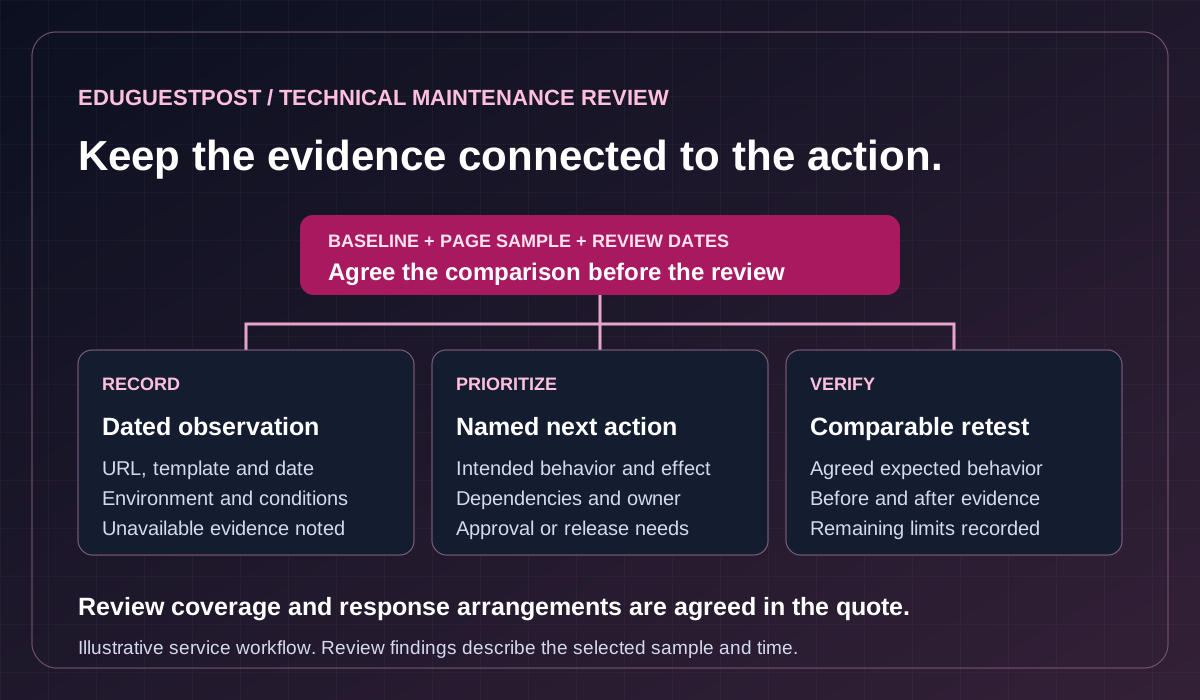
Confirm the contract period, page and template sample, review dates, reporting format, communication route and people responsible for decisions. A scheduled review describes what was checked when it ran. Continuous availability monitoring and emergency response need separately defined coverage.
Request a technical SEO maintenance quote with your website, platform, important pages and typical update schedule. Share the main concern first; any private evidence and implementation access can be arranged separately.
Set a schedule that reflects how the site changes
Review timing should reflect how often important pages change, how quickly a problem would matter and which evidence is available. A shared template used by many service pages may need different attention from a rarely changed reference article. Agree which groups are checked each cycle and which rotate through the sample.
Choose the evidence and frequency together
Scroll across to explore all columns.
| Review type | Evidence it can provide | Scope to agree |
|---|---|---|
| Scheduled review | Dated observations for selected pages and templates. | Review dates, sample, comparison baseline and report. |
| Review after an update | Differences linked to a known release or change. | Which updates trigger checks, who gives notice and what gets verified. |
| Account alert review | Findings from alerts available to authorized users. | Source, recipient, response coverage and verification method. |
| Availability monitoring | Repeated observations from a configured monitor. | Targets, intervals, locations, alert routing and response terms if included. |
Google’s monitoring guidance distinguishes trends, comparisons and alerts that need action. Apply that distinction to the website. A change that can wait for the next review should not be handled like a confirmed interruption affecting priority pages. An alert needs context and an owner before it becomes an instruction to make a change.
Record what each review covered
Keep the URL, template, date, environment and relevant request or browser conditions with each observation. Use the same conditions where possible when checking for regressions. If a page could not be fetched, a source was unavailable or a customer state was outside scope, record that limit in the report.
Repeated samples can uncover problems and show whether agreed changes behaved as expected. They do not describe every URL, browser, private journey or minute between checks. Use known changes and actual impact to adjust the next sample instead of expanding it without a purpose.
Check access declarations and important links
Begin with the intended behavior of the affected page. A public service page sending an unintended noindex needs a different decision from a private account page or a deliberately retired article. Separate the response, the content reached and the instructions the page actually sends.
Compare access and indexing evidence
The Indexability Checker supplies bounded diagnostic response, robots and declaration evidence. It does not establish Google’s indexed status. Google’s noindex guidance explains why a crawler must be able to fetch the instruction; a robots block can prevent it from being read. Keep deliberate access restrictions in place and investigate the source of an unintended directive before changing it.
The Canonical Tag Checker observes HTML and header declarations, with conditional target checks. A declared preference does not identify the URL Google selected. Compare it with the page purpose, expected destination and other signals rather than treating every non-self declaration as a defect.
Trace link findings to the affected source
The Broken Link Finder records where discovered links appeared and the outcomes of bounded public checks. A failed request may be temporary, restricted or genuinely missing. The report helps identify what to verify and where an approved repair belongs. It does not discover every link or operate as a background monitor.
For sitemap changes, the XML Sitemap Checker inspects one document at a time. An index lists child sitemap files; reviewing it does not recursively inspect the page files or confirm indexing. Check the files relevant to the changed URLs and compare them with the intended destinations.
Agree a next action for unexpected outcomes. A legitimate removal, a useful redirect and an incomplete check should remain separate in the findings register.
Verify the effects of platform and template changes
Record which component changed, when it changed and which pages it can affect. A shared theme, plugin or application update can alter navigation, mobile content, indexing instructions, markup and measurement. Review the delivered output rather than relying only on a version number or a successful update message.
Confirm the platform owner and recovery options
WordPress upgrade guidance recommends backing up before changes. Identify the actual core, theme, plugins and hosting responsibilities. A child theme, stored template or host-managed component may contribute output that is not obvious from a standard plugin list.
Shopify’s theme-copy guidance explains that downloaded themes exclude important store content. Agree the restoration scope before treating a theme copy as sufficient. In applicable Adobe Commerce deployments, cache management distinguishes application caches from browser caches. A cache operation does not establish that every visitor received the same version.
Check the relevant output and visitor state
Compare representative mobile and desktop pages, useful links and content, relevant structured data and actual instructions. Preserve intentional locale, product and login differences. A missing declaration can matter, but a syntax check alone cannot confirm that markup remains accurate or eligible for a search feature.
The Rendered HTML Checker compares source with a supplied browser DOM snapshot. Match the final URL, time, consent and other relevant conditions. It does not run a remote browser or reproduce Google’s rendering. Differences help direct investigation; they do not diagnose every cause or certify the full journey.
Keep changes to analytics events, tags and consent behavior in the change log where relevant. They can change what is measured without a matching change in demand. Confirm who approves and verifies any repair, which evidence supports it and how restoration would work if needed.
Compare performance and search data in context
Use the same measurement source and relevant conditions before interpreting a change. A new lab run can help investigate one template. Field data summarizes eligible real visits over a collection period, so it answers a different question. The distinction is explained in field and laboratory data guidance.
Keep the target and period attached to the result
The CrUX API documentation describes rolling field data and distinguishes page and origin records. Overlapping collection windows can contain many of the same visits. Do not use an origin record to certify every page or a recent field record to isolate the effect of yesterday’s release.
The current Core Web Vitals Checker supports supplied CrUX record JSON and supported Lighthouse JSON. Live CrUX and the separate automatic PageSpeed and Lighthouse panel are disabled pending setup. Missing field evidence remains unavailable. A Lighthouse score does not replace field Core Web Vitals, and Total Blocking Time is not Interaction to Next Paint.
Treat Search Console evidence according to its coverage
The site’s Google Search Console Audit currently shows that connection setup is required. Do not assume automatic reports are available. Where appropriate, agree authorized access or a suitable supplied export for the maintenance review. Current public page evidence and Google’s recorded search data remain separate.
Search Console’s weekly and monthly views can help compare trends. Its recent-data guidance also describes incomplete recent points. Match periods, filters and aggregation before drawing conclusions. Search clicks, visits and enquiries are different measurements; a reporting change should not be presented as a technical regression without corroborating evidence.
Close issues with evidence your team can review
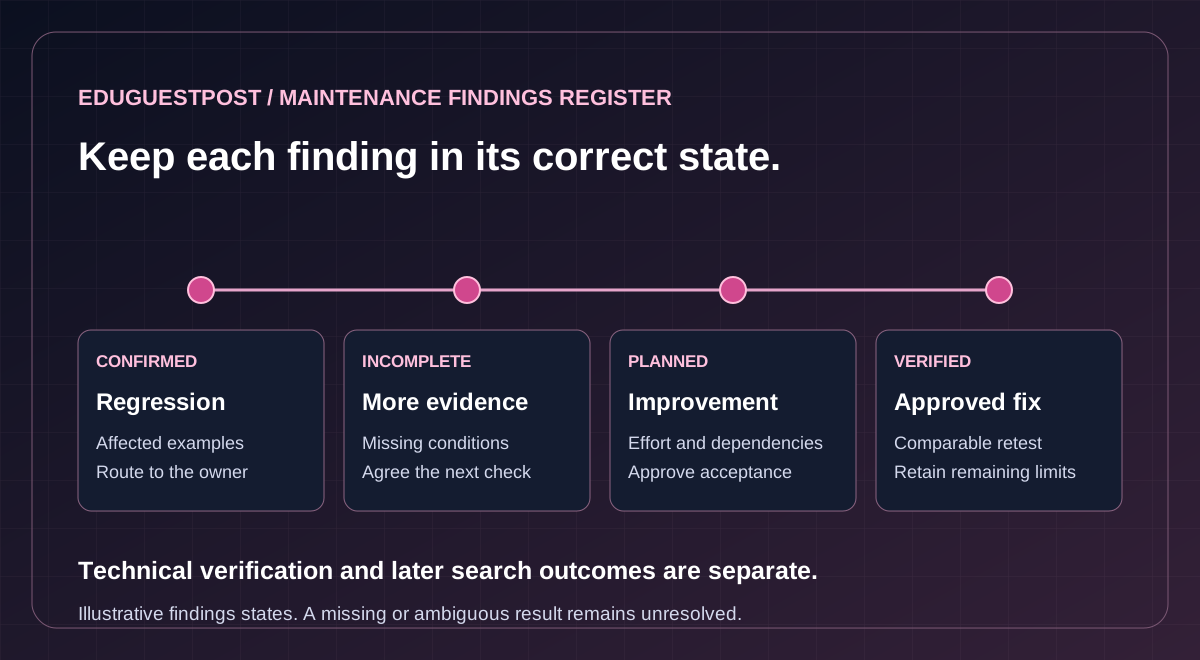
Each maintenance report should show what changed, why it matters, what remains uncertain and who owns the next step. Prioritize issues by verified effect on important pages and tasks, rather than the number of warnings. Keep changes that require development, approvals or a separate release visible.
Scroll across to explore all columns.
| Finding | Next action | Evidence to retain |
|---|---|---|
| Confirmed regression | Route it to the responsible owner under agreed terms. | Affected examples, intended behavior, scope and impact. |
| Incomplete or ambiguous result | Recheck conditions or obtain the relevant evidence. | What was observed, what is missing and the next check. |
| Planned improvement | Agree effort, owner and acceptance before implementation. | Reason for the change, dependencies and expected behavior. |
| Approved fix verified | Record the retest and any remaining observation. | Comparable before and after evidence and unresolved limits. |
Keep implementation and later outcomes separate
An approved repair can be checked against its expected response, link or template behavior. Later crawling, indexing and traffic need their own observations. Google’s traffic-drop guidance describes several possible causes; a change in one metric does not by itself establish why it happened.
The proposed handoff includes a baseline and review schedule, a dated change and findings register, prioritized actions with owners, and agreed verification results. Confirm the number of reviews, report format, response arrangements and which implementation tasks are included. Redesign support, a complete migration, dedicated release QA and emergency recovery can require separate scope.
Questions about technical SEO maintenance
Does scheduled maintenance include continuous monitoring or emergency response?
A scheduled review records what was checked when it ran. Continuous availability monitoring and emergency response require separately defined coverage, including targets, intervals, routing and response terms where included.
What happens when the website has no reliable baseline?
A substantial backlog or missing baseline can need a separate technical SEO audit. The first maintenance review should identify evidence gaps and agree the pages, templates and comparison sample rather than describe an incomplete inventory as complete.
Do indexability and canonical checks confirm Google’s indexed URL?
Indexability checks provide bounded response, robots and declaration evidence. Canonical checks observe declarations with conditional target checks. These findings do not establish Google’s indexed status or the canonical URL Google selected.
Are automatic field and Search Console reports already available?
The supplied Core Web Vitals workflow accepts supported CrUX and Lighthouse JSON; its live connections remain disabled pending setup. Search Console Audit also requires connection setup. Authorized access or suitable exports can be agreed, and missing evidence remains unavailable.
How are platform changes and approved fixes verified?
Record the component, release and affected pages, confirm responsibilities and restoration options, and compare representative output under relevant conditions. The approved repair is checked against its intended response, link or template behavior, with evidence and remaining limits retained.
What should the maintenance handoff and quotation define?
Agree the baseline, review schedule, dated findings register, priorities, owners and verification results. The quote confirms coverage, report format, response arrangements, implementation tasks, price and timing, without promising automatic repair, uninterrupted monitoring or search outcomes.
Request a technical SEO maintenance quote
Request your technical SEO maintenance quote with your site, important page groups, update frequency and preferred review period. The quotation should confirm coverage, deliverables, responsibilities, price and timing. The goal is to keep technical decisions and verification visible, without promising automatic repair, uninterrupted monitoring or a search outcome.
Tell us about your maintenance requirements
Share public page examples, typical changes and the review support needed. Agree private evidence and access arrangements separately.