
Verified details / Maintained structured output
Structured Data Implementation Services
Give search engines a consistent description of your pages and the people, services or products they describe. Structured data works best when it uses accurate information and stays aligned with the content your customers see.
Ask EduGuestPost to review your markup requirements and propose an implementation scope. The work can include a page and entity map, verified data requirements, template specifications, agreed configuration changes and validation. The quote confirms supported systems, development responsibilities, access, coverage, timing and follow-up.
The aim is a maintainable implementation with clear evidence of what was checked. Google decides whether eligible markup produces a search enhancement; correct code does not guarantee a rich result, ranking improvement or additional enquiries.
When a structured data review is useful
- A theme, plugin or platform change has altered the markup your pages deliver.
- Product details, author information or business identity differ between visible content and structured data.
- Search reports show issues that your team needs to trace to the responsible template.
- Several tools generate overlapping markup and you need a consistent approach.
The Schema Markup Generator provides supported starting templates using details you supply. The Structured Data Checker can inspect JSON-LD syntax and selected vocabulary relationships. Their results help define the investigation; installing and validating live output remain separate work.
Request a structured data quote with your website, platform, affected page types and examples of the issue. If the cause extends beyond markup, SEO audit services can help establish the wider priorities.
Map the page to the things it describes
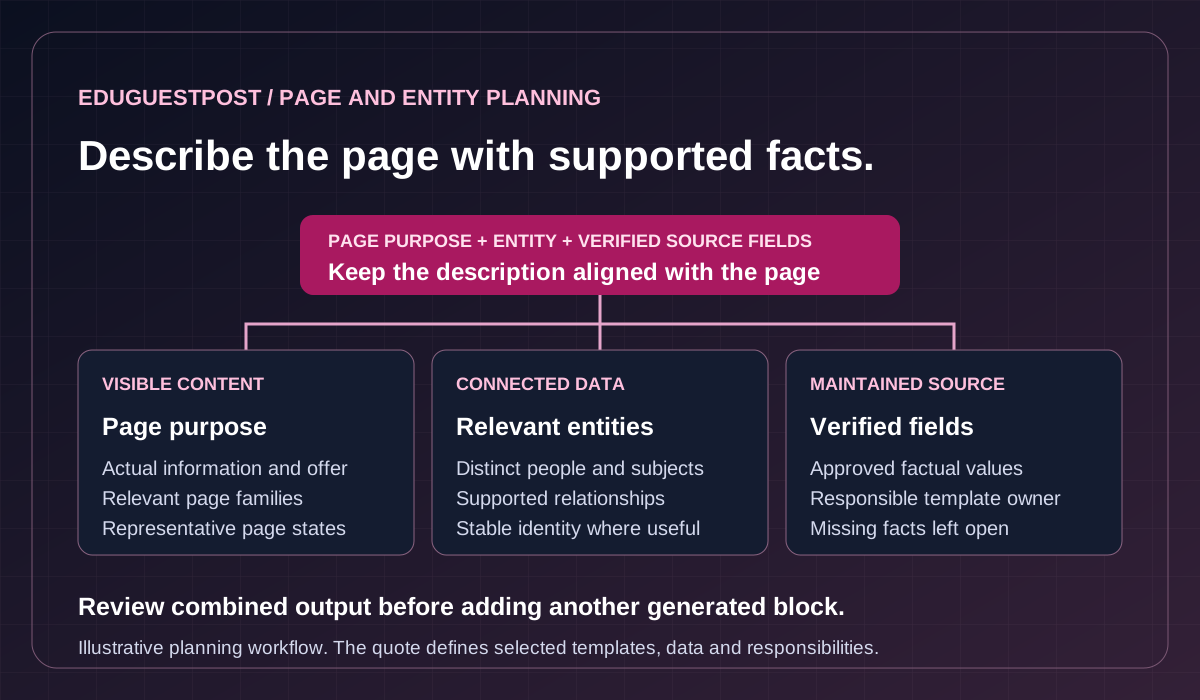
Begin with representative pages and their purpose. Identify the page itself, its main subject and the relationships that matter. An organization publishing an article, the article’s author and the service discussed are different things, even when they appear together.
Use the Schema.org data model to choose relevant types and properties, then check the requirements of the intended consumer. Google supports a subset of the vocabulary for specific search features. A type’s existence is not proof of a dedicated search display.
Select markup according to the actual content
Scroll across to explore all columns.
| Page purpose | Possible markup focus | Details to verify |
|---|---|---|
| Business identity | Organization and an applicable specific subtype | Genuine name, identity, contact details and relevant references |
| Service information | Service connected to its provider | Actual offer, provider and supported service area |
| Editorial content | Article or an appropriate subtype | Visible headline, actual authors, images and meaningful dates |
| Product purchase | Product, offer and relevant variant relationships | Selected item, seller, price, currency and availability |
| Navigation | BreadcrumbList | Useful route, ordered entries and intended destinations |
These are starting decisions rather than a package of types to add everywhere. Service can describe a service without creating a special Google service rich result. A physical-business subtype needs real location evidence; targeting customers in a city does not establish an office there.
The proposed mapping should record the page family, selected entities, data source, template owner and any unresolved facts. Identify which properties are required for the intended feature and which are recommended. Keep unsupported or unavailable details visible as open decisions instead of filling them with invented values.
Implement markup in the system that owns the output
A theme, SEO plugin, ecommerce app, page builder and custom template may all contribute structured data. Inspect their combined output before adding another block. The implementation proposal should identify where each entity is generated and who can maintain its values.
Google’s structured data introduction recommends JSON-LD in most cases and also supports Microdata and RDFa. Choose a format the website can maintain and consider existing working markup before changing it. A different encoding alone is not a reason to rebuild a useful implementation.
Keep related entities consistent
Use stable identifiers for the same organization, author or other entity where appropriate. The JSON-LD standard explains how identifiers and contexts support connected data. An entity identifier and a page’s canonical preference have different purposes.
Several scripts can describe related entities correctly. A repeated identifier is not automatically an error. Review whether the combined data agrees on identity, relationships and page-specific facts. Resolve conflicting names, dates, URLs or offers in the system responsible for them.
Connect values to their maintained source
Where practical, generate markup from the same maintained fields used by the page. Record how missing values, special characters and template exceptions will be handled. Safe serialization matters when content is inserted into an HTML data block; copying a demonstration without reviewing its encoding can introduce errors.
Confirm platform and version support before promising a particular change. Some hosted platforms generate markup that their normal controls cannot fully replace. Development work, plugin configuration and deployment support should be named in the quote, with an agreed backup, release owner and rollback approach.
Validate each layer and record what passed
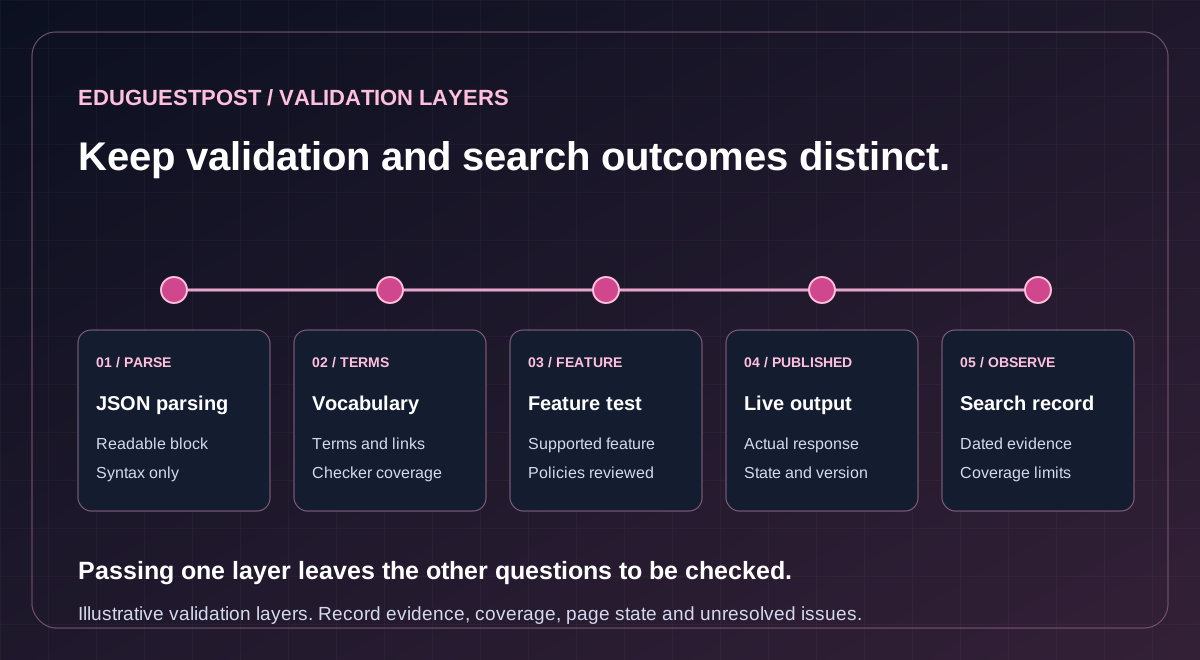
Validation answers several questions. A document can be valid JSON while using a misspelled property. Recognized vocabulary can still fail a feature requirement, and eligible markup can describe the wrong price or author. Define acceptance against the agreed page purpose and evidence.
Scroll across to explore all columns.
| Check | What it can establish | What still needs review |
|---|---|---|
| JSON parsing | Whether the inspected block can be read | Vocabulary, relationships and factual accuracy |
| Vocabulary and entity review | Recognized terms and relevant relationships within the checker’s scope | Consumer-specific requirements and actual page content |
| Google feature testing | Findings for features supported by the Rich Results Test | Untested policies and whether Google will display the feature |
| Published output review | What the selected live page delivers at the recorded time | Other templates, states and later changes |
| Search observation | Available indexed or search-report evidence | Processing delays, coverage limits and business outcomes |
The Structured Data Checker reviews JSON-LD parsing, expansion and selected Schema.org vocabulary relationships. It does not validate property value ranges, duplicate JSON keys, Google feature requirements or visible-content accuracy. Its URL mode reads the server response without running JavaScript; unsupported contexts or processing limits can leave a report incomplete.
Use Google’s Rich Results Test guidance for supported Google features. A pasted-code test does not establish what a published template delivers. Recheck representative live pages after release and record critical errors, warnings, unresolved questions and the evidence used to close each issue.
Warnings require interpretation. An optional missing detail should not be invented to make a report look cleaner. Keep the tested URL or supplied code, request time, template version and relevant page state with the handoff.
Keep markup aligned with the customer experience
Names, authors, dates, prices and availability should describe the actual page and offer. Review changes to visible content and structured data together. A cached product block or outdated author record can remain technically readable while becoming inaccurate.
Review dynamic content and product variants
Google can process structured data generated with JavaScript, but its implementation guidance warns that dynamic product markup can make Shopping crawls less frequent and less reliable. Choose the delivery approach for the actual platform and update frequency.
Product snippets and merchant listings have different requirements. Confirm the seller, selected variant, price, currency and availability against the relevant page. A category listing and a purchase page need different decisions. Product feeds and wider ecommerce repairs should have their own agreed scope.
The Rendered HTML Checker compares source with a browser DOM snapshot you supply. Match the final URL and relevant session, time and selected item. Its JSON-LD inspection checks syntax and declared types; it does not validate every schema property or reproduce Google’s rendering.
Treat ratings and identity as factual claims
Follow Google’s review snippet requirements. Reviews must relate to the identified item and be available to readers. Google excludes self-serving Organization and LocalBusiness review stars, including reviews displayed through an embedded third-party widget. A supported rating field does not make that business eligible.
Use the Indexability Checker for bounded access and directive diagnostics, and the Canonical Tag Checker for declaration evidence. Structured data does not override those controls. Neither checker confirms Google indexing or its selected canonical; those questions require the relevant Google evidence.
Receive a documented implementation handoff
Agree the deliverables before work begins. The handoff can include the page and entity map, verified source fields, implementation instructions or agreed changes, tested samples, remaining issues and maintenance responsibilities. Record which templates and states were checked so the next release can repeat useful checks.
Confirm who updates business details, authors, product information and other changing values. Define follow-up coverage and review dates separately from ongoing monitoring. If the team needs help deciding which templates deserve attention first, SEO consulting services can support that decision.
FAQ markup and current Google support
FAQPage remains part of Schema.org, but Google’s current documentation changelog states that FAQ rich results stopped appearing from May 7, 2026. Useful questions and answers can remain on a page; the former display should not be sold as an implementation benefit. QAPage has different eligibility requirements and is not a replacement label for ordinary publisher-written FAQs.
Structured data and AI search visibility
Google says its AI search features require no special Schema.org markup. Accurate structured data can describe the content, while inclusion, citations and search appearance remain Google’s decisions. A dedicated AI visibility guarantee is not an acceptance criterion for this work.
Questions about structured data implementation
What does the page and entity map record?
It identifies the page family, relevant entities, data sources, template owner and unresolved facts. Markup choices follow the actual content and intended consumer requirements, rather than a package of types added everywhere.
Should unknown details be added to remove warnings?
Unsupported or unavailable facts remain open decisions. Optional details should not be invented to make a report look cleaner; verified source fields and the evidence used for acceptance stay with the handoff.
Does valid JSON establish Google eligibility or factual accuracy?
Parsing establishes whether a block can be read. Vocabulary, feature requirements, visible-content accuracy and published output need their own checks, with each result recorded within its actual coverage.
Are several scripts or repeated identifiers automatically errors?
Several scripts can correctly describe related entities, and a repeated identifier is not automatically an error. The review checks their combined identity, relationships and page-specific facts, then traces conflicting values to the responsible system.
How is dynamic product markup assessed?
The delivery approach depends on the platform and update frequency. The review checks the selected item, seller, price, currency and availability against the page, while distinguishing product snippets, merchant listings and broader feed work.
Does implementation guarantee a rich result or AI citation?
Accurate markup describes the content, while search enhancements, inclusion and citations remain Google’s decisions. Correct code does not guarantee a rich result, rankings or enquiries, and no special Schema.org markup is required for Google’s AI features.
Request a structured data implementation quote
Contact EduGuestPost with your website, platform, representative pages, existing markup or issue reports, and the implementation support you need. Include any planned theme or content changes and your target date. Discuss supported templates, verification coverage, required access, price, timing and follow-up before deciding how to proceed. Clear examples help establish the scope even when a complete inventory is not yet available.
Tell us about your structured data requirements
Share public page examples, your platform and implementation support needed. Agree private evidence and access arrangements separately.