
Real coverage / Useful local answers
Service-Area Business SEO Services
Help customers understand what you do and whether you can come to them.
EduGuestPost’s service-area business SEO services connect your actual coverage with the profiles, website pages and business information customers use to choose a provider. We help businesses that travel to customers explain where they work, which services they provide and how to enquire.
The work starts with your operating model. A mobile repair business, cleaning company or home-service contractor may cover several towns from one base. Its website needs to describe that coverage clearly while its business profiles follow the rules for the real operation. A service area should help customers decide whether to contact you.
We turn those facts into a coverage brief, a review of the selected profiles and pages, and a prioritized delivery plan. Your proposal defines the work included, the information you need to supply and who will carry out any agreed changes. Recommendations, content preparation and implementation can be scoped to suit the project.
Request a service-area SEO plan with your website, main services, areas served and the problem you want to solve. Public profile and page links are useful starting points.
Make coverage clear before expanding it
Customers need practical answers. Do you offer the required service at their postcode? Can they arrange an appointment? Does a distant area have different booking conditions? We use confirmed business information to make those answers easier to find.
This service suits a business with unclear coverage, inconsistent public details or local pages that need a stronger purpose. It also helps an established provider decide which nearby markets deserve attention. The plan follows your capacity to accept and fulfil work, with priorities based on relevant search demand and the evidence available for each area.
What your service-area SEO plan includes
Your brief connects each service to the places where you can deliver it. We review the agreed website and profile coverage, identify missing facts and define the outputs needed. The proposal states the selected areas, URLs and records included in the work.
Scroll across to explore all columns.
| Work area | Included record | How your team uses it |
|---|---|---|
| Real coverage | Services, named areas, exclusions, operating bases and booking conditions | Confirm the places and jobs the business can accept. |
| Profile review | Business model, eligibility questions, categories, services and address visibility | Review supported recommendations for the selected profiles. |
| Website plan | Existing pages, customer questions, local evidence and proposed improvements | Choose useful updates and identify justified new content. |
| Listing review | Selected sources, current details, hidden-address support and unresolved issues | Prioritize suitable listings and specific corrections. |
| Measurement | Baseline, reporting coverage, available data and next actions | Follow delivery and assess observed changes over time. |
Define the service by area
A company may provide routine maintenance across a wider area than emergency repairs. Some jobs may require a site assessment before a booking is accepted. We record those differences so a general coverage claim does not promise every service everywhere.
Tell us which details are confirmed, which need checking and who can approve public wording. The working brief keeps private operating information separate from the details suitable for customer pages and listings.
Choose the work you need
For selected existing pages, our on-page SEO services provide a defined route for titles, headings, copy and related improvements. New page writing, template development and wider technical work need their own agreed scope.
Where the issue is business data across directories, local citation building covers suitable listing research and defined submission or correction work. Your proposal identifies which of these activities belong in the service-area project and which remain with your team.
Build profiles around the real business
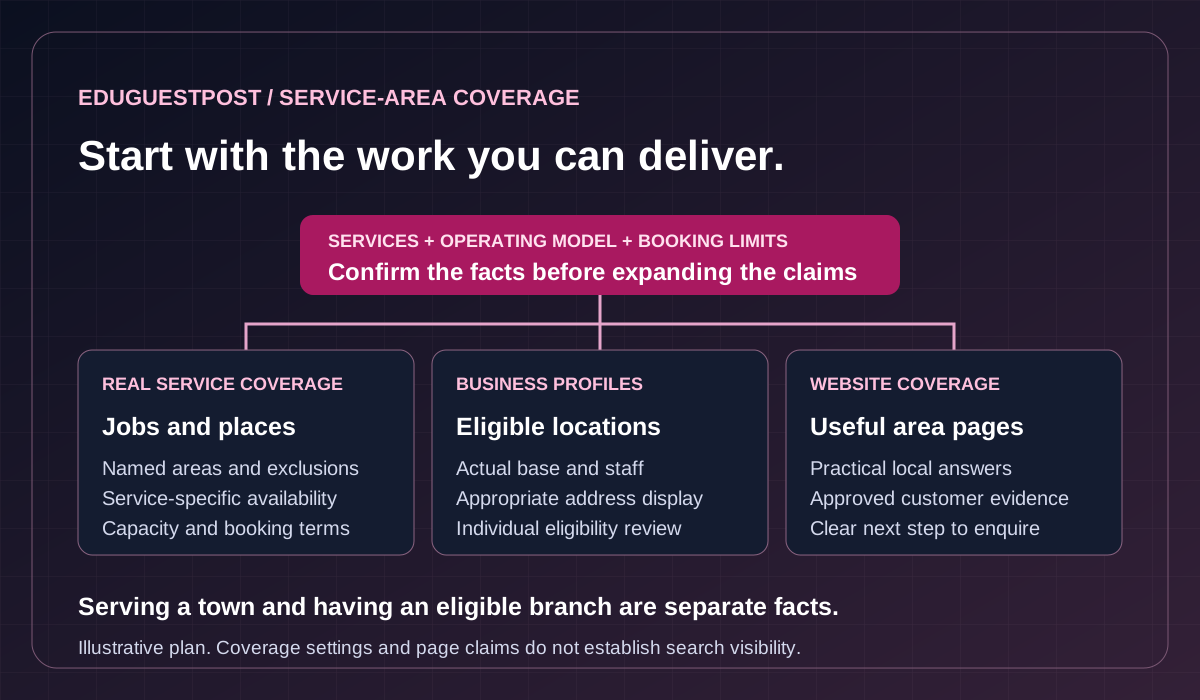
We assess how the business meets customers before recommending profile changes. A service-area business goes to customers and does not serve them at its business address. A hybrid business also serves customers at its premises. A storefront needs to meet the requirements for a customer-facing location.
Keep the operating base accurate
Google’s business representation guidelines govern eligible locations and public details. Additional service-business locations need separate staff and service areas under those guidelines. A target town, mailbox or virtual office does not establish an eligible branch.
We record the facts and unresolved eligibility questions for each selected location. Categories, service descriptions, hours and contact destinations should describe the operation customers can actually use. A new profile is a decision about a real business location, rather than a routine step for every town served.
Separate verification from public display
A service-area business can need a real address for verification while keeping that address hidden from customers on its profile. Private evidence belongs in the platform’s verification process. Public website copy, photographs and structured data need their own privacy review.
If Google offers video verification, its current video guidance explains the location, work assets and management evidence to show. Google determines the available verification methods. The plan can identify preparation tasks; acceptance and timing remain with the platform.
Describe coverage without promising visibility
Google’s service-area settings currently allow up to twenty named areas, such as cities or postcodes, rather than an editable radius. Its general guidance uses about two hours’ driving time from the base, with exceptions recognized in the main guidelines.
These settings describe where you work. They do not guarantee rankings throughout that territory. We prioritize realistic coverage and assess search visibility separately, using the searches and locations included in the measurement plan.
Give each area page a useful purpose
A service-area page should help someone decide whether to book work in that place. We review existing pages before recommending additions, using actual coverage, relevant demand and enough local substance to make the page useful on its own.
Scroll across to explore all columns.
| Customer question | Useful page information | Facts to confirm |
|---|---|---|
| Can you help here? | Named coverage and the available services | Postcodes, exclusions and service differences |
| How does booking work? | Enquiry route and appointment arrangements | Contact details and booking conditions |
| Have you worked nearby? | Relevant projects or customer evidence | Accuracy and permission to use material |
| What should I expect? | The process and practical local answers | Genuine conditions affecting the work |
We keep claims tied to evidence. A page can explain service in a town without suggesting an office there. Project examples and images need permission, and customer addresses or identifying details should stay private. Shared service information can remain consistent across the website while each area page answers a distinct customer need.
Internal linking services can connect selected service, coverage and contact pages through descriptive links. The agreed changes should give visitors a clear route to the relevant answer and enquiry.
Check markup against the public facts
The Structured Data Checker reviews supplied JSON-LD or a page’s server-returned HTML for syntax, expansion and selected Schema.org vocabulary relationships. It does not render JavaScript or validate Google feature requirements.
Google’s LocalBusiness documentation requires an address for that rich-result feature. Keep private addresses out of public markup when disclosure is unsuitable; inventing premises or exposing a home address to satisfy a test is not an SEO solution.
Use Google’s feature-specific testing alongside a review of the visible content. Its structured data guidelines explain why correct markup still does not guarantee a rich result.
Measure the searches and areas you selected
A business can accept jobs across a wide region while appearing differently from one search location to another. The baseline records what was measured, when it was checked and which services and areas were included. That context makes later comparisons useful.
Website search performance
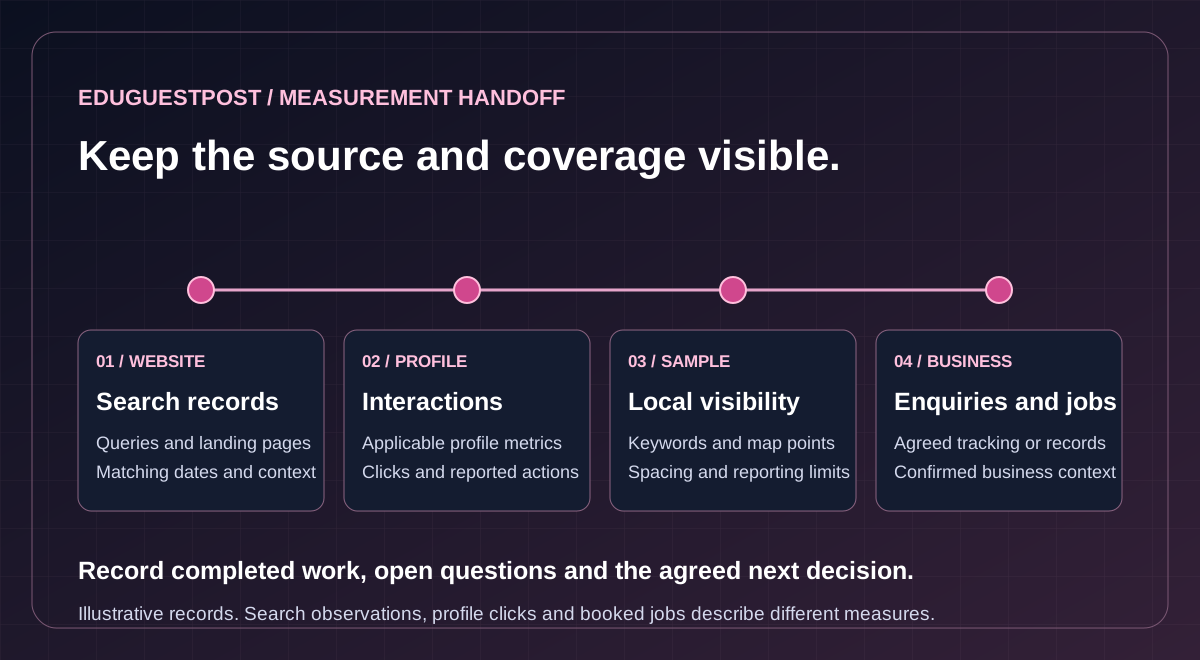
Where authorized data is available, Search Console performance reports help review relevant queries, landing pages, impressions and clicks. We compare the selected pages and periods, noting material changes to content, tracking or business operations.
Search Console’s average position describes the reported website results. It does not show every customer’s experience across the service area. URL Inspection can help investigate a selected page’s indexed status or live accessibility; a successful live test alone does not confirm indexing.
Profile and local search observations
Business Profile performance provides the applicable profile metrics. Its data can include organic activity and Google Ads. Call metrics count clicks on the call button, so they need to be kept separate from answered calls, qualified enquiries and completed jobs.
If local grid tracking is included, we define the keywords, map points, spacing and dates. A grid is a sample of visibility from selected search locations. A result from one point cannot stand for the entire town, and a missing result needs the tool’s reporting limit and settings for context.
Work completed and next decisions
The delivery record shows recommendations, approved changes, completed work and items waiting on facts, access or external review. It also identifies areas that need better evidence before more content is commissioned.
Enquiries and booked work require suitable business records or agreed tracking. Where that information is available, we review it alongside search observations so the next priority reflects the customers you can serve. Rankings, profile interactions and website clicks remain different measures, each with its own limits.
Common questions about service-area SEO
Can one operating base serve several towns
Yes. We can plan website coverage around the places you genuinely serve. Each additional Google profile needs its own eligibility assessment; listing more towns does not create additional business locations.
Will hiding my address remove it everywhere
Each source needs checking. Hiding an address on Google does not erase an address already published on a directory or elsewhere. We identify the selected public records and assess the available correction routes.
Can we use directories that require a public address
We check the source’s rules and your approved public details. A directory that cannot support your operating model or privacy requirements may be unsuitable. Listing volume should follow fit and eligibility.
Will we need a separate page for every area
We recommend pages where relevant demand, real coverage and useful information support them. Some areas may fit a broader coverage page. A long list of place names is not a content plan.
How long will results take
The quote sets the delivery stages for the agreed work. Search outcomes depend on competition, the website, location and platform decisions. We establish a baseline and review progress without promising a ranking or booking deadline.
What do we need to confirm before the work begins?
Your team confirms the services, real coverage, operating bases, booking limits and facts that can be made public. The proposal identifies the selected pages and profiles, deliverables, implementation responsibilities and reporting coverage.
Request a scoped service-area SEO quote
Send your website, main services, public profile links and the towns or postcodes you cover. Describe the issue, the priority areas and any important booking limits. Mention whether you need recommendations, content preparation, implementation or a combination. Private verification documents and account credentials are not needed for an initial enquiry.
Ask EduGuestPost for a service-area SEO quote. We use the brief to define the coverage, deliverables, required information and implementation responsibilities before work begins.
If you need help choosing between local priorities and broader website work, SEO consulting services can address that decision first.
Tell us about the service-area work you need
Share public business and page links. Keep verification documents, private operating details and account credentials for an agreed private route.