
Relevant destinations / Documented release checks
SEO URL Structure and Redirect Implementation Services
Keep visitors moving to the right page when your website changes. A new address should have a clear purpose, a relevant destination and a route your team can verify.
Ask EduGuestPost to review your URL structure and redirect requirements. The proposed scope can cover an inventory, destination mapping, implementation specifications and verification. Any configuration work, deployment access, developer involvement and follow-up period must be confirmed in the quote.
A redirect that reaches a working page can still send someone to the wrong service, language or product. The objective is to preserve the intended journey and document what each change achieves.
When this work can help
- A redesign or platform change will replace established page addresses.
- Old links reach irrelevant pages, redirect chains or error responses.
- Several address formats serve equivalent content and need a consistent policy.
- Teams need an agreed mapping before changing categories, directories or domains.
Start with examples in the Redirect Checker. Compare the observed route, expected address and final response separately. Its local mapping analysis reviews a supplied plan without applying rules to your website.
If the underlying problem is still unclear, SEO audit services can help define the investigation. For a known URL change, request a quote with your website, representative old and intended addresses, platform and target date. A full mapping is useful when available; examples are enough to begin the discussion.
Build the inventory and agree the destination
Begin with the addresses that exist and the journeys they support. Relevant inputs can include the CMS export, current and historical sitemaps, an agreed crawl and authorized analytics, search or log exports. Each source has coverage limits; one sitemap is not a complete history of every address people still use.
Prioritize important commercial pages, linked resources and known entry points. Keep original values alongside any normalized comparison fields so that meaningful differences remain visible.
Give each URL a documented decision
Scroll across to explore all columns.
| URL situation | Proposed treatment | Evidence needed |
|---|---|---|
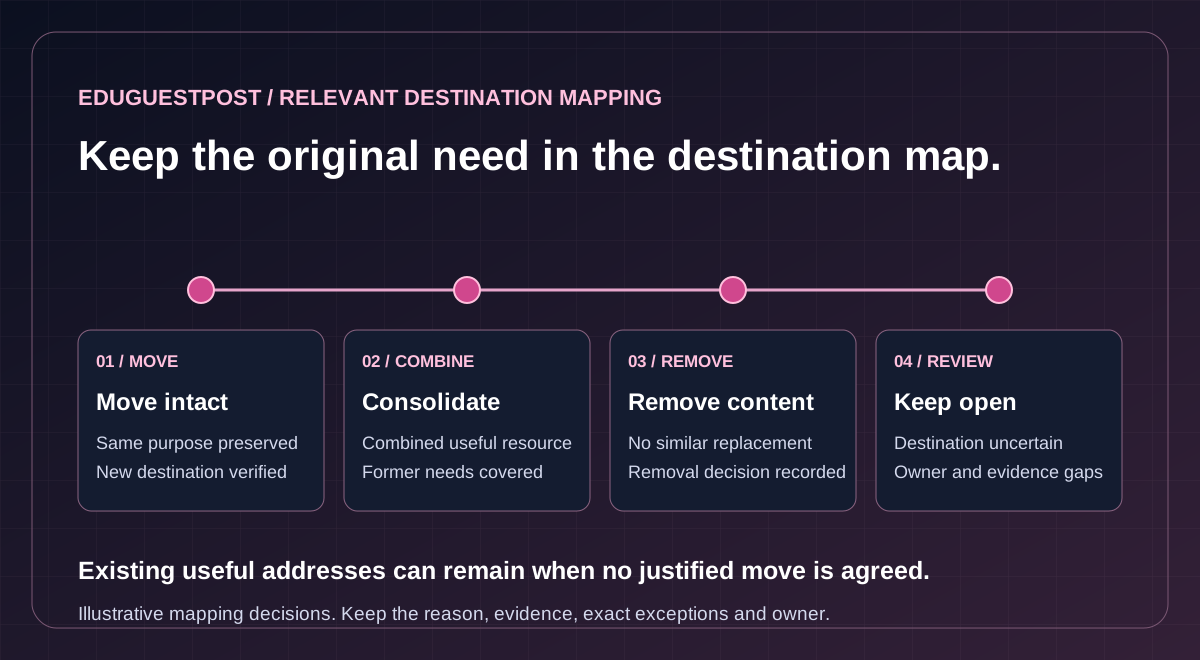
| Content moves intact | Map the old address to its intended new location | Same page purpose and a verified destination |
| Several pages are consolidated | Use the relevant combined resource where it answers the old need | Coverage of each former page’s essential content |
| Content is removed | Consider a proper 404 or 410 when no similar replacement exists | Removal decision and useful error-page behavior |
| An address remains useful | Retain it unless a justified change is agreed | Content purpose, links and available performance |
| Destination is uncertain | Keep the decision open for review | Named owner and missing information |
Google’s crawling troubleshooting guidance distinguishes moved content from content removed without a suitable replacement. An unrelated homepage fallback can leave visitors without the answer they expected.
The mapping should record the source, intended destination, decision reason, proposed response, priority and owner. Separate exact exceptions from broader patterns. Preserve existing rules that remain necessary, and investigate conflicts before replacement.
A spelling resemblance is not proof of equivalent content. Review the actual offer, language, product identity and availability before approving a destination. Unresolved rows should remain visible through implementation and handoff.
Choose a URL policy the website can maintain
Clear addresses help people understand where they are going. Follow Google’s URL structure guidance when designing new routes: use descriptive words, a logical structure and conventional parameter encoding. A cosmetic preference alone is a weak reason to move an established page.
Decide how the website handles hostnames, HTTPS, trailing slashes, path capitalization and necessary query values. Confirm the current application behavior before enforcing consistency. A color, locale or pagination value may identify a different destination; deleting it can change what the visitor receives.
Write these decisions as rules the publishing team can follow. For each proposed pattern, include a representative destination, an exception and the person responsible for future changes. This helps new pages follow the same policy without repeating the mapping exercise whenever a category or service is added.
RFC 3986 distinguishes URL components and normalization rules. Lowercasing a hostname does not justify lowercasing every path. Decoding reserved delimiters or reordering query values requires care. A fragment after a hash is handled separately from the address sent in an HTTP request.
Match the response to the purpose
Permanent moves commonly use 301 or 308; temporary moves commonly use 302 or 307. The HTTP semantics standard also distinguishes request methods: 301 and 302 permit POST to become GET, while 307 and 308 preserve the method. Application owners should review forms and API routes before changes. A 303 used after an action serves a different purpose.
Preserve meaningful destinations
Keep later pagination pages reachable through their own URLs and canonicals, as Google’s pagination guidance recommends. Review product variants and language alternatives individually. A shorter address is useful only when it continues to serve the intended content and customer journey.
Implement rules in the layer that owns the response
A CDN, web server, CMS, plugin and application can each influence the route. The proposed implementation scope should identify the controlling system, current rules, available access and person responsible for release. Supported configuration work depends on the actual setup and agreed responsibilities.
Rules need matching examples and examples that must remain unaffected. Test exact routes, deeper paths, uppercase characters, encoded values and relevant queries. A general pattern can silently override a specific destination.
Platform behavior changes the implementation
Scroll across to explore all columns.
| Configuration area | What needs confirmation | Why it matters |
|---|---|---|
| Matching and order | Source host, path context, rule precedence and exceptions | An earlier or broader rule can handle the request first |
| Query handling | Values to preserve, replace or remove | Different platforms have different defaults and matching limits |
| Redirect versus rewrite | Actual status and client-visible destination | Internal routing can serve content without changing the address |
| CMS constraints | Supported routes, existing content and locale behavior | A valid mapping may need a different implementation mechanism |
For example, Cloudflare Bulk Redirects disables query preservation by default, while Netlify’s documented options describe automatic forwarding for specified statuses. Copying one platform’s assumptions into another can lose required values.
Prepare a controlled release
Agree the accepted map, configuration backup, test environment, release owner and rollback approach. Check priority journeys before deployment and recheck them afterwards. Define any phased rollout according to the site’s size and dependencies.
Update internal links, intended canonical declarations, relevant language annotations and sitemap generation together. Use Google’s canonical guidance to keep preferences consistent. A canonical declaration does not forward a visitor or establish which URL Google selected.
Verify the old route and the destination content
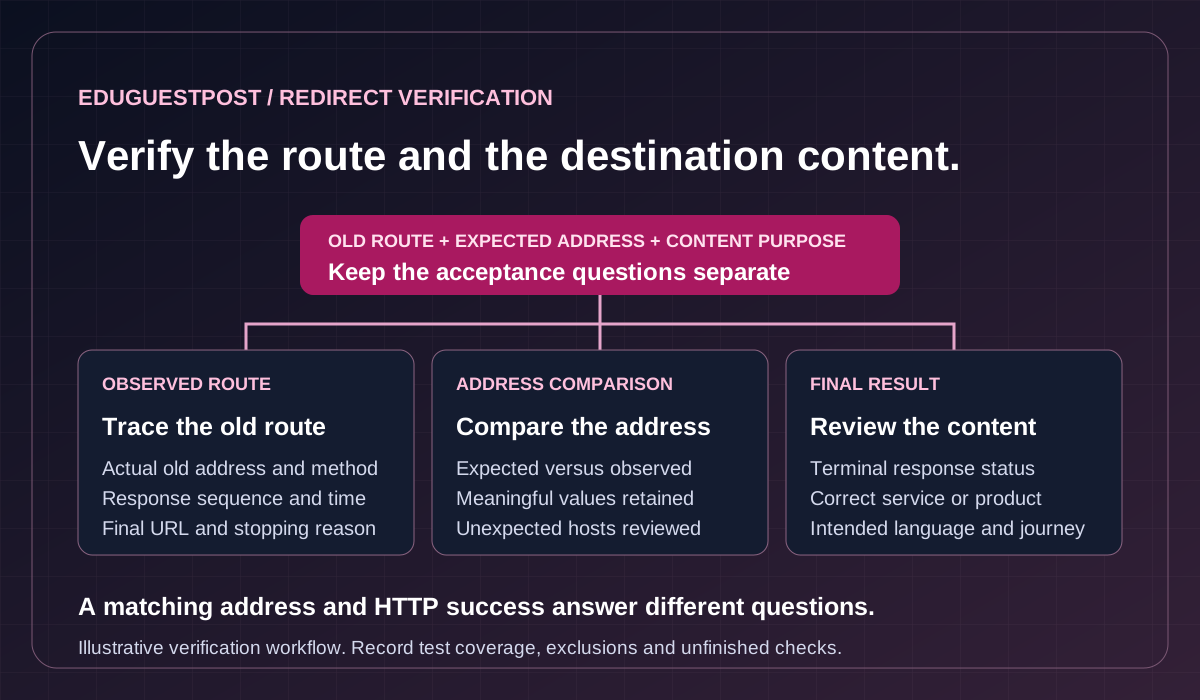
Start each check with the actual old address. Capture the request method, time, response sequence, Location values, final URL and stopping reason. Aim for a direct route to the agreed destination where practical, and investigate loops, avoidable chains, unexpected hosts and terminal errors.
Use the Redirect Checker to compare supplied old-to-expected pairs within its published limits. An address match, an observed redirect and a successful HTTP response answer three separate questions. The comparison follows the old route; it does not independently fetch every expected address as a separate test.
A hypothetical old address can redirect to the exact expected URL and still end in 404. A direct 200 from the new address establishes no forwarding rule from the old one. An incomplete trace leaves an open question. Even a matched route ending in 200 needs a content review for the intended service, product or language.
Check the surrounding signals
The Canonical Tag Checker reviews declarations in available evidence. The Indexability Checker provides bounded response and directive diagnostics. Neither establishes Google’s selected canonical or confirms indexing.
For JavaScript-dependent pages, the Rendered HTML Checker compares source with a DOM snapshot you supply. Match the final address and relevant session state; the tool does not operate a remote browser. The XML Sitemap Checker examines the selected XML document without recursively opening an index or testing every listed page.
Record coverage, exclusions and unfinished checks in the handoff. Account for browser and intermediary caches when observations disagree. Under the HTTP caching standard, freshness depends on response controls and applicable cache behavior; removing a rule does not itself prove every client has stopped using a cached response.
Receive a handoff your team can use
The quote should confirm which outputs are included: the reviewed inventory, accepted destination map, URL policy, implementation instructions or agreed configuration changes, verification results and remaining decisions. Keep the responsible owner, release details and follow-up dates attached to the work.
If your team needs help deciding priorities before committing to development, SEO consulting services can support that decision. Wider architecture, content, hosting and migration requirements should have their own agreed responsibilities and budget.
Questions about URL changes and redirects
How long should redirects remain?
Google’s site-move guidance advises keeping redirects as long as possible, generally at least one year. Useful old links can justify longer retention. Plan continued control of the old host and functioning HTTPS where needed. A review date is a checkpoint, not an automatic instruction to delete working rules.
Will correct redirects preserve rankings?
Redirects help communicate a move, but they do not guarantee rankings, traffic or the timing of search updates. Evaluate technical acceptance separately from later crawling, canonical selection and indexing. Assess commercial performance with comparable periods and known data limitations.
Can implementation be quoted without a complete map?
Representative examples can establish the initial requirements. The quote should explain how the remaining inventory and decisions will be resolved, what access is needed and who approves the mapping. Confirm platform support and deployment responsibility before committing to release dates.
What if removed content has no similar replacement?
The mapping can consider a proper 404 or 410 with useful error-page behavior when no similar replacement exists. The removal decision is documented, while uncertain destinations stay open for review.
Does an expected-address match prove a successful redirect?
An address match, an observed redirect and an HTTP success answer different questions. The check begins at the old route, then reviews its final response and whether the content serves the intended service, product or language.
Who configures and deploys the agreed rules?
The scope identifies the system controlling the response, supported configuration work, access and release owner. The accepted map, backup, test environment and rollback approach are agreed, with implementation instructions or configuration changes identified in the handoff.
Request a URL and redirect implementation quote
Contact EduGuestPost with your website, proposed change, old and intended URL examples, platform, target date and implementation owner. Include any existing map or known problem routes. Discuss the deliverables, access, price, timing and follow-up scope before deciding how to proceed.
Tell us about your URL and redirect project
Share public URL examples, your platform and implementation support needed. Agree private evidence and access arrangements separately.