
Useful filter states / Defined search treatment
Faceted Navigation SEO Services
Give filtered pages a clear search purpose
Filters help visitors narrow a catalog by size, price, location or another useful attribute. They can also generate many overlapping URLs, including combinations that return nothing or repeat the same results. EduGuestPost’s faceted navigation SEO services help you decide which destinations should support search discovery and how the remaining filter states should behave.
The proposed engagement connects your filter controls, generated URLs, public responses and search instructions. It produces a decision map and implementation tasks for the agreed sections, with checks that preserve useful landing pages and working navigation.
Google’s faceted navigation guidance distinguishes filtered URLs that need crawling from combinations that do not. The choice comes before the rule. A restriction applied to every parameter can capture valuable destinations along with unnecessary combinations.
Your proposed scope can include:
- An inventory of filter dimensions, URL patterns and representative states.
- A decision map for search landing pages, browsing controls and invalid combinations.
- Prioritized tasks assigned to the relevant platform or implementation owner.
- Acceptance checks, unresolved findings and an agreed handover.
The work can focus on a product collection, directory section or a known pattern of excessive URL generation. A large URL count alone does not establish which pages should disappear. Start with the content, the visitor’s task and the evidence that prompted the concern.
Share your website, an affected listing page and examples showing the filters applied. Identify useful destinations you want to preserve and any recent platform or navigation changes. Explain whether you need recommendations, implementation support or a review of work already completed.
Request a faceted navigation SEO quote to agree the coverage, deliverables and responsibilities.
Map the filter states before extending a rule
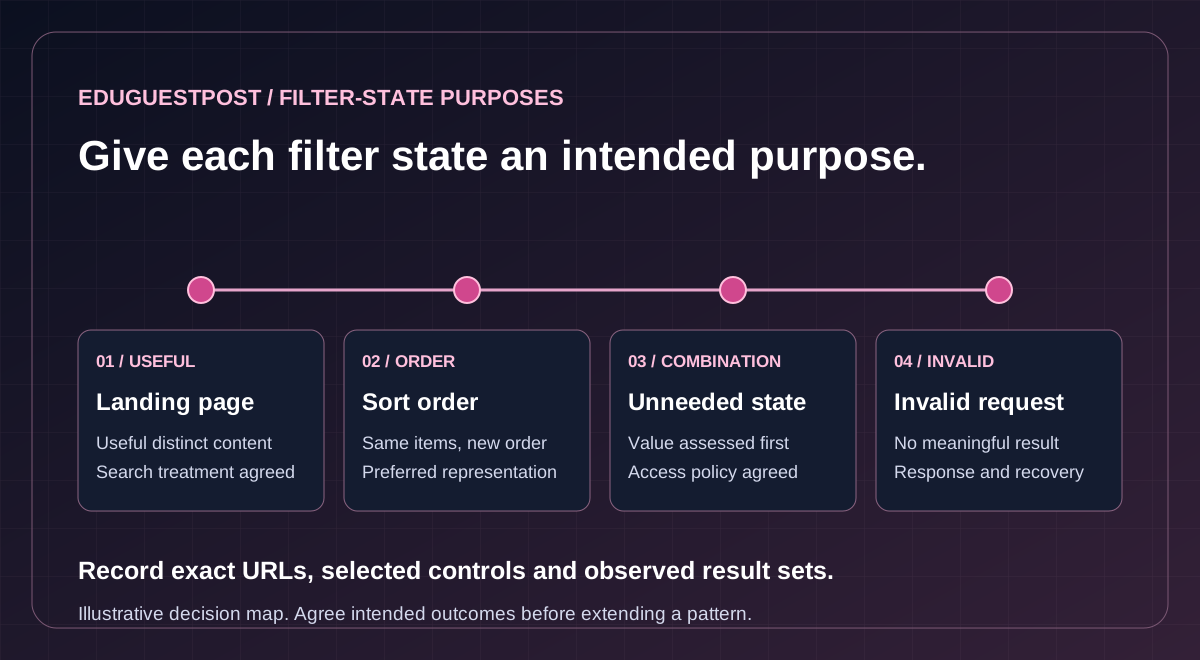
Record what each filter changes: the item set, ordering, page number or presentation. Several selections can represent one useful destination, while a small URL difference can select entirely different content. Keep the exact address beside the selected controls and observed results.
Scroll across to explore all columns.
| URL or state | Purpose to establish | Decision to document |
|---|---|---|
| Selected filtered landing page | A useful, distinct destination for a real audience | Content, discoverability and intended search treatment |
| Alternative sort order | A different ordering of an existing item set | Preferred representation and browsing behavior |
| Unnecessary combination | A state with little value as a search destination | Appropriate crawl and indexing policy |
| Invalid or empty request | No meaningful result for that combination | Response status and helpful recovery options |
Google’s ecommerce URL guidance explains how changing parameters, fragment-only versions and alternative routes can affect discovery and retrieval. Review actual behavior before removing a parameter, changing its order or sending every version to the same destination.
Check the result as well as the address
The proposed sample set should include individual filters, multiple selections, reordered parameters, price boundaries and reset actions. Confirm whether values combine as alternatives or requirements, and whether the underlying system matches products, variants or another type of record.
A displayed count can describe matching products, available facet values or a limited search result set. Record what it measures. It is not automatically the number of public URLs, indexed pages or crawler requests.
The Canonical Tag Checker can inspect public or supplied declarations, with destination evidence where verification is enabled. It does not determine content equivalence or Google’s selected canonical. Use those findings alongside the result-set review before deciding which addresses belong together.
Choose controls for the intended outcome
The decision map should distinguish crawl access, index exclusion and canonical preference. These controls answer different questions and have different prerequisites. Applying several instructions without a policy can leave the implementation working against itself.
Google’s canonical guidance describes signals for duplicate or very similar pages. A filtered destination with a different useful purpose should be assessed before it points to a broader listing. A canonical is a preference, and it does not guarantee Google will stop crawling the alternative.
Plan indexing decisions alongside access rules
Google’s noindex guidance explains that a supporting crawler must fetch the page to read the instruction. Blocking that fetch can prevent noindex from being seen. A known blocked URL may still appear without fetched content, so crawl restrictions alone cannot promise removal from Search.
Keep existing indexed URLs and newly generated combinations visible as separate cases in the plan. Preserve deliberate private access controls. Neither a robots rule nor an indexing directive authenticates a visitor.
The Indexability Checker supports a bounded review of public responses and declarations. It does not crawl the entire site, render remote JavaScript, determine soft 404s or confirm Google indexing. An incomplete check remains unresolved evidence.
Test permitted and restricted examples
The Robots.txt Generator can prepare draft rules and compare supplied paths with generated, pasted or fetched robots text. Tested paths are not visited, and selecting a bot does not impersonate it. A winning-rule result does not reproduce a crawler’s cached file or request history.
Agree representative public pages, intentional restrictions and boundary cases before extending a pattern. Keep required resources available and assign any approved change to the system that actually controls the delivered file or page directive.
Verify responses and protect the agreed destinations
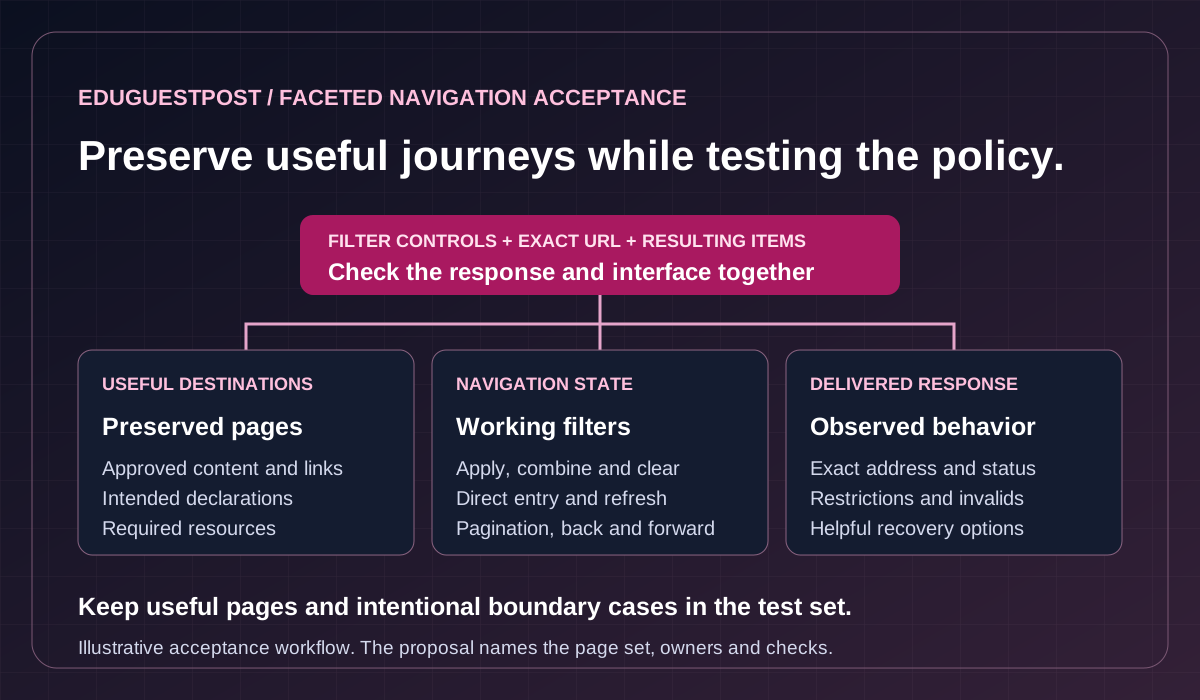
Empty combinations, repeated filters and nonexistent page numbers need explicit treatment. Google’s guidance for empty filter combinations recommends an HTTP 404 at the affected URL rather than a redirect to a shared error page. Single-page applications have additional implementation considerations; verify the response and interface together.
The acceptance record should include useful pages that must survive the change as well as requests expected to be restricted or invalid.
Scroll across to explore all columns.
| Test case | Evidence to retain | Acceptance question |
|---|---|---|
| Approved landing page | Response, content and intended declarations | Is the useful destination preserved? |
| Restricted combination | Selected crawler, file version and matching rule | Does the agreed access policy apply? |
| Empty or invalid request | Exact URL, status and displayed recovery | Does the response match the intended treatment? |
| Pagination and reset | Selected controls, URL and resulting items | Can visitors reach and restore the expected list? |
The Redirect Checker distinguishes observed redirects, destination matches and HTTP success. Its pair mode does not independently fetch the expected destination. An intended 404 for an invalid request can satisfy the agreed policy even though it is not a successful HTTP response.
Align discovery with the selected page set
Review internal links and sitemap entries for the destinations intended for search. Sitemap inclusion does not override a crawl restriction, noindex or a conflicting canonical choice. Broader sitemap repairs can be specified separately.
The XML Sitemap Checker inspects one document within its limits. It extracts child-file addresses from an index without following them, does not visit listed pages and cannot establish complete coverage or indexing. A comparison against the agreed landing-page inventory remains a separate check.
Agree implementation and measure the right evidence
The quotation should define the sections and filter dimensions covered, representative test coverage, deliverable formats and quantities, required access and implementation owner. Confirm whether the engagement includes recommendations, specified changes, verification or continuing monitoring, with price and timing agreed before work starts.
A theme, search application, catalog configuration or server response may own different parts of the behavior. The change plan should identify those dependencies, the release sequence and a rollback approach. A drafted rule or recommendation is not a deployed change.
Separate technical acceptance from later processing
Where authorized evidence is available, Search Console’s Crawl Stats report can help review crawling and serving conditions. Its examples are not a complete URL history. Investigating requests for particular filtered families may require appropriately scoped logs or other agreed evidence.
URL Inspection can help investigate individual pages. Indexed data and a live test differ; the live result cannot predict Google’s selected canonical. Preserve report dates and response versions so an older observation is not mistaken for evidence about the latest release.
Lower request totals alone do not prove that useful pages are being discovered faster. Assess the agreed page set, working filters, response behavior and remaining issues before interpreting changes in crawling or search performance. No fixed crawl saving, indexing timetable or ranking result follows from a cleaner URL policy.
For a broader investigation, SEO Audit Services and SEO Consulting Services provide routes to separately defined diagnosis or prioritization. Confirm any private evidence exchange and retention requirements for the selected scope.
Common questions about faceted navigation SEO
Should every parameter or filter combination be blocked?
The choice starts with content, visitor purpose and evidence. A broad restriction may capture useful destinations alongside unnecessary combinations, so the decision map identifies which states should support search discovery first.
Are canonical, noindex and crawl controls interchangeable?
They address different questions and have different prerequisites. A canonical expresses a preference, while a supporting crawler must fetch a page to read noindex. The plan records the intended outcome and the access needed for each case.
Does a displayed result count equal the number of indexed URLs?
The count may describe products, available facet values or a limited result set. The review records what it measures; that number does not automatically describe public URLs, indexed pages or crawler requests.
Should later listing pages point to page one?
The review preserves distinct component URLs, their own canonicals and sequential access to later items. It also checks what happens to pagination, selected controls and results when a filter selection changes.
Do the public checkers establish complete coverage or Google indexing?
Their coverage is bounded. The Indexability Checker reviews selected public evidence, and the XML Sitemap Checker inspects one document without following index child files or visiting listed pages. The agreed inventory remains a separate comparison.
What does the acceptance record establish?
It checks preserved landing pages, intended restrictions, invalid requests and working pagination or reset behavior against the agreed policy. Later crawling and search performance require their own evidence, without a fixed saving or outcome promised by the policy.