
From observed issues / To checked implementation
Technical SEO Services
Turn technical SEO findings into changes your website team can act on. Request a scope from EduGuestPost that connects the affected pages, the proposed fixes, the people responsible and the checks needed before a task is closed.
Technical problems can appear in crawl controls, URL handling, JavaScript output, mobile content, performance or structured data. A useful engagement identifies which problems affect your site and what it will take to resolve them. It should give your team a clear route from evidence to an approved change.
Choose work that fits your website
Bring an existing issue list, a recent release concern or a specific website problem. Possible starting points include important pages missing from navigation, conflicting canonical signals, content absent from rendered output, unstable layouts or inconsistent template markup.
The proposed work can cover selected fixes, a template improvement project or a defined sequence of changes. Agree the website sections, access requirements, implementation responsibilities and acceptance checks before delivery begins. A continuing review arrangement needs its own scope and cadence.
If the underlying problems are still unclear, start with SEO audit services to establish findings and priorities. This technical SEO engagement takes agreed issues forward into implementation planning, coordinated changes and verification.
Google’s technical requirements describe minimum conditions for eligibility. Meeting those conditions does not guarantee indexing or a particular search position.
Request a technical SEO scope
Send your website and technical brief, including the affected URLs, known issues, platform and available development support. The quotation should identify the work, its dependencies and the evidence you will receive.
Build the scope around affected pages and templates
A technical SEO project should identify what will change and how the change will be checked. Use the areas below to define the work your website needs. They are possible workstreams; the proposal should select the relevant tasks and explain any exclusions.
Scroll across to explore all columns.
| Project area | Possible work | Evidence to agree |
|---|---|---|
| Crawl and index controls | Review robots rules, index directives and access on affected URLs. | Intended access and indexing instructions, checked against the observed response. |
| URL signals | Align canonical declarations, redirects, sitemap entries and internal destinations. | A URL mapping and checks for conflicting signals or unintended destinations. |
| JavaScript and navigation | Investigate missing content, links and routes across selected templates. | Matched source and browser evidence, plus checks for discoverable destination URLs. |
| Mobile and performance | Investigate content differences, loading delays, responsiveness and layout movement. | Defined test conditions and separately labelled lab and available field evidence. |
| Structured data | Review existing template output, entity details and applicable feature requirements. | Recorded syntax checks, visible-content review and unresolved eligibility questions. |
| Language and regional pages | Review alternate URLs, language annotations and related canonical signals. | A checked set of intended page relationships and documented exceptions. |
Make coverage explicit
Record the templates, page types, URL samples and environments included. A sample can reveal a shared template problem, but it does not establish that every URL behaves identically. Identify where broader testing is needed.
For a large or frequently changing site, include crawl-budget analysis when discovery or crawling evidence justifies it. A small website does not automatically need a crawl-budget workstream.
The proposal should also identify access, developer availability, third-party dependencies and release constraints. Changes to copy, titles and headings can be scoped through on-page SEO services when those tasks are needed alongside technical work.
Give each fix an owner and an acceptance check
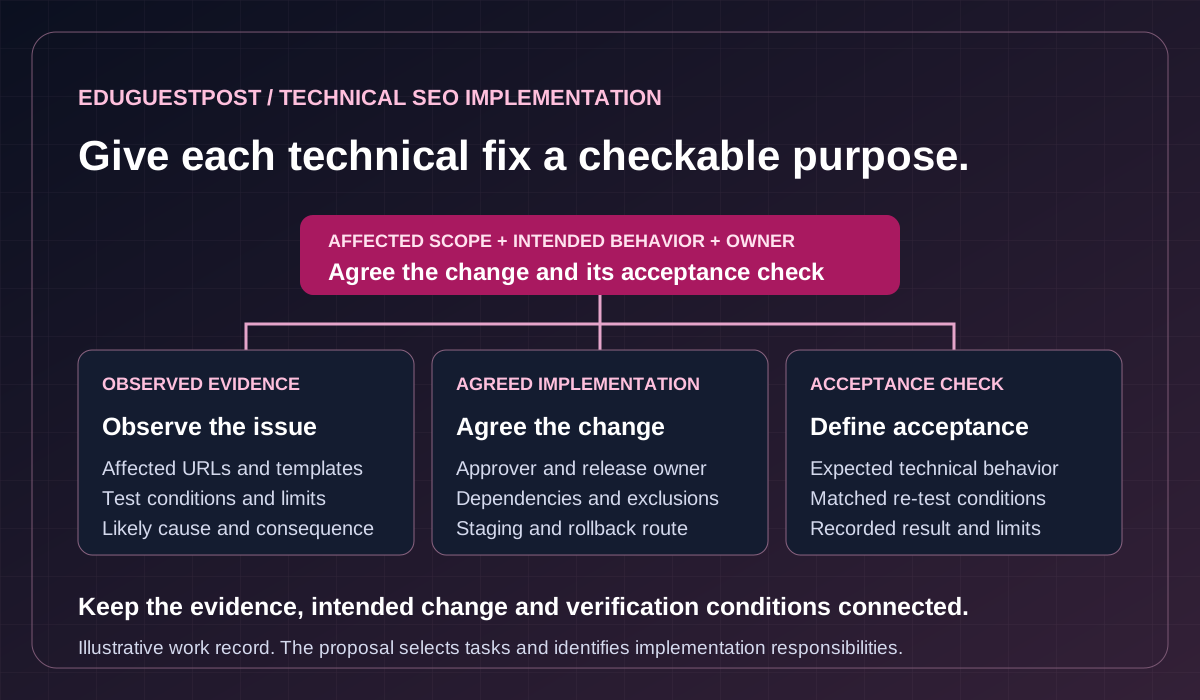
A finding becomes actionable when the team can see the problem, the affected scope and the intended behavior. For each selected issue, the proposed work record should include the observed evidence, likely cause, recommended change, implementation owner and acceptance check.
Prioritize the consequence
Start with issues that obstruct important content, damage useful journeys or create repeated errors across a meaningful template. Consider the number and purpose of affected pages, confidence in the diagnosis, implementation effort and release risk. A crawler’s severity label can inform the discussion; it should not determine the entire queue.
For example, a category page with product links that require an interaction may need a navigation change. The acceptance check should establish that the intended links and destinations are available under the agreed conditions. A green checklist item alone would not establish that Google indexed every product.
Agree who changes and releases the website
The quotation should distinguish changes EduGuestPost would implement from instructions or tickets for your own team. Name who approves the change, who can deploy it and who verifies the production result. Confirm staging availability, release timing and a rollback route where the change requires one.
Check the wider effect before changing a shared rule or template. A redirect can affect forms and other requests as well as page visits. Existing exclusions, regional variants and working redirects may have a valid purpose. Unused-looking URLs should be investigated before removal or consolidation.
Keep decisions usable
Record dependencies, approved exceptions and deferred items with a reason and next owner. If your team needs advice across competing platform or architecture options, SEO consulting services can be scoped around that decision.
Major URL moves require a separate migration plan, including mapping, deployment coordination and follow-up checks. Include only the migration-related tasks explicitly agreed for this engagement.
Check crawling, rendering and URL signals together
Search engines need to discover a URL, fetch the resources they can access, interpret its content and decide how to use it. Evidence from one stage does not settle every later stage. The investigation should connect the observed response to the problem you are trying to resolve.
Use public checks for a defined question
The Indexability Checker can support a bounded review of public responses and supplied robots rules. Its checker requests do not impersonate a verified search-engine visit. It does not establish Google’s indexed state, execute JavaScript or replace an authenticated Search Console inspection.
A robots exclusion controls crawling. A noindex directive needs to be accessible to the crawler to be processed. Removing either instruction requires a decision about the page’s intended purpose and access, including whether the content belongs in public search.
The Rendered HTML Checker compares initial source with a browser DOM snapshot you supply. Match the page, final URL and capture conditions. It does not run a remote browser or establish what Google rendered. Google’s JavaScript SEO guidance helps frame the checks needed for accessible resources, content and links.
Align the intended destination
Review redirects, canonical declarations, sitemap entries and internal links as related signals. Google’s canonicalization guidance explains how preferred URLs can be indicated; a declaration does not prove which canonical Google selected.
Where authorized account evidence is available, distinguish the indexed information and live test in URL Inspection. Record the date and scope of each observation.
For navigation changes, internal linking services can help define useful connections to important pages. Agree checks for real destinations and relevant journeys. A universal click-depth target is not a substitute for understanding your website.
Investigate performance with comparable evidence
Choose the page types, devices and conditions before comparing performance. Field data describes recorded user experience; a lab test helps investigate a particular run. Google’s lab and field data guidance explains why the results can differ.
The current Core Web Vitals Checker supports review of supplied CrUX and Lighthouse report JSON. Its live CrUX connection and automatic Lighthouse/PageSpeed test are currently disabled. Bring an appropriate exported report for this workflow.
Keep the target URL or origin, device, collection dates and report source visible. Missing field data remains unknown. A Lighthouse result or Total Blocking Time value should not be presented as a field INP measurement. Overlapping reporting windows also limit conclusions about a particular release.
The proposed work should connect the evidence to a specific change, such as investigating a delayed main image, an expensive interaction or space reserved incorrectly for dynamic content. Agree the implementation owner and re-test conditions. Estimated savings from different audits may overlap, so they should not be added together as a promised improvement.
Review markup against the page it describes
Structured data work starts with the content and entities on the page, including markup already produced by themes or plugins. Review ownership, identifiers and conflicting output before adding another block.
The Structured Data Checker supports bounded checks of initial HTML or supplied markup. Its JSON-LD syntax and vocabulary checks do not establish factual accuracy, validate every markup format or prove eligibility for a Google feature.
Use Google’s structured data policies and the relevant feature requirements alongside a visible-content review. Publish accurate values that describe the page. A valid markup check does not guarantee a rich result.
Receive a record of changes and remaining work
The handover should let your team understand what was proposed, what was implemented and what was checked. Agree its format and coverage in the quotation. Include enough evidence to support the recorded status without treating every unfinished dependency as a completed fix.
Scroll across to explore all columns.
| Handover item | What to record | What the status establishes |
|---|---|---|
| Selected work list | Affected URLs or templates, priority, owner and agreed acceptance check. | The work covered by the engagement and its dependencies. |
| Change record | Approved action, implementation reference and release environment or date. | Which change was made, where and by whom. |
| Verification | Test conditions, observed result, evidence date and any limits. | Whether the agreed technical check passed under those conditions. |
| Open decisions | Deferred items, unresolved findings, reasons and next owner. | What remains to be decided or completed. |
| Follow-up scope | Any agreed re-checks, observation period and reporting responsibility. | Which further work is included and what requires another scope. |
Separate a completed fix from its search outcome
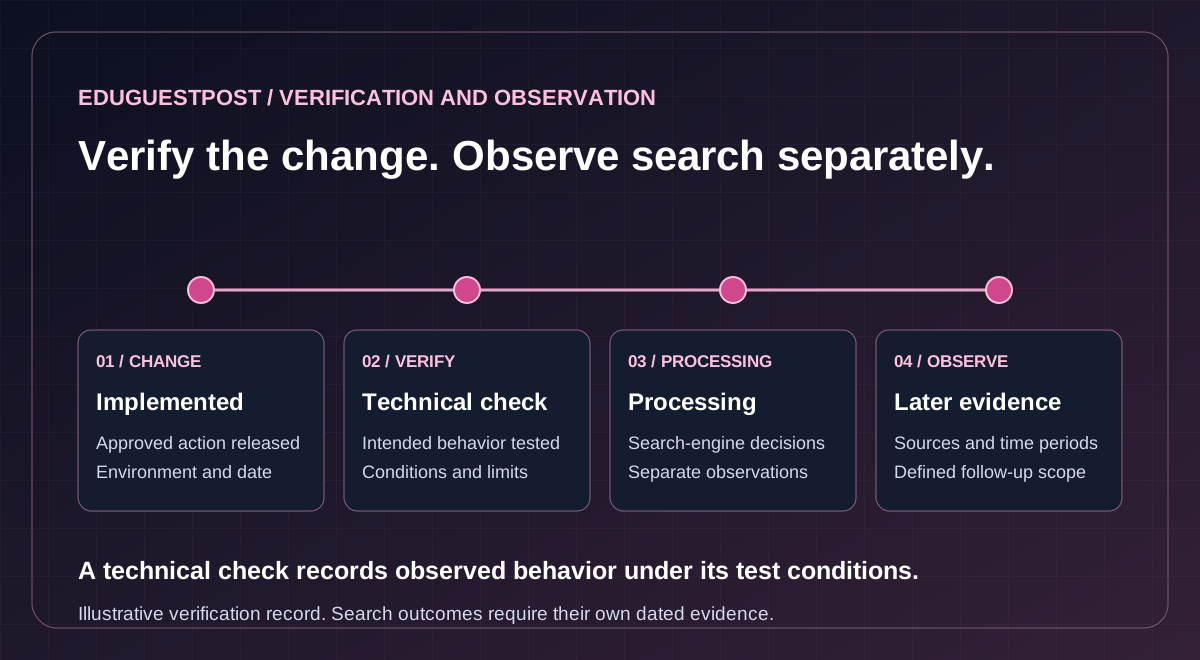
A production check can confirm that a redirect reaches the intended destination, a directive changed or a template now emits the expected markup. Search-engine processing and search performance require their own observations. Do not label a task as an indexing or ranking gain solely because its implementation passed.
If follow-up monitoring is included, specify the sources, comparison periods and reporting dates. Account access, useful field data and a suitable observation period may affect what can be assessed.
Common questions about technical SEO implementation
Should we start with an audit or selected technical fixes?
If the underlying problems are unclear, an SEO audit can establish findings and priorities. This technical SEO engagement takes agreed issues into implementation planning, coordinated changes and verification.
Does a sample cover every URL on the website?
The scope identifies included templates, page types, URL samples and environments. A sample may reveal a shared template problem, while broader testing is identified where the evidence requires it.
Who implements, approves and releases the changes?
The quotation separates EduGuestPost implementation from instructions or tickets for your team. It names the approver, deployment owner and production verifier, with staging, timing and a rollback route agreed where needed.
Can a public checker establish Google’s indexed or rendered state?
The Indexability Checker provides bounded public-response checks, and the Rendered HTML Checker compares source with a browser snapshot you supply. Their coverage does not establish Google’s indexed state or what Google rendered.
How are lab tests and field performance evidence compared?
Define the page types, devices and conditions first. Field data describes recorded user experience, while a lab test investigates a particular run. The report keeps the source, dates and scope visible and treats missing field data as unknown.
Does passing a technical check guarantee a search result?
A production check can verify the agreed technical behavior under its recorded conditions. Indexing, search performance and rich-result eligibility require their own evidence; implementation or markup validation alone does not establish those outcomes.
Get a quote for your website
Request a technical SEO quote with your website, platform, affected pages, existing reports, development support and desired timing. Include any access or release restrictions. Ask for a proposal that names the selected tasks, deliverables, implementation responsibilities, dependencies and verification coverage.
Start with a defined problem and leave with a usable record of the agreed work.
Tell us about your technical SEO work
Share affected public URLs, platform details and the support needed. Agree private report and access arrangements separately.