
Your agency’s brand / Defined local fulfilment
White-Label Local SEO Services
Give your account team a clear local SEO delivery plan behind the service you sell.
EduGuestPost’s white-label local SEO services support agencies that need defined fulfilment for their local business clients. Your agency sets the brief and manages the client relationship. We prepare the agreed work, document the decisions and provide a handoff your team can review and present under the agreed branding.
Bring a web design client who needs stronger local foundations, a group of branches with inconsistent information or a local SEO workload your team needs help delivering. The scope can cover selected tasks or continuing support, with the responsibilities and review process agreed before work begins.
The quotation identifies the businesses, locations, deliverables and professional fees. Google Business Profile itself is available at no charge. Paid software, directory charges, content production and other third-party costs are identified where they form part of the proposed work.
Request a white-label local SEO quote with your agency website, client business type, target markets, location count and the work you need. A client code can be used for the initial brief; keep passwords, verification codes and unnecessary personal information private.
Start with a client need you can explain
An inaccurate profile, an unclear location page and a wider drop in local visibility need different investigations. We define the problem, available evidence and intended next step before recommending the delivery scope.
Where the starting point is uncertain, Local SEO Audit Services can establish the relevant profile, website and customer-journey priorities. Your agency can then decide which recommendations to commission and which its own team will handle.
Build a scope your account team can use
The proposal names the client records and pages covered, the inputs required and the handoff for each workstream. It also distinguishes recommendations, prepared material and authorized implementation.
Scroll across to explore all columns.
| Workstream | What we agree | What your agency receives |
|---|---|---|
| Local assessment | Business model, locations, priority questions, available sources and review coverage | Findings with supporting evidence, priorities and unresolved questions. |
| Business profiles | Selected platforms, existing records, approved facts, access and owner tasks | A proposed change plan and a record of agreed actions and platform status. |
| Citations | Suitable directories, existing inaccuracies, business information and verification needs | A location-specific record of planned, submitted and observed listing work. |
| Local website content | Existing pages, useful customer questions, factual inputs and revision depth | Agreed briefs, revised copy or implementation instructions for review. |
| Reporting and coordination | Source data, report format, agency branding, review steps and communication route | A delivery summary, available performance evidence and the next actions. |
Choose the responsibilities that fit your team
Some agencies need research and instructions for their own specialists. Others need help preparing copy, coordinating citation work or managing approved profile updates. We identify the work to be delivered and the access it requires.
Your proposal sets the quantities, review dates and revision coverage. A continuing engagement also defines how priorities are refreshed, how new requests enter the plan and how incomplete work is carried forward. Additional clients or locations receive a scope review before joining the workload.
Keep specialist work identifiable
Our white-label link-building service provides a separate route for publisher research, exact-site approvals and placement reporting. If that work is relevant to a local client, its publisher criteria, costs, link treatment and editorial decisions are specified separately.
A local SEO brief should make those choices visible so your account manager can explain what the client is purchasing and what remains outside the quotation.
Set the working relationship before delivery begins
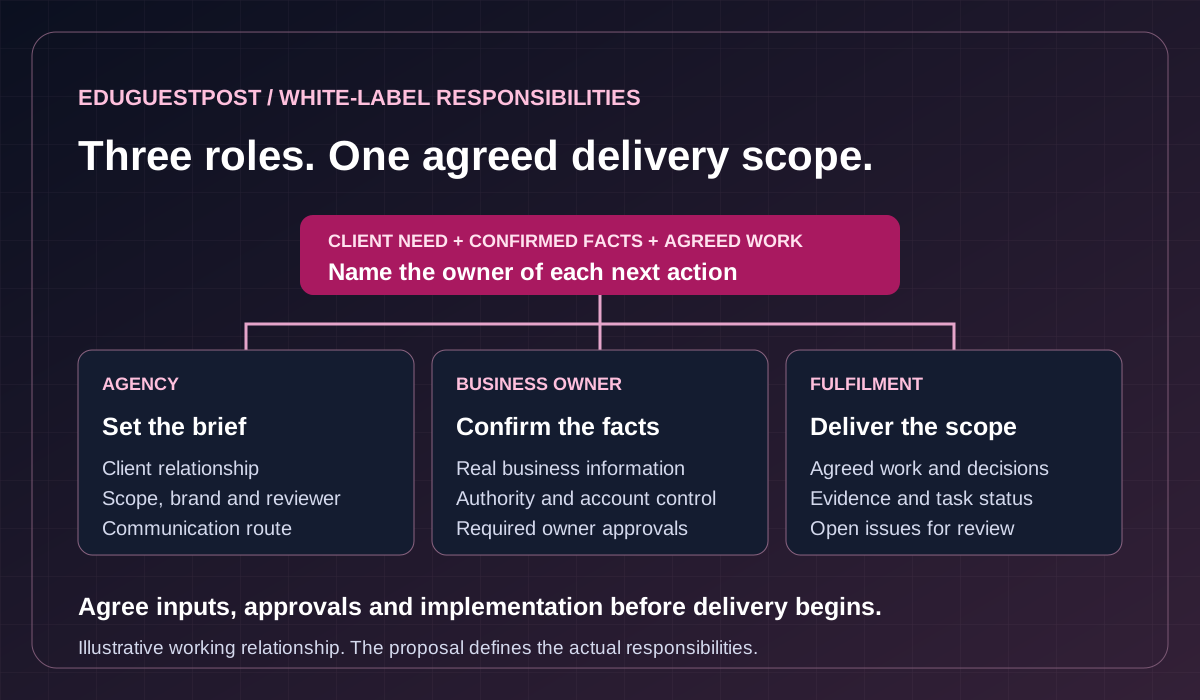
Your agency provides the client’s objectives, approved scope, brand requirements and designated reviewer. The business owner confirms the real business facts and the authority to manage its records. EduGuestPost supplies the agreed fulfilment and records the issues that need a decision.
The communication plan names the agency contact and the route for owner questions. Any direct client contact is agreed separately, including who may speak on whose behalf and how approvals are recorded. Confidentiality requirements and client exclusions belong in the brief.
Keep the business in control of its accounts
For Google Business Profile, we use the distinction between owners and managers to identify appropriate access. Each person can use their own account; password sharing is unnecessary. The business keeps ownership while authorized users receive the access needed for their tasks.
Business Profile, website, analytics and Search Console access are separate decisions. We document what is needed, who can authorize it and any work that can proceed from supplied evidence. Verification and ownership conflicts remain visible owner or platform tasks.
Make branding and disclosure requirements clear
We agree how your agency name, logo, wording and reporting format will be used. Google’s third-party policies still apply to profile management, including consent, ownership, fee transparency and access to relevant information. The proposal identifies the applicable disclosures and approval responsibilities.
Give writers approved inputs
For local page copy, profile descriptions or supporting content, the brief should state the audience, offer, factual sources and reviewer. The Content Brief Generator can assemble those manually supplied notes into an editable brief. It does not research the business or verify the claims.
Your team reviews the brief before production, so missing facts and decisions can be resolved before they become revisions to finished work.
Deliver local work around the actual business
The approved business record gives everyone a reference for names, phone numbers, websites, locations, service coverage and hours. Branch differences remain explicit. A genuine difference in opening hours should not be overwritten to make every location look identical.
Maintain accurate profiles and citations
Profile work follows the platform’s current requirements and the business’s operating model. Google’s business representation guidelines govern names, locations and other details. We check existing records and eligibility before proposing a new profile, and preserve the appropriate public-address handling for service businesses.
For directory work, local citation building services cover approved business information, suitable listings, corrections and status reporting. A submission, a verification request and a live listing are recorded as different outcomes.
Make local pages useful to customers
Local content should explain the services, coverage and next step for the location it serves. Your team supplies the facts that make the page accurate. Google’s spam policies address doorway pages and low-value content created to manipulate rankings; a city-name swap alone does not create a useful local page.
On-page SEO services can address agreed headings, titles and navigation. SEO content optimization services can develop missing explanations in existing copy.
Use website evidence within its limits
The Local Website Evidence tool inspects supported business declarations in a bounded sample of initial website HTML. It can help locate details for review against approved facts.
It does not inspect Maps profiles, external citations or local rankings, and it does not verify the real business. Missing declarations and cross-page differences remain review questions. A utility result supports a defined investigation; its coverage stays visible in the handoff.
Give your agency a report it can stand behind
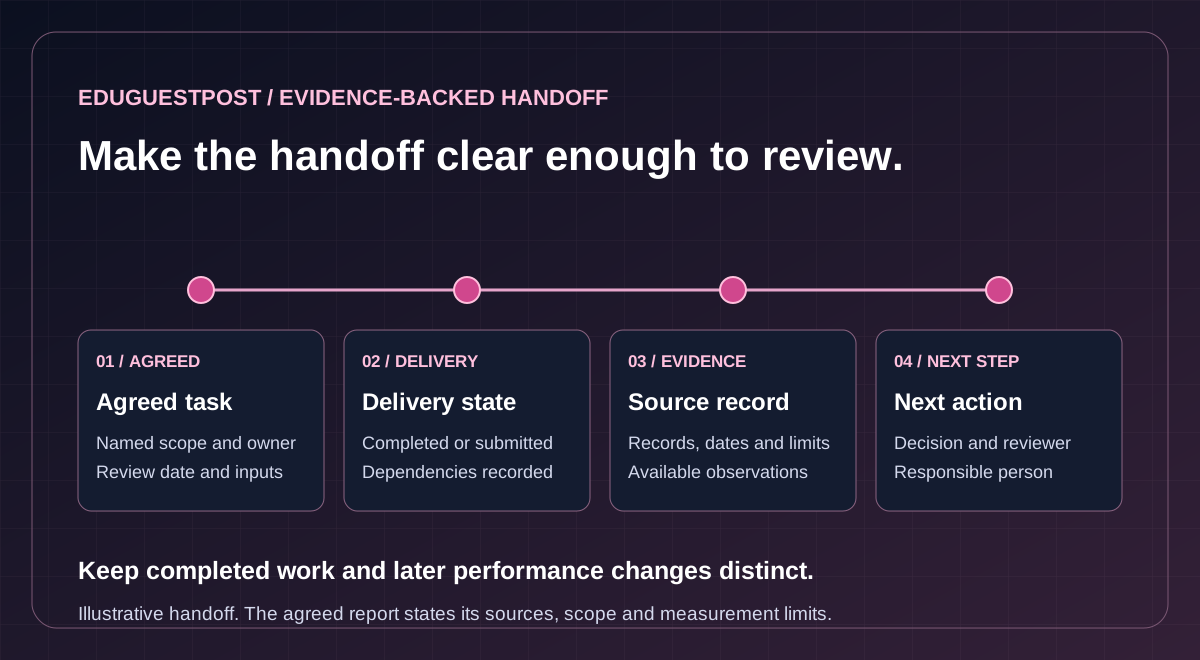
A useful white-label report helps your account manager explain what happened, what the evidence shows and which decision comes next. We agree the audience, format, branding and reporting period before preparing the handoff.
Scroll across to explore all columns.
| Report area | Evidence to include | Decision it supports |
|---|---|---|
| Delivery status | Agreed tasks, completed work, submitted items and remaining dependencies | What is finished, awaiting review or blocked. |
| Profiles and citations | Selected records, changed fields, platform responses and available public observations | Whether information is correct and what needs another check. |
| Website work | Reviewed URLs, approved revisions and implementation status | What your team can approve, publish or verify next. |
| Performance | Available source data, dates, locations, definitions and coverage limits | Whether the observed pattern warrants a change in priorities. |
Keep the source and meaning of each measure visible
Business Profile interactions, website visits and qualified enquiries answer different questions. Google’s performance guidance explains the available metrics: a call count records call-button clicks, and reported profile activity can include organic results and Google Ads.
We identify the source and scope of the evidence used. Google Business Profile information stays distinguishable from other platforms. If lead or sales evidence is supplied, the report states its definition and relevant attribution limits.
For a comparison, we check the locations, periods and measurement conditions. Changes in tracking, business hours, seasonality or campaign activity can affect interpretation. Unavailable information is marked as unavailable, and a completed task is reported separately from a later performance change.
Agree the presentation you actually need
The handoff may use your approved report template or a defined set of unbranded delivery fields. A branded document, a connected dashboard and scheduled reporting require different arrangements. The quotation identifies the agreed output and any software, data access or setup needed to produce it.
Keep approvals, exceptions and handover manageable
Local work often depends on someone outside the fulfilment team: a business owner confirming holiday hours, a developer publishing copy or a platform reviewing a change. The delivery record names that dependency and the next responsible person.
We agree how your agency raises revisions and how work is checked against the brief. A new branch, changed business model or request for another platform can alter the scope. Those changes receive a documented decision so the report reflects what was actually commissioned.
Specify customer-facing activity separately
If review-related support is requested, define whether the work concerns a request plan, response drafts or authorized management. Your agency and the business approve the relevant messages and responsibilities. Genuine customer feedback, privacy and platform requirements govern that work.
Ownership disputes, suspensions, record merges, closures and transfers also need their own investigation and authorization. The scope identifies the evidence and support needed, together with the owner tasks and platform dependencies.
Plan the handover from the start
The agreement defines how completed work, current records, supplied assets and outstanding tasks are handed back if the engagement changes or ends. It also identifies access that needs review or removal under the applicable platform requirements. The business retains control of its accounts, and your agency receives the information needed to continue the approved work.
Common questions about white-label local SEO
Which local SEO tasks can be included?
The scope can cover selected assessment, business-profile, citation, local-content and reporting work. The proposal names the records, pages, required inputs and handoff, and distinguishes recommendations, prepared material and authorized implementation.
Who communicates with our client?
Your agency manages the client relationship. The communication plan names the agency contact and the route for owner questions. Any direct client contact is agreed separately, including authority and how approvals are recorded.
Does the business keep account ownership?
The business keeps ownership while authorized users receive task-appropriate access. Business Profile, website, analytics and Search Console access are separate decisions, and each required permission is documented.
Can the handoff use our agency branding?
The agreed output may use your approved report template or a defined set of unbranded delivery fields. A branded document, connected dashboard and scheduled reporting need different arrangements, which the quotation identifies.
Does a completed task establish a performance gain?
Completed work is reported separately from a later performance change. Comparisons identify the locations, periods, sources and measurement conditions, and unavailable information is marked as unavailable.
What does the quotation cover?
The quotation identifies the businesses, locations, deliverables and professional fees. Google Business Profile itself is available at no charge. Relevant software, directory, content and other third-party costs are identified where they form part of the work.
Request a white-label local SEO scope
Send your agency website, client business type, countries, locations and existing website or profile links. Explain the current problem, the delivery tasks you want help with and what your own team will handle.
Include your intended timing, branding requirements, report format and agency contact. An existing audit or client brief can help define the first project.
Request your white-label local SEO quote. We will define the deliverables, business inputs, approval steps and reporting coverage for the work your agency needs.
Tell us about your agency’s local SEO work
A client code can be used for the initial brief. Keep passwords, verification codes and unnecessary personal information private.