
Useful local pages / Clear customer routes
Local Landing Page Optimization Services
Help local visitors choose the right service and take the next step.
EduGuestPost’s local landing page optimization services improve the pages people use to evaluate a particular location or service area. We review a defined set of URLs, identify unclear or missing information and prepare the agreed changes to copy, page structure and customer routes.
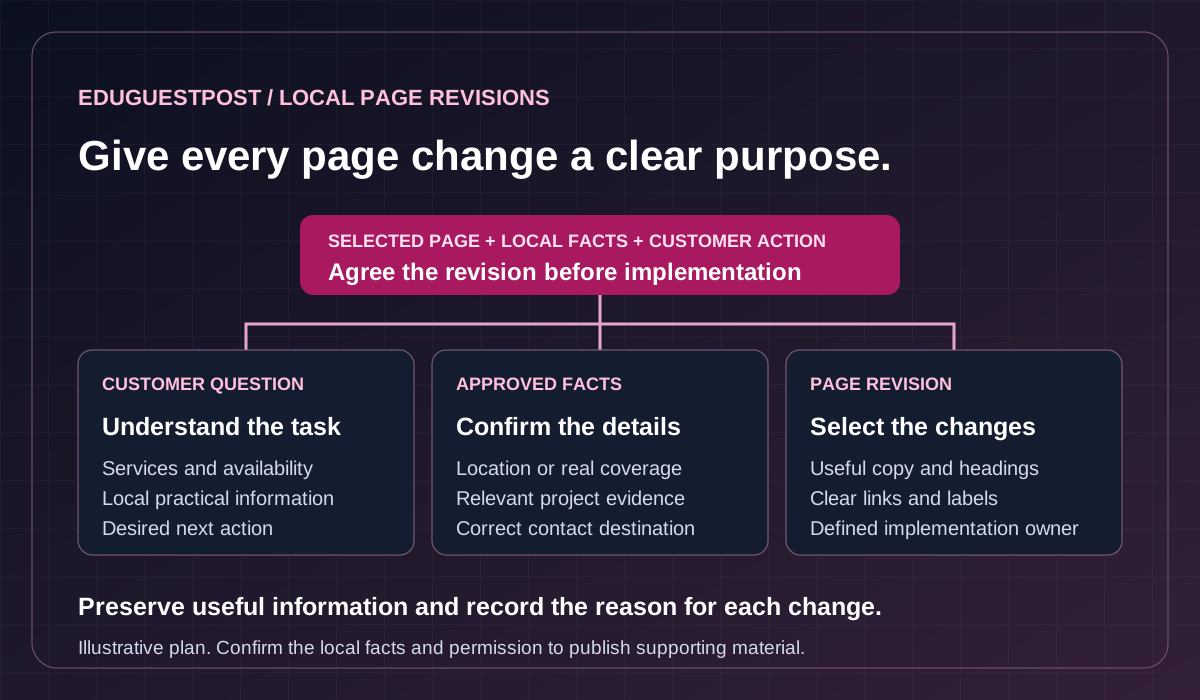
A local page needs to do more than mention a town. Visitors should understand which services are available, whether the location or coverage suits them and how to contact the right business. Useful details might include appointment arrangements, actual branch facilities, arrival information or relevant examples of work.
We connect those customer needs with the page’s search purpose. The handoff shows what should change, which facts support the revision and who will implement it. Your proposal can cover recommendations, edited copy, agreed website changes and checks on the published result.
Request a local landing page review with your website, priority URLs and the action you want visitors to take. Tell us whether the pages represent physical branches, service areas or services at a particular location.
Improve the page customers actually reach
A visitor may arrive directly on a local page without seeing your homepage. That page needs enough context to explain the offer and help the person decide what to do next. Sending everyone elsewhere for basic information can make the journey harder than it needs to be.
This service suits existing location pages with weak explanations, inconsistent business details or a difficult enquiry path. It also helps teams prepare a repeatable layout while retaining the facts that distinguish each location. We define the page batch, revision depth and implementation responsibilities before work begins, with priorities based on the customer task and available evidence.
What your optimization project includes
The work begins with the selected URLs and the role of each page. We review relevant search intent, neighboring content and the business facts needed to make the page useful. Your proposal identifies the page batch and the outputs included in the engagement.
Scroll across to explore all columns.
| Work area | Included record | How your team uses it |
|---|---|---|
| Page purpose | Intended visitor, local market, relevant services and desired action | Confirm what each page needs to explain. |
| Content review | Missing answers, unclear claims, local facts and evidence requests | Prioritize the revisions that matter to customers. |
| Revised elements | Agreed copy, title, description, headings and link recommendations | Review the proposed page before publication. |
| Implementation | Completed edits or instructions for the responsible website team | See what is delivered and what still needs action. |
| Validation | Checks performed, remaining issues and measurement notes | Assess the published work and plan follow-up. |
Agree on revision depth
Some pages need a clearer opening and a corrected booking destination. Others need substantial rewriting because the current copy does not explain local availability or answer practical questions. We identify that difference before setting the scope.
For a wider batch of existing website pages, on-page SEO services provide the broader editing route. SEO content optimization is suitable when the main need is to improve the substance of existing copy. The local landing page project applies those disciplines to a defined local customer decision.
Make responsibilities clear
Your team confirms the business facts, approves claims and supplies suitable material. We identify missing information and record questions that affect the revision. The proposal also states whether changes will be implemented within the agreed website access or handed to your editor or developer.
New page production, template development, booking-system changes and broader technical investigations are additional work to define when needed. They are not assumed from the number of pages selected for review.
Replace vague local copy with useful detail
A branch page and a service-area page answer different practical questions. A branch may need directions, public opening hours and information about facilities. A service-area page should explain where the business travels, which jobs it accepts and how customers arrange the service.
The following examples show the kinds of editing decisions a review can identify. They are illustrative, rather than findings from a client audit.
Scroll across to explore all columns.
| Page issue | Proposed improvement | Evidence to confirm |
|---|---|---|
| Every service appears available everywhere | Show the services offered at the selected location | Approved branch or coverage information |
| Visitors cannot tell how to arrange work | Explain the booking or enquiry route and relevant conditions | The actual customer process and contact destination |
| A local claim lacks useful support | Add a relevant project, photograph or factual explanation | Accuracy and permission to use the material |
| Arrival information is unclear | Explain the correct entrance, access or parking where relevant | Confirmed details for premises customers can visit |
| The page implies an office in every town | Describe genuine service coverage accurately | The operating model and publishable business facts |
Keep the location truthful
We use confirmed details about the actual operation. A page describing service in a town does not establish an office there or make the business eligible for an additional profile. Google’s business representation guidelines remain relevant when page content and profile information are reviewed together.
Private addresses, customer details and identifying project information need careful handling. We use approved public information and appropriate evidence rather than exposing a home address or inventing local staff, facilities, credentials or experience.
Shared brand descriptions can remain consistent across the website. The useful difference comes from answering the customer’s questions about this location or coverage area. We do not prescribe a percentage of unique wording as a condition for keeping a page.
Make the page easier to understand and use
The visitor should be able to recognize the service, understand the local context and find a relevant next step. We review how the agreed elements work together, rather than treating each heading, keyword or button as an isolated fix.
Titles and page structure
We prepare descriptive titles and headings that reflect the actual offer and place. The opening should explain who the page serves, while later sections answer the questions that matter before an enquiry. A meta description should summarize that page clearly.
Google’s title-link guidance favors useful, concise descriptions. Search engines can choose different display text, so the supplied title and description are recommendations rather than guaranteed search-result wording.
Relevant photographs should support the page’s explanation. We review captions and text alternatives where included, keeping image descriptions useful instead of filling them with place names. Awards, qualifications, reviews and project examples need genuine supporting information.
Links and customer actions
Selected service, location and contact pages should connect through useful paths. Our internal linking services can define the source, destination, anchor and placement for agreed changes. A booking or enquiry link should lead to the correct location and process.
Mobile and form usability
Where included, the page review considers mobile presentation, readable content, prominent contact options and obstacles to completing the intended task. Clear labels and instructions help visitors understand what information a form needs; W3C’s form-label guidance explains the association between a control and its purpose.
Loading, interaction delays and unexpected layout movement need suitable performance evidence. A source-code check alone cannot assess those experiences. The scope identifies whether visual review, functional checks or specialist development are needed and who will carry them out.
Check the implementation and the evidence
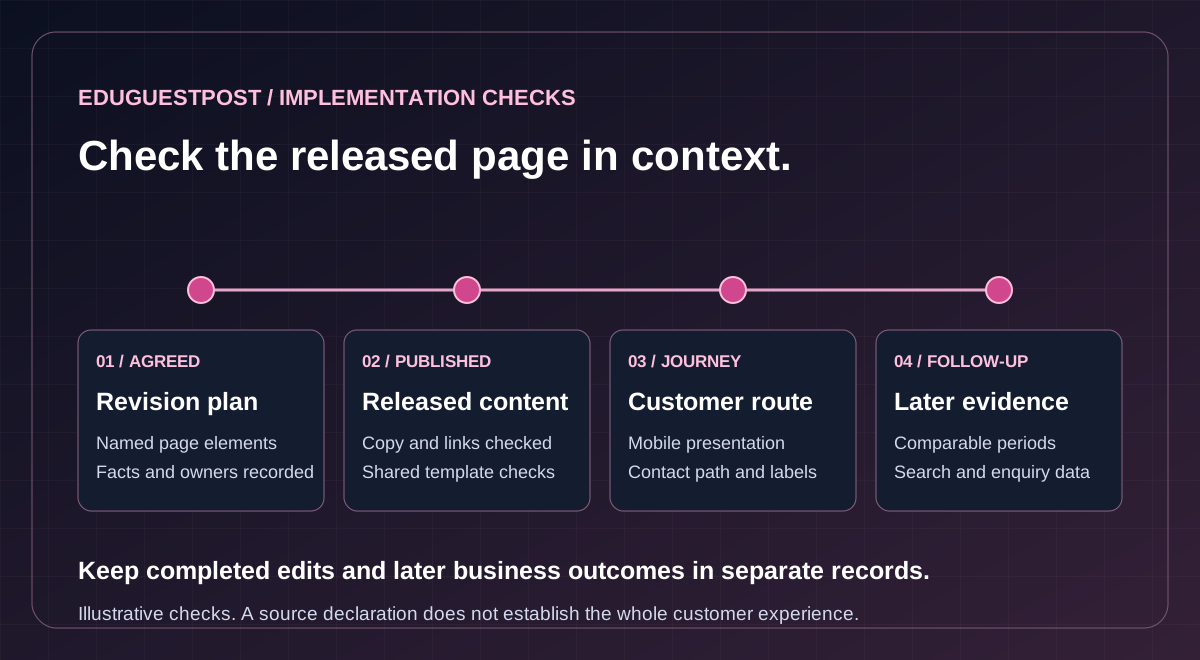
We record the agreed change and its acceptance check before implementation. After publication, the review should confirm the affected page and elements, including shared templates where relevant. A completed edit and a later business outcome remain separate observations.
Investigate technical signals
The Indexability Checker reviews bounded public response evidence, crawl rules, page directives and declared canonicals. It does not render remote JavaScript or confirm Google indexing. Its findings help define a specific question for the person responsible for the website.
For a property you control, Search Console URL Inspection provides indexed-page evidence and a separate live test. A live result does not establish Google’s selected canonical or guarantee the page will appear in search.
Markup also needs to agree with the public page and the intended feature. Google’s structured data guidelines explain why technically valid code can still be ineligible for a search display. We do not invent business facts to satisfy a test.
Review the enquiry path
The Landing Page Conversion Audit checks source declarations on eligible public pages. It does not execute JavaScript, test mobile layout, calculate a conversion score or establish accessibility conformance. A functioning customer journey requires the appropriate review beyond those declarations.
Measure the selected pages
Where authorized data is available, Search Console performance reports help compare relevant pages, queries, devices and periods. Website clicks and average position need that context; they are not measurements of Maps coverage or completed bookings.
Enquiries and booked work require suitable business records or agreed tracking. We record the available measures, changes to the page and limitations affecting comparison. This gives your team a basis for choosing the next improvement without assigning every later change to one edit.
Common questions about local landing page optimization
Do we need new pages or better existing pages
We review existing destinations first. A useful page may need stronger information or a clearer route to contact. New pages need their own customer purpose, real coverage and enough supported detail to justify separate content.
Can we use one layout for several locations
Yes. A shared layout can make pages easier to maintain. Each page still needs accurate services, contact information and relevant local detail. Changes to a shared template need checks beyond the first page edited.
Does the service include business profile changes
The proposal names the assets and tasks included. Profile information can help verify consistency, but profile creation, management and verification are separate from editing the selected website pages unless specifically scoped.
Can you work with our website team
The engagement can provide revised copy and implementation instructions, or include agreed edits where suitable access is available. We identify the editor or developer responsible for changes and the information needed to finish them.
Will better pages guarantee rankings or more enquiries
Clearer pages support the customer’s decision, but outcomes depend on demand, competition, the wider website and business operations. We establish suitable measures and review progress without promising a position, conversion uplift or results deadline.
What should we include in the initial brief?
Share your website, priority page URLs, target locations, the services represented and the customer action you want to improve. Explain whether you need a review, revised copy, implementation or a combination. Include an existing keyword map or page report if available.
Request a local landing page optimization quote
Send your website, priority URLs, target locations and the services each page represents. Explain the desired customer action and the problem you want to address. Include an existing keyword map, page report or business-information record if available.
Ask EduGuestPost for a page optimization quote. Tell us whether you need a review, revised copy, implementation or a combination so the proposal can define the deliverables and responsibilities.
If choosing the right page batch or wider priorities comes first, SEO consulting services can help settle that decision.
Tell us about the local pages you want to improve
Share public page links and the revision or implementation support you need. Agree private evidence exchange separately.