
Technical diagnosis / Explainable priorities
Technical SEO Audit Services
Request a technical SEO audit from EduGuestPost to understand which website problems need attention and what your team should investigate or change next. Build the scope around your important pages, the evidence available and the decisions holding up progress.
A defined investigation. Evidence your team can assess.
The proposed output is a findings register with affected examples, supporting evidence, reasoned priorities and recommended actions. It gives your marketing and development teams a shared basis for estimating work and deciding what to address first.
When a technical audit is useful
Bring a specific concern or a website section that needs a closer review. Important pages may be difficult to discover, reports may show conflicting indexing signals, or a template release may have changed content and navigation. An audit can also help assess an inherited backlog before you commit development time.
The investigation needs to establish what is happening and whether it conflicts with the page’s intended purpose. An excluded account page, a retired article and an accidentally excluded service page require different decisions. A warning count alone cannot make those decisions for you.
Define the question before testing
Agree the website sections, page types, environments and evidence included. Explain recent changes, the pages that matter most and what a useful answer would let your team do.
If your brief also needs content, keyword or wider website assessment, discuss the broader SEO audit services scope. This technical engagement concentrates on the website conditions and evidence relevant to technical diagnosis.
Request an audit scope
Send your website and audit brief, including the platform, example URLs, known concerns and available reports. Ask for a quotation that defines coverage, deliverables, access requirements and handover.
Agree what the audit will cover
Select the areas that fit your website and the problem being investigated. The quotation should identify the checks, required inputs and exclusions. A specialist review of one template or section can have a different scope from a wider website assessment.
Swipe or scroll to read all columns. Keyboard: focus the table, then use the arrow keys.
| Project area | Questions to investigate | Proposed record |
|---|---|---|
| Access and responses | Can intended pages and resources be fetched? Are errors or redirects appropriate? | Observed responses, affected examples and access questions requiring follow-up. |
| Indexing and URL signals | Do directives, canonical declarations and reported states match the intended URLs? | Conflicts, intentional exclusions and unavailable Google-specific evidence. |
| Discovery and navigation | Can important destinations be found through the inspected links and URL sources? | Navigation gaps, sitemap differences and coverage limits. |
| JavaScript and mobile | Does important content appear under the relevant response and browser conditions? | Matched observations, template examples and rendering questions. |
| Performance | What do available field records and comparable lab diagnostics show? | Source, target, device, collection window and investigation priorities. |
| Structured data | Does markup describe the visible content and meet applicable requirements? | Parsing findings, content discrepancies and feature-specific questions. |
| Regional variants | Are intended language or regional relationships represented consistently? | Selected alternate-page relationships and unresolved configuration issues. |
Make coverage measurable
Record the URL sources, crawl settings, template samples, exclusions, failed requests and limits. A completed sample does not establish that every page was inspected. A feature omitted from data collection remains outside the tested coverage.
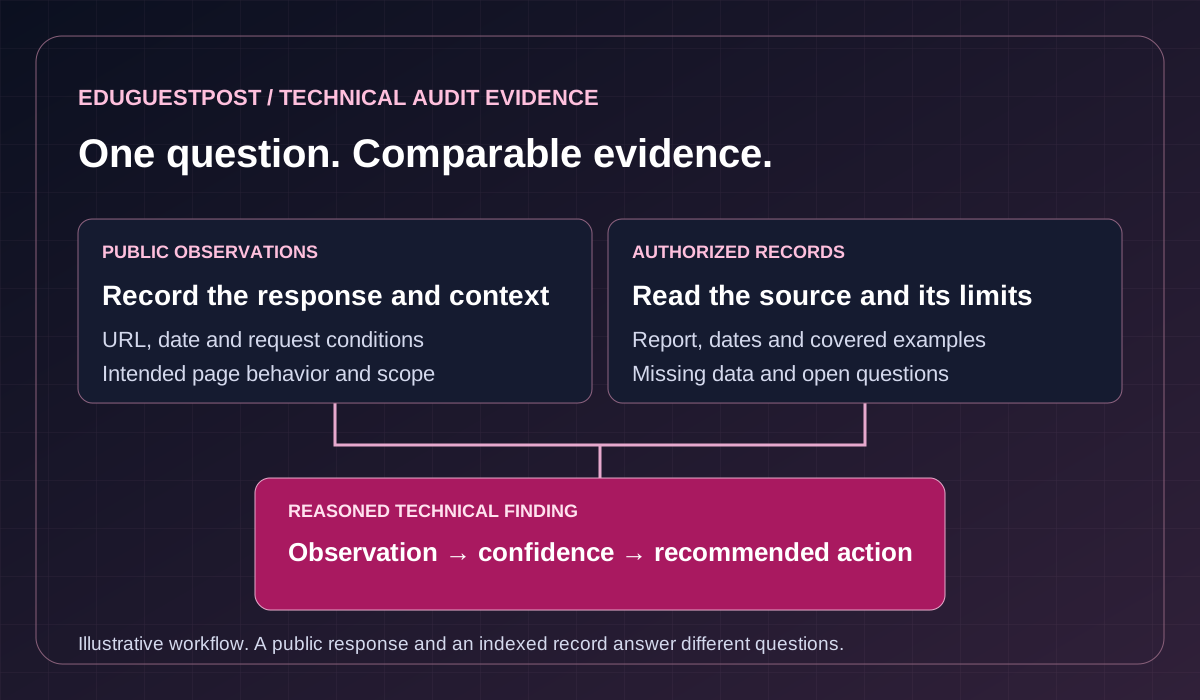
For larger or frequently changing sites, authorized logs and crawl-activity reports may help investigate discovery or availability problems. Their scope and examples need interpretation; neither provides a universal crawl-budget score. Include that work when the website and evidence justify it. Explore server log file analysis services or crawl budget optimization services when those investigations fit the brief.
Reconcile evidence before recording a defect
An audit should connect each observation to its URL, date and request or report context. A fresh public response can differ from an older Google crawl. A browser session can also receive different content because of cookies, location or access rules.
Read Google reports in context
Where authorized indexing-report evidence is available, investigate the reported reasons and patterns alongside the important intended destinations. Report example lists can be limited. Some non-indexed URLs have a valid purpose, so the aim is to assess the relevant pages and explain unexpected exclusions.
Indexed inspection information and a live public test answer different questions. A reported search-selected canonical belongs to the indexed record; a fresh fetch or live test cannot predict that selection. Keep the reported crawl date with the finding and identify questions the evidence cannot settle.
If the brief concerns a traffic decline, compare the affected sections and periods before attributing it to a technical cause. Demand changes, search updates and reporting differences may need investigation alongside website changes. Missing report rows should not automatically become zero traffic or proof of deindexing.
Use focused checks for supporting evidence
The Indexability Checker reviews bounded public-response evidence and supplied rules. It uses its own checker identity and does not establish Google’s indexed state or perform a full website crawl. Read the observed response, directives and declared canonical together with the page’s intended behavior.
The XML Sitemap Checker checks the supplied sitemap document and extracts inspected entries. It does not open the listed pages or recursively inspect child sitemaps. A readable index may list sitemap files rather than your website’s page URLs. Further URL-level checks need their own evidence.
Receive findings a developer can reproduce
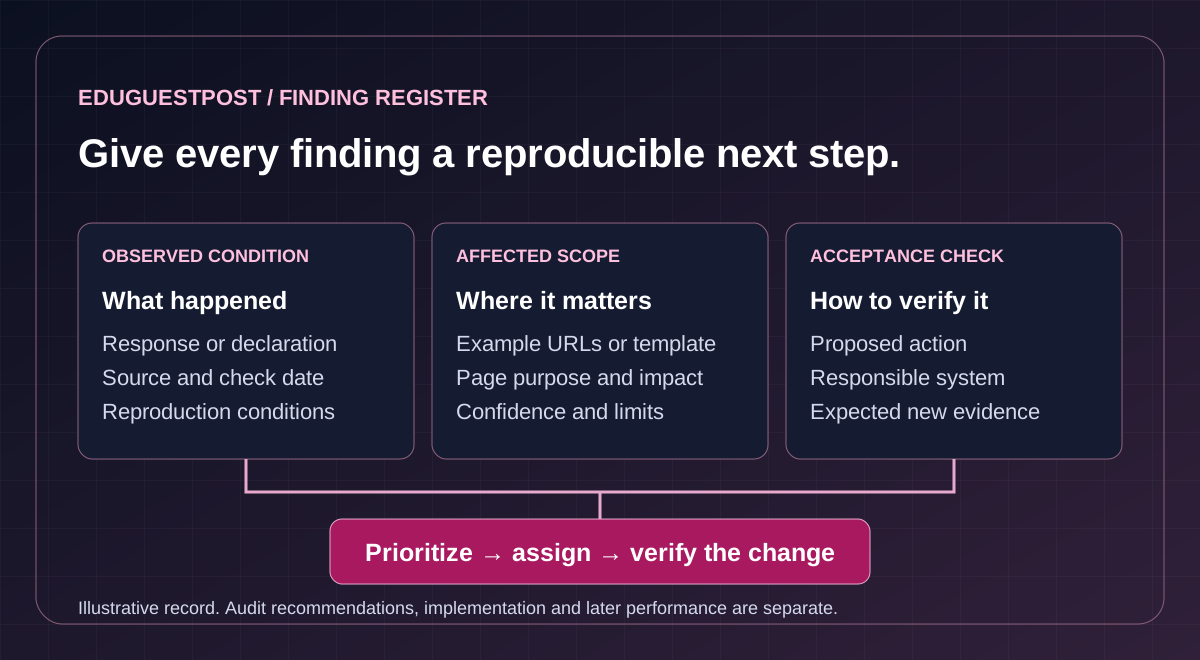
Each substantive finding should explain the observed condition and the action it supports. Keep confirmed observations separate from a likely cause or an unresolved question. This makes the report useful when someone needs to estimate a fix or verify the diagnosis.
Swipe or scroll to read all columns. Keyboard: focus the table, then use the arrow keys.
| Finding field | Information to include | Why it matters |
|---|---|---|
| Observed condition | The response, declaration or behavior that prompted the finding. | Establishes what was actually seen. |
| Affected scope | Example URLs, template or section, and how coverage was determined. | Prevents a sample from becoming an unsupported whole-site claim. |
| Evidence and context | Source, date, relevant settings and reproduction conditions. | Lets another person check the observation. |
| Impact and priority | The affected page purpose, likely consequence, confidence and dependencies. | Explains why the item deserves attention. |
| Recommended action | A specific investigation or change, with the likely responsible system. | Gives the implementation team a task it can assess. |
| Acceptance check | The expected behavior and evidence needed after an approved change. | Defines how technical completion would be assessed. |
Prioritize the effect on important pages
Consider the purpose and reach of the affected pages, confidence in the finding, implementation effort and release risk. A shared template problem can deserve attention before a cosmetic warning. A vendor’s severity label is one input to that judgment.
For example, a retired article returning 404 may be behaving correctly. If important navigation still points to it, the broken journey needs a separate recommendation based on the intended destination. Redirecting every removed URL to the homepage would not answer that question.
Group repeated symptoms when evidence supports a common cause, while retaining the affected examples. Record intentional behavior and items needing more evidence with a reason, so they do not remain unexplained warnings in the backlog.
Investigate rendering and performance with the right evidence
For JavaScript-dependent templates, the Rendered HTML Checker compares initial source with a browser DOM snapshot you supply. Match the final URL, page state and capture conditions. It does not execute JavaScript or prove what Google rendered or indexed.
Further JavaScript checks should identify the content, resources and browser conditions being investigated. The audit records which evidence supports the finding, whether observations are comparable and what remains untested.
Separate field experience from lab diagnostics
Field records describe recorded user experience; lab tests investigate a particular run under specified conditions. Different targets, devices, collection periods and test conditions can explain different results. Preserve the URL or origin, device, report source and collection dates when interpreting performance.
The current Core Web Vitals Checker supports review of supplied CrUX and Lighthouse report JSON. Its live CrUX source and automatic Lighthouse/PageSpeed test are currently disabled. Use appropriate existing reports for this workflow.
Missing field data remains unknown. A Lighthouse score or Total Blocking Time value cannot replace field INP. Overlapping collection windows also limit conclusions about the effect of a release. Performance recommendations should identify a specific investigation and suitable re-test conditions.
Check markup against visible content
Review structured data already emitted by the website, including theme or plugin output. A parsing error, a factual mismatch and a feature-eligibility question are different findings and can require different actions.
Assess markup against the visible content, the vocabulary used and the requirements of the feature under review. Passing syntax checks does not certify the facts or guarantee a rich result. Describe the affected template and required correction without inventing values to satisfy a validator.
Agree the deliverables and the next step
Use the quotation to establish how the audit will be delivered and who needs to review it. A marketing lead may need a concise explanation of priorities, while a developer needs affected examples and enough detail to assess the recommended work.
The proposed handover can include:
- A coverage summary identifying the inspected sections, methods, evidence sources and important gaps.
- A findings register with supporting examples, confidence and reasons for the assigned priorities.
- Relevant URL lists or extracts, labelled with the source and any sampling or inspection limits.
- Recommended actions, dependencies and questions for the team responsible for implementation.
- Suggested acceptance checks and an agreed discussion of unresolved decisions or the next work package.
Confirm the formats, review arrangements and any follow-up checks in the scope. If a comparison with an earlier audit is required, establish whether comparable evidence is available. A new list of warnings alone does not show what changed.
Plan implementation from the findings
The audit supplies diagnosis and recommendations. Agree implementation responsibilities, release arrangements and subsequent verification as a defined follow-up scope. Approved changes to existing page copy, titles or headings can be discussed through on-page SEO services.
If your team needs help choosing between competing recommendations, SEO consulting services can address that decision. Major URL moves need a separate migration plan. Technical completion and later search performance require their own evidence and observation periods. Website migration SEO services provide a separate route for an agreed migration project.
Questions about technical SEO audits
Does a technical audit inspect every page?
The quotation defines the website sections, page types, URL sources and checks included. The coverage record identifies samples, exclusions, failed requests and limits. A completed sample does not establish that every page or feature was inspected.
What will the findings include?
The proposed findings register includes observed conditions, affected examples, supporting evidence, reasoned priorities, recommended actions and suggested acceptance checks. Agree the formats, handover and any follow-up review in the project scope.
Do you need access to search or analytics accounts?
Available authorized reports can support the agreed investigation, but the evidence requirements depend on the question being tested. The proposal identifies access needs and missing evidence. Public-response checks cannot establish a search engine’s indexed state.
Does the audit include implementing the fixes?
The audit supplies diagnosis and recommendations. Implementation responsibilities, release arrangements and later verification are defined as follow-up work. The initial quotation should make the delivery and implementation boundaries clear.
How do you assess rendering and performance?
Use comparable response and browser observations for rendering questions, and keep the source, target, device and collection period with performance evidence. Field experience and lab diagnostics answer different questions; missing field data remains unknown.
What should I send for a technical audit quote?
Share the public website, platform, important sections, example URLs, known concerns and recent changes. Identify available reports, development support, desired timing and access restrictions. Keep passwords, verification codes and private customer records out of the initial enquiry.
Request a technical SEO audit quote
Share your technical audit requirements, including the website, platform, important sections, known concerns, recent changes, available reports and development support. Add your desired timing and any access restrictions. Request a proposal that makes the coverage and deliverables clear before work begins.
- Which pages and technical questions matter most?
- What changed, and which reports or examples are available?
- Who can review recommendations and implement approved work?
Use public website links in your first enquiry. Keep passwords, verification codes and private customer records out of the initial enquiry. Agree any necessary account access or private report sharing separately.
Request a technical SEO audit
We use your brief to define coverage, required evidence, deliverables and handover.