
Local visibility / Listing identity
Duplicate Business Listing Removal Services
Give customers a clear route to the right business profile.
For overlapping profiles, duplicate flags and listings held by a former provider.
EduGuestPost’s duplicate business listing removal services help you investigate overlapping profiles, identify the record that should represent each business and pursue the appropriate resolution. The work starts with the actual listings: what they show, whom they represent and which account can manage them.
Send the suspected duplicate URLs, your website, country and location count. We can scope the comparison, prepare a case for each confirmed duplicate and define any submission or owner action needed. The final record shows the public outcome and anything still awaiting a platform decision.
Request a duplicate listing review with the links you want checked. Include an existing listing report if you have one; a fresh report is not required to explain the problem.
When duplicate listing support can help
You may have two profiles for the same shop after an agency handover, an old directory entry competing with the current record, or a dashboard warning that a location has been marked as a duplicate. Similar business names and addresses can also create uncertainty across a larger branch network.
The first decision is whether the records describe the same eligible business. A separate branch, practitioner or department may need its own profile under the platform’s rules. A lost login may require an ownership request. Each situation needs a different response.
This service focuses on resolving duplicate groups and documenting the result. If your brief also includes new directories and broad corrections to names, addresses or phone numbers, our local citation building service provides the wider campaign route. We confirm the boundaries together before quoting. For outdated details across existing listings, see local citation cleanup services.
Confirm the duplicate before choosing an action
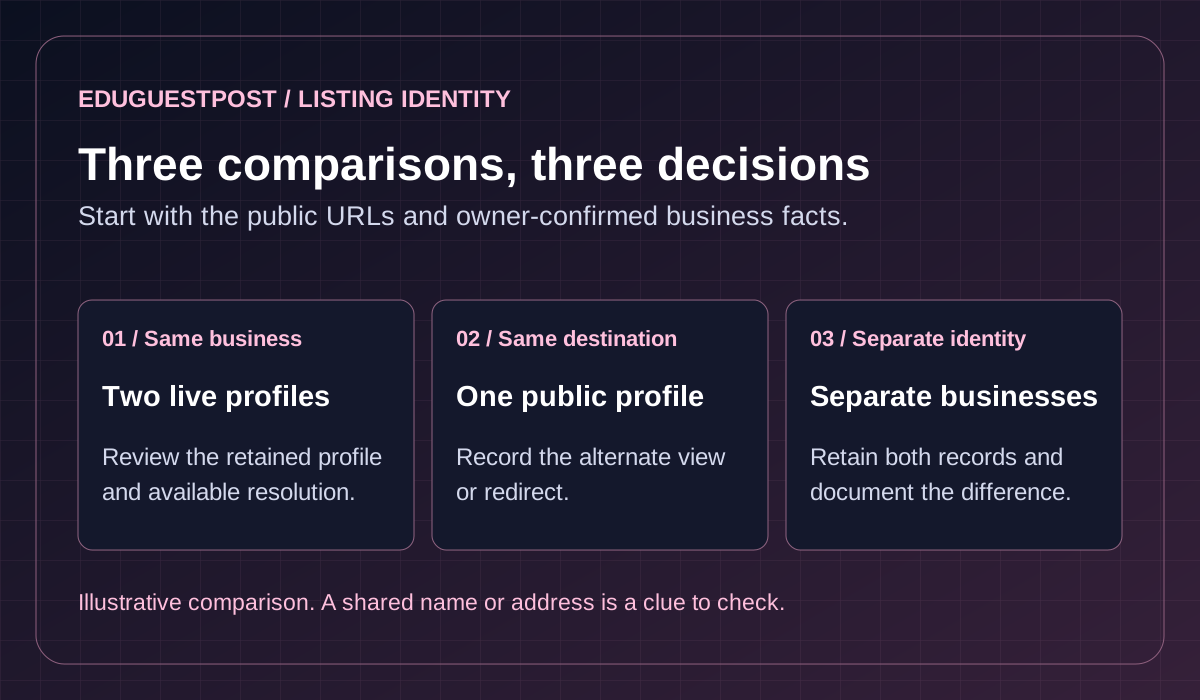
Two similar search results are a starting point for investigation. We compare the original URLs and their destinations, visible business details, location history and the relationship between the records. Where a platform exposes a profile identifier, it can help distinguish a separate record from another view of the same one.
Names, addresses and phone numbers are useful clues, but a match can also occur between real branches or related businesses. Your team confirms the operating facts that public pages cannot establish.
Swipe or scroll to read all columns. Keyboard: focus the table, then use the arrow keys.
| Case found | Decision to make | Appropriate direction |
|---|---|---|
| Two records for one active business | Which record correctly represents the business, and what content could be affected? | Review a supported merge, duplicate report or removal request. |
| Two URLs reaching the same profile | Is either URL a separate live record? | Record the redirect or alternate view; correct the duplicate flag in the working report. |
| Separate eligible businesses at one address | Does each identity satisfy the platform’s rules? | Keep valid profiles separate and document the distinguishing evidence. |
| Correct profile held by a former provider | Is the problem access rather than duplication? | Follow the applicable ownership or transfer route. |
| Distinct businesses incorrectly merged | What evidence shows separate eligible operations? | Prepare the available support or appeal route for that platform. |
Choose the profile to retain for a reason
The recommendation considers the correct business identity, current location details, management access and relevant content. Review count alone does not decide which profile belongs to the business. Reviews from an unrelated company or practitioner should not be absorbed to strengthen another listing.
If the evidence is incomplete, the case remains unresolved until the owner supplies the missing facts. We do not invent a suite number, change the business to unrelated details or describe an active shop as closed to make a duplicate disappear.
What the duplicate removal work includes
The proposal defines the locations, platforms and duplicate groups to be reviewed. It also distinguishes URLs you already know from any additional discovery work. A group containing three candidate records needs a clear decision for each record, even when the proposed outcome is one retained profile.
Swipe or scroll to read all columns. Keyboard: focus the table, then use the arrow keys.
| Work area | Included record | Completion check |
|---|---|---|
| Identity comparison | Candidate URLs, visible details, historical variants and owner-confirmed facts | Each candidate has a reason for inclusion or exclusion. |
| Resolution plan | Proposed retained profile, recommended route and expected public behavior | The business approves the identity and understands the action’s implications. |
| Case preparation | Relevant URLs, factual explanation, supporting material required and access dependencies | The case is ready for the permitted route or an identified owner task. |
| Authorized action | Agreed submissions or owner instructions, date and available reference | A submitted request is recorded separately from a completed outcome. |
| Outcome review | Original URL, current destination or state, retained URL and remaining issue | The report describes what is publicly observable and what remains unknown. |
Evidence from your own website
A website can help confirm what the business currently publishes about its locations. EduGuestPost’s Local Website Evidence tool inspects a limited sample of public website HTML for supported business declarations, explicit phone links and address elements.
It does not discover duplicate directory listings or inspect Google Business Profile, Maps, reviews or off-site citations. It also does not verify ownership or real-world facts. A missing or unsupported declaration is not proof that a business detail is absent or wrong.
The tool can support a website review when useful. The duplicate case still requires comparison of the actual listing pages and the owner’s evidence. Tool availability does not grant access to a directory account or establish that a removal request will be accepted.
Use the route that matches the platform
Google Business Profile and Maps
For Google Business Profile, compare the evidence for a genuine same-business duplicate, an eligible separate business, or an ownership issue. A supported merge can combine reviews, and owner replies may be lost. Confirm the current route and implications before submitting. If separate eligible businesses were incorrectly combined, review the support route and the evidence for each business.
We identify the proposed retained profile and the relevant evidence before recommending that route. Photos, posts, products, historical metrics and other content should not be assumed to transfer intact. Review movement and missing-review issues can also require separate investigation.
Removing access or owner-managed content is a separate action. It can permanently remove business-supplied content without removing the public profile. Check the original public listing and retained profile before confirming a resolution.
An inaccurate or ineligible listing may have a public reporting route. The reason should describe the actual issue. Mark a location as closed only when the business confirms that location has closed.
Apple Maps and Apple Business
Apple’s single-location management guide explains that the reason chosen for removal affects the result. Removing a location from management can leave its public Maps presence available. We check the location, access and available reporting route instead of treating account removal as a confirmed public deletion.
A brand-level removal can affect associated locations and assets. It is not an appropriate default response to one suspected duplicate.
Other directories and listing platforms
Each publisher controls its own records. Where an authorized listing-management product is involved, its supported publishers and listing types must be checked. For example, Yext’s suppression guidance limits its feature to location-type listings and notes that some publishers do not support it.
The scope identifies any account or subscription needed. A named product is not an included integration, and a suppression request is still subject to the publisher’s process.
From listing URLs to an outcome record
1. Establish the business and location facts
Provide the customer-facing name, current website or location page, publishable address or service area, phone and known profile URLs. Include previous names, former contact details and the person who can confirm access or verification requirements. Describe existing support cases so the next action takes them into account.
For multiple locations, supply a separate row for each real branch. If the website itself gives conflicting information, selected on-page SEO work can address the agreed pages as a separate task.
2. Review and approve the resolution plan
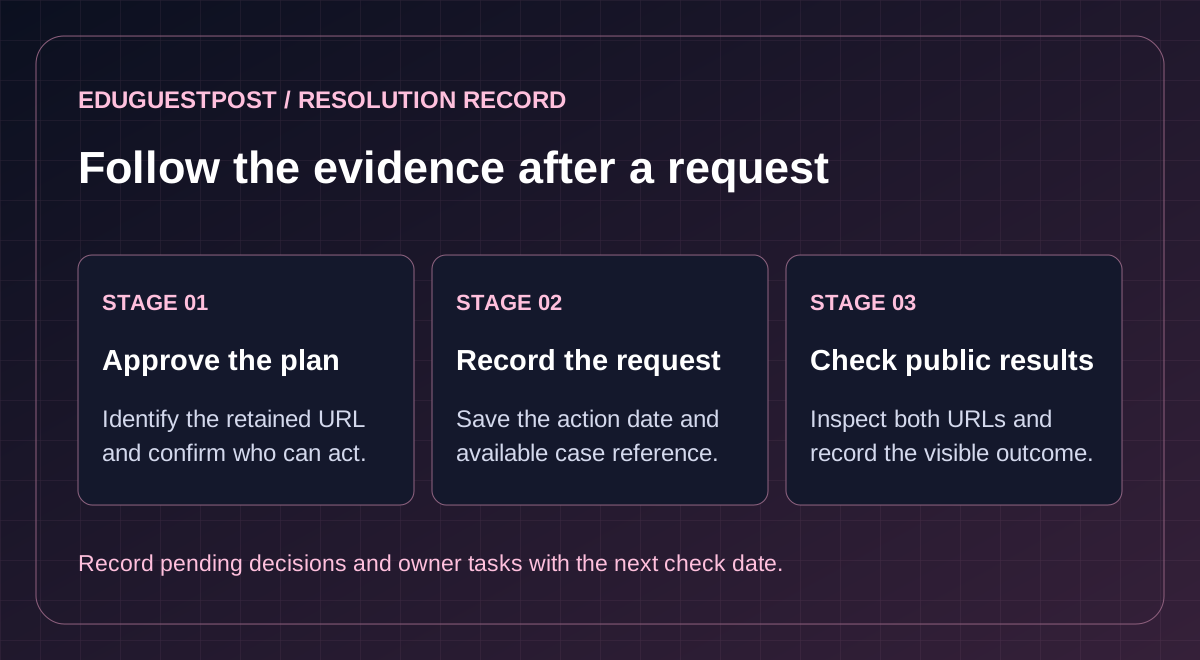
We classify each candidate, recommend the profile to retain and explain the intended result. The plan records content implications, required evidence, access needs and the person responsible for each action. Any merge, removal or closure proposal needs a clear factual basis.
3. Carry out the agreed casework
The engagement can cover case preparation, owner instructions and specifically authorized submissions where the current platform permits them. Required owner verification stays with the business. Passwords and one-time verification codes should not be included in the initial enquiry.
4. Check the public result and hand over open cases
We compare the original profile URL with its current destination or visible state and check the retained listing. A redirect, closed label, unavailable page and separate live profile are recorded as different observations. An error or inaccessible page alone may leave the outcome unconfirmed.
The handoff separates confirmed merges or redirects, publisher-reported suppression, public observations, pending requests, valid profiles retained and unresolved owner tasks. It includes the check date, available case reference and recommended next step. Follow-up frequency and the end of the monitoring period are agreed in the scope.
An illustrative duplicate group
Imagine a florist with two profiles for the same active shop after changing agencies. A similarly named florist nearby is a separate business. The review would establish which two records belong to the first shop, confirm the correct retained identity and assess content implications before preparing a case. The neighboring business would remain outside that request.
This example explains the decision process; it is not a client result or a forecast of platform approval.
Questions before you request a quote
Can you guarantee that every duplicate will disappear?
No. Publishers decide whether to accept a request and how to display their records. The agreed work covers defined investigation, casework and checks. A pending or declined request remains visible in the report with its reason and next action where available.
Will all reviews and other content be preserved?
Content behavior depends on the platform and action. We review the implications before proceeding and identify content that matters to your business. A personal copy of relevant information can support your records, but it cannot guarantee restoration or transfer after an action.
What if we cannot access the listing?
The case review identifies whether ownership, transfer, a public report or another support route is available. The business may need to complete verification or supply evidence directly. Creating a second profile does not resolve lost access and can add another record to investigate.
How long does removal take, and what does it cost?
The quote depends on location count, platforms, duplicate groups, discovery needs, access and the amount of case preparation and follow-up. Delivery stages are agreed around that scope; publisher review time remains outside our control. Any proposed third-party charge or subscription is identified for approval before purchase.
Does this include every future duplicate?
The proposal defines the search scope and review period. New profiles or changes found after that period need an agreed follow-up batch or monitoring arrangement. No finite scan establishes that every listing on the internet has been found.
What should I send for an initial review?
Send your public business website and listing URLs, country, location count, and any open case status. Tell us which listing you manage and which business facts are current. Keep passwords, verification codes and private documents out of the initial enquiry.
Request a duplicate business listing removal plan
Send your website, country, number of locations and the URLs that appear duplicated. Explain which profile you currently manage, what customers should see and whether a support case is already open. Historical business details and an existing report can help resolve uncertain matches.
- Which listing URLs appear to represent the same business?
- Which profile should customers see?
- Which profiles can your team manage, and is a case already open?
Send the listing URLs for review to discuss the practical route, deliverables, responsibilities and quote. If duplicate listings are one issue in a wider backlog, SEO consulting can help your team prioritize the related work.
Use public listing examples in your first enquiry. Keep passwords, verification codes and full private documents for your own records. Agree any necessary private evidence sharing and access separately.
Request a duplicate listing review
We use your enquiry to scope the comparisons, owner tasks and public checks.