
Core Web Vitals
Optimization Services
Load useful content sooner.
Make every important action feel better.
Turn a slow product image, delayed mobile menu or shifting layout into a defined improvement project. We connect the available evidence to selected pages and templates, prioritize changes and agree how the work will be checked.
- Pages and journeys agreed first
- Named implementation owners
- Evidence retained with context
Start with the problem.
Define the work that follows.
Give visitors useful content sooner, help important interactions respond promptly and reduce unexpected movement while they read or act. A shared product template may affect many URLs; a booking widget may create a problem on one important route.
The proposed scope can cover a baseline of selected pages and devices, investigation of contributing resources or components, implementation instructions and verification with a clear handover.
Development, hosting and release work are defined in the quotation. Recommendations and changes a named, authorized implementer will deliver are identified separately. If the underlying problem needs broader diagnosis, SEO audit services provide another starting point.
Keep the evidence attached
to the experience it describes.
Agree the representative pages, templates and journeys, with exceptions recorded before one result is extended to the whole website.
Useful content appearing
Largest Contentful Paint measures when the largest eligible visible content element appears.
Good field p75: ≤ 2.5 secondsActions responding
Interaction to Next Paint measures responsiveness to qualifying interactions across a visit.
Good field p75: ≤ 200 millisecondsContent staying in place
Cumulative Layout Shift measures unexpected visual movement. Its value is unitless.
Good field p75: ≤ 0.1These targets apply at the 75th percentile, or p75, with mobile and desktop considered separately. An average, median or Lighthouse performance score describes something different from a field p75.
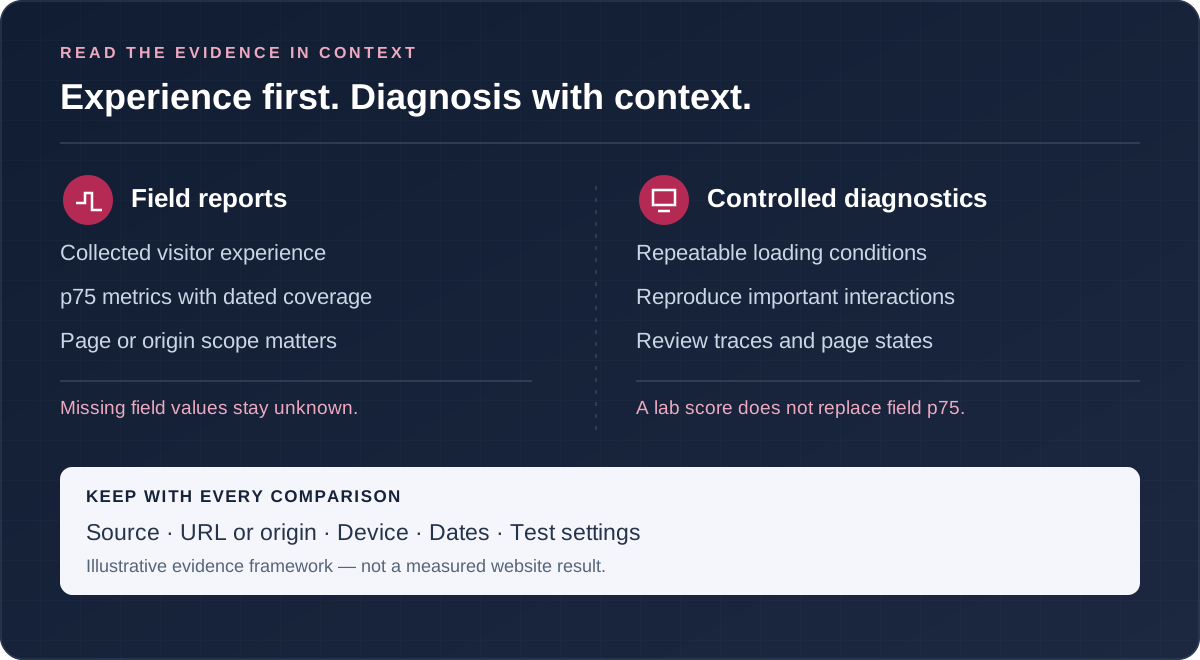
Retain the source, target URL or origin, device and collection dates. Origin data combines experiences across a site and cannot establish every individual page’s performance. A missing field record remains unknown.
Compare the field targets in one reference table
| Metric | Experience measured | Good field p75 target |
|---|---|---|
| Largest Contentful Paint or LCP | When the largest eligible visible content element appears | At or below 2.5 seconds |
| Interaction to Next Paint or INP | Responsiveness to qualifying interactions across a visit | At or below 200 milliseconds |
| Cumulative Layout Shift or CLS | Unexpected visual movement | At or below 0.1, unitless |
Two evidence types.
Different jobs in the review.
Field reports describe collected experience. Controlled diagnostics help investigate loading behavior and important interactions. Preserve their context rather than treating their values as interchangeable.
Why an overall assessment may not include a measured INP value
Provider rules matter. PageSpeed Insights can permit an overall assessment without sufficient INP data when LCP and CLS meet its requirements. That label does not supply a measured INP value. Keep the available values and gaps visible beside any provider label.
Target the delay.
Preserve the useful experience.
A proposed change needs an affected template, supporting evidence, an expected mechanism and a verification method. Platform restrictions and dependencies remain visible.
Find what delays
useful content.
A slow LCP can involve the initial response, image discovery, download or the work required to display it.
For an image-led page, review whether the browser discovers the important image promptly, requests a suitable resource and assigns appropriate priority. A smaller file may help, but it cannot resolve a template that keeps the image hidden while unrelated code runs.
Changes can specify responsive candidates, compression, dimensions and selective resource hints. Immediately visible content, especially the LCP image, needs prompt loading. Lazy loading suits appropriate offscreen media; applying it to every image can delay the content visitors came to see.
Fonts and styles need the same care. Text should appear promptly with suitable fallback behavior. Styles unused in one loading sample may support menus, forms, other states or languages. Preserve them when deciding what to defer or remove.
Where response time contributes, involve the hosting, application or CDN owner. Personalized and transactional pages need appropriate cache rules and functional checks. If the work also changes content or navigation, on-page SEO services can define that separate editorial scope.
Follow the action
that feels slow.
Opening a menu, choosing a variant and submitting a form each create a different investigation.
Start with a reproducible task on the affected page and device. Separate waiting before an interaction runs, processing its callbacks and presenting the next visual update. The change may need to reduce competing work, simplify an expensive update or adjust how a component renders.
Browser traces can support developer review of scripts, long tasks and layout work. Deferring non-essential work or reducing startup code still requires checks that the intended action, feedback and error handling work.
Total Blocking Time, or TBT, is a lab diagnostic. It does not replace field INP. A default navigation audit does not exercise every filter, menu or checkout interaction, so testing must include the behavior behind the enquiry.
Keep content stable
after loading too.
A short loading test can miss movement that occurs during scrolling or later page states.
Review missing media dimensions, resizing embeds, inserted content and font changes. A task may specify reserved space, suitable aspect ratios or a component change. Identify the cause: an element that moves may be displaced by something appearing above it.
Performance work must preserve important content and usable controls. The Mobile SEO Checker can review supplied mobile markup and Lighthouse evidence, while actual layout and interaction behavior still require browser or device checks.
A clear scope.
Named owners. Testable changes.
Prioritize the affected experience, likely reach, supporting evidence and implementation effort. An estimated opportunity remains a hypothesis until the change is checked.
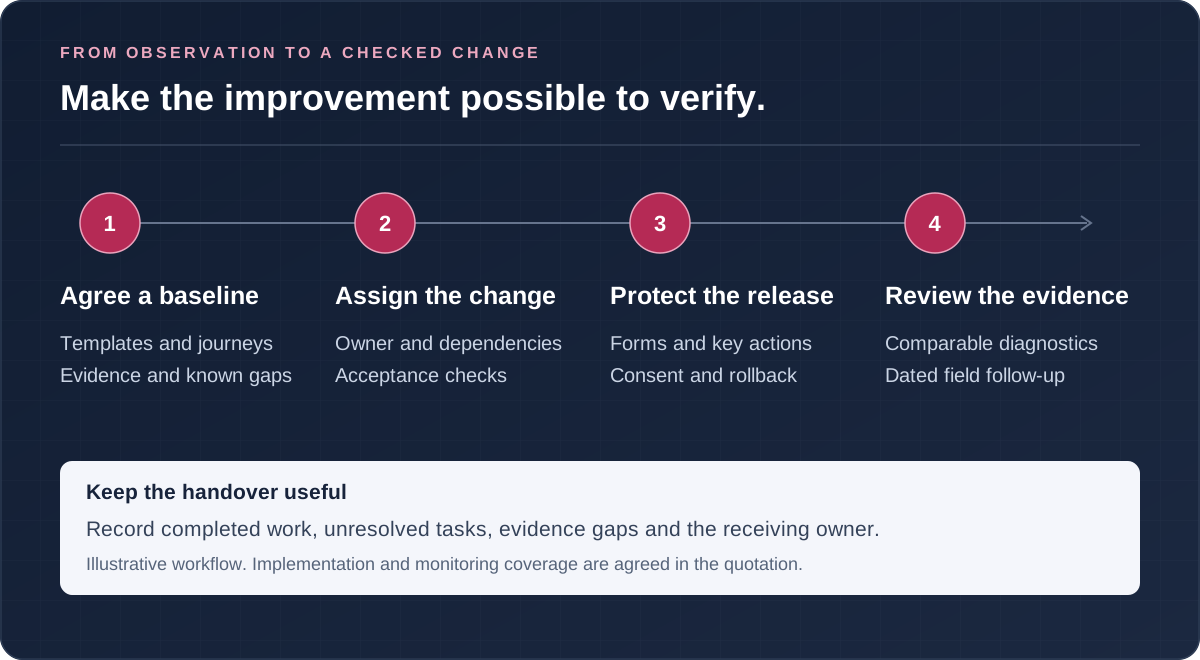
| Work stage | Proposed deliverable | Responsibility to confirm |
|---|---|---|
| Scope and baseline | Selected templates, journeys, reports and evidence gaps | Website owner and review lead |
| Change planning | Prioritized tasks, dependencies and acceptance checks | Review lead and implementer |
| Implementation | Agreed code or configuration changes and a change record | Named authorized developer or platform owner |
| Release checks | Comparable measurements and functional review | Release owner and agreed reviewers |
| Handover | Results, unresolved tasks and follow-up arrangements | Named receiving owner |
The quotation defines which stages EduGuestPost delivers, the quantities, required access, external costs and included review period. Implementation or ongoing monitoring is included only when expressly agreed.
Protect the release
as you improve performance.
Agree the deployment route, rollback responsibilities and checks for forms, purchases and other important actions. Changes to caching, resources or script timing must respect those functions and consent requirements.
Keep relevant content, links and indexing declarations in release checks. The Rendered HTML Checker compares initial HTML with a matched DOM snapshot you supply. It does not execute JavaScript or establish what Google indexed.
For dependencies or decisions about the next development batch, SEO consulting services provide a separate decision and handoff scope. Leave outstanding tasks with a clear owner.
Recheck the journey.
Keep the context.
After release, repeat comparable diagnostics for the selected pages and journeys. Retain the Lighthouse version, device settings, throttling, final URL, run time and warnings. Use repeated comparable runs when conditions vary, and review the underlying metrics alongside the score.
Field follow-up needs its own dates and scope. Rolling 28-day CrUX periods may include visits from before deployment, and nearby periods can overlap. A change between reports describes the reported experience; it does not isolate its cause. Traffic mix, content and third-party behavior can also change.
Estimated savings may overlap. They should not be added into a promised improvement. Rankings and commercial outcomes require separate evidence.
Core Web Vitals
optimization FAQs
What does a Core Web Vitals optimization project include?
The agreed scope can cover selected pages and journeys, a field and lab baseline, investigation, prioritized tasks and verification with a handover. The quotation defines quantities, access, costs, review arrangements and which stages EduGuestPost or another named owner will deliver.
Are implementation and ongoing monitoring included?
Only when expressly agreed in the quotation. Development, hosting, release work and monitoring need named authorized owners. Recommendations, dependencies, acceptance checks and any work your team must complete are identified in the scope.
Does a good Lighthouse score mean the site passes Core Web Vitals?
No. A Lighthouse performance score describes a controlled lab test, while field p75 values describe collected experience. TBT does not replace field INP. Keep the source, URL or origin, device, dates and test settings with each result, and retain missing data as unknown.
Can one report represent every page and device?
No. Agree a representative sample of pages, templates and important journeys, including exceptions. Origin records combine experiences across a site and do not establish every page’s performance. Mobile and desktop field results are considered separately.
How soon will field reports show a released change?
Field follow-up depends on the available collection period and coverage. Rolling 28-day CrUX reports can include visits from before a deployment, and nearby periods may overlap. Changes in traffic, content and third-party behavior also affect comparisons, so a report difference alone does not isolate the cause.
Do you guarantee passing scores, rankings or sales?
No. We agree the selected work, responsibilities and acceptance checks. Measured outcomes depend on the page, platform, audience and external dependencies. Performance evidence, rankings and commercial outcomes must be assessed separately.
Request your optimization
scope and quote.
Tell us which experience needs attention. A descriptive brief helps define the page sample, deliverables, implementation responsibilities and verification arrangements before work begins.
- Your website, priority URLs and platform
- Affected devices and the symptoms you see
- Available reports and their collection dates
- Recent changes and release constraints
- Who can implement work and receive the handover
Keep credentials and confidential reports out of this initial enquiry. Agree access and data handling before exchanging private records.
Share a non-sensitive project brief
Your enquiry requests a scope review. It does not confirm an order or authorize website changes.