
Crawl Budget
Optimization Services
Help crawlers reach
your important content.
Investigate unnecessary URL expansion, access problems and discovery gaps. Turn the evidence into a prioritized change plan—with implementation responsibilities and checks agreed before work begins.
- Priority-page inventory
- URL-family decisions
- Testable handover
More requests are not the objective.
Useful page coverage is.
Does your site need
a specialist crawl review?
An expanding product catalog, layered filters or a recent website release can make a crawl review useful. Begin with the pages your business needs discovered and refreshed, then investigate their access and request patterns.
This work is particularly relevant to large, frequently changing or rapidly expanding URL sets. A small website whose important pages are discovered promptly may need a narrower technical or content review instead.
Crawl budget involves both what a search engine can retrieve and its demand for the content. We connect technical recommendations to intended page coverage; indexing and search outcomes are assessed separately.
What your project can include
Your quotation confirms the sections, evidence, deliverables and implementation arrangements included.
- 01
A useful-page inventory
Important destinations, relevant URL families and intended behavior.
- 02
An evidence baseline
Available request activity, access observations, host availability and coverage gaps.
- 03
A prioritized change plan
Decisions for unnecessary variants, discovery paths and response behavior.
- 04
A testable handover
Affected examples, owners, dependencies, acceptance checks and open items.
Establish the baseline
before choosing a fix.
Agree the hosts, templates, URL families and period before interpreting a graph or request total.
The baseline starts with important public destinations and their intended behavior. It records what was inspected, which records were available and where coverage remains incomplete.
Keep request counts separate from distinct URLs. Origin records may omit requests served by a CDN. A declared crawler name is not verified identity. Missing rows, sampling and partial periods belong beside the findings.
Search Console Crawl Stats has its own property scope and request definitions, including some attempts that never reached a server. Its example lists are incomplete. We compare compatible views and explain differences rather than forcing the totals to match.
| Review area | Evidence to compare | Decision it supports |
|---|---|---|
| URL inventory | Important pages, variants and discovery paths | Which destinations should remain accessible |
| Request activity | Dated counts with source and identity labels | Which patterns need closer investigation |
| Host availability | Response failures and relevant serving evidence | Whether retrieval problems need attention |
| Search processing | Available reports for intended canonical pages | Which questions extend beyond crawling |
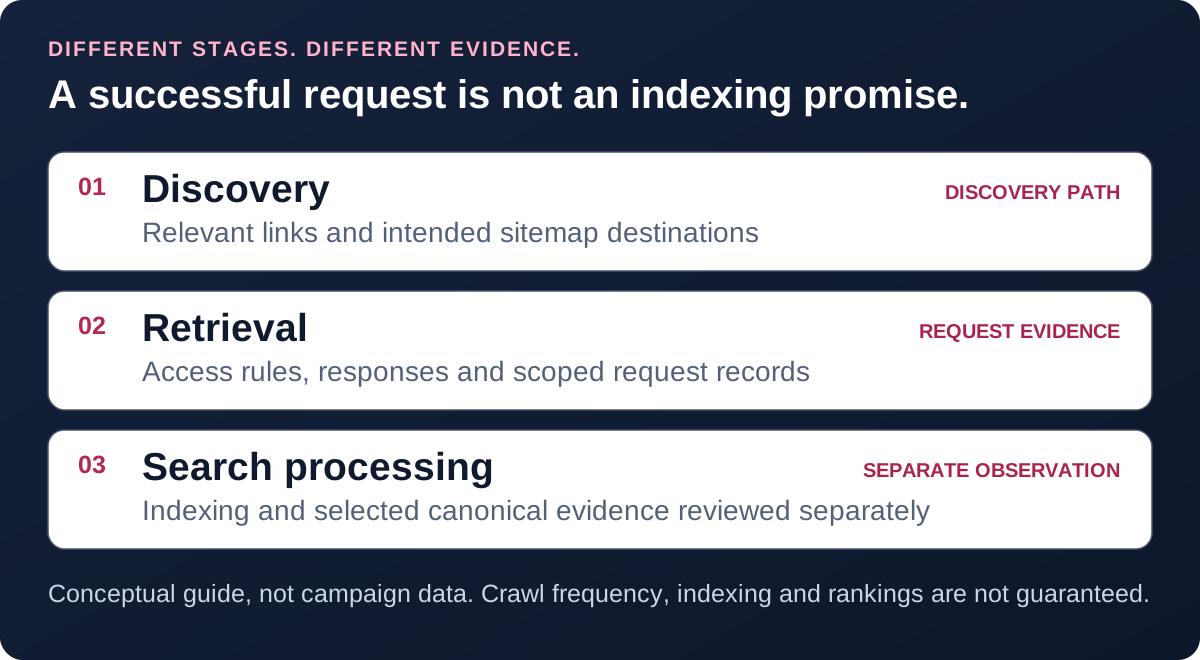
Discovery is not
an indexing promise.
A usable discovery path, successful retrieval and search processing need different evidence. Source, identity, collection gaps and the inspected period shape what each view can tell you. An activity sample does not measure Google’s allocated crawl budget.
Use the available tools within their evidence limits
The SEO Log Analyzer can summarize supported plain UTF-8 Common or Combined samples locally in an isolated browser workspace. Its crawler labels are unverified, and processing limits can produce partial results. Review exports because paths may contain identifiers.
The Crawl Budget Audit describes an owner-hosted connector and existing-account workflow for private aggregate reports. Setup and a controlled log source are required. These utilities provide scoped activity evidence; neither reveals an allocated crawl budget.
Control unnecessary variants.
Keep useful journeys working.
A useful filtered category, an alternative sort order and a changing session value need different decisions.
Classify representative examples before choosing a template or access change. The review distinguishes combinations that offer useful destinations, versions that repeat existing content and paths that can expand without a useful boundary.
Each recommendation identifies the affected URL family, intended behavior and exceptions. Confirm who owns the generating template or configuration before extending a rule across the website.
Acceptance checks preserve the paths that must remain accessible, the resources needed to process them and deliberate restrictions that must remain effective. Invalid combinations and genuinely missing pages should retain their intended responses.
Preferred addresses
Review canonical signals alongside the content relationship. The Canonical Tag Checker can inspect public or supplied declarations, with destination evidence where enabled.
A declared preference does not establish Google’s selected canonical or immediately stop requests to other versions.
Access and indexing instructions
Robots rules govern access; indexing instructions serve another purpose. A crawler needs access to read a noindex instruction, so a new robots block can interfere with an intended exclusion workflow.
The Indexability Checker supports bounded response and supplied-rule review, including draft-rule comparisons. Its token-based tests do not reproduce Google’s processing or authenticate Googlebot.
Strengthen discovery.
Keep routes clear.
Review menus, category relationships and contextual links around the agreed sections. A public page available only through a site-search form may need another discovery route.
Useful internal paths
Internal linking services can define source pages, destinations and implementation responsibilities when a wider placement plan is needed. Link changes should help readers navigate as well as expose useful URLs.
Later pages and load more
Preserve persistent component URLs and sequential paths to later content. Paginated segments should retain their own canonical destinations rather than all pointing to page one. Check later items and direct visits when reducing filter combinations.
Accurate sitemap output
Align the sitemap with the intended inventory and accurate significant-change dates. Priority and changefreq values do not control scheduling. The XML Sitemap Checker inspects a bounded document; it does not recursively fetch sitemap-index children. Inclusion and structural validity are not proof of crawling or indexing.
Meaningful responses
The Redirect Checker can inspect bounded current HTTP routes and supplied mappings. Remove avoidable chains without breaking migrations. A correct 404 or 410 can describe removed content; a successful response or homepage redirect is not a universal replacement.
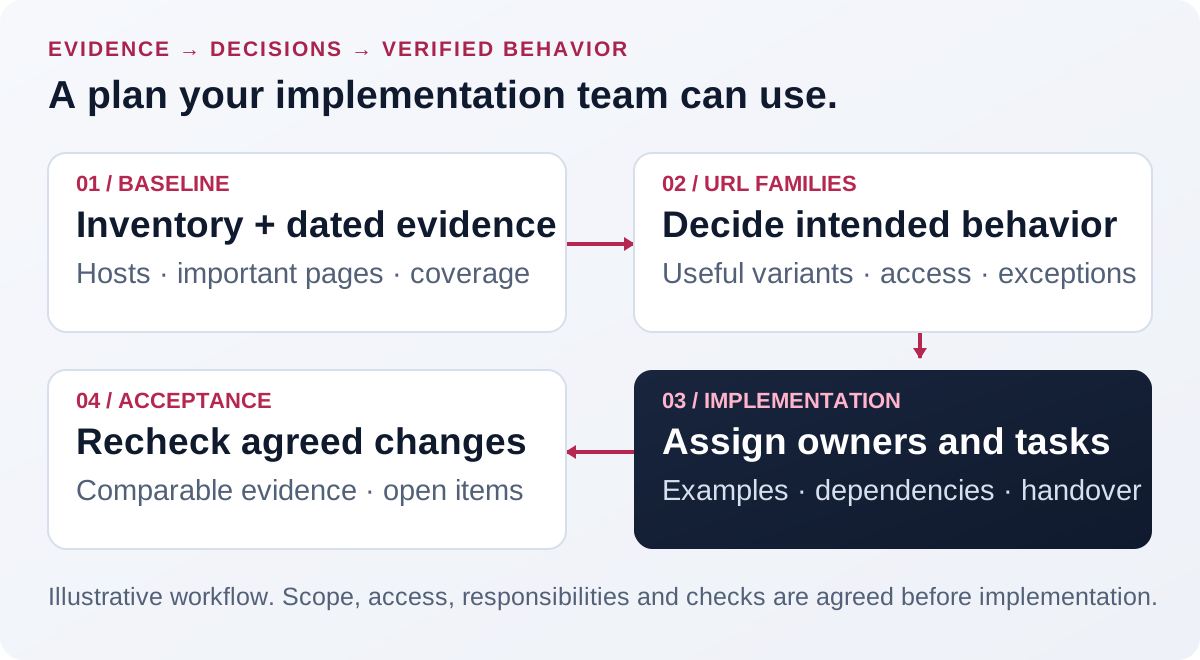
Make every recommendation
possible to verify.
Connect the observed issue to a proposed change, a responsible owner and an acceptance check. Keep the remaining questions visible in the handover.
Support reliable retrieval.
Verify the agreed changes.
Where evidence points to serving failures, identify the affected layer and involve the hosting or application owner. A timeout, overloaded origin and inaccessible resource need different investigations. The repair plan should name the examples that justify it.
Caching needs context too. A legitimate 304 response can let a crawler reuse unchanged content. Recommendations must preserve freshness, meaningful variants and private responses.
After a release, repeat relevant observations with comparable hosts, sources, periods and grouping rules. Keep collection gaps, traffic changes and altered sampling alongside the comparison. Request durations describe server or delivery operations, not Core Web Vitals.
A lower request total can reflect a smaller inventory, changed demand, caching or restricted access. Assess intended behavior and important-page coverage together before attributing the result to one change. Search processing remains a separate observation.
| Change area | Example acceptance check | Evidence to retain |
|---|---|---|
| URL generation | Unwanted combinations stop appearing in the agreed output | Template examples and affected family |
| Discovery | Important and later pages have usable paths | Relevant links and component URLs |
| Access and routing | Intended rules, responses and destinations hold | Dated representative checks and exceptions |
| Serving behavior | The identified failure or validation issue is rechecked | Comparable source, method and response context |
Crawl budget
optimization FAQs
Does every website need crawl budget optimization?
No. This specialist review is most relevant to large, frequently changing or expanding URL sets with a specific access or discovery question. A small site whose important pages are discovered promptly may need a narrower technical or content review.
Will this guarantee more crawling, indexing or rankings?
No. The project is evaluated against agreed technical changes and useful page coverage. Crawl frequency, indexing decisions, canonical selection and rankings remain outside a fixed service promise.
What evidence do we need to provide?
Start with the website, important sections, approximate URL count, publishing frequency and a description of the problem. Describe dated server or CDN records and Search Console evidence already available, including gaps. Agree permitted access and data handling before sharing private logs or credentials.
Are robots rules, noindex and canonical tags interchangeable?
No. Robots rules govern access, noindex concerns indexing, and canonical signals express a preferred address. A crawler needs access to read a noindex instruction. A canonical declaration does not establish the selected canonical or immediately stop requests to another version.
Does the service include implementing every recommendation?
Implementation responsibilities are confirmed in the quotation. The scope identifies who supplies access, prepares findings, makes changes and reviews the results. Collection setup, application development and continuing monitoring need explicit coverage and owners.
How are changes checked after a release?
The agreed acceptance checks are repeated against representative examples using comparable hosts, sources, periods and grouping rules. The handover records completed work, open items, exceptions and evidence gaps. Request totals are interpreted alongside important-page coverage, not as a stand-alone success measure.
Request your crawl budget
optimization quote.
Tell us what your team needs answered. A descriptive brief helps us define the coverage, deliverables, responsibilities and review arrangements around your website.
- Your website and important sections
- Approximate URL count and publishing frequency
- The affected URL families or recent release
- Available dated evidence and known gaps
- Who can approve access and receive the handover
Do not paste passwords, private logs or customer identifiers into this form. Agree access, data handling and timing before exchanging sensitive records.
For broader unexplained visibility issues, SEO audit services can establish diagnostic priorities. SEO consulting services can support decisions involving several teams or competing implementation approaches.
Share a non-sensitive project brief
Your enquiry requests a scope review. It does not authorize website changes or confirm an order.