
Link Relevance Checker
Review a backlink or internal link against the page it points to. Compare the anchor, surrounding text and destination passages, then record your judgment with the evidence.
Follow the connection
A workshop article can sensibly link to a lighting guide. That does not make every link between those pages useful. A paragraph about lamp position creates a different expectation from a paragraph about storing hand tools. The placement matters as much as the broad topic.
Start with the page containing the link and the exact destination you want to review. The checker finds direct matches in the selected source area, captures their nearby text and compares that wording with the destination. It can inspect links between different websites or two pages on your own site. It does not discover your backlink profile.
For a draft placement, choose Proposed placement and supply the intended anchor and paragraph. That wording is labeled as a proposal throughout the report. It is never presented as a link found on the source page.
Read the paragraph
Ask what the reader expects to find after clicking. If the sentence promises a sizing chart, the destination should provide that chart. A general category page may contain many of the same words while leaving the reader to start searching again.
Google recommends descriptive, concise anchors and context around links. It also cautions against forcing keywords into link text. Its link guidance is a useful reference for reviewing the sentence, not a specification for a numerical relevance score.
Inspect a placement to see its anchor, link attributes, surrounding text and closest inspected destination passage. Read beyond the shared terms. Does the target support the claim, add a needed explanation or offer the next practical step? A topical connection is a starting point, not the answer.
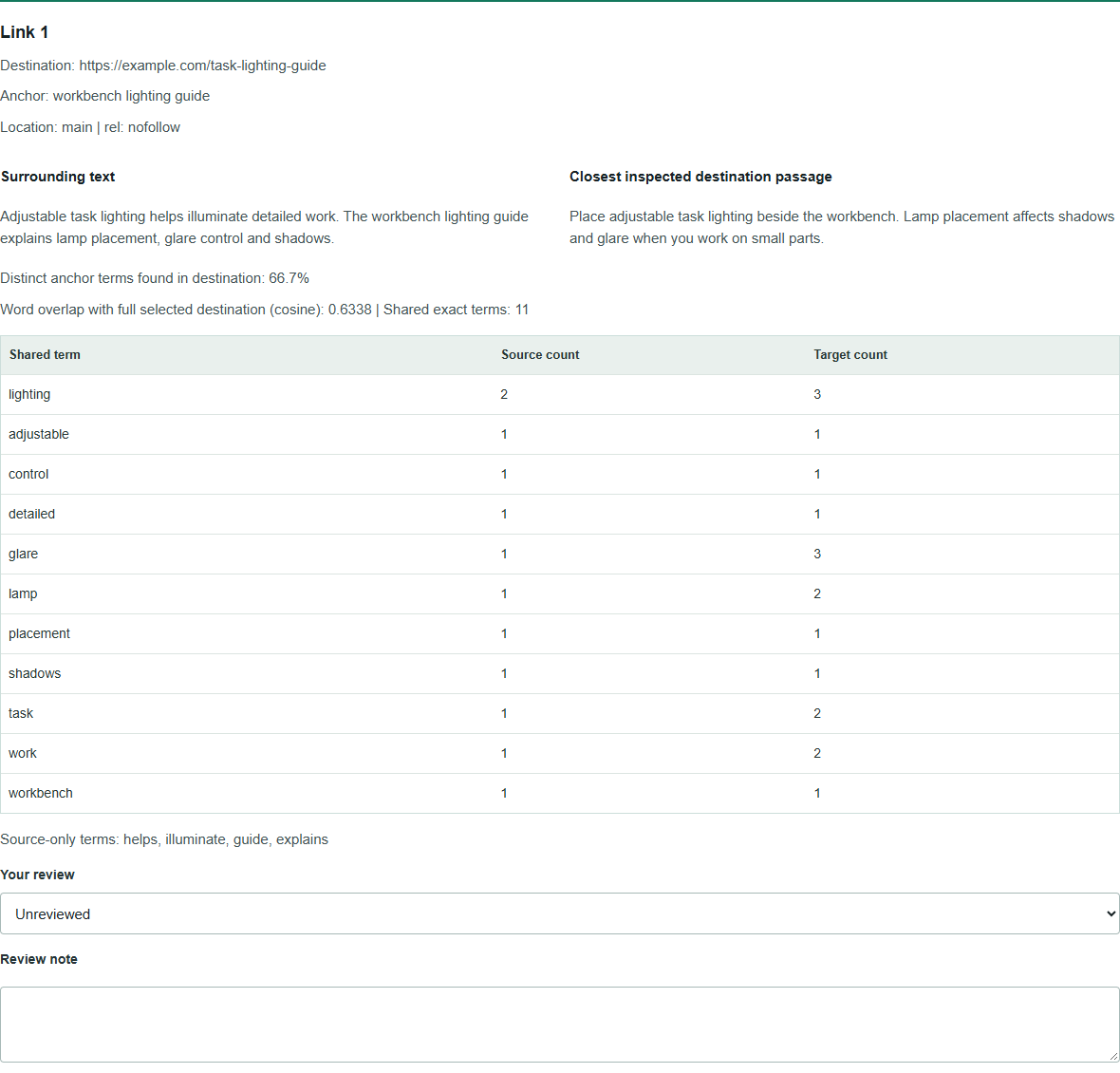
Use scores carefully
Word overlap uses cosine similarity: it compares the frequency of retained words on each side. A value near 1 means the word-frequency patterns are similar. Zero means no retained exact words are shared. Unavailable means there are not enough comparable terms on one side to calculate it.
There is no recommended passing score. A short paragraph compared with a long guide may score modestly despite making a useful connection. Two passages can also share the same words while disagreeing completely. This is lexical evidence, not a test of meaning, factual accuracy or Google’s assessment.
Distinct anchor terms found in destination answers a narrower question: how much of the retained anchor vocabulary appears in the selected target text? It does not show whether the page fulfills the anchor’s promise. Similarly, the closest inspected passage is the strongest word match among the eligible blocks checked, not necessarily the best answer for the reader.
The comparison normalizes Unicode and letter case, then removes very short tokens, numeric-only tokens and the selected stopwords. Choose a language list or None, and add recurring template or brand terms to Additional ignored terms when they distract from the subject. The checker does not translate, stem words or infer synonyms. For example, bicycle and bike remain different terms.
Check the source
Auto selects the first main element, otherwise the first article, otherwise the body. Template sections such as navigation and footers are excluded by default. Open Inspected pages to verify that the intended content, headings and title were extracted. You can select a different area when a site’s structure needs it.
Exact destination matching preserves path case, trailing slashes and query strings. Fragments and default ports are normalized. A live check can also match the final destination URL observed after a redirect. It does not follow every outbound tracking link, treat canonical addresses as equivalent, execute JavaScript or log in.
A missing match therefore needs investigation. Check the original page, the chosen area and the destination spelling. Supplied HTML can omit the very section containing the link. Unresolved destinations and scan caps are reported explicitly; incomplete evidence is not proof that a backlink is absent.
Keep your reasoning
Record a review and a short note for each placement. A useful note explains the decision: for example, “The paragraph promises a lamp-position diagram; the target has instructions but no diagram.” That is more actionable than marking a link weak because of its score.
Placements CSV includes the reported links and your notes. Report JSON also keeps the inspected page text, options, source details and comparison evidence. Downloads include reported rows, not any matches beyond the evidence cap. Submitted HTML and reports are not stored in WordPress; avoid sending confidential material or credentials. Hosting and verification-provider policies apply separately.
Relevance and link attributes are separate questions. A nofollow or sponsored link can still be useful to a reader. Use the Dofollow/Nofollow Checker for a closer inspection of link qualifications and page-level directives. Use this review to assess the connection, not to infer authority, link safety, ranking credit or indexing.
Questions
Does the score measure backlink quality?
No. Word overlap is a lexical comparison of the inspected text. It does not measure semantic relevance, authority, link safety, Google scoring or expected ranking credit. Review the context and destination before making a decision.
Can I review a link before it is published?
Yes. Choose Proposed placement and supply the anchor wording and surrounding paragraph. The report keeps that proposal separate from links observed in the selected source HTML.
Why does a relevant link have little word overlap?
A useful link can connect related ideas using different wording, synonyms or another language. A short context and a long destination page can also have low overlap. The tool does not infer synonyms or meaning.
Does a missing link mean the backlink was removed?
Not necessarily. The check is limited to the selected source area and supplied or fetched HTML. JavaScript links, excluded sections, tracking redirects and a different destination URL can explain a missing match. An incomplete scan cannot establish absence.
Discuss publisher outreach
Share your target page and the audience it serves.