
A FOCUSED START. A CLEAR NEXT MOVE.
Startup SEO
Services.
Build search into
your next stage.
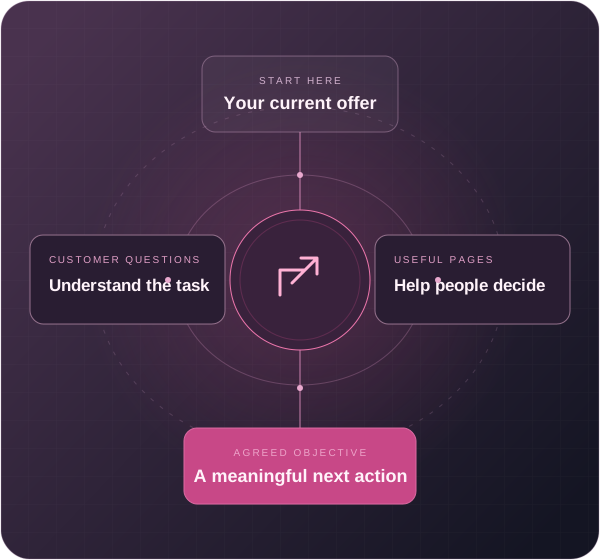
Your startup’s website should help the right people understand what you offer, decide whether it fits their problem and take a useful next step. That starts with a clear offer, accessible pages and a search plan your team can actually deliver.
Bootstrapped, product-led or service-based.
Start with your offer, market and implementation capacity.
SEARCH THAT FITS YOUR BUSINESS
Useful work.
At the right stage.
EduGuestPost’s startup SEO services bring keyword research, page planning, content improvements and implementation priorities into one agreed scope. The work starts with what you sell today, the customers you can serve and the resources available to improve the site.
Whether you are bootstrapping a service, launching a consumer product or developing a software business, the first question is the same: which search opportunities deserve attention now?
THE WORK YOU CAN REVIEW
Know what the engagement will produce
Your proposal should identify the work you are buying and how it will be reviewed. Depending on the agreed scope, that can include:
- 01
A priority assessment explaining which search opportunities fit your offer and which need more evidence.
- 02
A page map assigning useful query groups to existing or proposed URLs, with a purpose and next action for each page.
- 03
A technical task list with affected URLs, evidence, recommended actions, owners and dependencies.
- 04
Content briefs or agreed page revisions, including the product facts and proof needed for approval.
- 05
A measurement baseline and review plan that connect completed work with search visibility and relevant business actions.
Research, preparation, implementation and verification are defined in your agreed scope.
Discuss the right starting scopeBUILT AROUND YOUR CAPACITY
Start with a scope your team can support
A founder may be handling sales, product decisions and website approvals in the same week. A useful SEO plan accounts for those demands. It identifies the decisions that need your input, the work that needs a developer and the pages that deserve attention first.
The starting brief covers your current offer, intended market, customer questions, launch status and next commercial objective. Existing customer conversations are valuable evidence. If your audience or positioning is still uncertain, we record those assumptions and keep the initial commitment proportionate.
SEO can support discovery and evaluation. It cannot establish product-market fit or guarantee the next customer. When you need immediate demand, search work should sit within a wider acquisition plan with a realistic time horizon.
FROM QUESTION TO DELIVERY
Make every next step clear.
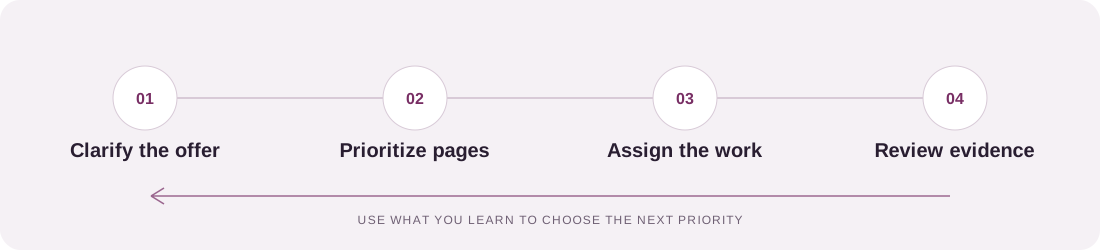
A practical sequence for the work you agree.
01 / PAGE STRATEGY
Choose the first useful pages
The starting point is the language customers use when describing their problem and evaluating possible solutions. We combine that information with keyword research and a review of relevant search results in your intended market.
Our keyword research services help assess demand, page format, competition and commercial relevance together. Volume estimates are planning inputs. A smaller topic can deserve attention when it closely matches your offer; a large audience can still be a poor fit.
Before adding a URL, we review whether an existing page can serve the task. Related wording often belongs on one useful page. A separate destination needs a distinct purpose and enough substance to justify it.
| Customer task | Likely page | Information needed |
|---|---|---|
| Understand the offer | Main product or service page | What it does, who it serves, limitations and next step |
| Check suitability | Use-case or application page | A real customer situation, relevant capabilities and evidence |
| Evaluate the commitment | Pricing or buying information | Current terms, what is included and how to get an accurate quote |
| Resolve a practical question | Supporting guide or help page | A useful answer connected to the product or service |
This is a planning framework. The right starting set depends on your business; every row does not require a new page.
An example of a focused starting scope
Consider a fictional startup offering reusable delivery containers to independent food businesses. Its first conversations reveal repeated questions about collection, cleaning, minimum quantities and the areas it serves.
A sensible initial scope might improve the main service page, explain the collection process and make current buying terms easy to find. One supporting guide could answer a recurring question about changing from disposable packaging, using verified operating details.
We would investigate the relevant searches before deciding whether an industry page adds anything useful. Pages for dozens of cities would need genuine service coverage and distinct value. The plan would also identify who supplies operational facts, who approves the copy and who updates the website.
The example illustrates a scope decision. It contains no client results or assumed search demand.
02 / LAUNCH & IMPLEMENTATION
Make launch checks part of the delivery plan
A new website needs checks tied to its intended state. A public preview may deliberately exclude itself from search. Pages intended to attract customers after launch need a different review. The team should agree which URLs are public, which should be discoverable and who can change the relevant settings.
Within the agreed website review, we prioritize issues affecting important pages and the actions visitors need to complete:
- Access and responses: Check intended public URLs, redirects and relevant crawl restrictions. Separate a page that loads for a logged-in founder from one available to visitors and crawlers.
- Indexing signals: Review page-level exclusions and canonical declarations in context. A declared canonical is a signal, rather than proof of Google’s selected URL.
- Page content: Confirm that important text, navigation and links are available in the delivered page. Sites relying on JavaScript may need additional rendered checks.
- Structure and discovery: Connect key pages through clear navigation and relevant internal links. Review the sitemap against the URLs intended for search.
- Visitor tasks: Test the contact, signup or purchase path included in the scope, alongside relevant mobile usability and performance issues.
A sitemap submission or successful public check does not guarantee Google indexing. Where you provide access, Search Console supplies Google-specific evidence for further investigation. Findings should record what was inspected, what remains unknown and what needs a separate specialist review.
Give implementation a named owner
An audit finding becomes useful when someone can act on it. We distinguish recommendations, copy preparation, CMS edits, development work and verification in the proposal. Each agreed task needs an owner, access requirements and an acceptance check.
For a broader diagnosis, SEO audit services provide a dedicated starting point. A startup engagement then selects the work that fits the current objective and implementation capacity.
Keep useful URLs through product changes
Startups change their offers. Before renaming a section, removing a page or rebuilding the site, review its current purpose, links and available search data. Decide what can be updated, what has an equivalent replacement and what should be retired. Use redirects where an appropriate replacement exists, and update the internal links that point to it.
Record significant changes so later reporting can distinguish a new offer or website release from an unexplained movement in traffic.
03 / CONTENT & CONNECTIONS
Build content from what your team knows
Useful startup content often begins with information that already exists: product demonstrations, onboarding questions, founder explanations, customer objections and operating procedures. The work is to turn those inputs into clear pages that help someone evaluate or use the offer.
The content brief should identify the reader, intended outcome, facts to confirm, examples to include and person responsible for accuracy. Drafts should explain available capabilities honestly. Roadmap features, customer logos, security claims, testimonials and performance figures need permission and supporting evidence before use.
On-page SEO services can address titles, headings and other agreed page elements. SEO content optimization can improve an existing explanation before you commission another article. Clearer information and a relevant next action matter more than meeting an arbitrary word count or keyword-density target.
Connect supporting answers to the offer
A helpful guide should make the relevant product, service or next resource easy to reach. Commercial pages should also connect visitors to the information needed to decide. Our internal linking services can support that review without forcing unrelated anchor text into the copy.
Expansion should follow evidence. Additional pages may make sense when customer questions repeat, the offer can serve another use case and the team has something useful to contribute. A fixed article quota alone does not establish a reason to publish.
Separate website work from publisher campaigns
If third-party coverage belongs in the plan, its audience, destination page, editorial angle and approval requirements should be clear. Guest posting for startups is the dedicated route for publisher work. Placement selection, content and current commercial terms need their own scope and approval.
Wider SEO campaign management can coordinate connected activities when required. Website improvements and publisher delivery should each remain visible in the work record.
Account for the work between deliverables
The cost discussion should cover research, writing, review, development, implementation, tools and reporting where applicable. Founder approval time is a real dependency. Agree the review process and what happens when a release, market change or new priority alters the brief.
If the need is mainly advice for your own team, SEO consulting services may be the more suitable starting point. A delivery engagement should specify which implementation tasks EduGuestPost will perform and which remain with your team.
04 / USEFUL TOOLS
Tools that support a startup SEO workflow
EduGuestPost’s SEO and content tools can help organize inputs and inspect specific evidence. Choose the tool for the question you need to answer, and retain its coverage limits with the report.
| Tool | Useful for | How to interpret it |
|---|---|---|
| Pre-Launch SEO Audit | Comparing observed signals with your expectations for supplied public URLs | A bounded check of declarations, not launch clearance; private staging and Googlebot access are outside its assessment. |
| Keyword Research Tool | Expanding a starting topic into possible wording | Free mode provides English word suggestions and generated ideas, without measured volume, difficulty or live SERP evidence. |
| Keyword Mapping Tool | Assigning supplied keywords to pages and owners | Planning checks use your inputs; they do not establish demand, current rankings or URL availability. |
| Topical Map Generator | Organizing researched topics into a page hierarchy | You supply the research. The map does not discover demand or justify every proposed page. |
| Content Brief Generator | Recording the reader, outcome, outline and review responsibilities | It assembles supplied information; source verification and finished writing remain separate work. |
| SEO Content Optimizer | Reviewing supplied text or HTML for phrase counts, long passages and structural observations | Counts and flags support editing. They do not assess factual accuracy or establish a ranking target. |
| Indexability Checker | Inspecting public responses, redirects, crawl rules and page directives | No common blocker observed is not confirmation of Google indexing or rendered-page behavior. |
| Internal Link Opportunity Finder | Reviewing observed connections and suggested links in a bounded crawl | Suggestions need editorial review. The sample cannot establish complete site coverage or confirmed orphan pages. |
These tools make particular checks easier to review. Your business knowledge, source evidence and implementation decisions give those checks their purpose.
05 / LEARN & REFINE
Measure progress against the agreed objective
We separate completed work from search and business outcomes. A revised page, corrected setting or implemented link can be verified when delivered. Its effect on search visibility and customer activity needs a suitable observation period.
Reporting should show the agreed URLs and query groups, available impressions and clicks, relevant landing-page activity and the next actions visitors complete. For a lead-based startup, distinguish an enquiry from a qualified lead and a customer. For a product business, define the relevant signup, purchase or activation action before interpreting the numbers.
Measurement implementation, access and reporting responsibilities belong in the scope. Test the agreed events rather than assuming every button click represents a completed action. Low early volumes, missing tracking and attribution settings can limit the conclusions. Keep those limits visible alongside launch dates, product changes and completed work.
At each agreed review, assess whether to continue, narrow or expand the plan. If the offer is changing or the team cannot implement priorities, the useful next step may be a smaller commitment while those dependencies are resolved.
YOUR NEXT CONVERSATION
Shape a useful starting scope.
Tell us where your business is today. Prepare a draft brief with suggested priorities, responsibilities and review questions.
BEFORE WE START
Startup SEO questions
Make the commitment with a clear understanding of the work.
Should we begin before product-market fit?
Some foundations can be useful early: a clear website, sensible URLs, accessible public pages and a way to measure relevant activity. A substantial publishing commitment needs stronger evidence about the audience, offer and search opportunity. The initial assessment helps decide how much work is justified now.
How soon should we expect results?
Delivery dates and search outcomes are different commitments. We can define dates for agreed work after reviewing the scope and dependencies. Rankings, traffic and customer acquisition depend on competition, demand, implementation and search-engine processing. A new domain alone does not support a reliable outcome date.
Can our founder or existing team handle part of the work?
Yes. The plan can divide responsibilities around available skills and time. Your team might supply product facts, approve drafts or implement changes, while EduGuestPost handles the agreed research and page work. Make those handoffs explicit so progress does not depend on unassigned tasks.
Is this suitable for a bootstrapped or consumer startup?
The scope should follow the business model and customer problem. Funding status does not determine whether search is a useful channel. The assessment considers your audience, offer, market, website and available resources, including whether another acquisition activity deserves priority.
YOUR NEXT STEP
Discuss your startup’s next SEO priority
Share your website, current offer, intended market, launch status and the people available to review and implement changes. Include your budget range and the next business objective. We can then discuss a defined starting scope, its deliverables and the evidence needed to review progress.
Discuss your startup SEO scope
Share your offer and the next decision you need to make.