
Useful paths between related pages
Internal Linking Services for Your Website
Help visitors reach the next useful answer and find the pages that matter to your business.
EduGuestPost's internal linking services connect related pages through relevant placements, descriptive link text and checked destinations. We review the agreed website section, plan the changes and provide implementation or a handoff for your website team. You receive a record showing where each change belongs and why it helps the reader.
A guide should make supporting resources easy to reach. A service page should connect visitors with the evidence they need to enquire. We build those paths around your confirmed priorities.
Send your website, priority destinations and the section you want reviewed. Tell us whether you need a link plan, implementation or both.
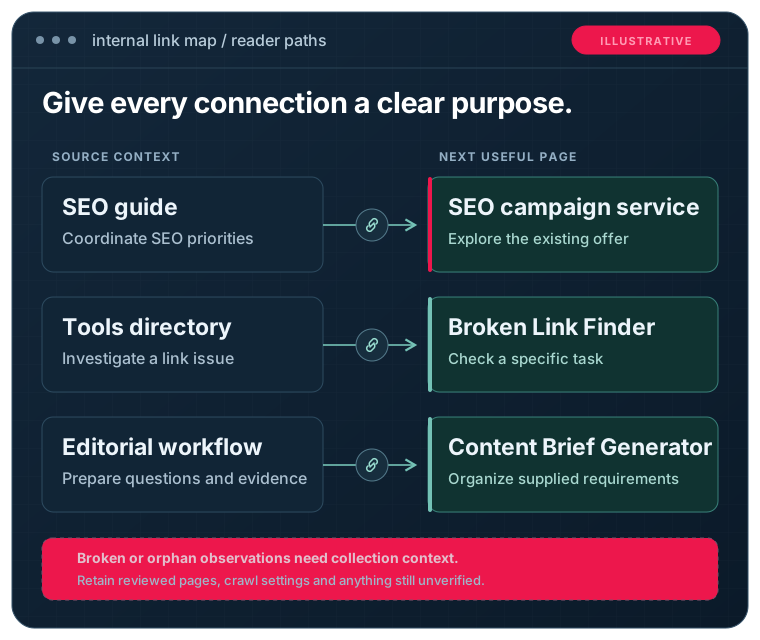
Illustrative network, not a live website crawl or client result.
A clear record of the work
What you receive
The proposal defines the website coverage, change volume and implementation responsibilities. Your handoff can include the following records.
| Deliverable | What it contains | How your team uses it |
|---|---|---|
| Coverage and priority record | Pages reviewed, collection method, exclusions and destination priorities | Understand the evidence behind the recommendations |
| Internal link map | Source URL, destination URL, placement, anchor text and reason | Review each proposed connection before editing |
| Link cleanup list | Observed broken links, redirects, unclear labels and items needing verification | Correct supported issues without guessing |
| Implementation record | Completed edits, remaining tasks and the person responsible | Track delivery and hand work to your editor or developer |
| Validation and follow up notes | Checks performed, unresolved dependencies and measurement approach | Confirm the published changes and review their effects |
A plan for an existing blog section has different requirements from a catalog with thousands of products. Page types, rendering, access and the work needed to publish changes determine the scope and quote.
Review the reader’s next step
When internal linking deserves a closer review
Visitors may rarely encounter some useful pages while browsing. New resources can lack a route from established content. Older articles may still send readers through redirects or to a page that no longer answers the question.
Other sites have plenty of links but weak choices. Every article may promote the same offer when a specific resource would help. Related blocks can repeat broad topics while overlooking the reader's immediate problem.
We assess those connections against actual page purposes. Available search and enquiry data can help set priorities, but low traffic alone does not establish an internal linking problem. We record what the review shows and identify questions that need wider investigation.
For questions that need a wider website review, SEO Audit Services provides a separate starting point.
Placements with different purposes
The link changes we plan
Contextual links within your content
A contextual link belongs where the reader needs the destination. A task guide might link to a detailed method, a relevant tool or a service that carries out the work. The surrounding sentence should explain that relationship.
We choose anchor text that describes the destination, with wording that fits the source passage naturally. An anchor percentage is not a ranking requirement, and a collection of search phrases rarely makes a helpful label.
Navigation and related resources
Menus and section navigation help people browse the website. Related resource blocks help them continue from a particular page. These placements have different jobs from a link inside an explanation.
We identify changes within the agreed scope and review their effect across the pages sharing that component. A useful related block should contain relevant choices with clear labels. Template edits and a wider navigation redesign need defined development work before implementation.
Breadcrumbs and page hierarchy
Breadcrumbs can help someone arriving on a deeper page understand its place within the site and return to a relevant parent page. The visible trail should reflect a sensible browsing hierarchy and lead to real destinations.
We can review existing breadcrumb links as part of the selected scope. Changing breadcrumb components or adding structured data requires its own implementation and validation. Markup does not replace working navigation or establish a guaranteed search appearance.
Destination and link health
We record the source of an observed problem and the destination it points to. A confirmed missing page needs a different decision from a temporary timeout, a blocked request or an intentional redirect. A working page can also have a broken section link if the target heading identifier has changed.
Where an appropriate final destination is confirmed, the source link can be updated to it. Existing redirects remain in place unless a separate approved project changes them. Choosing a replacement requires checking that it still answers the promise made by the link.
Inventory → map → implementation → validation
How your internal linking project works
Review the inventory
Agree on the pages, priority destinations and collection boundaries.
Map useful connections
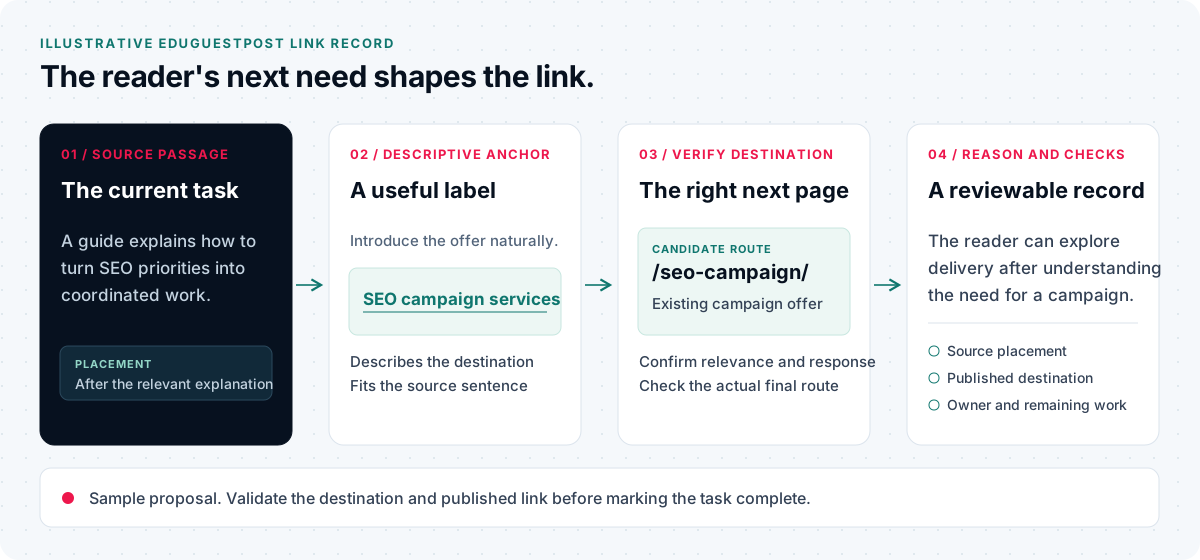
Record the source, destination, descriptive anchor, placement and reader benefit.
Publish agreed edits
Identify who implements each change and which dependencies remain.
Validate the path
Check the changed placement and destination within comparable review settings.
Confirm the pages and business priorities
We start with your preferred destinations, the audience they serve and the action each page supports. Useful inputs include a current page inventory, keyword map, sitemap export and any routes that must be protected.
The review also considers nearby pages with similar subjects. A guide, a product page and a service offer can each serve a different need. We select the appropriate destination for the source context and flag unclear ownership for further review. Adding links alone cannot determine or resolve harmful keyword cannibalization.
Collect and compare the available evidence
We document the crawl starting points, reviewed sections and collection limits. When available, CMS exports, sitemap entries and Search Console records help identify pages that may be absent from the crawl. We distinguish a URL discovered in an inventory from one reached through an observed internal link.
An orphan finding means no incoming path was observed within the stated evidence. A limited crawl cannot establish that a page has no links anywhere on the website. Some records also count only contextual text links, so we keep that definition visible before recommending changes.
For sites relying on JavaScript, the review must account for rendered links. Links using an anchor element with a valid destination are easier to inspect than navigation controlled only by a click event. Basic HTML checks may require a rendered crawl or developer review to complete the evidence.
Build a map with editorial reasons
Each proposed change identifies the source, destination, anchor and placement. We explain why that reader would benefit from the next page and whether the source sentence needs a small edit to introduce it properly.
We prioritize useful connections to confirmed business pages and supporting resources. Existing relevance, visitor needs and the effort required to implement a change inform that order. A provider's link score can help organize analysis, but it is not Google's PageRank or a result guarantee.
Where a page needs substantial new copy before a link makes sense, we flag that dependency. The Content Brief Generator can organize supplied audience details, questions, evidence and internal link notes into a brief. It does not research or verify those inputs independently.
Implement with a clear change record
The proposal identifies who publishes the edits. With suitable access and an agreed scope, we implement the selected changes. If your team controls the website, we supply the map and instructions for its editor or developer.
Contextual edits should preserve the meaning of the source passage. Shared navigation changes need checks on representative page types and mobile layouts. We review whether links remain recognizable, whether their labels explain the destination and whether the resulting path is usable.
URL restructuring, page consolidation, migrations and complex faceted navigation need separate technical decisions. We record those dependencies before changes are implemented.
Check the published work
We check the changed links within the agreed coverage and record any items that remain unverified. Relevant checks include the source placement, actual destination, response, redirects and section targets. Rendered output is included where the platform requires it.
Before and after crawls should use comparable settings. Otherwise, an apparent change in link counts or reachability may come from a different collection method. Your completion record identifies what was checked and the remaining work, including anything your team must publish.
When destination ownership needs research first, Keyword Research Services can help plan query groups and page purposes.
Include the website platform and any restrictions on content or template edits. This helps define a practical implementation scope.
A reader reason for each connection
An example using EduGuestPost pages
EduGuestPost has service information, editorial resources and tools that answer different visitor needs. These illustrative placement decisions show how a source context connects with a useful destination.
| Source context | Useful destination | Reason for the connection |
|---|---|---|
| A guide explains how to turn SEO priorities into coordinated work | SEO campaign services | The reader can examine the existing campaign offer after understanding the need |
| A tool directory visitor needs to investigate links that may be broken | Broken Link Finder | The destination addresses a specific checking task |
| An editorial workflow needs a written brief with questions and evidence | Content Brief Generator | Supplied requirements can be organized for the person preparing the content |
For your website, we compare what the source explains with what the destination provides. A shared topic identifies candidates; the reader's next need determines whether a link belongs there.
EduGuestPost's editorial standards emphasize relevance, originality and factual support. Those principles also matter when adding a link: the anchor and surrounding claim should accurately represent the next page.
Evidence within its collection boundaries
EduGuestPost tools that support the work
The SEO tools directory provides focused ways to organize and inspect evidence. These utilities support individual review tasks; their collection boundaries remain part of the analysis.
| Tool | Useful evidence | What still needs review |
|---|---|---|
| Broken Link Finder | Source pages, destinations, anchors and response observations within a bounded public crawl | Large or JavaScript sites need suitable wider collection; blocked or timed out requests are not confirmed broken links |
| Anchor Text Optimizer and Analyzer | Link wording and classifications from supplied content, anchor records or supported page input | Counts and percentages prompt an editorial review; they do not define a required anchor ratio |
| Link Relevance Checker | Anchor context and destination passages for observed or proposed placements | Text matches are evidence to interpret; a proposed placement is not proof that the link already exists |
| URL Link Domain Extractor | Links and domains extracted from supplied text, HTML, Markdown or supported files | Extraction does not visit destinations or establish their response, indexability or relevance |
| Canonical Tag Checker | Declared canonical information and available destination evidence | A declaration does not reveal Google's selected canonical; route choices need wider context |
| Indexability Checker | Available response, robots, noindex, redirect and declared canonical evidence | Public checks do not prove that Google has indexed the page |
| XML Sitemap Checker | Structure, duplicates and extracted entries from an inspected XML sitemap or index | A sitemap index lists child sitemaps; the check is not a recursive site crawl or a visit to every listed page |
Some public page inputs expose initial HTML rather than everything generated in the browser. We identify that limitation when it affects a recommendation. The service adds page selection, editorial decisions, implementation planning and checks to the evidence available from the tools.
Independent learning resource · 6:02
How to Use Internal Links to Rank Higher in Google
An independent tutorial by Ahrefs about internal linking. This educational resource is not an EduGuestPost service demonstration or endorsement.
Watch the Ahrefs tutorial on YouTube or read the tutorial overview.
The video loads from YouTube only when you choose to play it.
Connected with the wider plan
Internal links within your wider SEO work
EduGuestPost's existing SEO campaign offer brings together target page readiness, content priorities, internal links and publisher planning. A focused linking project can support the website work within that wider plan.
A campaign destination should be useful when visitors reach it. Supporting content can provide routes to that page and answer questions too detailed for its main offer. Each connection should follow the reader's needs.
The guide to maximizing the benefits of SEO connects content, website readiness and measurement. For offsite publisher work, guest posting and blogger outreach has a separate delivery scope. Internal linking concerns your own website.
Accessible paths and useful content
Search visibility and AI discovery
Clear links help people and crawlers understand page relationships. Google's guidance for AI features in Search also includes making content easy to find through internal links, alongside accessible pages and useful content.
AI citations and search positions cannot be guaranteed. AI visibility measurement needs its own prompts and collection method. Our guide on getting cited by AI search engines explains related source page considerations.
Validation before interpretation
How we review the results
The completion record documents implemented changes and validation, with proposed or unverified items identified separately. It gives your team a clear basis for the next review.
Where performance follow up is included, we establish the pages and comparison period before interpreting results. Search Console can show page and query visibility; suitable analytics can show onward visits and enquiries. Click tracking may require a separate measurement setup.
We review both the pages receiving links and the pages where links were added. Changes can affect those groups differently, and a gain on one page does not prove a gain across the website. Seasonality, other edits and changing search results also influence comparisons. Published internal linking tests have mixed outcomes, so we do not forecast an uplift from link volume alone.
Before you enquire
Frequently asked questions
How many internal links should a page have
There is no universal ideal count. We choose links according to the reader's needs, the page's purpose and usability. Where relevant, the record distinguishes sitewide navigation from contextual links within the content.
Can you find and fix orphan pages
We compare the agreed crawl with other available inventories, then check the page's purpose before suggesting incoming links. The finding stays tied to the collection limits. Pages intentionally excluded from normal browsing may not need new links.
Will you change our existing content
Contextual links may need small sentence edits, which we document. The proposal identifies larger copy or template work and defines access, review responsibilities and who publishes each change.
Can internal linking fix keyword cannibalization
A link map clarifies page relationships. Diagnosing harmful overlap requires intent and query page evidence. We flag unclear ownership for investigation before recommending consolidation, redirects or a change to either page's purpose.
Do you support WordPress and ecommerce websites
The scope depends on the platform and editing access. WordPress article edits and shared ecommerce components have different requirements. Catalog size, JavaScript rendering and developer involvement affect coverage, implementation and the quote.
How long does an internal linking project take
We confirm the schedule after defining page coverage, collection requirements, permissions and review arrangements. Crawlers need to revisit changed pages after implementation, and a ranking or traffic improvement cannot be promised by a fixed date.
Your website. Your priority destinations.
Request an internal linking quote
Tell us which pages your visitors should be able to reach more easily and where you want the review to begin. Include your website platform, preferred implementation arrangement and any available sitemap or page inventory.
You can also email [email protected] with your website and project requirements.
This form prepares a brief in your browser. It does not submit an enquiry. Choose “Open email draft,” review your message in your email app, and send it when you are ready.
You can also visit our contact page.