
SOURCE QUALITY, WITH THE EVIDENCE IN VIEW
AI Citation
Readiness
Optimization Services.
Make your next
page review count.
A page can look complete while leaving its most important claims difficult to check. A specification may lack a source, an offer may hide its conditions, or essential information may be missing from the HTML a particular fetcher receives.
Agreed page set · Prioritized fixes · Defined re-check
A CLEAR HANDOVER FOR CONTENT & DEVELOPMENT
Make your important pages easier to review as sources
EduGuestPost’s AI citation readiness optimization services review those gaps across an agreed page set. We assess available access evidence, answer clarity, claim support and consistency, then prepare a prioritized plan for the changes that matter. Approved page edits and technical tasks can be included in the scope, followed by a defined re-check.
You receive findings attached to pages and passages, with the evidence available, the limitation identified and the next action. This gives your content and development teams a practical route from assessment to verified improvements.
Request a citation readiness review. Share your website or draft, the customer question it should answer and the pages you want assessed.
What the engagement can deliver
- A defined page inventory or sample, with the purpose and evidence available for each page.
- An assessment of access, clarity, sources, attribution and relevant structured data.
- A claim-and-source review identifying supported wording, missing evidence and unresolved questions.
- Prioritized editorial and technical tasks with owners and acceptance checks.
- Agreed copy changes or implementation instructions, plus a re-check of the updated evidence.
Page volume, source-review depth, implementation responsibility and review rounds are confirmed before work begins. A focused first review can establish the main issues before expanding across more templates or sections.
Who this service helps
The offer suits content teams preparing an important guide, businesses clarifying product or service information, and site owners whose technical and editorial checks need one coordinated handover. Drafts can be reviewed before publication, with live-site checks added when the corresponding evidence becomes available.
A readiness assessment reviews the page and its supporting information. Recurring observations of AI answers are a separate monitoring requirement.
01 / PURPOSE, ACCESS & APPLICABLE CHECKS
Assess the page against its actual purpose
A service page, research article and product document have different jobs. We establish the intended reader and question before applying checks. The aim is useful, supportable information in a suitable format, rather than a uniform answer template across the website.
| Review area | Evidence we examine | What needs separate confirmation |
|---|---|---|
| Access and eligibility | Responses, redirects, crawl rules, directives and relevant provider controls. | Actual indexing, authenticated crawler access and account-only settings require appropriate evidence. |
| Answer clarity | The main explanation, definitions, conditions, headings and useful comparisons. | Editorial usefulness needs judgment; text length and phrase counts do not predict citation selection. |
| Claims and sources | Source passages, figures, units, dates, quotations and qualifications. | A nearby link does not establish support for the exact wording. |
| Identity and attribution | Business names, real contributors, revision information and visible markup. | Declarations do not authenticate expertise, authorship or the freshness of the underlying information. |
| Implementation | Approved changes and the evidence returned after editing. | A completed fix does not prove that an AI system selected the page or that revenue increased. |
Match access checks to the intended search surface
Search crawling, model training and user-requested retrieval have different purposes. We review relevant provider documentation and the owner’s chosen policy before recommending changes. Allowing search access does not require a blanket decision to allow every training crawler.
For Google, our review can include indexing and snippet eligibility and, with suitable owner access, the current Search generative AI control. An account-only choice cannot be inferred reliably from a public HTML request.
Challenge pages, errors and content that depends on JavaScript may need further investigation. Comparing initial HTML with a supplied browser snapshot helps locate a difference; it does not prove how every provider processed the page. Genuine request evidence and appropriate owner tools answer different questions.
Keep the finding proportionate to the evidence
We distinguish an observed issue from a possible issue and an unavailable check. A public fetch returning successfully is one observation. It is not an indexing certificate or a guarantee of access under every condition.
Where the wider site has unresolved technical problems, a broader SEO audit may be the right starting point before detailed passage editing.
02 / CLAIMS, SOURCES & CONTEXT
Connect important claims to evidence readers can inspect
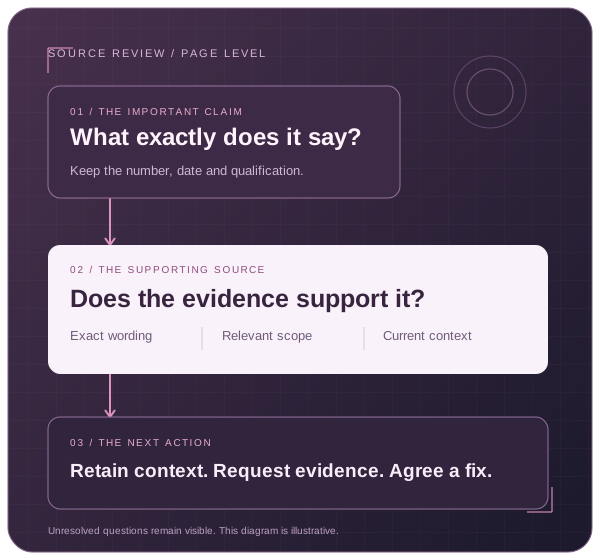
The most useful source review begins with claims that affect a customer’s decision. These can include product capabilities, eligibility, availability, pricing conditions, performance figures or a conclusion drawn from research.
We identify the claim and inspect the supporting material included in scope. Does the source support the exact number, date, population and qualification? Is it original evidence or another page repeating the same assertion? Does the page explain enough context for a reader to interpret it correctly?
The review records support, partial support, missing evidence or an unresolved question. Important factual decisions remain with the appropriate business or subject reviewer. A resemblance between passages, an automated flag or a citation marker cannot replace that decision.
Preserve the conditions that make a statement accurate
Consider a fictional inventory-software page that says “Export your complete stock history instantly.” Its approved documentation actually describes exports for a selected date range, with processing time depending on the size of the request.
The useful fix is to explain what can be exported and the relevant conditions, then connect that explanation to current documentation. Adding an unsourced statistic or repeating the original claim in a shorter answer block would leave the same problem.
This example illustrates a review method. It does not report a customer result or establish that revised wording will earn a citation.
Make attribution and current information meaningful
We review contributor and reviewer descriptions where they apply, the publisher’s identity and the relationship between visible dates and actual revisions. Real qualifications and clearly described methods help a reader assess the material. Invented credentials, decorative bylines and a new date attached to unchanged content do not supply evidence.
For business pages, names, capabilities and limitations should agree across the pages and profiles being reviewed. Any external correction request remains a separate action subject to that publisher’s process.
Choose structure because it helps the reader
A clear opening explanation, relevant headings or a comparison table may make a page easier to use. A step-by-step procedure may need a list. The format follows the content and audience.
There is no compulsory paragraph length, FAQ quota or minimum article size in this service. Recommendations should improve the explanation while preserving necessary context. Our editorial standards guide that review.
NOT ALL FINDINGS MEAN THE SAME THING
Keep uncertainty
visible.
Record what was observed, what needs investigation and what could not be checked.
Open the existing readiness checker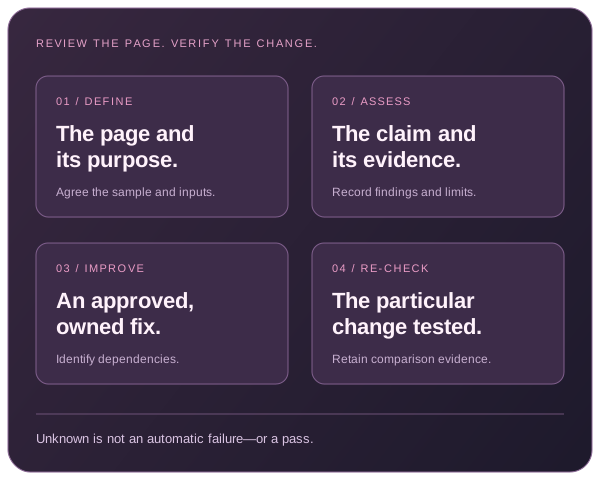
03 / FROM ASSESSMENT TO A CHECKED CHANGE
Turn the assessment into an approved fix plan
1. Define the pages and evidence
We agree the URLs or drafts, page types, target questions and intended platforms. For larger sites, the sample can represent important templates and sections. The report states what was inspected and where broader coverage would require more work.
You identify who can approve commercial and technical facts. Available documentation, source files, account evidence and implementation access determine which findings can be confirmed.
2. Prioritize blockers and material inaccuracies
A page that returns an error or a claim that misstates the offer may need attention before a small formatting issue. Shared template problems are grouped so the team can address their cause instead of treating every affected URL as unrelated.
Each task identifies the page or template, observed evidence, recommended change, dependency and verification step. Unavailable evidence remains a request for investigation, rather than an automatic failure.
3. Prepare the agreed improvements
The scope can include revised passages, source and attribution corrections, markup recommendations or developer instructions. Work on the page can connect to on-page SEO, content optimization or a focused content refresh.
Markup should describe the real page and agree with visible details. We inspect existing output before recommending another block that could conflict with it. A valid JSON-LD file does not guarantee a rich result or an AI citation.
4. Re-check the changed evidence
After approved changes are implemented, we review the affected pages or supplied drafts against the acceptance checks. The handover identifies resolved findings, remaining issues and dependencies that still need an owner.
Where comparable conditions are available, we retain the before-and-after evidence. A successful re-check confirms the particular correction tested; it does not establish that the change caused a later visibility movement.
Understand any readiness grade
If the agreed assessment includes a grade or score, its rubric, method version, applicable checks and coverage should be visible. Unknown and not-applicable items remain identifiable. Changes to the method are separated from changes to the page.
The grade summarizes that assessment. It is not a probability of citation, a platform-issued rating or proof that every claim is true.
ONE PAGE. ONE IMPORTANT CLAIM.
Prepare your readiness review brief.
Identify the question, claim and evidence you want reviewed. Get a draft checklist for agreeing the work.
04 / THE RIGHT TOOL FOR EACH QUESTION
Use focused tools with their evidence limits intact
EduGuestPost’s tools can support specific parts of a readiness review. We interpret their outputs alongside the actual page and the approved supporting material.
| Tool | Useful contribution | Scope to retain |
|---|---|---|
| AI Citation Readiness Checker | Reviews a bounded initial-HTML response or supplied HTML/text; can compare supplied rendered HTML. | It does not run a browser, fetch linked sources or independently verify claims. |
| Indexability Checker | Inspects public response, crawl-policy, directive and declared-canonical evidence. | It does not prove Google indexing or genuine access for every AI crawler. |
| Rendered HTML Checker | Compares source HTML with a browser DOM snapshot you provide. | Differences require investigation; the comparison does not show Google’s rendered page. |
| Structured Data Checker | Checks JSON-LD syntax, expansion and selected vocabulary relationships. | It does not confirm visible-content accuracy or Google rich-result eligibility. |
| AI Citation Checker | Maps passage references within a supplied captured answer. | A reference match is separate from factual support or a complete citation history. |
| Content Brief Generator | Organizes supplied findings and approved inputs for a writing task. | A brief is neither verified evidence nor the finished article. |
Keep useful existing content connected
Some findings concern navigation rather than missing content. A relevant explanation may already exist but be difficult to find from the main offer. Internal linking support can connect those pages when it is part of the agreed work.
We avoid creating multiple near-identical answers simply to cover variations of a question. Google’s current guidance does not require special AI files, markup or writing patterns for its generative Search features. Optional discovery files or agent integrations should have a defined use before becoming a task.
Separate page readiness from observed outcomes
A readiness review examines available page evidence. Captured answers show whether a particular system actually mentioned or linked to the business under recorded conditions. Identifiable referrals and qualified actions are further observations with their own limits.
Our guide to getting cited by AI search engines explains the broader topic. Ongoing monitoring, dashboards and alerts need a separately defined scope and suitable collection access.
BEFORE WE START
Questions before you start
Define the page set, the evidence available and what the review can establish.
Is this different from a general AI search engagement?
This offer centers on a defined set of pages, the quality and limits of their evidence, a prioritized improvement plan and verification. A wider AI search program may also involve market research, a larger content plan and other delivery work. The initial scope identifies which engagement fits your need.
Can you review an unpublished page?
Yes. Supplied text or HTML can support an editorial and evidence review before publication. Live responses, server headers, crawler policies and account-only settings need their corresponding evidence. The assessment states which checks were possible.
Do we need to add schema or llms.txt to pass?
We recommend markup when it accurately describes the content and serves a relevant supported purpose. Google does not require special AI schema or llms.txt for its generative Search features. Optional files are assessed for a real use, rather than used as compulsory pass conditions.
Does adding sources make every claim reliable?
No. A source may be outdated, support a narrower statement or repeat an unsupported claim. We review the relationship between important wording and the available source material within the agreed scope. Unresolved questions stay visible.
Can you guarantee that the page will be cited?
No. Platforms select their own sources and answers. We agree improvements and verification steps that can be delivered, and keep observed citations separate from readiness findings. No score establishes a guaranteed inclusion rate.
How much of the website will you inspect?
The proposal defines the pages, sections or template sample. A sitemap can inform the inventory, but it does not mean every URL has been inspected. Additional coverage and specialist source review can be scoped when the first findings justify them.
What determines price and timing?
The page set, available evidence, depth of factual review, technical dependencies, implementation responsibility and review rounds determine the work. We confirm deliverables, exclusions and timing after reviewing the brief.
START WITH THE IMPORTANT PAGES
Request your citation readiness review
Send the page URLs or draft, the intended customer question, target markets and any supporting documentation or captured AI answer you want examined. Tell us who will approve facts and who can implement the changes.
Contact EduGuestPost to agree the first page set, the review depth and the verification process. Your plan will identify what can be improved, what evidence is missing and how the completed work will be checked.
Tell us what needs checking.
Send the page or draft, the question it answers and the evidence available.