
Local SEO Competitor Audit Services
Understand your local search competition and choose the work that deserves attention.
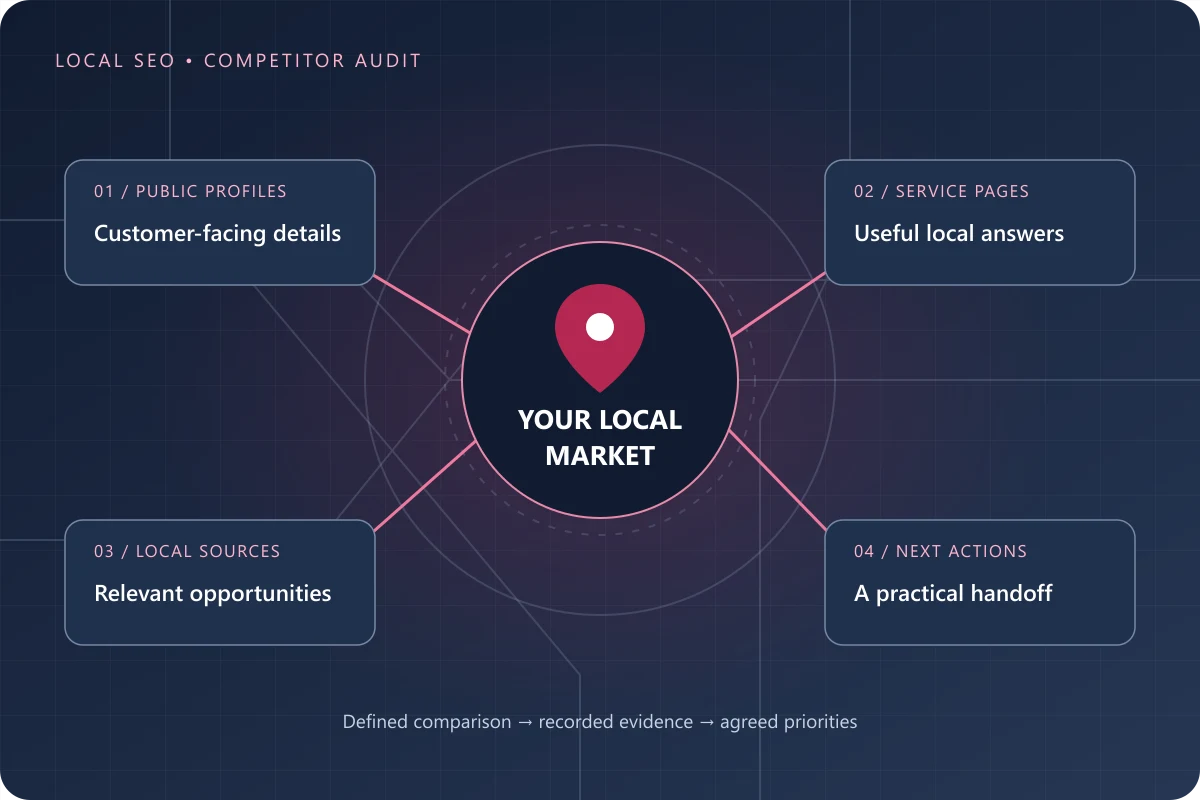
EduGuestPost’s local SEO competitor audit services compare your business with a defined set of relevant competitors. We review the agreed search results, public profiles, website pages and available supporting data, then turn the findings into priorities your team can assess and implement.
Agreed competitor sample · Dated evidence · Prioritized handoff
What do you need to understand about your competitors?
The audit begins with a business question. You may want to understand which businesses appear for an important service, why your selected pages leave customer questions unanswered, or which directory and link opportunities deserve investigation. That question guides the research scope and the evidence we collect.
Request a local SEO competitor audit with your website, business location or service area, priority services and the decision you need help making. Include the competitors you already know and any relevant public profile links.
- Your website and customer area
- Priority services and known competitors
- The decision the research needs to support
Choose a starting point for your enquiry.
Prefer email? [email protected]
Request your scoped audit quote
Tell us where you compete and which services matter most.
We use these details to respond to your enquiry. Privacy policy
Compare the competitors that matter to your business
The company competing for your customers may differ from the website appearing beside you in search. A directory, publisher or national brand can occupy an important result without offering the same local service.
We record those differences and explain why each business or website belongs in the review. The comparison follows your real services, customer area and business model. It gives you a reasoned basis for selecting work, with search observations and business priorities considered together.
Who serves the same customers?
Compare the services, customer area and business model that make a rival commercially relevant.
Who appears in the local sample?
Record the selected query, search surface, location and observation date before comparing visible profiles.
Which pages answer the search?
Separate service businesses from directories and publishers, then compare the purpose of each relevant page.
What you receive from the competitor audit
You receive a documented comparison and a practical handoff: the competitors reviewed, the observations behind each finding, the important limitations and the proposed next action. Your team can see which recommendations concern its own information, website content, listings or further research.
The proposal defines the locations, services, queries, competitors, pages and evidence sources included. It also states whether the review uses public observations, suitable exports you supply or other agreed research sources. The size of the comparison follows that scope.
Research brief
What it containsBusiness question, priority services, customer area and agreed coverage
Keep the investigation focused on a useful decision.
Competitor register
What it containsSelected businesses and websites, their relevant pages and reasons for inclusion
Understand who was compared and where each competes.
Comparative evidence
What it containsDated observations, source references, comparable fields and information gaps
Review the basis and limits of each finding.
Priority actions
What it containsRecommended work, supporting evidence, dependencies and proposed owner
Choose the changes or further checks worth pursuing.
Implementation handoff
What it containsA usable task list, affected assets and checks for the agreed work
Brief the people responsible for the next stage.
Define the question before expanding the sample
A single-location service business may need a focused comparison for its main service. A business with several branches may need separate local samples because its competitors change from one area to another. An organic page comparison may involve different websites from a Maps review.
We agree on the depth needed to answer your question. Additional locations, languages, services, search surfaces or reporting periods can expand the work and should appear in the proposal.
Keep research and implementation clear
The audit supplies findings and instructions. Website editing, new content, profile management, citation submissions, outreach and recurring monitoring need defined implementation responsibilities and scope.
Your team confirms the business facts and priorities. Where evidence is unavailable or a finding needs another check, the handoff records that dependency so it can guide the next decision.
Set a fair local search comparison
Local results depend on the search and its context. Google’s local ranking guidance describes relevance, distance and prominence. Its personalization guidance explains that location, language and device can still affect results when personalization is off.
We define the observation method before comparing positions. A useful review distinguishes the local pack, Maps and ordinary website results, with any additional search surface explicitly included in the scope.
Queries
Agree before reviewActual services, wording and relevant location terms
Different searches can reveal different competitors.
Search surface
Agree before reviewMaps, local pack, organic results or another defined surface
A position on one surface is not a position on another.
Observation context
Agree before reviewDate, location or points, device and collection method
Comparisons need the circumstances that produced them.
Dataset coverage
Agree before reviewSource, selected scope, result depth and any filters
An absent record can reflect limited coverage.
Make the sample understandable
Where a grid report is included, the brief records its configuration, keywords, dates and provider conventions. A grid summarizes the selected points and queries. A provider’s visibility score or share of voice needs that context before it can support a decision.
We distinguish a result that was not observed within the selected depth from an unavailable or unchecked result. Later comparisons should use equivalent settings, with changes to the sample made visible.
If the starting query set needs more work, keyword research services provide a broader route for researching customer language and page priorities. The competitor audit then uses the agreed terms to answer its defined question.
Review the information customers can use
Useful comparisons connect public evidence to a customer need. We look for details that help someone understand the service, judge its suitability and choose an appropriate next step.
Business profiles and customer feedback
The agreed profile review can compare visible categories, services, hours, website destinations, review ratings and other available details. Recommendations for your profile follow the business’s actual operation and Google’s representation guidelines.
A competitor’s category can prompt a question about your services. It should not replace business confirmation. Service-area address privacy and eligibility requirements still apply when another business uses a different presentation.
Where selected public feedback is included, we record its source and coverage. Review themes can reveal customer questions worth investigating. Ratings, review quantities and unusual patterns alone cannot establish whether a review is genuine. Any future review work must follow the platform’s contribution policies.
When you are ready to implement approved profile changes, explore Google Business Profile Optimization Services.
Website pages and useful coverage
We compare pages serving similar customer needs, checking their purpose, service explanations, local information and contact routes. A useful finding identifies the question your page leaves unanswered and the evidence needed to improve it.
The Competitor SEO Analysis Tool compares a chosen page with one or two competing pages using initial HTML or supplied snapshots. It organizes source evidence; it does not discover search competitors, render remote JavaScript or explain ranking causes. Word counts and heading differences remain prompts for inspection.
Agreed revisions to existing pages can move into on-page SEO services. Relevant directory findings can inform local citation building, after checking source fit, eligibility and the business information approved for publication.
Use keyword and link evidence with its context
Comparable datasets can help investigate a finding. We record the provider, dates, filters and scope, then review the underlying pages or sources before turning a difference into a recommendation.
Keyword gaps that deserve investigation
The Competitor Keyword Gap Tool compares compatible ranking exports you supply. Use the same provider, market, device, search engine and snapshot date, with the coverage of each file identified. Domain, hostname and page comparisons need equivalent scopes.
A missing keyword means it is missing from the target export. We check relevance, existing content and source coverage before recommending a change. Search Console average positions, including rounded averages, are unsuitable substitutes for the individual ranking records this tool requires.
Referring sources worth reviewing
The Backlink Gap Tool compares supplied exports to identify referring-source overlap and differences. It does not discover links independently or confirm that an imported link still exists.
We review the source, audience and reason for a citation before suggesting follow-up. Counts and vendor authority scores describe their own datasets; they do not establish quality, permission or the cause of a ranking. Backlink gap analysis provides a broader route when detailed referring-source research is needed.
Keep your own performance measures separate
Authorized Search Console performance can inform your website priorities. Available Business Profile performance can add profile activity, including paid and organic interactions. A profile call-button click does not confirm an answered enquiry or sale.
These first-party measures answer different questions from public competitor observations and vendor estimates. We identify the available period and gaps, then connect the recommended work to checks your team can perform. No competitor’s private analytics or account access is assumed.
Turn the findings into clear next actions
Each recommended action should identify the affected page or profile, the observation behind it, its business relevance and the next check. Dependencies may include confirmed service information, suitable data or an implementation decision.
We prioritize the work with your goals and available resources in view. The handoff distinguishes recommendations ready for a decision from questions requiring more evidence. It gives your writer, editor or other supplier a clear reason for the task and a way to review the completed work.
- 01 / SCOPE
Agree the question.
Define the services, customer area, competitors and evidence sources.
- 02 / COMPARE
Record the evidence.
Capture observations and explain the differences worth investigating.
- 03 / HAND OFF
Assign the next work.
Set priorities, dependencies, owners and checks for the agreed actions.
Turn a page difference into a useful task.
A customer question is unanswered.
The reviewed competitor page explains emergency service coverage. Your selected page does not state which areas your team actually serves.
Confirm the facts first.
Ask the business owner to approve its real coverage and availability, then brief a relevant update to the existing service page.
Verify the published answer.
Check the updated page on mobile and desktop, confirm that the area information is accurate and follow its contact route.
This fictional example shows the form of a finding. It is not a client result or evidence of a ranking change.
Questions about a local competitor audit
How many competitors will you review
The proposal states the sample and depth. Relevant competitors can change by service, location and search surface. We agree on a useful comparison before assigning quantities or expanding coverage.
Can the audit prove why a competitor ranks higher
The audit documents differences and supports reasoned priorities. Public observations cannot isolate every ranking influence. A recommendation should explain its evidence and expected customer benefit, with any hypothesis left open for further checking.
Does the audit include changes to our website or profile
The audit provides the agreed research and handoff. Editing, content production, account work and ongoing monitoring require their own defined scope. Your business retains control of its facts, priorities and account permissions.
What information helps you quote the work
Send your website, public profile links, locations or service areas, priority services and known competitors. Explain the decision you want to make and identify any existing research or suitable data available for review. Passwords and verification codes are not needed for a quote.
Request your local SEO competitor audit quote
Ask EduGuestPost for a scoped competitor audit. We use your brief to define the sample, research depth, deliverables and handoff. If your first decision concerns the wider direction, SEO consulting services can help establish the priorities.