
AI Overviews SEO in brief
- Treat AI Overviews as a Google search result format, not as a separate marketing channel.
- Research the original query and the follow-up questions Google may fan out to answer.
- Build crawlable source pages with direct answers, distinctive evidence, clear ownership, and useful next steps.
- Measure citations, organic visibility, click change, brand presence, and business outcomes separately.
AI Overviews SEO is the work of making a page useful and trustworthy enough to support Google’s generated answer for a specific search. The practical job is not to sprinkle “AI-friendly” phrases across an article. It is to understand the question set, publish the strongest available source, keep it technically accessible, and track what happens when Google places an answer above the familiar blue links.
What Are AI Overviews?
AI Overviews are Google’s AI-generated summaries that appear in some search results. Instead of only showing a list of traditional links, Google may generate a direct answer using information from its search systems and supporting sources.
An AI Overview can include:
- A summarized answer
- Supporting links
- Source cards
- Follow-up paths
- Product or local information
- Images or videos where relevant
- Related subtopics
- Helpful context from multiple sources
For example, if someone searches:
- “How do I build backlinks safely for a new SaaS website?”
Google may show an AI-generated answer that explains safe link-building methods, warns against spammy tactics, and links to supporting pages. For marketers, this changes the SEO game. You are no longer only competing for a traditional organic ranking. You are also competing to be included, cited, or linked as part of the AI-generated answer.
That does not mean traditional SEO is dead. Actually, AI Overviews still depend heavily on SEO fundamentals. But it does mean your content needs to be clear, useful, structured, trustworthy, and source-worthy. That is what AI Overviews SEO is about.
Why AI Overviews Matter for SEO
AI Overviews matter because they can shape what users see before they click anything. In traditional search, users scan titles, snippets, and URLs. In AI-assisted search, users may first read a generated answer.
That answer may influence:
- Which brands users trust
- Which pages they click
- Which sources they consider credible
- Which products they compare
- Which advice they follow
- Which follow-up questions they ask
For example, if your competitor’s guide is cited in an AI Overview and yours is not, your competitor may gain visibility before the user reaches the organic results.
That matters for:
- SEO teams
- Content marketers
- SaaS companies
- Ecommerce brands
- Agencies
- Publishers
- Local businesses
- Affiliate websites
- B2B service providers
AI Overviews can affect both informational and commercial journeys.
Users may ask:
- “What is link velocity?”
- “Best link building strategies for ecommerce”
- “How much should guest posting cost?”
- “Guest posting vs link insertion”
- “How do I get cited by AI search systems?”
- “Best tools for content marketing agencies”
These are not only traffic opportunities. They are brand visibility opportunities. If your content becomes part of the answer, your brand can build authority earlier in the decision-making process.
Can You Optimize for AI Overviews?
Yes, but not with shortcuts. You cannot add one tag, one schema type, one file, or one hidden prompt and magically appear in AI Overviews. There is no guaranteed AI Overview ranking trick. Optimizing for AI Overviews means making your content more useful for Google Search overall.
That includes:
- Technical SEO
- Helpful content
- Search intent match
- Crawlability
- Indexability
- Clear structure
- Strong page experience
- Useful internal links
- Original information
- Brand trust
- Author expertise
- Backlinks
- Freshness
- Source-worthy formatting
In other words, AI Overviews SEO is still SEO. But the content bar is higher. A generic article that only repeats what every competitor says is less likely to stand out. A strong article that answers the query clearly, adds original value, shows expertise, and earns references has a better chance.
The goal is not to trick Google’s AI. The goal is to become a source worth using.
AI Overviews vs Traditional Search Results
AI Overviews and traditional search results are connected, but they are not exactly the same.
| Area | Traditional organic result | AI Overview source | Practical response |
|---|---|---|---|
| Visibility | A title, URL, and snippet in a ranked result | A cited card or link supporting a generated answer | Track both rankings and citation presence. |
| Selection | Relevance, quality, authority, intent, and page experience | Retrieval for the question, extractable evidence, source credibility, and answer fit | Keep SEO foundations strong and make key passages easy to verify. |
| User action | The searcher chooses whether to open the result | The searcher may read the summary before opening any source | Make the cited page worth the click with deeper evidence and a clear next step. |
| Measurement | Rankings, impressions, clicks, CTR, leads, and revenue | Presence, cited URL, brand mention, competitors, clicks, and assisted value | Use one dashboard instead of treating AI visibility as a separate campaign. |
Traditional SEO still matters. Ahrefs found substantial overlap between high organic visibility and AI Overview citations, but the source set is dynamic rather than a fixed second ranking. Build pages that can compete in search and support a specific answer passage.
That means you should optimize for both:
- Search result visibility
- AI answer usefulness
Your content should be good enough to rank and good enough to cite.
How Google AI Overviews Choose Sources
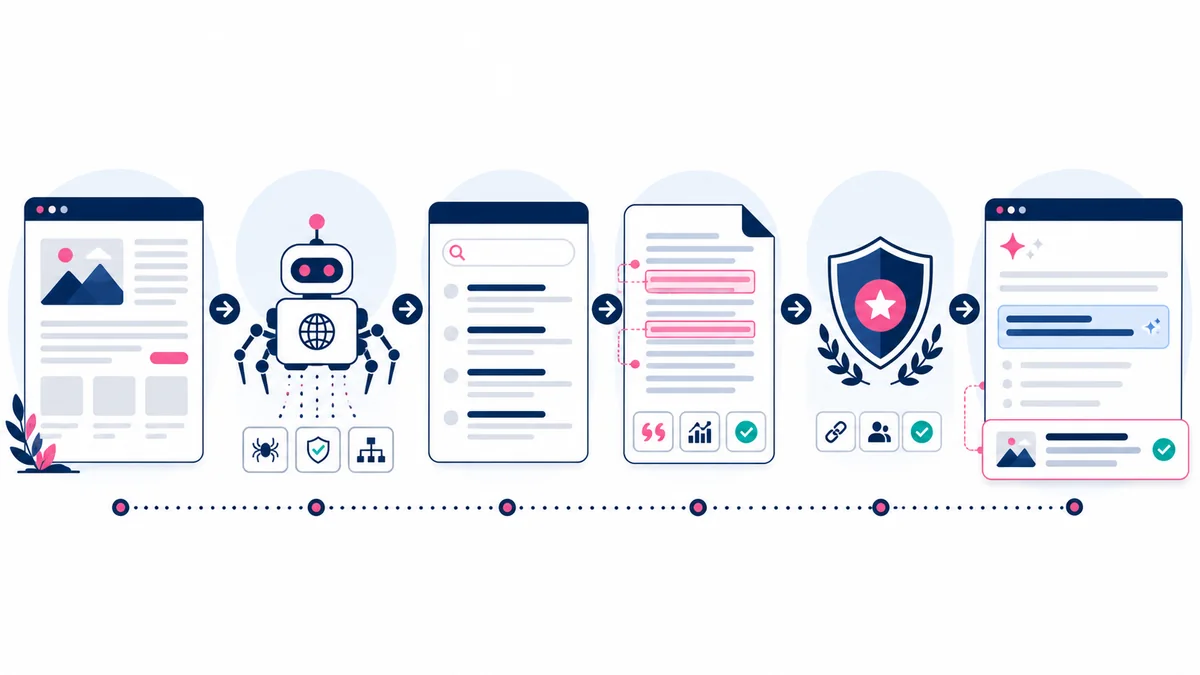
There is no single score or checklist that reserves a citation. Ahrefs updated its research in March 2026 using four million AI Overview URLs and found that 37.9% of cited URLs also appeared in the first ten search-result blocks. That overlap is meaningful, but it also shows why “rank number one and wait” is incomplete advice: Google can retrieve sources from fan-out searches and result features that differ from the original query.
Use those findings as a research direction, not a magic percentage. Strong organic visibility, exact question fit, extractable passages, current evidence, and recognizable authority all improve the quality of the candidate source. The final source set can still change between checks.
| Check | What the system needs | What the page should provide | Common weakness |
|---|---|---|---|
| Discovery | A retrievable, indexable URL | 200 status, correct canonical, crawlable internal links, and visible HTML content | Noindex, orphaned URL, blocked resources, or important copy hidden after interaction |
| Query fit | A passage that answers the specific question | A direct answer, accurate scope, definitions, examples, and natural follow-up coverage | A broad article that circles the topic without resolving the query |
| Extraction | Information that can be interpreted quickly | Descriptive headings, concise paragraphs, real lists, labeled tables, and clear terminology | Long preambles, vague headings, or hundreds of disconnected bold fragments |
| Verification | Claims that can be checked | Named sources, author information, methodology, dates, examples, and stated limitations | Anonymous statistics, unsupported claims, or unclear methods |
| Authority context | Evidence that the site and author are credible on the topic | Consistent topical coverage, relevant mentions, editorial links, and clear brand information | An isolated page with weak topic support or unrelated off-page signals |
A page is more likely to be useful if it is:
- Crawlable
- Indexable
- Relevant to the query
- Helpful for the user
- Clear and well structured
- Supported by expertise
- Updated when needed
- Not blocked from snippets
- Connected to trusted signals
- Part of a strong topical ecosystem
- Better than generic alternatives
AI Overviews may also explore related subtopics.
For example, a user may search:
- “How do I choose guest posting sites?”
Google may need to understand related ideas like:
- Niche relevance
- Publisher traffic
- Domain authority
- Organic keywords
- Spammy outbound links
- Anchor text
- Link attributes
- Guest post pricing
- Content quality
So a strong page should not only answer the main question. It should also cover the related questions users may need next. That is where query fan-out thinking becomes useful.
Watch: how AI Mode changes the search journey
Neil Patel’s 2026 explanation is useful here because it connects AI summaries with longer queries, zero-click behavior, citation visibility, and brand authority. Treat the video as strategic context; the implementation checklist below remains the working plan for the page.
11 Steps to Improve AI Overview Visibility
Step 1: Keep SEO Fundamentals Strong
Before you optimize for AI Overviews, fix normal SEO. AI search does not remove the need for SEO basics.
Start with:
- Crawlable pages
- Indexable content
- Clean site architecture
- Helpful title tags
- Strong headings
- Descriptive anchor text
- Mobile-friendly pages
- Fast loading
- Useful content
- Clear authorship
- Updated pages
- Topic clusters
- Backlinks
- Clean technical setup
If the site has technical problems, thin content, weak internal links, or little authority, AI Overview visibility becomes harder. Start with the live URL and the wider topic cluster. The SEO tools can support checks, while the case studies show how to document work and results without vague claims.
Step 2: Make Pages Crawlable, Indexable, and Snippet-Eligible
This is the technical foundation. For your page to be considered in Google Search features, Google needs to access and understand it.
Check:
- Is the page indexable?
- Is it blocked by robots.txt?
- Does it have a noindex tag?
- Is the canonical URL correct?
- Does the page return a 200 status code?
- Is important content visible on the page?
- Is the content accessible without login?
- Is the page included in your sitemap?
- Are internal links pointing to it?
- Is the page eligible to show snippets?
- Are preview controls blocking useful snippets?
If you block snippets or restrict previews too aggressively, you may limit how your content appears in AI-powered search features. This does not mean every website should allow everything by default. Publishers may have business reasons to control previews. But from an SEO visibility perspective, blocking important content can reduce inclusion opportunities.
Also, make sure your important content is not hidden behind scripts, tabs, or interactions that make it hard to access. AI Overviews SEO starts with discoverability.
Step 3: Create Unique, Useful, Non-Generic Content
Generic content is one of the biggest problems in AI search. If a page only repeats the same surface-level advice as dozens of alternatives, it gives a retrieval system little reason to select that page.
If your article says the same thing as 100 other articles, why should Google use yours as a source?
AI Overviews are built to help users quickly understand a topic. That means content that is vague, repetitive, or commodity-level may struggle. To stand out, add unique value.
Examples of unique value include:
- First-party data
- Original research
- Expert commentary
- Real examples
- Case studies
- Screenshots
- Templates
- Checklists
- Comparison tables
- Methodology
- Frameworks
- Industry-specific advice
- Updated pricing or benchmark data
- Practical workflows
For example, a weak article says:
- “Backlinks are important for SEO.”
A better article says:
“Backlinks help support SEO, but the number needed depends on competitor referring domains, link quality, search intent, domain strength, and topic relevance.”
A great article adds:
- A backlink gap calculation method
- Examples
- Tables
- Mistakes
- A checklist
- Updated guidance
That is source-worthy content. AI Overviews SEO rewards usefulness. Not fluff.
Step 4: Answer the Main Query Clearly
AI Overviews often summarize direct answers. So your content should give direct answers. If your article targets “AI Overviews SEO,” explain what it means near the top. If your article targets “how many backlinks do I need,” answer that question directly before going deeper. If your article targets “link velocity,” define it clearly.
A good answer pattern looks like this:
- Direct answer
- Short explanation
- Why it matters
- Examples
- Step-by-step guidance
- Checklist
- Common questions
Avoid long intros that delay the answer.
A weak opening
In today’s rapidly changing digital landscape, businesses around the world are looking for innovative ways to adapt to new technologies…
A stronger opening
AI Overviews SEO is the process of improving content so it can compete in organic search and serve as a useful source for Google’s generated answers.
The second version answers the question immediately, then leaves room for evidence, examples, and practical steps.
Step 5: Cover Query Fan-Out Questions
AI Overviews and AI Mode may explore related subtopics around a query. This is often described as query fan-out. Instead of only answering the exact phrase the user typed, Google may look at related questions needed to build a better answer.
For example, for the query:
- “How to optimize for AI Overviews”
Related subtopics may include:
- Does SEO still matter?
- Do I need schema?
- Does content need to be indexed?
How do AI Overviews choose sources?
- What content gets cited?
- Do backlinks matter?
How do I measure visibility?
How does AI Mode differ from AI Overviews?
- Should I block AI crawling?
- What are common mistakes?
Your content should cover the natural follow-up questions. This does not mean stuffing every possible keyword variation. It means building complete, helpful coverage.
A good way to plan is:
Start with the main query. List 10–20 follow-up questions. Group them by intent. Answer the most important ones in the article. Link to deeper guides for complex subtopics.
Build the topic as a connected resource rather than a pile of near-duplicate posts. Keep this guide focused on Google AI Overviews, use the GEO guide for the wider discipline, and use the AI citation guide for source eligibility and prompt auditing.
Step 6: Build Source-Worthy Content Sections
If you want AI Overviews to cite your page, make your content easy to cite.
Source-worthy sections usually include:
- Clear definitions
- Short summaries
- Step-by-step instructions
- Original statistics
- Tables
- Examples
- Expert quotes
- Methodology
- Checklists
- Common questions
- Pros and cons
- Comparison frameworks
For example, instead of writing a vague paragraph about backlinks, create a table like: Tables are useful because they turn complex ideas into structured information. AI systems can more easily extract and summarize structured explanations. Readers also prefer them. A source-worthy article is not just long.
It is organized and useful.
Step 7: Strengthen E-E-A-T Signals
E-E-A-T stands for experience, expertise, authoritativeness, and trustworthiness. It is not a direct “score” you can improve with one plugin. It is a quality framework. For AI Overviews SEO, trust signals matter because Google does not want to surface unreliable information.
Improve E-E-A-T with:
- Clear author bios
- Expert reviewers where needed
- Real examples
- First-hand experience
- Case studies
- Transparent methodology
- Updated dates
- Accurate sources
- Editorial standards
- About page
- Contact information
- Product documentation
- Customer proof
- Brand mentions
- Backlinks from relevant websites
For example, an article about link-building pricing is stronger if it includes real pricing data, explains methodology, and is written by someone with SEO experience. A generic anonymous article is weaker. AI Overviews SEO is not only about formatting. It is about credibility.
Step 8: Use Structured Content, Not Gimmicks
Structured content helps. Gimmicks do not.
Useful structure includes:
- H2 and H3 headings
- Tables
- Lists
- Common questions
- Schema where appropriate
- Breadcrumbs
- Product data
- Author information
- Organization details
- Clear navigation
- But do not confuse structured content with “AI hacks.”
You do not need to:
- Hide prompts in your page
- Stuff keywords for AI
- Add fake FAQs
- Create thin pages for every question
- Use schema that does not match visible content
- Create fake author bios
- Add irrelevant llms.txt claims
- Publish AI-generated filler at scale
Schema can describe visible page details, but it is not a citation switch. An Ahrefs experiment tracking 1,885 pages found no meaningful citation uplift from adding schema alone. Use accurate structured data because it clarifies the page, then invest in the content, authority, and usability that users can actually see.
The best structure is still simple:
Clear headings, clear answers, clear evidence.
Step 9: Earn Backlinks and Brand Mentions
AI Overviews SEO is not only on-page. Off-page signals still matter. Backlinks and brand mentions can help establish your content as trustworthy and known.
Strong signals include:
- Relevant backlinks
- Industry citations
- Guest posts
- Digital PR coverage
- Podcast mentions
- Expert quotes
- Research citations
- Product reviews
- Tool roundups
- Partner pages
- Customer stories
- Author mentions
- Brand mentions across trusted websites
Relevant third-party references can strengthen discovery and authority around an original study or useful guide. Use guest posting and blogger outreach for genuine subject expertise, and follow the editorial standards when planning authorship, evidence, and placement quality.
The best AI Overview optimization happens when your brand is genuinely referenced by relevant sources.
Step 10: Refresh Fast-Changing Content
AI search is moving quickly. A guide can become outdated when interfaces, reporting, source behavior, or terminology changes. Refresh important URLs when the underlying guidance changes, not merely to replace the year in the title.
Update:
- Google feature names
- Search Console reporting details
- AI Mode information
- Screenshots
- Examples
- Statistics
- Tool references
- Common questions
- Outdated claims
- Best practices
Do not only change the year. Actually improve the article. For example, if Google introduces a new AI performance report in Search Console, update your measurement section. If Google publishes new documentation, update your guidance. If the interface changes, update screenshots. Freshness matters more for AI search topics than for evergreen definitions.
Treat AI Overviews SEO as a living topic.
Step 11: Measure AI Overview Visibility
Measuring AI Overview visibility is still evolving. But you can track several useful signals.
1. Search Console Performance Data
Use Search Console to track query, page, country, device, impression, click, and position changes around the pages in your AI Overview portfolio. Do not label those numbers “AI Overview traffic” unless the reporting interface provides that distinction. Pair Search Console trends with saved SERP observations and citation tracking so the evidence stays honest.
2. Manual Query Tracking
Create a list of important queries. Check them regularly.
Record:
- Does an AI Overview appear?
- Is your brand mentioned?
- Is your page linked?
- Which competitors are cited?
- Which source types appear?
- What topics are included?
- What gaps exist?
3. Organic Performance
Track normal SEO metrics too:
- Rankings
- Impressions
- Clicks
- CTR
- Branded search
- Referral traffic
- Assisted conversions
- Content engagement
AI Overviews may change click behavior, but traditional SEO metrics still matter.
4. Brand Mentions
Monitor where your brand appears online. More mentions can support authority and visibility.
5. Competitor Citations
If competitors are repeatedly cited and you are not, study their content.
Ask:
- Do they answer better?
- Do they have stronger data?
- Are they fresher?
- Do they have better backlinks?
- Do they have clearer structure?
- Are they better known as an entity?
- Do they cover more follow-up questions?
Measurement should lead to better decisions, not panic. Ahrefs notes that AI Overview content and citations can change between checks, so compare a stable prompt set over time rather than treating one screenshot as a trend.

| Metric | Record | What it can tell you | Next action |
|---|---|---|---|
| Query and result | Exact query, market, date, device, whether an AI Overview appeared | Whether the opportunity exists and how volatile it is | Prioritize stable, commercially relevant query groups. |
| Citation outcome | Cited URL, visible source position, supporting passage, and competing sources | Which pages and formats are being retrieved | Improve or consolidate the page that best matches the question. |
| Brand outcome | Mentioned, recommended, absent, sentiment, and context | Whether citation visibility is also creating brand recognition | Strengthen positioning and third-party mentions where the brand is missing. |
| Organic outcome | Rank, impressions, clicks, CTR, engagement, leads, and assisted conversions | Whether visibility creates qualified business value | Improve the post-click experience, not only the citation rate. |
| Editorial change | Update date, evidence added, section changed, links earned, and result after the change | Which interventions correlate with better visibility | Repeat useful improvements and stop low-value busywork. |
Common AI Overviews SEO Mistakes
Mistake #1: Thinking AI Overviews Are Separate From SEO
AI Overviews still rely on Search systems. SEO fundamentals remain important.
Mistake #2: Chasing Shortcuts
There is no magic schema, file, or prompt that guarantees inclusion. Focus on useful content and visibility fundamentals.
Mistake #3: Publishing Generic AI Content
Generic content is easy to summarize and easy to replace. Add original value.
Mistake #4: Blocking Important Content
If your page is not indexable or snippet-eligible, it may lose visibility opportunities. Review technical controls carefully.
Mistake #5: Ignoring Query Fan-Out
Do not answer only the exact keyword. Cover related questions users need to understand the topic fully.
Mistake #6: Weak Trust Signals
Anonymous, unsupported content is less source-worthy. Show authorship, expertise, sources, and methodology.
Mistake #7: Forgetting Backlinks and Mentions
Authority still matters. Earn real references from relevant websites.
Mistake #8: Letting Fast-Moving Guidance Go Stale
AI search features change quickly. Refresh important URLs regularly.
Mistake #9: Measuring Only Rankings
Track AI mentions, AI links, impressions, citations, branded search, and competitor visibility too.
Mistake #10: Writing for AI Instead of People
Do not make content awkward just to satisfy a machine. Clear, helpful human content is usually better for AI search too.
AI Overviews SEO Checklist
Use this checklist before publishing or refreshing a page.
Technical Checklist
- Is the page crawlable?
- Is the page indexable?
- Is the canonical correct?
- Is important content visible?
- Is the page eligible for snippets?
- Is the page mobile-friendly?
- Is it internally linked?
- Is it included in the sitemap?
- Does it load properly?
Content Checklist
- Does the page answer the main query clearly?
- Is the answer near the top?
- Does the content match search intent?
- Does it include examples?
- Does it include original value?
- Are claims supported?
- Are tables or lists used where helpful?
- Are FAQs included?
- Is the content better than generic alternatives?
Query Fan-Out Checklist
- What follow-up questions might users ask?
- Are related subtopics covered?
- Are complex subtopics linked to deeper guides?
- Does the article support conversational queries?
- Does it include definitions and practical steps?
Trust Checklist
- Is the author clear?
- Is expertise visible?
- Are sources credible?
- Is the content updated?
- Is methodology explained where needed?
- Does the brand have an About page?
- Are contact details available?
- Are claims accurate?
Authority Checklist
- Does the page have internal links?
- Does the page have backlinks?
- Is the brand mentioned elsewhere?
- Is the content part of a topic cluster?
- Are related articles connected?
- Can this page earn citations?
Measurement Checklist
- Are target AI queries tracked?
- Is Search Console monitored?
- Are AI Overview appearances recorded?
- Are competitor citations reviewed?
- Are branded searches tracked?
- Are updates logged?
If your page passes most of these checks, it is better prepared for Google’s AI results.
The EduGuestPost AI Overview Source Opportunity Record
This working record keeps the query, the generated result, the cited competitors, the source-page gap, and the business outcome in one place. It is deliberately more useful than a screenshot folder: every observation must lead to a page decision.
| Field | Record | Decision it supports |
|---|---|---|
| Search question | Exact query, intent, market, device, date, and priority. | Which search journey are we improving? |
| Result state | Whether an AI Overview appears, answer type, source cards, and competing features. | What did the searcher actually see? |
| Fan-out map | Follow-up questions, modifiers, comparisons, entities, and cited subtopics. | Which supporting questions shape source selection? |
| Selected sources | Cited URLs, page type, supported claim, ranking footprint, freshness, and repeated appearances. | What information advantage is Google using? |
| Our source page | Target URL, direct answer, evidence, author, update date, internal links, and technical status. | Is the intended page a credible candidate? |
| Gap and action | Missing fact, method, passage, comparison, proof, or authority signal, with owner and deadline. | What single improvement has the strongest rationale? |
| Outcome | Citation, brand mention, impressions, clicks, conversions, accuracy, and next review. | Did visibility or customer behavior improve? |
What to Prioritize Next
Keep the work inside a documented SEO campaign so source-page edits, internal links, authority building, and reporting share the same owner.
AI Overviews SEO is not about gaming Google’s AI. It is about creating content that deserves to be part of the answer. Google’s AI search features still depend on core SEO foundations. That means crawlability, indexability, helpful content, strong structure, trust, backlinks, and user value still matter.
But AI Overviews add a new layer. Your content needs to answer questions clearly, cover related subtopics, show expertise, provide original value, and be easy to cite. Do not chase tricks. Do not publish generic AI filler. Do not ignore technical SEO. Do not forget brand authority.
Build pages that are useful for people and reliable enough to support an AI-generated answer. Then connect those pages to the rest of the site, earn relevant third-party recognition, and measure whether the visibility creates qualified visits or conversions. Review available publishers in the publisher marketplace, or send a detailed brief through the campaign order form.
FAQs About AI Overviews SEO
What is AI Overviews SEO?
AI Overviews SEO is the process of improving your content so it has a better chance of being included, linked, or cited in Google’s AI-generated search results.
Can I optimize for Google AI Overviews?
Yes, but there is no guaranteed shortcut. Focus on SEO fundamentals, helpful content, crawlability, indexability, clear structure, original value, trust signals, backlinks, and freshness.
Do I need special schema for AI Overviews?
No special AI-only schema guarantees inclusion. Use structured data where it accurately represents visible content, but do not rely on schema alone.
Does traditional SEO still matter for AI Overviews?
Yes. Technical SEO, helpful content, internal links, backlinks, page experience, and authority signals remain important.
How do I get my page cited in AI Overviews?
Create indexable, snippet-eligible, useful, source-worthy content that answers the query clearly, covers related questions, shows expertise, earns backlinks, and stays updated.
What kind of content appears in AI Overviews?
AI Overviews can use helpful pages that answer user questions clearly. Strong candidates often include guides, definitions, original research, comparisons, tutorials, product information, local content, and source-worthy explanations.
Do backlinks matter for AI Overviews?
Yes, backlinks can help support discovery, authority, and trust. The best backlinks are relevant, editorial, contextual, and connected to your expertise.
What is query fan-out?
Query fan-out is when an AI search system explores related subqueries around the original question to build a more complete answer. Your content should cover the natural follow-up questions around your topic.
How do I measure AI Overview performance?
Combine Search Console query and page trends with saved AI Overview observations, citation tracking, competitor source checks, branded search, clicks, conversions, and accuracy reviews. Keep each metric labeled according to what it actually measures.
What is the biggest AI Overviews SEO mistake?
The biggest mistake is chasing AI tricks while ignoring useful content, technical SEO, trust, originality, and authority.
Research Behind This AI Overviews SEO Guide
These current studies and practitioner resources informed the ranking-overlap, query fan-out, source-volatility, schema, measurement, and brand-visibility sections.
- Ahrefs 2026 update: ranking overlap across four million AI Overview URLs
- Ahrefs: tracking citations, changing sources, click loss, and visibility
- Ahrefs experiment: schema alone did not create a meaningful citation lift
- Semrush: AI Overview frequency, intent, and industry patterns
- Semrush 2026 operating example: citations, positioning, and competitive visibility
- Neil Patel: AI SEO, source visibility, proprietary insight, and human editorial input
Build Authority Around Your Best Source Pages
Review how EduGuestPost handles publisher selection and campaign delivery before requesting opportunities.
Send us the questions, source pages, markets, current citations, and publisher standards behind your campaign. We will review relevant opportunities and prepare a shortlist that connects content quality, placement relevance, anchor planning, and reporting.