
Technical SEO / Request evidence
Server Log File Analysis Services
EduGuestPost’s server log file analysis services help you investigate recorded crawler activity, recurring response problems and the website sections receiving requests. The proposed engagement turns available records into findings your SEO and website teams can use, with the evidence and its limits attached.
Start with your question and available history. Private records are exchanged only through an agreed process.
Understand the requests reaching your website
You may want to understand a traffic spike, investigate requests for retired URLs or review access to important pages after a migration. Start with the question and the history available. A clearly defined period and source make the resulting analysis easier to interpret.
An agreed project can include:
- A coverage review identifying hosts, log sources, dates and collection gaps.
- Request analysis by relevant crawler label, route group, response and period.
- Identity verification where the required source evidence is available.
- Prioritized findings, supporting examples and a handover for the responsible team.
The quotation confirms supported formats, processing arrangements, quantities and the deliverables EduGuestPost will prepare. It also identifies the people responsible for supplying records, reviewing findings and implementing any later changes.
Bring your website, the issue you want to investigate and a description of your available logs. File formats, approximate volume and coverage dates help define a useful scope before any private records are exchanged.
If the cause could involve content, linking or wider technical issues, SEO audit services can provide the broader diagnostic scope.
Request a server log analysis quote with a brief description of your requirements and available history.
Establish the coverage before counting requests
Your analysis starts with a record of where the data came from. Confirm the hostnames, collection layer, event period, time zone, format and selection rules. Preserve the difference between when a request occurred and when its record arrived.
Swipe or scroll horizontally to read every column. Keyboard: focus the table region, then use the arrow keys.
| Log source | Useful evidence | Coverage to confirm |
|---|---|---|
| Origin server | Requests handled by the website server | Hosts, filters and requests served elsewhere |
| CDN or edge | Requests and responses at the delivery layer | Sampling, cache behavior and internal subrequests |
| Load balancer | Handling before requests reach application targets | Product, listeners and target coverage |
| Supplied aggregate | Counts grouped by the source’s defined categories | Grouping rules and detail omitted during collection |
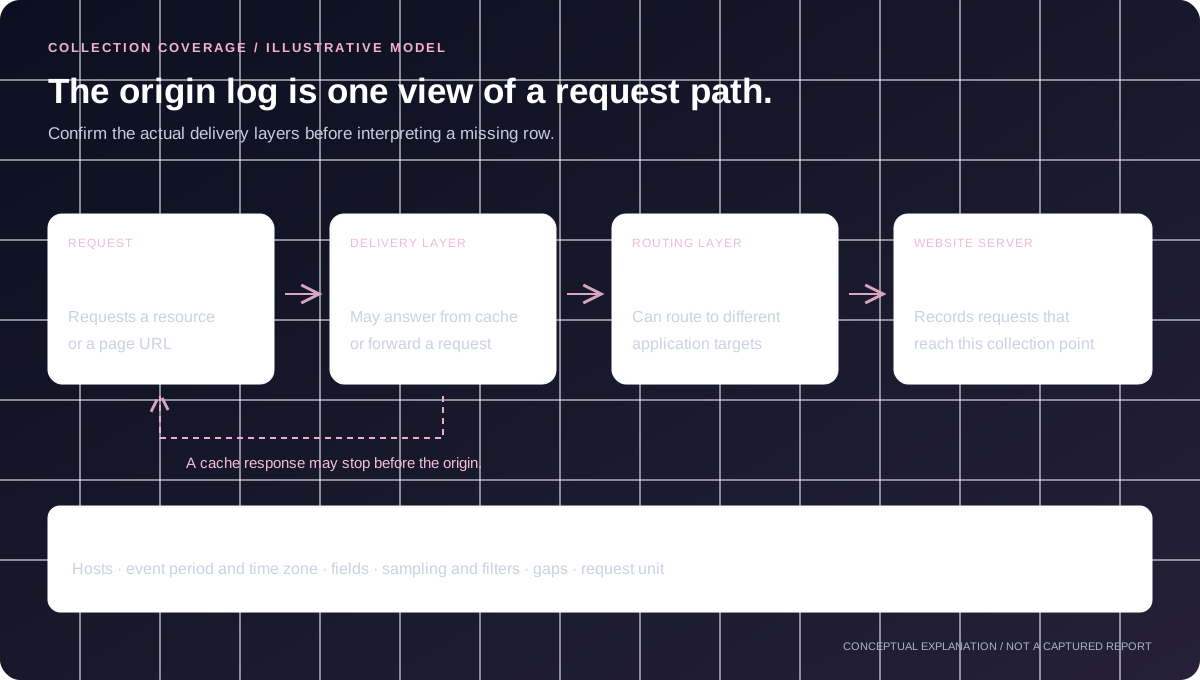
Formats need their own field map. Apache’s logging reference distinguishes original and final status, timestamp meaning and duration units. Similar-looking columns from another system may represent different events.
The coverage report records accepted and rejected rows, duplicates, missing periods, filters and any processing cap. Deduplication rules distinguish repeated requests from duplicate deliveries. Counts retain a defined request unit. Late delivery also matters: CloudFront standard-log guidance describes best-effort delivery with possible delays and omissions.
For a small supported sample, the SEO Log Analyzer processes plain UTF-8 Common or Combined records in an isolated browser workspace. It does not upload log contents or verify crawler identity. Custom columns, compressed files, IIS W3C and arbitrary JSON need another agreed processing route.
Its reports omit several raw fields, but paths may still contain identifiers. Review exports before sharing and retain partial-processing labels when a limit stops the analysis.
Separate crawler labels from verified identities
A request can declare a Googlebot user agent without coming from Google. Keep declared labels, verified sources and unresolved identities separate in the report. Records without a useful agent value remain unclassified; they are not established human visits.
Crawler verification can use reverse DNS followed by forward confirmation, or matching the appropriate published IP ranges. The method must fit the requestor being investigated. Search crawlers, inspection tools and other Google fetchers have different purposes.
Where proxies are involved, establish what the recorded address represents. An origin may see a CDN address, while a forwarded header requires a trusted source and configuration. The report should state the verification method, lookup date and limits of using current network information for historical requests.
Analyse requests with a defined denominator
Group relevant requests by host, route, period, method and response source. Keep request totals separate from distinct requested URLs. State which records form the denominator for every percentage and retain sampling limitations alongside the result.
One client request can create several internal fetches. Cloudflare’s Worker log guidance explains how separate request and parent identifiers connect those entries. Correlate them where possible before treating a larger count as additional website visits.
Investigate the response in context
Repeated redirects, server failures or requests for unexpected paths can identify worthwhile questions. A legitimate 304 can represent cache validation; an intended 404 can correctly describe removed content. The finding needs the affected examples, period and intended behavior.
Recorded durations describe particular server or delivery operations. They do not measure Core Web Vitals or establish how the completed page appeared to a visitor.
Connect recorded activity to important pages
An agreed URL inventory gives request patterns business context. Identify the product, category, service or information pages that matter, then compare their recorded activity within the available period. Preserve host, path and meaningful query distinctions before grouping variants.
The XML Sitemap Checker can extract entries from the bounded sitemap document it inspects. A sitemap index lists child sitemap files, and the checker does not recursively fetch them. Its output can help prepare an inventory; inclusion does not prove that a page was crawled or indexed.
Describe missing evidence accurately
For an unmatched URL, record "no request found in the supplied source and period." Cached delivery, another host, collection filters or an incomplete window may explain the absence. A log match likewise establishes a recorded request, with further evidence needed for rendering or indexing.
For selected follow-up questions, the Redirect Checker can inspect current HTTP routes, while the Indexability Checker reviews bounded response and directive evidence. Current checks need their own dates and scope; they cannot reconstruct a historical response from a log row.
Compare search reports on compatible terms
Search Console Crawl Stats counts repeated requests and redirect hops separately. It can include attempts that never reached a server, and its example URL lists are incomplete. Align property, host, period and request definitions before comparing it with available logs.
The handover explains material differences instead of forcing totals to match. It identifies which question needs a current page check, an availability investigation or a separate crawl-efficiency project. Request counts alone do not reveal Google’s allocated crawl capacity and demand.
Receive findings your team can act on
Each proposed deliverable should answer the original question and show how the conclusion was reached. The report separates observed behavior, plausible explanations and unresolved questions, with priorities based on business relevance and the strength of the available evidence.
Swipe or scroll horizontally to read every column. Keyboard: focus the table region, then use the arrow keys.
| Project area | Proposed deliverable | Acceptance point |
|---|---|---|
| Data coverage | Source, period, schema and processing record | Gaps, exclusions and partial results are visible |
| Request analysis | Defined counts, groups and relevant examples | Units, identity labels and denominators are clear |
| Findings | Prioritized issues and supporting observations | Evidence is tied to affected routes and dates |
| Handover | Recommended tasks, owners and review checks | Next actions and open questions are assigned |
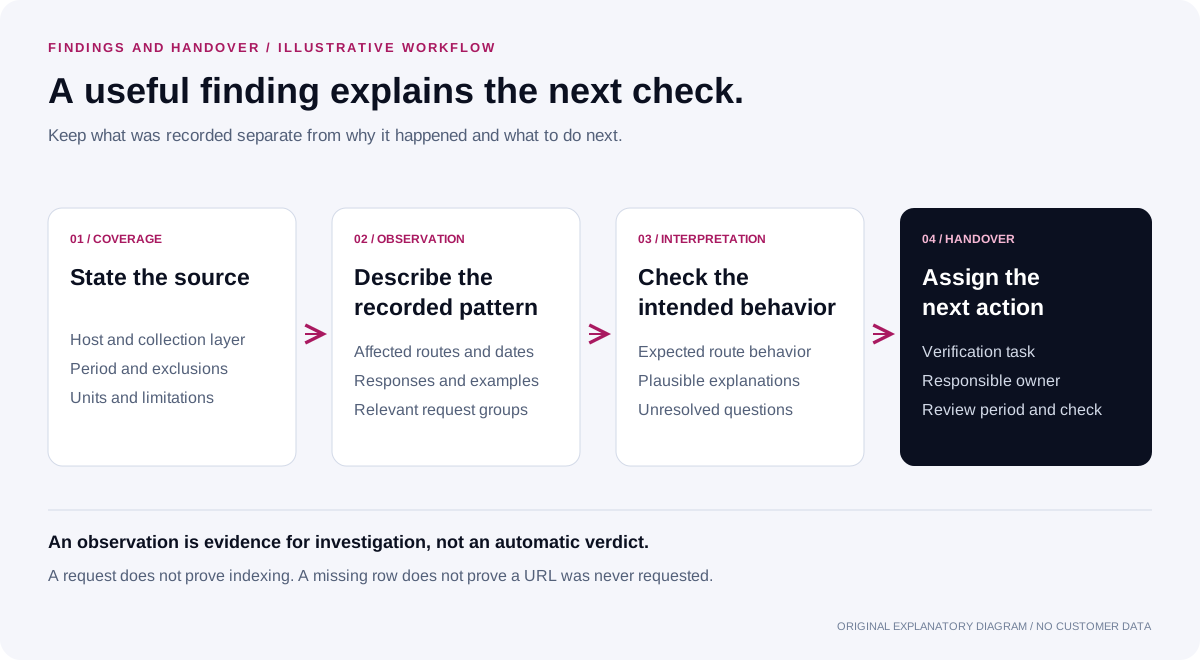
An actionable finding identifies the affected website section, the response pattern, its likely consequence and the next verification step. Recommendations can then be assigned to the person who controls the relevant template, application, hosting or delivery setting.
Agree access and handling before exchanging records
Access logs may contain IP addresses, identifiers in paths or queries, authentication details and other sensitive values. OWASP’s logging guidance provides useful principles for excluding or protecting information that should not be exposed.
Agree the minimum fields needed, permitted reviewers, an appropriate exchange method and retention or deletion responsibilities before sharing records. Redaction changes which questions can be answered. Crawler verification, for example, needs trustworthy source-address evidence. If a necessary field cannot be shared, reduce the verification claim or agree another approach.
Deliverable formats, example redaction and access arrangements belong in the scope. Share only records you are authorized to provide, and keep credentials and private log files out of an initial enquiry.
Request your server log analysis scope
Choose the review around the history you have and the decision you need to make. A focused investigation might cover a migration period, recurring errors in one section or unusual request growth. A wider engagement needs a defined set of hosts, sources and questions.
The quotation can account for file volume, format complexity, coverage period, source combinations, verification work and the number of requested comparisons. Confirm timing after reviewing those requirements and any missing information needed to begin.
If the available history is limited
A domain name alone cannot reveal private crawler history. Begin by confirming which records exist and what the website owner can provide. Missing or overwritten periods may remain unavailable; new collection would need its own setup and access agreement.
The Crawl Budget Audit describes an owner-hosted connector for private aggregate reports from a supported log. It requires setup and an existing account. Its declared-agent counts do not authenticate bots, measure Google’s allocated budget or replace the original records.
Plan any follow-up around comparable evidence
If your team implements a recommendation, agree the later review period and repeat the relevant analysis with compatible coverage. Record releases, traffic changes, sampling and gaps that could affect the comparison. A lower error count needs context before attributing it to one change.
SEO consulting services can define additional decision support. Collection setup, implementation and continuing monitoring should each have named responsibilities and an agreed scope.
Request your server log analysis quote. Send your website, priority sections, investigation question, available dates, source types, formats and approximate volume. Include the person who can approve access and receive the findings. Begin with that brief so the proposed work can be scoped before private data is exchanged.
Server log analysis questions
Define the evidence, the decision and the people involved before private data changes hands.
Can you analyse a website from its domain name alone?
A domain name does not reveal private crawler history. First confirm which records exist, the hosts and period they cover, and what the website owner is authorized to provide. Missing or overwritten periods may remain unavailable.
Which log formats and sources can a project include?
The quotation confirms supported formats and processing arrangements after reviewing your source types, fields, approximate volume and dates. Origin, CDN or edge, load-balancer and aggregate records need their own coverage and field definitions; support should not be assumed from a filename alone.
Does a Googlebot user agent verify that a request came from Google?
No. A user agent is a declared label. Verified identity needs trustworthy source evidence and an appropriate verification method. The report keeps declared labels, verified sources and unresolved identities separate, including the limits of applying current network information to historical requests.
Does a recorded request prove that a page was indexed?
No. A log match establishes a recorded request within the supplied source and period. It does not prove rendering or indexing. Likewise, no matching row is not proof that a page was never requested, because coverage, caching, hosts and collection gaps can affect the record.
What will the handover contain?
The agreed scope can include a coverage record, defined request counts and groups, affected examples, prioritized findings and recommended tasks. Findings distinguish observations, plausible explanations and unresolved questions, with owners and review checks agreed for the next actions.
Should I attach private logs or credentials to my initial enquiry?
No. Start with your website, investigation question, source types, formats, dates and approximate volume. Agree minimum fields, reviewers, a suitable exchange method and retention or deletion responsibilities before sharing authorized records. Keep credentials and private log files out of the initial enquiry.
Discuss your server log analysis project
Tell us your website and the question you need answered. Describe the available dates, source types, formats, approximate volume and priority sections.
- Which decision should this analysis support?
- Which records and collection layers are available?
- Who can approve access and receive the findings?
Keep the initial enquiry free of private logs and credentials. Agree access, minimum fields and handling arrangements before exchanging records.
Request an analysis scope
Submitting an enquiry does not create a confirmed order or authorize access to your server.