

A backlink from a strong university .edu domain can be one of the most valuable links in an SEO campaign.
Why?
Because many established university websites have spent years accumulating:
- Powerful referring domains
- Academic citations
- Research links
- Government and nonprofit references
- Media mentions
- Institutional partnerships
- High-authority internal pages
- Strong brand recognition
- Natural editorial links
That creates exactly the type of backlink environment experienced SEOs look for.
Ahrefs describes .edu backlinks among the kinds of high-quality links many SEOs would strongly want to acquire, while Neil Patel’s current backlink guidance specifically lists .edu websites as examples of authoritative backlink sources.
But getting a useful university backlink usually requires more than emailing:
“Can I publish a guest post?”
The strongest strategy is to identify where your expertise can genuinely contribute to a university-owned page, resource, department, blog, publication, program, or student-facing section.
Then create a reason for the university to reference you.
This guide explains how.
Key Takeaways
- University
.edubacklinks can be extremely powerful because many universities have exceptionally strong backlink profiles. - The real advantage comes from the authority, referring domains, institutional credibility, topical context, and page strength behind the link.
- Ahrefs specifically highlights
.edubacklinks as highly desirable SEO links. - Neil Patel identifies
.eduwebsites as examples of trusted, authoritative backlink sources. - Strong university links can contribute to authority, rankings, referral traffic, credibility, citations, and brand visibility.
- University-domain backlinks can also strengthen your site’s wider backlink profile by adding a highly credible referring domain.
- The best placements normally come from useful contributions rather than generic link requests.
- Research, tools, scholarships, educational resources, expert content, faculty collaboration, student resources, and guest articles can all create university-link opportunities.
- A contextual link inside useful university content is generally more strategically valuable than a random profile link.
- Your target page should be good enough to deserve an academic or institutional reference.
- Anchor text should fit naturally into the university article or resource.
- University backlinks become even more useful when the receiving page supports a wider internal topic cluster.
Why Are .EDU Backlinks So Valuable?
The value of a strong .edu backlink is not difficult to understand when you look at how university domains develop.
Major universities naturally earn references from:
- Research organizations
- Government agencies
- News publications
- Academic journals
- Other universities
- Professional associations
- Libraries
- Nonprofits
- Corporations
- Alumni organizations
- Conferences
- Educational resources
Those relationships can create enormous backlink profiles.
Ahrefs’ education SEO research specifically highlights .edu backlinks alongside government, nonprofit, research-journal, press, and relevant editorial links as highly desirable backlink types.
Ahrefs also uses Harvard as an example of an extremely authoritative university website, showing just how strong major academic-domain backlink profiles can become.
That is why an authoritative university link can potentially add something very different from another backlink from an ordinary blog.
Neil Patel Also Treats .EDU Sites as High-Authority Link Sources
Neil Patel’s updated guide on building high-quality backlinks defines a strong backlink around three major characteristics:
relevance
authority
natural placement
When explaining authority, .edu websites are specifically included among examples of credible backlink sources.
Neil’s broader point is particularly important:
one strong link from a trusted, relevant source can outperform large numbers of weak backlinks.
That is exactly how I would think about university backlinks.
The objective should not be:
Get as many EDU URLs as possible.
It should be:
Earn links from the strongest university pages and domains we can realistically access.
What Can an EDU Backlink Do for SEO?
A strong university backlink can create several forms of value at the same time.
1. Strengthen Your Backlink Profile
Authority is one of the clearest reasons SEOs pursue .edu links.
A backlink from a website with a deep, credible backlink profile adds another strong referring domain to your own profile.
That matters when competing against websites that already have:
- Many quality referring domains
- Strong domain authority
- Strong page authority
- Established brand mentions
- Years of earned links
Backlinks are cumulative.
One excellent university link does not operate in isolation.
It becomes part of your website’s overall authority profile.
2. Help Close the Authority Gap With Competitors
Competitive SEO often comes down to gaps.
Suppose the pages outranking you have:
- Better content
- More internal links
- More authority
- More strong referring domains
You improve your content.
You strengthen your internal linking.
But your competitors still have significantly stronger backlink profiles.
That is where acquiring quality links becomes particularly important.
Ahrefs itself recommends comparing authority against competitors when deciding whether link building deserves more attention.
University .edu links can be excellent additions when your campaign needs stronger referring domains.
3. Add a High-Quality Referring Domain
There is an important difference between:
20 backlinks from the same website
and:
20 backlinks from 20 strong independent websites
Both backlink quantity and referring-domain diversity matter.
A university domain can add a completely new high-quality referring source to your profile.
This is one reason I would often value:
1 strong university backlink
more than:
several ordinary backlinks from websites we already have links from.
The additional referring domain expands the authority footprint of the site.
4. Build Brand Credibility
Imagine seeing a company referenced on:
randomblog123.com
versus:
a recognizable university website
Those references create different impressions.
University associations can add credibility because academic websites are associated with:
- Education
- Research
- Expertise
- Professional development
- Knowledge
- Public resources
That matters for humans as well as SEO.
A relevant institutional citation can make a company look more established.
5. Generate Referral Traffic
University backlinks are not merely numbers inside Ahrefs or Semrush.
People can click them.
A link placed inside a useful:
- Student resource
- Career guide
- Department article
- Faculty resource
- Technology guide
- Business resource
- Research page
can send visitors directly to your website.
Semrush’s current backlink guidance emphasizes that quality backlinks can contribute to both authority and direct referral traffic.
The stronger the placement and the more relevant the university audience, the more interesting this becomes.
6. Create Topical Associations
Backlink quality is not only about domain strength.
Context matters.
Suppose your company provides cybersecurity software.
A university IT or cybersecurity page references your research.
Now the relationship looks like:
University
↓
Cybersecurity article
↓
Cybersecurity anchor/context
↓
Your cybersecurity resource
That creates strong topical alignment.
Compare that with the same backlink appearing on an unrelated page.
The first relationship is much more valuable strategically.
That is why the best EDU links combine:
university authority + relevant topic + useful page + natural reference
7. Increase the Chances of Secondary Citations
Good backlinks can produce more backlinks.
Imagine a university resource references your original research.
A writer later finds the university page.
They discover your research.
They cite it in their article.
Another publisher then discovers the same resource.
That creates a chain:
your research
← university
← industry publication
← blogger
← journalist
This is why original studies and useful resources can be so effective.
The first high-authority reference can expose your content to people who create additional links.
8. Strengthen Brand Presence for AI Search
Off-page SEO is expanding beyond traditional rankings.
Semrush’s 2026 guidance on answer-engine optimization specifically recommends earning mentions from high-authority sources and lists .edu websites among the types of sources worth targeting.
Backlinko also emphasizes that modern search and AI systems increasingly encounter brands through credible third-party publications, mentions, and citations.
That gives .edu links another interesting role:
university backlink + university mention + topic association + third-party authority
can contribute to a broader web presence around your brand.
What Makes the Best EDU Backlink?
Not every university link opportunity is identical.
When choosing among available placements, I would prioritize several characteristics.
Strong University Domain
Check the university’s:
- DR
- DA
- Referring domains
- Overall backlink profile
- Brand recognition
Higher authority can make the opportunity significantly more attractive.
Strong Individual Page
Also evaluate the exact page.
Check whether it:
- Has backlinks
- Is internally linked
- Is discoverable
- Fits the subject
- Contains useful content
- Has been maintained
Ahrefs’ current backlink-quality framework emphasizes both domain authority and page authority.
That distinction matters.
A strong page on a strong university domain is particularly attractive.
Topical Relevance
Look for pages connected to your business.
Possible university sections include:
- Computer science
- Business
- Engineering
- Finance
- Marketing
- Careers
- Entrepreneurship
- Health
- Law
- Research
- Student resources
- Technology
- Continuing education
The closer the topic is to your target page, the easier it becomes to create a meaningful reference.
Editorial Placement
Ahrefs’ backlink-quality framework also emphasizes links placed naturally inside the main content.
For a guest-post-style EDU placement, I would generally prefer:
contextual editorial reference
over:
random footer/profile reference
because the contextual link has a stronger relationship with the surrounding topic and is more likely to be seen by readers.

Step 1: Decide Which Page You Want the University to Link To
Do this before outreach.
Potential targets include:
- Original research
- Statistics
- Industry studies
- Educational guides
- Tools
- Templates
- Calculators
- Career resources
- Student resources
- Scholarship pages
- In-depth tutorials
- Useful commercial resources
Ask:
Why would a university want to reference this page?
The stronger your answer, the easier the campaign becomes.
Build Something Universities Can Cite
One of the best ways to earn powerful university links is to create something genuinely referenceable.
For example:
Original Research
Instead of:
What Is Cybersecurity?
create:
2026 University Cybersecurity Report: Analysis of 500 Higher-Education Security Incidents
A university writer now has a reason to cite you.
Statistics
Create:
Student Employment Statistics 2026
Universities discussing graduate careers may find the data useful.
Free Tools
Examples:
- Scholarship calculator
- GPA calculator
- Career planning tool
- Student budgeting tool
- Citation tool
- Research tool
Useful tools naturally attract references.
Templates
Examples:
- Resume templates
- Research templates
- Study planners
- Business-plan templates
- Financial worksheets
The principle is simple:
Create something the university’s audience needs.
Step 2: Find Relevant University Pages
Do not limit prospecting to homepages.
University websites can contain thousands or hundreds of thousands of pages.
Interesting areas may include:
Department Blogs
Departments often publish:
- News
- Research
- Faculty commentary
- Educational resources
Student Resources
These may cover:
- Career planning
- Finance
- Accommodation
- Technology
- Learning
- Student wellbeing
Career Centers
Potential subjects include:
- Employment
- Entrepreneurship
- Resumes
- Interviews
- Workplace skills
- Industry research
Research Centers
Excellent for:
- Original statistics
- Studies
- Industry reports
- Expert commentary
Libraries
Libraries frequently maintain curated resources.
Continuing Education
Professional-development content can create opportunities for B2B and specialist companies.
University News and Publications
Some universities operate extensive editorial sections.
Entrepreneurship Centers
Very useful for:
- SaaS
- Finance
- Marketing
- Startups
- Ecommerce
- Technology
The goal is to find where your expertise overlaps with the university audience.
Step 3: Study University Competitor Backlinks
One of the fastest ways to discover EDU opportunities is competitor analysis.
Open Ahrefs or Semrush.
Analyze:
- Direct SEO competitors
- Industry leaders
- Major informational sites
- Ranking pages
Then filter referring domains or backlinks for:
.edu
Now ask:
Why did the university link to them?
You may discover:
- Research citations
- Resource recommendations
- Career resources
- Faculty interviews
- Software resources
- Scholarships
- Educational partnerships
- Events
- Student discounts
- Guest contributions
- Original statistics
You do not necessarily want to copy the backlink.
You want to understand the reason the backlink exists.
Then create an opportunity of equal or greater value.
Step 4: Choose the Right University Topic
If you’re proposing content, start with the audience.
Suppose you run a SaaS company.
Weak topic:
Why SaaS Is Important
Better university topic:
How University Departments Can Reduce Software Costs Without Creating Tool Sprawl
Suppose you operate in cybersecurity.
Weak:
Benefits of Cybersecurity
Better:
7 Security Risks Universities Face When Students Connect Personal Devices to Campus Networks
Suppose you work in finance.
Weak:
Financial Planning Tips
Better:
How Final-Year Students Can Build Their First Post-Graduation Budget
The stronger topics connect:
your expertise
*
university audience
*
useful information
*
natural backlink opportunity
Step 5: Make Your Pitch Worth Opening
University staff receive large amounts of email.
Do not send:
Dear Sir/Madam,
>
I am a passionate writer and would like to contribute a high-quality article to your esteemed site.
That sounds like everyone else.
Instead, demonstrate immediately:
- You know the department
- You understand the audience
- You have a specific idea
- You have something useful to contribute
Keep the message short.
Neil Patel’s current backlink outreach guidance recommends brevity, relevance, and clearly explaining how the proposed resource helps the recipient’s audience.
That is exactly how I would approach universities.
Step 6: Use Expertise as the Entry Point
A university may care much more about your knowledge than your request for a backlink.
Possible contribution angles include:
- Expert interview
- Faculty collaboration
- Industry commentary
- Career advice
- Student workshop
- Original research
- Data contribution
- Guest lecture
- Professional insight
- Case study
- Educational resource
Neil Patel has specifically discussed university-focused link-building approaches involving faculty relationships, university contributions, student opportunities, scholarships, and educational value.
The backlink should emerge from the relationship.
Step 7: Consider Faculty and Expert Interviews
This is one of the most interesting university strategies.
Suppose your company works in artificial intelligence.
Interview a professor who researches AI.
Publish:
Professor [Name] on How Generative AI Will Change Enterprise Software
The faculty member may:
- Share it
- Reference it
- Add it to a profile
- Mention it through a department
- Recommend it to colleagues
The article itself can also attract secondary backlinks.
The advantage is that you are creating a real academic connection rather than simply asking for a link.
Step 8: Create Student Resources
Student-focused resources can produce excellent university outreach opportunities.
Examples:
Career Resources
- Resume templates
- Interview guides
- Salary data
- Career statistics
Finance Resources
- Student budget calculators
- Loan calculators
- Financial planning guides
Technology Resources
- Cybersecurity checklists
- Productivity resources
- Software comparisons
Academic Resources
- Citation tools
- Research templates
- Writing resources
If a university already maintains a resource page, your objective becomes straightforward:
create something better than what they currently reference.
Step 9: Use Original Data
Neil Patel’s 2026 backlink guide describes original research as a strong backlink magnet because writers need credible statistics and data they can cite.
This strategy is especially powerful for .edu outreach.
Universities and academic writers naturally reference evidence.
For example:
Average Graduate Salary by Major — 2026 Study
State of AI Adoption in Higher Education — 2026
Cybersecurity Readiness Across 200 Universities
Student Entrepreneurship Survey — 2026
Remote Learning Technology Benchmark
These assets give universities something substantive to reference.
And the same study may later earn backlinks from:
- News outlets
- Bloggers
- Industry websites
- Research organizations
- Other universities
That creates compounding backlink value.
Step 10: Build a Strong Contextual Link
Once you secure the placement, don’t waste it with an awkward backlink.
Think about:
article → paragraph → anchor → destination
All four should align.
For example:
Universities evaluating AI-assisted writing tools should also consider transparency, student data handling, accessibility, and how the technology fits existing academic policies. This AI writing technology research provides additional data on adoption patterns across educational environments.
That is contextual.
Compare:
For SEO visit best AI software company.
The second wastes the opportunity.
Step 11: Choose the Anchor Text Carefully
University backlinks are valuable enough that I would not obsess over forcing one commercial exact-match anchor.
Depending on the opportunity, strong anchors can include:
Brand
EduGuestPost
Brand + Topic
EduGuestPost EDU backlink research
Research Title
2026 University Cybersecurity Study
Descriptive Anchor
university cybersecurity research
Partial Match
EDU backlink strategy
Exact Match
EDU backlinks
Exact-match wording can absolutely be useful when it fits.
But the surrounding content should remain natural.
Our complete anchor text optimization guide explains how anchor choice should fit the target page and overall backlink profile.
Step 12: Evaluate the University’s Authority
Do not judge university opportunities blindly.
Use Ahrefs, Semrush, Moz, or another SEO platform to check:
- DR
- DA
- Referring domains
- Total backlinks
- Page-level backlinks
- Organic visibility
- Authority trend
Many university domains will immediately stand out because of the quality and depth of their backlink profiles.
The stronger the domain and host page, the more attractive the opportunity can become.
For a deeper comparison of authority metrics and search visibility, see our Domain Authority vs Organic Traffic guide.
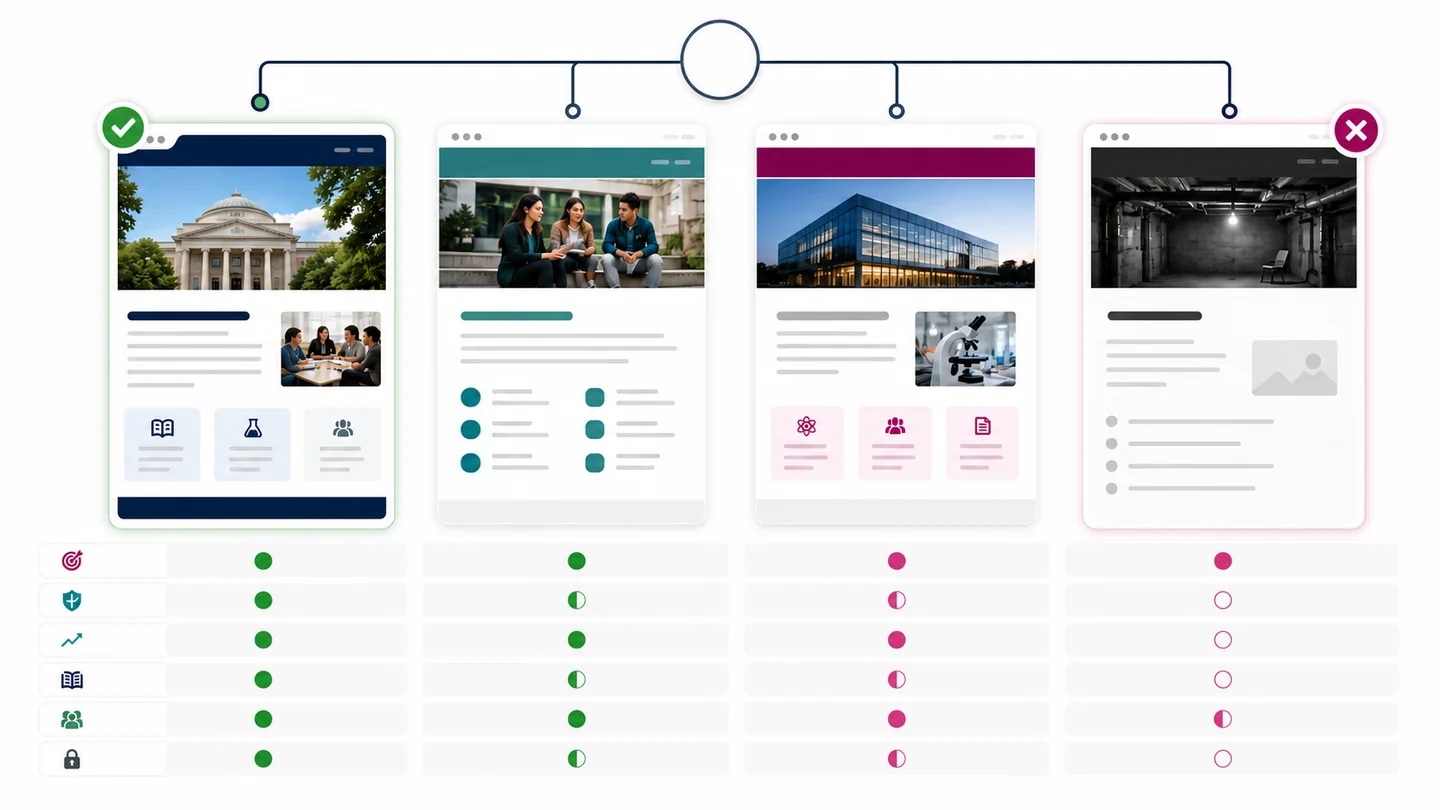
Step 13: Look at the Host Page, Not Only the Domain
This is particularly important.
Suppose you have two opportunities.
Opportunity A
University DR: 91 Page has no internal links Very weak connection to your niche
Opportunity B
University DR: 78 Department article strongly related to your topic Internally linked Relevant audience Strong contextual placement
Both are excellent domains.
But Opportunity B may produce a much stronger contextual link.
The ideal EDU backlink combines:
strong university domain + strong page + relevance + editorial context
That is the target.
Step 14: Use EDU Links to Support Your Topical Cluster
A university backlink becomes even more strategic when it lands on a well-connected page.
Suppose a .edu domain links to your:
Complete Cybersecurity Research Guide
That page internally links to:
→ Enterprise Cybersecurity Guide
→ SaaS Security Checklist
→ Data Protection Statistics
→ Cybersecurity Service Page
Now the EDU backlink enters a connected topic cluster.
This is how external authority and internal architecture work together.
Our safe link-building strategy explains this wider model in detail.
EDU Backlinks vs Ordinary Guest-Post Backlinks
Both can be useful.
But university links often have characteristics that make them particularly attractive.
| Factor | Strong University EDU Link | Typical Guest-Post Link |
|---|---|---|
| Institutional authority | Often very strong | Varies |
| Referring-domain profile | Often extensive | Varies |
| Academic credibility | Strong | Usually lower |
| Citation potential | High | Moderate to high |
| Referral traffic | Depends on page | Depends on publisher |
| Brand perception | Often strong | Depends on publication |
| Scarcity | Often higher | Usually more available |
| Topical potential | Excellent when relevant | Excellent when relevant |
| SEO value | Potentially very strong | Depends heavily on quality |
This does not mean ordinary guest-post links should be ignored.
A strong backlink profile should contain links from many types of credible domains.
But .edu backlinks can become premium authority additions within that larger profile.
How Many EDU Backlinks Do You Need?
There is no reason to chase a huge number merely for the count.
University backlinks are generally better approached as quality acquisitions.
Imagine:
Campaign A
50 weak backlinks
versus:
Campaign B
5 powerful relevant university links 15 strong niche editorial links 10 industry citations Several branded mentions
I would much rather build Campaign B.
Neil Patel’s modern backlink guidance strongly emphasizes this quality-first principle: a small number of top-tier authoritative links can outperform large volumes of weaker backlinks.
University links fit naturally into that strategy.
Should Every Website Try to Earn EDU Links?
Many industries have legitimate university angles.
SaaS
- University software
- Productivity
- Campus administration
- AI
- Technology
Cybersecurity
- Campus security
- Student privacy
- Device security
- Research protection
Finance
- Student finance
- Economics
- Investment education
- Financial literacy
Business
- Entrepreneurship
- Careers
- Startups
- Leadership
Health
- Research
- Public health
- Student wellbeing
- Medical education
Legal
- Legal education
- Student rights
- Research
- Career resources
Ecommerce
- Entrepreneurship
- Retail research
- Consumer behavior
- Student discounts
Marketing
- Digital marketing education
- Careers
- Branding
- Analytics
- Consumer research
The question is not:
“Are we an education company?”
It is:
“Do we have knowledge or resources that are useful to a university audience?”
How EDU Guest Posts Can Help Beyond Rankings
A strong university placement can produce benefits that extend beyond SEO metrics.
Brand Recognition
Institutional references can make a company look established.
Referral Traffic
Students, faculty, researchers, or professionals can discover the company directly.
Sales and Leads
A relevant visitor can become a customer regardless of how they arrived.
Partnerships
University relationships can develop into:
- Events
- Research
- Lectures
- Sponsorships
- Student opportunities
- Collaborations
Public Relations
A university relationship can strengthen future pitches to journalists and publishers.
Secondary Backlinks
Writers may discover your resource through the university.
AI Discovery
Semrush’s current answer-engine guidance recommends high-authority citations including .edu sources as part of broader brand visibility.
The strongest EDU backlinks therefore have multi-channel value.
Why EDU Backlinks Can Remain Valuable in 2027 and Beyond
I expect high-quality university .edu backlinks to remain among the most desirable authority links in 2027 and beyond.
The reason is not dependent on one SEO trick.
A strong university link can represent:
- Institutional authority
- A powerful referring domain
- Third-party validation
- Academic or educational context
- A genuine citation
- Referral discovery
- Brand credibility
- Topic association
- Research visibility
- A long-term external reference
Those characteristics are valuable across traditional SEO, brand building, referral marketing, and emerging AI-driven discovery.
The tactics may evolve.
The value of being referenced by respected, authoritative organizations is much more durable.
Common Ways to Earn University EDU Backlinks
Some of the strongest opportunities include:
Guest Contributions
Educational articles written for university-owned editorial sections.
Original Research
Studies universities can cite.
Scholarships and Student Opportunities
Useful programs that universities can share with students.
Expert Interviews
Faculty or professional collaborations.
Student Discounts
Relevant university resource pages may list legitimate offers.
Career Resources
Tools and guides useful to graduates.
Academic Tools
Calculators, templates, datasets, and research utilities.
Broken Resource Replacement
Replace useful educational references that no longer work.
Events and Lectures
Contribute real expertise to a university community.
Partnerships
Collaborate with departments, student organizations, research centers, or programs.
Resource Pages
Create something useful enough to be included in an academic resource collection.
You do not need to use every method.
Find the approach that genuinely fits your business.
EDU Guest Post Publishing Checklist
Before pursuing a university backlink, review these questions.
University
- Does the university have strong authority?
- Does it have quality referring domains?
- Is the relevant department active?
- Is the institution relevant to our market?
Page
- Does the page fit our subject?
- Is it internally linked?
- Is the content useful?
- Is it an appropriate place for our contribution?
Topic
- Does the university audience care?
- Does our company have genuine expertise?
- Can we add original insight?
- Is there information gain?
Target Page
- Is our resource strong enough to deserve a university citation?
- Does it provide useful information?
- Is it connected to our wider topical cluster?
Anchor
- Does it describe the destination?
- Does it fit the sentence?
- Does the wider backlink profile already contain too many similar anchors?
Campaign Value
- Does this add a strong new referring domain?
- Can it create referral traffic?
- Does it strengthen authority?
- Does it improve brand credibility?
- Could it generate secondary links?
When these factors align, you have much more than “an EDU backlink.”
You have an authority asset.
How to Find EDU Guest-Post Opportunities Faster
Manual outreach can produce excellent opportunities, but prospecting university websites can take significant time.
EduGuestPost’s EDU backlinks and university authority placements service is designed for campaigns where university-domain authority is an explicit requirement.
You can also review broader education guest-post opportunities when the campaign includes both university and high-authority education publishers.
The important part is still the same:
choose the strongest relevant opportunity for the target page rather than chasing quantity.
EDU Guest Post FAQs
What is an EDU guest post?
An EDU guest post is an article, resource, expert contribution, or contextual reference published through a university or academic .edu domain that links back to your website.
Are EDU backlinks powerful for SEO?
High-quality EDU backlinks can be very powerful because many established universities have exceptional authority, strong referring-domain profiles, and extensive citation histories.
SEO platforms such as Ahrefs and Neil Patel specifically identify .edu links as highly desirable or authoritative backlink sources.
Why are university backlinks valuable?
Their value can come from:
authority + referring domains + credibility + citation context + referral traffic + topical relevance + institutional association.
Can an EDU backlink improve domain authority?
A strong backlink from an authoritative university can contribute to the strength of your backlink profile, which third-party authority metrics such as DR and DA are designed to approximate.
Can EDU backlinks help rankings?
High-quality backlinks remain strongly associated with competitive ranking performance, and a strong university link can become a valuable part of a wider backlink strategy.
The greatest value normally comes when the university, page, topic, anchor, and destination are all relevant.
Do EDU backlinks generate traffic?
They can.
A link placed on a useful university resource or article can send students, researchers, faculty, professionals, and other visitors directly to your website.
Are EDU backlinks good for AI visibility?
They can contribute to wider authority and citation visibility.
Semrush’s current answer-engine optimization guidance specifically recommends earning mentions from high-authority sources including .edu websites.
What pages should I build EDU backlinks to?
Good candidates include:
- Research
- Statistics
- Guides
- Tools
- Calculators
- Student resources
- Career resources
- Industry studies
- Useful commercial resources
The destination should provide a genuine reason for the university to reference it.
What anchor text should I use?
Use an anchor that fits the university page naturally.
Branded, descriptive, research-title, partial-match, and exact-match anchors can all work depending on context.
Are EDU backlinks better than normal guest-post backlinks?
A powerful university backlink can be stronger than many ordinary guest-post links because of its authority and institutional backlink profile.
However, overall backlink strategy should still include a diverse set of strong relevant referring domains.
How can I earn a university backlink?
Common strategies include:
- Guest articles
- Original research
- Scholarships
- Student resources
- Faculty interviews
- Career resources
- Educational tools
- Expert contributions
- University partnerships
- Resource-page outreach
How many EDU backlinks should I build?
Focus on quality rather than a fixed number.
A handful of strong relevant university backlinks can be more strategically useful than large numbers of weak links.
Final Takeaway
University .edu backlinks have been prized by SEOs for a reason.
Many established university websites sit at the center of extremely powerful backlink networks built through:
research
academic citations
government references
journal links
media coverage
institutional partnerships
other universities
professional organizations
When one of those domains links to your website from a relevant page, you can gain much more than another backlink count.
You can gain:
authority
a strong referring domain
topical relevance
institutional credibility
referral traffic
citations
brand visibility
secondary backlink opportunities
broader search and AI presence
That is why I would not approach EDU link building as a volume game.
Find the strongest universities.
Find the relevant departments and pages.
Create something genuinely worth referencing.
Develop a topic their audience needs.
Use the right target page.
Place the backlink naturally.
Then connect the page receiving that link with the rest of your topical cluster.
That is how a university EDU guest post becomes one of the strongest assets inside a broader link-building strategy.
Need this turned into a real placement plan?
Send the URL you want to promote, the market you care about, and the type of publishers you prefer. EduGuestPost will review fit, availability, anchor options, and reporting before quoting.