
Updated for 2026
A safe link building strategy is a deliberate plan for earning or arranging relevant third-party references without turning backlinks into a volume contest. It starts with the page you want to strengthen, the audience that page serves, and a reason another publisher would mention it. Metrics, outreach, anchors, and price come later.
Link building still matters, but the useful question is no longer, “Do backlinks work?” It is, “Which links are worth building, and what should they achieve?” This guide takes that question from the first backlink audit through publisher selection, placement review, and reporting.
- Start with the outcome. Decide whether you need ranking support, referral traffic, brand discovery, new referring domains, or authority for a topic cluster.
- Improve the target first. A strong link cannot make a weak, unclear, or unhelpful page deserve visibility.
- Review relevance before metrics. DA, DR, traffic estimates, and Authority Score are screening tools, not editorial judgment.
- Let the sentence shape the anchor. Natural context is more defensible than a fixed anchor-text percentage formula.
- Measure more than delivery. Track the live page, referring domain, target URL, link attribute, referral behavior, visibility, conversions, and link stability.
Does link building still work in 2026?
Yes, useful backlinks remain part of competitive SEO. They can help search engines discover pages, strengthen a page’s competitive position, send referral visitors, and show that independent websites consider a resource worth citing. That does not mean every link helps or that a backlink guarantees a ranking change.
Ahrefs’ current backlink guide summarizes research connecting referring domains with organic search performance and also stresses discoverability. Semrush’s study of 1,000 domains found associations between stronger backlink authority and visibility in AI-generated answers, with quality carrying more weight than sheer volume. Both are correlation studies, so they should inform a strategy rather than be turned into promises.
Ahrefs’ analysis of 75,000 brands found that branded web mentions had a stronger correlation with AI Overview visibility than classic link metrics. The practical lesson is broader than “build more backlinks”: earn links and mentions in places where your brand genuinely belongs. Read the Ahrefs brand-visibility study for the methodology and limitations.
What makes a link building strategy safe?
“Safe” should not mean timid, invisible, or guaranteed. It means the placement has an editorial reason to exist and can still make sense when an SEO metric changes. The publisher covers the subject, the article helps its readers, the destination adds useful detail, and the anchor accurately describes what is behind the click.
Consider a cybersecurity company cited in a security publication because its research explains a real threat. The publisher, article, audience, destination, and surrounding paragraph align. Compare that with the same company forced into a gardening article because the domain has a high DR. The second placement depends almost entirely on a metric. The first has editorial logic.
| Question | Stronger signal | Warning sign |
|---|---|---|
| Why this publisher? | It already covers the topic for the audience you want to reach. | The site accepts nearly every unrelated niche. |
| Why this article? | The subject naturally creates a reason to use your source. | The article was invented only to hold an anchor. |
| Why this destination? | The linked page supplies evidence, a tool, explanation, or next step. | The destination is thin, off-topic, or overly promotional. |
| Why this anchor? | It describes the destination in the language a writer would normally use. | The same commercial phrase is repeated across unrelated sites. |
| Why now? | The placement supports a documented campaign or useful publication. | The only reason is to hit an arbitrary monthly quota. |
Part 1: Build the foundation before outreach
1. Decide what the links need to achieve
Do not begin with “we need 30 backlinks.” Begin with the business and search outcome. You may be trying to strengthen a commercial page, move a page already near page one, expand the number of credible referring domains, earn referral traffic, support a new topic cluster, promote original research, or increase brand discovery in one market.
Different goals lead to different choices. A commercial page may need better supporting content, internal links, a handful of relevant editorial placements, and careful anchor wording. A brand-awareness campaign may give more weight to audience quality, recognizable publications, expert interviews, podcasts, or digital PR. Define the job before choosing the link.
2. Choose target pages that deserve support
Good targets include detailed guides, original studies, tools, calculators, templates, comparisons, useful category pages, and genuinely complete service pages. Before promoting a URL, ask whether it answers the query better than the pages currently winning. If it is difficult to explain why a publisher should cite the page, improve the page first.
You do not need every backlink to point directly at a money page. A strong research asset can earn references and then link internally to a related comparison, guide, and commercial page. This creates a route from a naturally citable resource to the pages that support the customer journey.
3. Build the topic cluster
External links work better inside a site architecture that helps readers move between related answers. For a link-building topic, the pillar can connect to publisher selection, DA versus organic traffic, guest-post pricing, anchor text, niche edits, and the publisher marketplace.
The links should follow real reader decisions. Someone learning how to judge a publisher can move into how to choose the right guest-post website. Someone ready to compare opportunities can move into the marketplace. Those are useful paths, not random cross-links added for a plugin score.
4. Audit the backlinks you already have
Record referring domains, total links, followed and nofollowed links, strongest sources, most-linked pages, new and lost links, anchor text, countries, and the distribution between informational and commercial URLs. Then inspect the pattern behind the totals.
- Is most authority concentrated on the homepage while an important service cluster receives almost nothing?
- Does one statistics page earn references naturally?
- Are strong pages connected internally to the URLs that need support?
- Are many links coming from the same small group of sites?
- Are lost links pointing to pages you can restore, redirect, or improve?
A new placement is not always the next best action. Sometimes the quickest improvement is fixing a broken destination or adding a useful internal link from a page that already has authority.
5. Study the pages that already rank
Compare the actual ranking URLs, not just their domains. Review referring domains, the quality and relevance of their strongest links, anchor patterns, link growth, brand mentions, resource citations, digital PR, guest contributions, and links pointing to supporting content.
Then ask why those links exist. A competitor with 250 referring domains may have earned 90 citations from one original statistic, 50 links to a calculator, 30 industry features, and 20 partnership links. The conclusion is not “buy 250 links.” It is “create something the market needs to cite, then promote it well.”
6. Create information other websites need
Generic summaries are easy to replace. Original information is harder to replace and easier to cite. Strong linkable assets include proprietary research, statistics, annual reports, useful calculators, free tools, templates, maps, datasets, experiments, and transparent case studies.
A publisher marketplace can also produce original knowledge: price ranges by niche, traffic distribution, countries, authority ranges, turnaround times, content rules, and placement types. When that information is anonymized, checked, and explained properly, it can become research that competitors cannot reproduce by rewriting the same search results.
Part 2: Acquire links with editorial judgment
7. Use more than one acquisition channel
Guest posting and blogger outreach can work when the publication, audience, article, and destination align. Niche edits can make sense when an existing page already ranks, attracts the right readers, and gains something useful from the reference. Digital PR, resource outreach, partnership pages, expert contributions, unlinked-mention reclamation, and broken-link outreach can add variety.
The method is less important than the editorial reason. Give the publisher something its readers need: a useful explanation, credible source, original number, working tool, practical example, or expert contribution.
Video reference
Ahrefs advanced link-building course
This official Ahrefs course is a useful companion for prospecting, outreach, and linkable-asset ideas. Use the tactical lessons alongside current publisher standards and the needs of the target audience.
8. Put relevance before DA or DR
A common failure is sorting a database by authority and buying from the top. A better sequence is relevance, editorial quality, relevant organic visibility, page-level fit, authority, audience, current terms, and price.
Suppose a CRM company can choose between a DR 76 celebrity site with 100,000 estimated visits and a DR 52 B2B SaaS publication with 14,000 relevant visits. The first wins the headline-metric comparison. The second is more likely to have readers who understand CRM, an article where the product can be mentioned naturally, and a topical setting that supports the destination.

9. Read authority and traffic together
Authority metrics estimate backlink strength. Organic-traffic tools estimate current search visibility. Neither measures the whole opportunity, and both can be imperfect. A strong candidate might show healthy authority, relevant rankings, consistent publishing, and stable or growing traffic. A high-authority site with almost no visibility and random content deserves investigation. A lower-authority specialist site with engaged, relevant traffic may still be valuable.
Use our DA versus organic traffic comparison when a shortlist looks strong in one column and weak in another.
10. Inspect where the traffic comes from
Do not stop at the total estimate. Check ranking keywords, leading pages, countries, relevant sections, traffic concentration, and the trend over time. A marketing site receiving most of its visits from celebrity queries is not equivalent to a smaller publication ranking for SEO, PPC, email, analytics, and software topics.
When current visibility matters to the campaign, browse guest-posting sites with organic traffic, then verify the topical portion of that traffic before shortlisting.
11. Read recent articles yourself
Open at least five recent articles and look beyond the homepage. Is the writing useful? Are the topics coherent? Does the site appear edited? Do authors demonstrate knowledge? Are references sensible? Is every article carrying unrelated commercial links? Does the publication cover every imaginable niche without depth?
One question catches many poor placements: would you be comfortable showing the live article to a client, manager, or customer? If the answer is no, a metric should not overrule that judgment.
12. Evaluate the exact page
A backlink lives on a page, not inside a domain-level score. This matters particularly for link insertions. Compare the page’s topic, rankings, estimated traffic, own backlinks, internal links, freshness, link position, and surrounding text.
A relevant page on a DR 55 domain may be more useful than a buried, off-topic page on a DR 80 domain. Domain authority sets the environment; page-level context decides whether the reference actually belongs there.
13. Confirm the commercial and editorial terms
Before approval, confirm current availability, content ownership, revision rules, publication timing, replacement terms, and what the delivery report will contain. Catalog data can change, and a publisher keeps editorial control over its own site.
EduGuestPost’s editorial standards explain the checks that should happen before a placement is treated as ready. The purpose is to remove surprises and make responsibilities clear before work begins.
Part 3: Plan anchor text, pace, and distribution
14. Let context determine the anchor
There is no universal formula requiring the same percentage of branded, URL, partial-match, generic, and exact-match anchors on every site. Real editorial links vary because sentences vary. Ask what phrase accurately describes the destination from this paragraph.
Natural options might include the brand name, the page title, a descriptive phrase such as “how to evaluate guest-post publishers,” a partial topical phrase, or the plain URL. Exact-match wording is not automatically wrong, but repeated commercial anchors across unrelated publishers can make a profile look engineered.
Use the anchor text analyzer to inspect concentration and wording, then make the final choice by reading the paragraph aloud.
15. Avoid invented link-velocity rules
There is no universal law that a new site must build three links per month or that every campaign should add exactly ten. A small site may receive one mention this month and 100 next month after a research report, launch, event, partnership, or successful PR story. A large brand may attract many references quickly.
The important question is why the links appeared and what pattern they create. Sudden volume from unrelated, low-quality sites is not made sensible by spreading it across a calendar. Focus on relevance, diversity, publication activity, brand growth, and the competitive environment.
16. Expand credible referring domains
One hundred links from one site and one hundred strong links from different relevant sites describe very different levels of third-party recognition. Repeat placements on a genuinely useful publication can still create audience and relationship value, but a mature campaign should continue expanding the pool of credible domains that know and reference the brand.
17. Treat mentions as part of off-page visibility
Modern off-page work is broader than followed links. Relevant unlinked mentions, branded anchors, interviews, video references, citations, and editorial appearances all help people and systems encounter a brand in context. The Ahrefs brand study cited earlier found particularly strong associations between web mentions and AI Overview visibility.
For an education link-building company, that means being discussed around guest posting, publisher review, education backlinks, editorial outreach, and contextual link building – not merely appearing on disconnected pages with the same keyword anchor.
18. Build links across a connected topic cluster
Do not distribute links across dozens of URLs without a plan. Identify the pillar, supporting guides, research assets, tools, and commercial pages. Acquire external references where each page has a realistic reason to earn them, then connect those pages internally.
A guest-posting cluster might include the complete guide, publisher-selection advice, pricing, anchor planning, niche-edit comparisons, outreach templates, industry-specific publisher lists, and the service page. This gives each new reference a clear place inside a larger body of expertise.
19. Use internal links to distribute attention and authority
When an article earns links, readers should have a useful next step. Link to the parent guide, a related comparison, the supporting evidence, and – where appropriate – the relevant commercial solution. Avoid stuffing a paragraph with every service on the site. One or two specific next steps are normally clearer.
Internal links also reveal content gaps. If a target page has no natural route from related articles, it may not yet fit the topic architecture or may need better supporting content.
20. Do not overpay for a metric
A DR 80 placement can be excellent or overpriced. A DR 45 placement can be excellent or worthless. Ask what the price buys: relevant audience, editorial work, page quality, current visibility, content requirements, placement position, authority, and reporting.
Price belongs near the end of the evaluation. Our guest-post pricing guide shows how to compare cost against what is actually included instead of treating DA or DR as a price tag.
Measure whether the campaign is working
“Links delivered” is a production count, not a complete result. Build a report that lets you inspect the placement, the target page, and the wider campaign over time.
| Level | Record | Question it answers |
|---|---|---|
| Placement | Publisher, source URL, anchor, target URL, link attribute, publication date, status, cost | What went live, where, and under which terms? |
| Source page | Topic, index status, rankings, relevant traffic, internal links, stability | Is the page still visible and useful? |
| Target page | Impressions, clicks, rankings, referring domains, conversions | Is the promoted URL gaining useful visibility? |
| Domain | New referring domains, authority trend, organic footprint, branded search | Is the wider site becoming easier to discover? |
| Business | Referral visits, enquiries, sales, assisted conversions, qualified leads | Did the campaign reach people who matter? |
| Brand and AI | Relevant mentions, citations, media appearances, tracked AI mentions | Is third-party visibility expanding beyond blue-link rankings? |
Compare outcomes by publisher type and tactic. You may learn that specialist SaaS publications outperform general business sites, that moderate-authority pages with relevant traffic send better visitors, or that one original study earns secondary links after the outreach campaign ends. That is how reporting turns experience into the next strategy.
A practical publisher priority framework
Use this sequence as a decision aid, not a mechanical score. A serious problem at the top of the list can outweigh a strong number near the bottom.
| Priority | Signal | Why it matters |
|---|---|---|
| 1 | Topical relevance | Explains why the link and brand belong. |
| 2 | Publisher quality | Determines the editorial environment around the placement. |
| 3 | Relevant organic visibility | Shows whether the publication currently reaches searchers in the right subject. |
| 4 | Page-level context | Determines whether the destination genuinely improves the article. |
| 5 | Authority | Provides a relative view of backlink strength. |
| 6 | New referring-domain value | Expands independent third-party recognition. |
| 7 | Audience fit | Creates referral, brand, and relationship value. |
| 8 | Traffic trend | Reveals growth, stability, concentration, or decline. |
| 9 | Anchor and surrounding copy | Shapes what the reference communicates to readers. |
| 10 | Price and terms | Determines whether the complete opportunity is good value. |
A simple 90-day link building plan
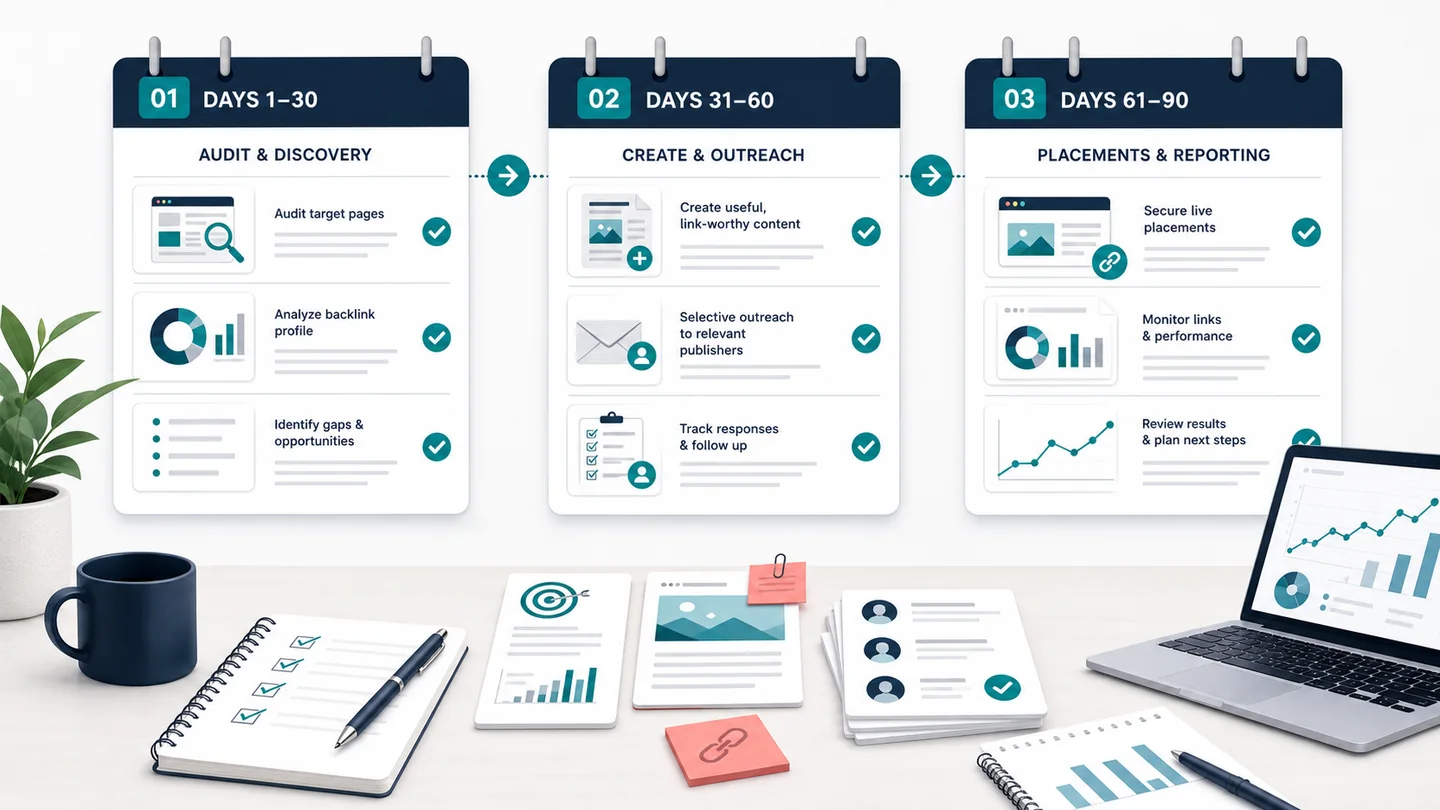
Common mistakes that make link building weaker
Link building approval checklist
Before approving a publisher or placement, work through these questions. A “no” is not always an automatic rejection, but it should be understood before money or content changes hands.
- Relevance: Does the website genuinely cover the niche, and does the intended audience belong there?
- Traffic: Does the site have current organic visibility in relevant topics and countries? Is the trend healthy?
- Authority: How does its backlink profile compare with real niche competitors, and does its history make sense?
- Content: Are recent articles useful, coherent, edited, and suitable for association with your brand?
- Page: Is the exact article relevant, internally connected, visible, and strong enough to host the reference?
- Anchor: Does the wording accurately describe the destination without forcing a keyword?
- Terms: Are revisions, timing, replacement terms, and reporting clear?
- Strategy: Which target page and topic cluster benefit, and does this add a useful referring domain?
- Economics: Is the complete opportunity worth the price compared with more relevant alternatives?
- Measurement: What observable result will you review after publication?
Will link building keep working beyond 2026?
High-quality third-party references are likely to remain useful because their value is not limited to one ranking calculation. A relevant placement can create a backlink, brand mention, editorial context, referral path, citation, relationship, and topical association at the same time.
Search interfaces will change, and AI discovery will keep evolving. Current research from Ahrefs and Semrush points toward a broader off-page model in which credible links, mentions, authority, and cross-web visibility work together. The durable strategy is not to chase URLs. It is to earn a defensible presence in the places your audience and industry already trust.
Research used in this update
Safe link building FAQs
What is a safe link building strategy?
It is a plan for earning or arranging relevant third-party references around useful pages, natural context, credible publishers, clear commercial terms, and measurable outcomes. It avoids treating volume or one domain metric as the objective.
How many backlinks do I need to rank?
There is no universal number. Compare the pages ranking for the actual query, including the quality and diversity of their referring domains, content strength, search intent, internal support, and brand authority. Some results need little link authority; others are dominated by well-established pages.
Is one strong backlink better than 100 weak links?
It can be. Relevance, publisher quality, page context, audience, authority, and the value of a new referring domain can make one strong editorial reference more useful than a large batch of unrelated links.
Do DA and DR matter?
They are useful third-party estimates for comparing backlink-profile strength. They are not Google scores and should be read with organic visibility, topical relevance, content quality, link history, and page-level context.
Does organic traffic matter when choosing a backlink?
Yes, because it can indicate current search visibility and audience opportunity. Inspect the keywords, pages, countries, trend, and topical portion of the traffic rather than relying on the headline estimate.
Is guest posting safe?
Guest posting can provide audience, brand, referral, and editorial value when the article is useful, the publication is relevant, and the reference makes sense in context.
Are niche edits worth using?
They can be useful when the existing article is relevant, visible, well maintained, and genuinely improved by the reference. Evaluate the exact page rather than assuming the domain score makes every URL valuable.
Should links point to commercial pages?
Sometimes. A commercial page can be a sensible destination when it directly helps the reader. Research, tools, statistics, and detailed guides often earn references more naturally and can support related commercial pages through internal links.
How should anchor text be planned?
Use wording that accurately describes the destination from the surrounding sentence. Maintain natural variation across brand names, titles, URLs, descriptive phrases, and occasional topical anchors rather than forcing one keyword repeatedly.
How long should I wait before judging a link campaign?
There is no fixed delay. Check the live placement and referral activity immediately, then review target-page visibility, referring-domain growth, conversions, and brand signals over several reporting periods. Search changes can take weeks or months and may be influenced by many factors beyond links.
Build links you can explain later
A strong backlink is not an isolated SEO token. It is a third-party relationship between a useful page and another part of the web. It can help people discover the brand, give writers a source worth citing, send qualified visitors, reinforce a topic, and support a connected body of content.
Before approving a placement, ask: why this publisher, this page, this topic, this anchor, and this destination? Which cluster does it strengthen? Which audience can it reach? How does it compare with the pages already ranking? What result will be reviewed?
When those answers are clear, link building becomes a disciplined part of content, authority, audience development, and search visibility – not another spreadsheet of URLs.
Need this turned into a real placement plan?
Send the URL you want to promote, the market you care about, and the type of publishers you prefer. EduGuestPost will review fit, availability, anchor options, and reporting before quoting.